

بسم الله الرحمن الرحيم

Tag: Thankfulness

  • Fulfilling One’s Potential Through Tafakkur (Reflection)

    Fulfilling One’s Potential Through Tafakkur (Reflection)

    “You should have some proportion of solitude or else you will become heedless.” -‘Umar b. al-Khaṭṭāb (r)

    Among the greatest blessings God has bestowed upon human beings is the ability to reflect, to contemplate. The blessings of utilizing rational thought, thinking fully and deeply, introspecting, and conceptualizing — these inform the beneficial ability to immerse oneself in contemplation about a belief or idea or perception, striving to penetrate beyond its apparent meaning or value.

    It does not make sense to confine our potential to goals that attach to this world with no investment in the life to come.

    Hallmarks of Western civilization are belief in the human mind’s capacity for rational thought and the human condition being imbued with the right to dignity, well-being, and fulfillment. Contrary to anti-theistic claims, Islam emphasized both of these more than 14 centuries ago. Islam does not disregard the use of reasoning and reflecting in favor of blind faith. Instead, the ability to reason and reflect is praised by Allah in the Qur’an and is considered to be a faculty that has the potential to bring one closer to Allah and the truth. Islam, thus, is a rationally justified belief system, and the correct use of reasoning, alongside other faculties, brings one to Islam. Furthermore, the ability to reason and reflect opens the door to self-actualization – becoming the greatest version of oneself — in numerous ways. There are countless things to reflect upon, but here are a few foundational ones:

    Reflecting on the Oneness of God, the Creator of the universe, and that He is source of blessings

    “Do you not see that Allah has made subject to you whatever is in the heavens and whatever is in the earth and amply bestowed upon you His favors, apparent and hidden? But of the people is he who disputes about Allah without knowledge or guidance or an enlightening Scripture” (Qur’an 31:20).
    “And every bounty that you have is from Allah…” (Qur’an 6:53).

    While we recognize the great benefits of a “productivity” culture in offering technologies, optimizing resources and methodologies, and encouraging lifestyles of goal-orientation, striving, and efficiency, one can never fulfill their greatest potential without the blessings of Allah, the source of all blessings. “Blessed is the One in Whose Hands rests all authority, and He has power over all things” (Qur’an 67:1). The Kingdom belongs to Him, and all blessings come from Him, and the believer regularly recites Surat al-Mulk (The Sovereignty), the 67th chapter in the Qur’an, and asks God for blessings while expressing gratitude for everything He has bestowed upon him.

    Reflecting on the fact that Allah created the universe with purpose, and recognizing one’s need for God in order to fulfill one’s own purpose

    “Indeed, in the creation of the heavens and the earth and the alternation of the night and the day are signs for those of understanding; those who remember Allah while standing, sitting, and lying on their sides, and reflect on the creation of the heavens and the earth and pray, ‘Our Lord! You have not created all of this without purpose. Glory be to You! Protect us from the torment of the Fire’” ( Qur’an 3:190-191).

    We all have our dreams of what we want to accomplish and, if we are realistic, we set goals to achieve them. Yet, without belief in and worship of Allah, we will not achieve the ultimate purpose of our existence — a place in Paradise. “Have they not reflected upon their own selves? Allah only created the heavens and the earth and everything in between for a purpose and an appointed term. Yet most people are truly in denial of the meeting with their Lord!” (Qur’an 30:8).

    Reflecting on the Qur’an and its signs, and recognizing its origin from God

    “Do they not then reflect on the Quran? Had it been from anyone other than Allah, they would have certainly found in it many inconsistencies” (Qur’an 4:82).

    By reflecting on the Qur’an, the stories of past nations, the signs of God all around us, and the miraculous nature of the final Message, the believer is re-motivated to strive harder for God’s pleasure and eternal paradise. There is no greater purpose for the believer than true belief in God, submission to His command, exemplification of the Prophet’s model of Islamic living in worship, attitude, speech, and action, and the teaching of the Islamic truth to the world.

    Reflecting on the inevitability of death and what comes after

    “Every soul will taste death, and you will only be given your full recompense on the Day of Resurrection. So, he who is drawn away from the Fire and admitted to Paradise, then surely he is successful. And the life of this world is nothing except the enjoyment of delusion” (Qur’an 3:185).

    The role of death in fulfilling one’s greatest potential cannot be emphasized enough. The awareness of human beings of their inevitable death, and the embracing and accepting of that reality that we are temporary residents of this earth, should motivate us to prepare for what comes after it.

    Too great an attachment to this worldly life makes the thought and reality of death very difficult, while wisdom necessitates preparation for what all human beings know is inevitable. Therefore, psychological escapism from the reality of death is unwise and futile, and it prevents an individual from attaining the greatest heights of self-actualization. While anxiety about death is not to be belittled, escapism does nothing for the one who wants to prepare and succeed in attaining Paradise. A man from the Ansar asked the Prophet (s) which of the believers is wisest. The Prophet answered, “The one who remembers death the most and is best in preparing for it. Those are the wisest” (Ibn Majah).

    Imagine, if you will, a man being informed of a pending hurricane and being provided instructions and a map to escape safely. Imagine if this man redirected and rechanneled his fear of the hurricane by distracting himself with mindless television, hours of streaming content, useless video games, and other worldly diversions. Does his escapism truly provide an escape from what is inevitable? Of course not! While the hurricane might veer on its course and miss the man’s house, no human being, regardless of his religious belief or earthly status, can escape death. It is an inevitable moment guaranteed for all human beings. Running from the thought of it does not stop it from manifesting in our lives. We are not meant to remain in this world. “Say, ‘the death you are running away from will inevitably come to you. Then you will be returned to the One who knows the unseen as well as the seen, and He will inform you of what you used to do’” (Qur’an 62:8).

    Reflecting on the temporality of this world and its insignificance compared to the afterlife

    Abu Dawood At-Tayalisi recorded from Jabir that the Prophet (s) said, “Jibril said, ‘O Muhammad! Live how you wish, for verily you will die; love what you wish, for verily you will part with it; and do what you wish, for verily you will meet it [your deed].’”

    By recognizing the temporality of this world, one’s efforts are redirected to greater purpose and potential. By keeping in mind the transitory nature of this life, we strive for that which is significant in an enduring way. We exert our efforts towards that which will be worth it in hindsight (in the afterlife). Self-actualization is to know that whatever you strive for in this life must be truly aligned with your greatest objective, which is a place in Paradise. In contrast, our potential is limited when we become overly attached to the things of this world. The significance of this world is in proportion to how much of it you use for attaining the reward in the afterlife — how much we make efforts for the sake of God, for establishing lasting continuous charities, for a beneficial and sincere legacy of good deeds.

    The Prophet (s) said, “What is the example of this worldly life in comparison to the Hereafter other than one of you dipping his finger in the sea? Let him see what he brings forth” (Muslim). One who dips his finger into any body of water sees how insignificant the few drops are compared to the sea or ocean. The temporality of this world and all that it contains of desires, comforts, and happiness is unimaginably insignificant compared to the eternal world of the Hereafter.

    Thus, the true home for the believer, and the source of motivation and the fulfillment of one’s potential, is the Hereafter. Allah says, “This worldly life is nothing but diversion and amusement. Verily, the home of the Hereafter is the true life if only they knew” (Qur’an 29:64). It does not make sense to confine our potential to goals that attach to this world with no investment in the life to come.

    Do not become attached to what is temporary. Do not become attached to what is a distraction. Attachments will make inevitable departure more difficult; attachments distract us from greater priorities, distort our expectations and grasp of realities, and cause us to become entitled and ungrateful. Attachments can become the source of future regrets and can shackle us to worldly desires and achievements. You are liberated in proportion to how much you submit to God and focus on the Hereafter, and your potential is increased in proportion to how much you are truly liberated. All people strive – and the greatest success is reserved for the one who strives for what is eternal.

    “Each person will have nothing except what he strives for. And what he strives for, he will come to see [in the next life]. Then he will be fully rewarded for it; and that to your Lord is the ultimate return of all things” (Qur’an 53:39-42). While we strive to unlock greater potential by seeking God’s pleasure and Paradise, we ask Him for well-being in this life; and we act out of that well-being consciously, for His sake, as a means of coming closer to Him and our ultimate objective.

    “Our Lord, give us goodness in this life and goodness in the Hereafter and save us from the punishment of the Hellfire” (Qur’an 2:201).

    Spending time in solitude and silence so as to engage in contemplation can lead to increased self-awareness, deeper understanding, and gratitude, as well as rewards and celebration on the Day of Judgment.
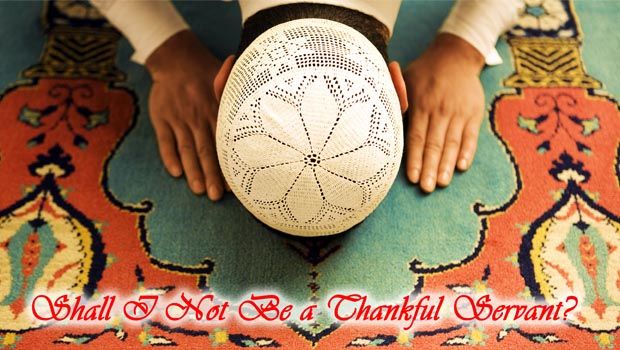

  • Shall I Not Be A Thankful Servant?

    Shall I Not Be A Thankful Servant?

    Let’s go back in time. Back to Madinah, through the masjid and to the Prophet’s home. We can imagine him there, in the darkness of night, praying to his Lord. He is crying as he recites the ayaat of the Qur’an. He has been standing for so long that his blessed feet have swelled and the skin is cracking. Many of us would wonder the same thing that A’ishah, his beloved wife, (radi Allahu anha) asked him afterward. She said, “O Prophet of Allah, why do you undergo so much hardship despite the fact that Allah has pardoned for you your earlier and later sins?” He (sal Allahu alayhi wa sallam) responded, “Afala akuna abdan shakura?” (Should I not prove myself to be a thankful servant?) We learn from this hadith that gratitude is shown through deeds, and must not remain solely in our hearts. Gratitude must be manifested in our thoughts, attitudes, and words, and in our prayers; and then it must be substantiated by action. The Prophet (sal Allahu alayhi wa sallam) was not commanded to worship to this degree but rather it was a complete act of devotion and thankfulness to Allah (SWT).

    If we say that we love Allah and that we are thankful to Him, then our actions must support that

    When we want to thank someone, we go the extra mile to make them happy, especially when they are beloved to us. We go to great lengths to show our parents, spouse, or friend that we appreciate them. We offer our help without their asking. We plan time to spend together. We give them gifts without expecting one in return. We do whatever will make them happy. We show our love and appreciation through our actions. Yet, how can we claim that we love Allah when we do not often act this way with Him? What about the times that we do not abide by His Rulings? Or we hardly go beyond the bare minimum of worship. Or we do not honor His Book. There might be times that we swear by His Name in vain. Or we are not shy to sin in front of Him while we are shy when other people are watching. What about when we delay our daily conversations with Him, and when we finally do go to pray, we do it as fast as we can – rushing back to what we think is more important than Him. Would we ever claim to love our mother, spouse, or friend if we treated them this way? Would they feel that we love them and appreciate them if we treated them in similar manner? We should be ashamed if we treat our family and friends better than we do our own Creator, the Source of All-Goodness, the one who is most worthy of our love and gratitude.

    Allah (SWT) does not need us or our worship at all. We are not harming Him or benefiting Him in any way by worshipping Him, by obeying or disobeying Him. He does not need anyone or anything, rather He is Self-Sufficient. It is we who are needy in all ways and entirely dependent upon Him for our survival and fulfillment and, ultimately, our salvation. If we are thankful servants, we would recognize that He is always deserving of praise. If we say that we love Allah and that we are thankful to Him, then our actions must support that. If instead our actions are careless and ungrateful, then we are simply good at saying what we don’t genuinely mean.

    What is Shukr?

    As a creation, we are wired to love those who give to us when it is done with genuine caring about us and our well-being and happiness. In an authentic hadith, the Prophet (sal Allahu alayhi wa sallam) taught us, “Give gifts and you will love one another.” Linguistically, shukr is used to describe a healthy cow – a cow that has visible signs of nourishment. Islamically, the scholars define shukr as the mentioning of Allah’s blessings upon the slave’s tongue, the slave’s recognition of these blessings in his heart, and obedience of the limbs due to these blessings.

    Being thankful to Allah does not mean to only say “alhamdulillah” or doing a quick sajdah when we feel blessed. The Prophet (sal Allahu alayhi wa sallam) taught us through his statement to A’ishah as mentioned above that we must show our thankfulness to Allah. We have to strive to demonstrate it. The Qur’an in many verses instructs us be grateful (2:151, 29:16, 31:12). We also learn from the Qur’an that shukr is by action, manifesting outwardly what resides in the heart. Allah (SWT) says to the family of Dawud (alayhi salaam): “Work, O family of David, in gratitude” (34:13). Imam ibn al-Qayyim (rahimahullah) states, in reference to this verse, that there are three branches of shukr:

    Knowledge: This is the foundation of shukr. We must have knowledge of the fact that Allah (subhanahu wa ta’ala) is the One who bestows upon us the countless blessings of this life. With knowledge, we will attribute all of our blessings to Him, including the opportunities to prove our eman during challenging times. Some people, in their spiritual ignorance, attribute the good things in their lives to their own merit, and when they are faced with difficulty or hardship, they attribute that to Allah. Without sound knowledge, one cannot be properly grateful.

    Recognition and awareness: The slave reveres Allah and His favors with his tongue – by remembering and praising Him through supplication, and keeping a vitality of awareness and recognition of His greatness in his heart. It is reported in Tafsir al-Qurtubi that Dawud (alayhi salaam) said, “O my Lord! How can I be grateful to You when gratitude is a blessing from You?!” Allah (SWT) responded to him, “Now you have shown true gratitude” (i.e., he recognized that all blessings are from Him).

    Deeds: The slave works in gratitude by being an obedient slave to Allah (subhanahu wa ta’ala). It is reported in Tafsir al-Tabari that Abu Abdur-Rahman al-Hubaly (rahimahullah) said, “Prayer is shukr, fasting is shukr, and any deed done for the sake of Allah is shukr.”

    Imam ibn al-Qayyim further states that the pillars of being grateful to Allah are submission of the believer to Allah; love of Him and acknowledging and praising Him for His favors; and refraining from utilizing the favors in a way displeasing to Allah.

    Benefits of Shukr

    Allah calls mankind ungrateful in many ayaat in the Qur’an, declaring that only a few of His slaves are grateful. It is easier for us to be heedless of His blessings because being a thankful slave requires being attentive, conscientious, and devoted to purifying of the heart and seeking the pleasure of Allah. When we do show gratefulness to Allah, He blesses us in many ways. Allah will increase us in blessings. He ta’ala says, “And [recall] when your Lord proclaimed: ‘If you are grateful, I shall certainly increase [My blessings on] you, and if you are ungrateful, then My torment is surely severe’” (14:7). Also, Allah rewards those who are thankful. He (SWT) says, “Allah will give reward to the thankful” (3:144). That rewarding encompasses being saved from punishment. Allah (sub?anahu wa ta’ala) tells us in the Qur’an, “The people of Lot denied the warning. Indeed, We sent upon them a storm of stones, except the family of Lot – We saved them before dawn —as a favor from Us. Thus do We reward he who is grateful” (54:33-35). If we are seeking the pleasure of Allah, then we will make daily effort to be grateful. Allah (SWT) tells us, “And if you are grateful, He is pleased with you.” (39:7)

    Taking Steps to Demonstrate Shukr

    Knowing what shukr means and what its benefits are, we should take action to be among al-shaakireen. We can assess ourselves to see how grateful we are, not just in principle but in practice. Not just in a vague and generic way (“I’m so grateful to Allah SWT for everything in my life”), but in the nitty-gritty way of examination and transformation of the self on a daily basis (“Oh, if I am grateful to Allah SWT, I will practice right now in this minute being more patient with my kids”; or “Let me pause here and remember that the Prophet said to forgive even one’s servant 70 times a day…so why am I yelling at my beloved and insulting her?”)

    For many of us, extra deeds or greater effort seems difficult because we are so used to the little we do. Don’t think that you cannot do more, but rather remember the hadith qudsi: “When my slave walks to Me, I run to him.” If you take that first step, which is the most difficult, Allah will guide and facilitate your ongoing efforts. It’s time we push ourselves to do more for Allah (SWT). It’s time that we refuse to accept the bare minimum from ourselves. It’s time that we set great goals for our deen just as we do for our education, career, and family life. And we can seek the help of Allah by means of du‘a. The Prophet (sal Allahu alayhi wa sallam) taught us to say: “Allahumma a’inni ‘alaa dhikrika wa shukrika wa husni ebadatika — O Allah, help me to remember You, to be thankful to You and to worship You in the best way.”And it is important to say it like we mean it, beseeching Allah (SWT) from the depth of the heart to make us among His few slaves that are grateful.

    And we must remember that nothing comes without sincere and consistent effort. If we want to worship Allah more, we must strive for that with dedication. If we want to enjoy our worship, we must put in the effort. For some, praying and fasting is easy. For others, it is extremely difficult. If it is difficult for you, don’t interpret it to mean that you do not love Allah. Rather, it means that you have to strive more and work more to see the fruits of your labor. Allah (subhanahu wa ta’ala) says, “And those who strive for Us – We will surely guide them to Our ways. And indeed, Allah is with the doers of good (29:69). Allah (subhanahu wa ta’ala) used the word “jaahadu” here, meaning they strive and work hard for the sake of Allah (SWT).

    To demonstrate, and at the same time, increase our gratitude, we can all do something extra in one way or another. Start slow and it will become easier, insha’Allah. We must be willing to step outside our comfort zone to train ourselves, to purify our hearts, to improve our practice of the deen. Following are some suggestions:

    If you can, fast three days every month; if not, fast at least one day.

    If you want to pray qiyam (voluntary night prayer) but already struggle with fajr, stay awake after fajr to remember Allah and read Qur’an, even for 15-30 minutes, before heading back to sleep.

    Keep your tongue moist with the remembrance of Allah by learning the du’as from the sunnah for various actions we perform throughout the day.

    Always do your adkhar – a collection of supplications and remembrances to make after fajr and ‘asr prayers.

    Keep a portion of the day, even 30 minutes, just to remember Allah – reading Qur’an, making du‘a’ and reflecting.

    Thank those around you. It is stated in a hadith, “Whoever does not thank the people has not thanked Allah.”

    Help others in your community. You can help at a soup kitchen, or prepare a meal for a needy Muslim in your community.

    Make it your habit to not belittle any good deed. If you have a chance to do a good deed, however seemingly small, then do it. The Prophet (sal Allahu alayhi wa sallam) said in the hadith about the man who gave a drink to the thirsty dog that, “Allah thanked him for that deed and forgave him” (Bukhari).We learn from this that a small deed sincerely done for the sake of Allah can earn His forgiveness and appreciation.

    Al-Shakur: The Most Appreciative

    Remember that all your efforts and all your striving is not in vain. It may be difficult for you to fast those extra days. It may be hard for you to get to sleep early so you can wake up at night to pray. But do not forget the One you are worshipping! You are worshipping Al-Shakur, The Most Appreciative. He ta’ala does not only look at your deeds, but He looks at the intention and effort behind it. Imam al-Qurtubi (rahimahullah) explains this Name of Allah, Al-Shakur, by saying, “He accepts the little from their good deeds, and repays them with a great reward.”

    He is Al-Shakur —He does not undervalue, overlook, or discount our efforts. He accepts our few deeds and gives us greater in return. He blesses us with something better when we restrain ourselves from anything harmful for His sake. Allah, Al-Shakur, not only rewards us for our deeds but He increases them because He appreciates our obedience to Him. He is Al-Shakur of our shukr! While we are struggling to show our thankfulness to Him, Al-Shakur is keeping account of all that we do, of all the effort we are putting in, of how much we sincerely want to worship Him in the best way. He will reward us with what we do not even deserve. Our deeds can never earn Paradise without the mercy and generosity of Allah (SWT), but this is how Al-Shakur shows His Appreciation to His righteous servants.

    Remind yourself of the Day that Allah (subhanahu wa ta’ala) will, in finality, show His gratitude by saying: “Indeed, this is for you a reward, and your effort has been appreciated” (Qur’an76:22). We ask Allah (SWT) to make us of those who hear these words. May He make us among His truly grateful servants and we ask that He bless us with the dedication to worship Him, remember Him, and thank Him in the best and most beautiful ways. Ameen.


  • Thoughts on Thankfulness

    Thoughts on Thankfulness

    How can we thank Almighty Allah for all His great blessings upon us? For sure we are unable to do so properly or adequately in any ultimate way, as His bounties and blessings are endless. We can’t ever comprehend the extent of the favors granted to us, and if we try to count them, we can’t do it. As the Qur’an says: “But if you count the favors of Allah, never will you be able to number them” (Al-Qur’an 14:34). Everything that we possess including our health, wealth, and talents—all are given by Him. Our very existence and our continuing sustenance are also dependent on Allah’s will and favor. So whatever praise is due, it is due to Him alone, for nobody has the power to give us anything except by His will. It is for this reason that Allah (swt) commanded Prophet Ibrahim to say: “It is He who has created me, and so it is He who guides me; it is He who gives me to eat and drink, and whenever I am sick it is He who heals me; and it is He who makes me die and then will bring me to life. And upon Him, I pin my hope that He would forgive my sins on the Day of Judgment” (Al-Qur’an 26:77-82).

    The Prophet (pbuh) made it clear that expressing our  gratitude to Allah by thanking Him also involves thanking people who benefit us  or do favors for us

    Allah governs and sustains everything in this universe, and whatever happens to us — even the things we call personal afflictions or natural disasters — are also from Allah. To quote Ibn Ataa, “When Allah puts one of us to a test by losing one, two, or even five blessings, he feels that he is faced with a severe crisis. While in reality he has billions of blessings which Allah is bestowing on him every moment. In every cell in your body, there are countless blessings. In every second you live, there are countless blessings. In every breath you breathe, there are countless blessings. In every glance you make, there are countless blessings. Allah is the One who is worthy of [receiving our] thankfulness.”As a matter of fact, in times of calamity and distress, there is always some good for us, provided we respond appropriately. The Prophet said: “How wonderful is the case of a believer! There is good for him in whatever happens to him — and none, apart from him, enjoys this blessing. If he receives some bounty, he is grateful to Allah and this bounty brings good to him. And if some adversity befalls him, he is patient, and this affliction, too, brings good to him” (Muslim).

    So how can we express our gratitude to Allah (swt)? The first and foremost way for us to thank Allah is to be aware of His presence and His power at all times and in all places, and to keep in mind all the favors He has granted to us, whether these favors are seen or unseen. This awareness has tremendous impact upon our daily life, as this brings us to submission and servitude to our Lord. Eman (belief) implies shukr or gratefulness, while kufr (disbelief) indicates overlooking, ignoring, or concealing the favors. Obviously, if a man is ungrateful, Allah is unaffected, but if that man becomes grateful, then he is the one who gains in all ways. Gratitude for blessings brings us more blessings. As Allah says: “And [remember] when your Lord proclaimed: ‘If you give thanks, I will give you more [of My blessings]; but if you are thankless, verily, My punishment is indeed severe’” (Al-Qur’an 14:7).

    Second, our gratitude to God should be expressed through gratitude of the heart, gratitude of the tongue, and gratitude of the physical faculties. As Imam Ibn al-Qayyim explained: “Gratitude may be in the heart, in submission and humility; on the tongue, in praise and acknowledgement; and in the physical faculties, by means of obedience and submission” (Madaarij al-Saalikeen-2/246). As for the verbal expression of gratitude which is contradicted by action, Al-Tabari says, “the one who does that, does not deserve to be called grateful at all.”

    Third, we should also remember that gratitude is a sense of genuine fulfillment, not because we have ceased to want or desire the good things in this life, but because we have cultivated a profound sense of knowing that Allah has already blessed us with what we need. In one of the hadiths, the Prophet (peace be upon him) said: “…if the son of Adam has one valley, he will wish that he had a second, and if he had two valleys, he would wish that he had a third. The stomach of the son of Adam will be filled only with dust [i.e., he is never satisfied]…” (Ahmad – 5/219). If we wish to transcend that state of malcontentedness, we should learn to truly appreciate what we have rather than fretting over what we don’t.

    Finally, gratitude should help us recognize other people’s favors to us as well. The Prophet (pbuh) made it clear that expressing our gratitude to Allah by thanking Him also involves thanking people who benefit us or do favors for us. He (pbuh) said: “He who does not thank people, does not thank Allah” (Ahmad, Tirmidhi). He also said: “Whoever does you a favor, then reciprocate, and if you cannot find anything with which to reciprocate, then pray for him until you think that you have reciprocated him” Abu Dawood (1672).

    Truly in gratitude we can find our contentment and fulfillment, our peace and final salvation.