
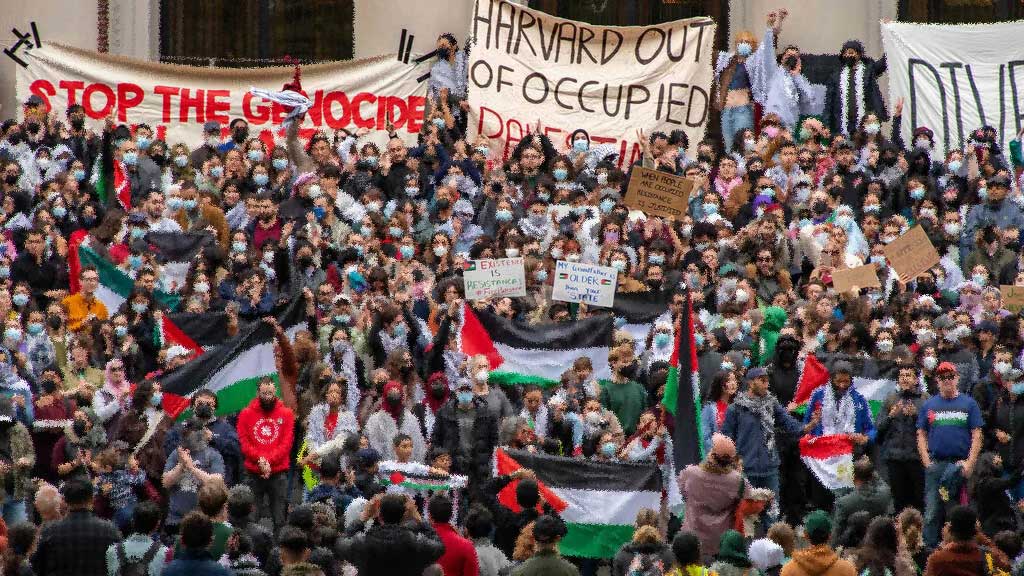
After visiting several university encampments in the United States and engaging in hundreds of conversations with university personnel, faculty, student organizers, and national leaders, I feel it is important to share key insights for the global Muslim community and others interested in important foundational elements of the movement.
First, the stance of anti-genocide is a self-evident principle of the most basic moral virtue.
It is morally natural and expected for students to side with justice. People of all backgrounds are fed up with genocide and a blatantly hypocritical status quo. There is no peace while genocide is ongoing. There is no peace as long as Gaza is under occupation. Without justice and peace in Palestine, there is no true peace in the world.
Students have much less to lose than American politicians who have collectively received millions of dollars in bribes—disguised as lobbying—from pro-Zionist groups. How can we expect politicians to advocate for true universal justice, for all people including Palestinians, Muslims, Jews, and others, when their decisions are swayed by external entities and financial incentives?
University administrators are not exempt from scrutiny. Virtually no American university president has condemned Israel’s actions as genocide, nor have they protected the rights of students to protest occupation, immoral investments, and the ethnic cleansing of Palestinians. University presidents and regents often receive direct pressure from wealthy donors, including Zionist supporters of Israel’s occupation of Palestine, and they prioritize their careers, political connections, and long-term ambitions over ethical concerns. The higher one climbs within an unethical system, the less independence they retain, especially when moral causes require the sacrifice of their comfortable status. Only those with moral fortitude would resign from their positions rather than renounce their moral values.
As for the everyday citizens who criticize students, it may be the media they consume shapes their perceptions of peoples, places, and events. It is the unfiltered social media documentation of genocide that has informed students and faculty worldwide.
Second, people who advocate for universal justice are increasingly frustrated with the double standards, hypocrisy, and selective justice they observe.
We see individuals, political groups, and institutions espouse morality and justice but then look away and remain silent when a clear injustice is taking place; they, directly or indirectly, support and promote a government and media narrative that inverts reality. This ruling class quagmire of self-interest, networked with ideological delusion, feeds a growing disgust among activists and the general population. Worse still is when peaceful protests against the genocide happening in real time, on screens in front of our eyes, are misrepresented as antisemitic and promoting of violence. How is it justifiable to violently arrest students peacefully protesting against the utter destruction of Gaza and the bombing that has killed so many tens of thousands, a majority of them women and children? The students are peacefully protesting settler-colonial structures that lead to ethnic cleansing, discrimination, land theft, oppression, violence, and now, genocide. Shutting down the peaceful protests against what is demonstrably wrong, let alone violently doing so, is the height of hypocrisy, displaying a double standard and selective justice that is beyond shameful.
For Muslims, standing against injustice involves a full commitment to the truth, not blind allegiance to a nation’s military-industrial complex, a political party, a particular politician, influencer, or even a “religious” scholar if he speaks or acts in any way that deviates from Islamic orthodoxy. In Islam, allegiance is to universal justice and truth as defined by God. Therefore, if a Muslim commits a crime, Muslims stand with the truth by willingness to condemn his crime and support his prosecution by the law, just as Muslims worldwide have condemned the terrorist movements that do not represent Islamic teachings. Similarly, many Jews condemn the Israeli occupation of Palestine, the inherent racism and supremacism in Zionism and in the far-right extremist groups in Israeli society, as well as the weaponization of antisemitism and the Holocaust. Some of the most vocal advocates for Palestinian liberation, calling for the end of occupation and injustice, are, themselves, Holocaust survivors. Organizations like Jewish Voice for Peace are at the forefront of numerous campaigns and university encampments.
Furthermore, students are tired of being lied to and deceived. Western media often portray peaceful protestors as radical anti-Semitic agitators, while ignoring the reality that these encampments are protesting genocide, immoral investments, and the suppression of pro-Palestinian voices. It has been documented on numerous occasions that agitators and undercover pro-Zionists frequently infiltrate these protests to provoke students, incite violence, and cause the mainstream media to portray the protestors as anti-Semitic.
Universities preach “freedom of speech” and when people freely speak about Palestine, they respond, “No, not like that.” Universities preach “inclusivity” and when we include Palestinian dignity and rights, they say, “No, not that kind of inclusive.” Universities preach “academic freedom” but when professors and scholars speak about Israeli settler-colonialism and the Palestinian right to freedom, they say, “Not that kind of freedom.” American norms preach “freedom to protest,” but when students and faculty protest genocide, they suppress them, suspend them, expel them, and assault them with military-trained police in scenes that resemble the IDF’s brutal and barbaric assault on innocent Palestinians.
Third, know that students and faculty involved in encampments are principled, courageous, and resilient.
The students understand the risks of protesting at institutions like Harvard, NYU, Columbia, Yale, UNC, Northwestern, University of Michigan, and literally hundreds of other campuses. They risk their educational and career ambitions, their comfort, and often their safety, to stand up for those who have been silenced or, worse, slaughtered. If Palestinian voices are ignored and lives obliterated with U.S.-funded weapons and the ideological extremism of Zionist settler-colonialism, then university students worldwide will speak and act on their behalf.
We should all recognize these truths: the more you suppress students and faculty who protest against genocide and the immoral investments in the Israeli economy, the stronger and more frequent the protests will become. The more you deploy military-style police to suppress peaceful protesters, to tase and assault them, to ban and intimidate them, the more that Jews, Muslims, Christians, and others will continue to rise up. And these efforts may not immediately change the status quo, but as they clearly are disrupting those in power, the Israeli war criminals, and those who fund them, protestors also recognize that the matter is intricate, complex, and contains many variables, and protest alone is not going to cause a shift in policy. It is but one part of the equation, and a necessary and inspirational one.
History shows that many contemporary figures once considered enemies of the state are now glorified and emulated. A good example is Martin Luther King Jr. Similarly, today’s students, faculty, and others who support the end of genocide and occupation will be viewed positively by future generations, and this recognition may not be so far off. The tides have turned. The fervent desire to stop a genocide generated by a supremacist and racist ideology and 75 years of occupation cannot be extinguished. The spark ignited on university campuses worldwide is spreading rapidly. And whether or not we see the immediate results, we will persist in our efforts to end genocide, replace it with universal justice for all people, and hold those accountable who have perpetrated and enabled one of the most barbaric and violent injustices of our times. Furthermore, whether future generations see us as being on the right side of truth and justice is not the ultimate factor in our decision-making and resilience; rather, it is the awareness that God sees our actions and is our ultimate judge.
And soon, God-willing, Palestine will be free.
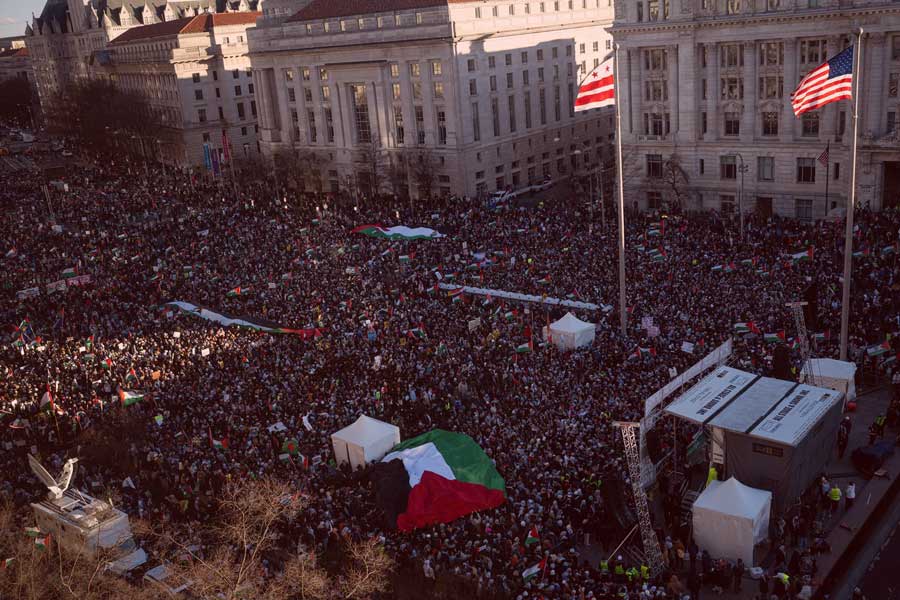
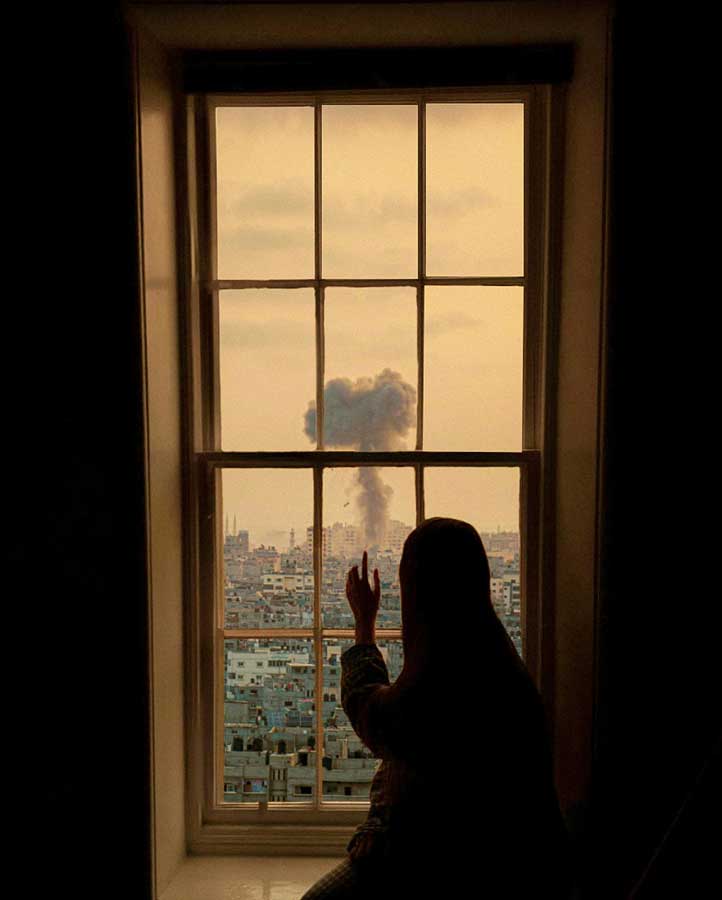 Seeing what Palestinians are going through, right there on the screens in front of our eyes, makes commitment to social justice, which can be for many people an intellectual exercise, become the reality it is — life’s challenge to feel the suffering of others, to empathize in ways that mobilize us intellectually, spiritually, emotionally, and morally. My voice is just a mere fraction of the megaphonic call to action to stop the destruction and death in Gaza.
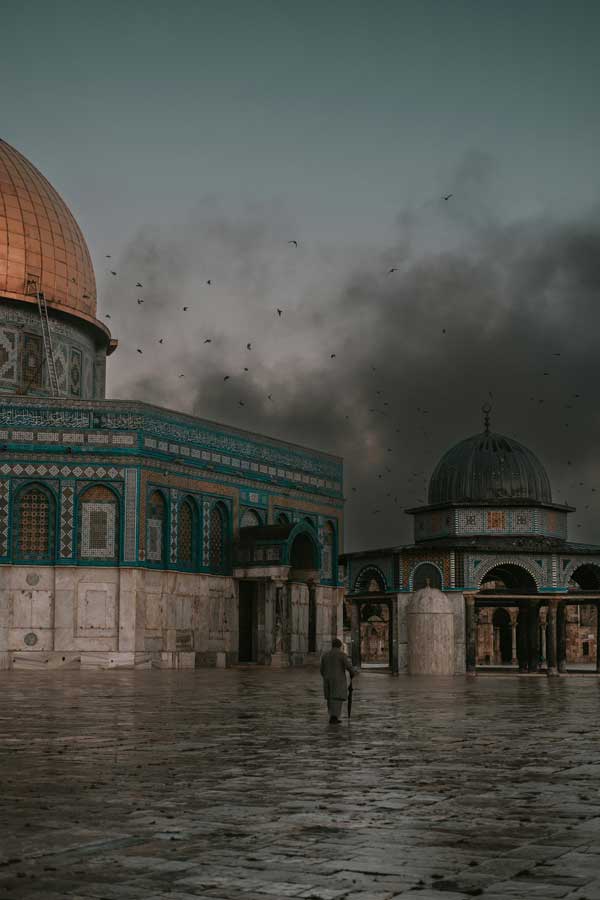 The struggles of the Palestinians have been obscured for decades by carefully curated narratives in the media. Headlines often reduce the suffering and deaths to numbers and statistics, stripping away their identities. Reducing individuals to these statistics perpetuates a cycle of indifference. Now, however, we see journalists on the ground in Gaza who are dismantling these decade-old narratives. At its core, we have all been forced to bear witness to the atrocities taking place. What we see is a compelling display of Palestinian strength and resilience. No class, no academic project, no intellectual analysis or reflection has shown me, as the Palestinians have, the depth of the human soul and its refusal to capitulate to death and destruction.