

بسم الله الرحمن الرحيم

Tag: Spotlight

  • Islamic Spotlight on Mental Health

    Islamic Spotlight on Mental Health

    Allah (SWT) says in the Quran, “And We have already created man and know what his soul whispers to him, and We are closer to him than his jugular vein” (50:16). In this ayah, the Lord of the worlds describes His awareness of each and every human being, his or her innermost thoughts, desires, and intentions. The statement, “We know what his soul whispers to him,”provides us with comfort because it gives us reassurance that no matter what we suffer – our sadness or grief or worry – Allah (SWT) is aware of it as well. We are not alone. It also can instill fear in us because we are reminded that the negative, irresponsible, or unvirtuous thoughts that we have are not completely private because Allah (SWT) knows of them as well. Whatever anger, resentment, or jealousy we may feel, He is aware of it all. It gives us a reminder to hold ourselves accountable because the One who will hold us accountable in the next life is aware of everything that goes on in our minds.

    The closeness between Allah (SWT) and His servant is further described by reference to the vein that our lives depend on, the jugular vein that is in the neck. The jugular vein carries large volumes of blood from the brain, face, and neck, back to the heart. Damage to the jugular and subsequent blood loss can quickly lead to shock and death. Yet, He (SWT) is closer to us than that physiological lifeline. There is nothing closer than that. Allah (SWT) is there even in our darkest of times. In our moments of sadness, feeling betrayed or abandoned, the Lord is with us, providing comfort and guidance through His deen, His Book, His messenger, and through our direct access to Him at every moment through salat and dua.He (SWT) is with us always. He has never left us and never will.

    Allah’s Closeness Converges with Examination of Self

    In tandem with Allah’s closeness to each one of us and His knowledge of the innermost self, is the Islamic focus on being self-examining. To be honest with ourselves, to increase awareness of our thoughts and behaviors so as to take fullest responsibility for ourselves and the way we live our lives – this is all part of maturing from the base level of unrestrained desire and impulse to the self-reproaching soul, aiming ultimately for tranquility and ease in daily living. This unfolds as thoughts, feelings, and actions come into harmony, aligned with Divine will. Sometimes we need help in candidly seeing ourselves and our habits of living, or in resolving issues that obstruct our growth, or solving problems that hamper the healthiness of our relationships. Mental health is just as real and important as physical health.

    Yet, mental health is, for the most part, not discussed in Muslim communities, but rather silenced. A common stigma that works against dealing maturely and pragmatically with mental health issues is reflected in people’s negative judgements of those suffering with depression, anxiety, lack of motivation, and other personal challenges. They are often viewed as weak, incompetent, or crazy. Within the Muslim community in particular, this intertwines with cultural and religious views. People see those afflicted with psychological problems as lacking faith, patience, or trust in God. They are seen as religiously weak. Culturally, Muslims are taught to avoid airing their dirty laundry, to keep their personal and family problems secret. Add to this the well-intentioned but misguided advice to turn to God and all your problems will vanish. What is missing from this is that human action might also be appropriate and necessary. The Prophet (pbuh) has told us to tie the camel and then trust in God for her protection. For individuals who are suffering from feeling stuck, dejected, unable to make decisions, or unable to find solutions to their personal or family problems, they end up feeling hopeless and unable to find the support that they need when talk of mental health issues is taboo. This is something that needs to change.

    It is difficult for many Muslims to accept that mental health issues exist. Instead of believing and accepting that mental illness does exist, many Muslims suspect black magic as a cause. They blame their issues on black magic and get caught up in finding out who is doing it and how to get rid of it. Even though there may be a chance that this is the case, it often serves as an unnecessary distraction from the real issue at hand. This can be a dangerous distraction since the real issue can fester while it is not being attended to.

    Awareness is First Step to Getting Help

    It is essential that we bring about more awareness within the Muslim community. In masjids, Islamic schools, community centers, and conventions, we need to offer more workshops and discussions on issues surrounding mental health. We need to normalize it and be open to talking about it so that we can eliminate the stigma and allow for more channels of communication, support, and change.

    For those of you who are dealing with mental health issues, you are not alone. There are so many out there who have or had similar challenges and understand what you are going through.And there are counselors and therapists who are available to help. Reach out for help, have hope that things will get better, and believe that you will be able to overcome your struggles. Medication is appropriate in severe or chronic cases.And in all circumstances, counseling/therapy is a valuable and empowering process that facilitates your determination and effort to transform your life for the better. Give it a chance, and ultimately, give yourself a chance for a better future.
  • Fatima Al-Fihri

    The name Fatima Al-Fihri crowns the annals of history with the distinction of having established the world’s very first university. Yes, it was a Muslim woman who pioneered a model of higher learning coupled with the issuance of degrees of various levels.

    Fatima Al-Fihri migrated with her family in the early ninth century from Qayrawan in present-day Tunisia to the city of Fez in Morocco. This was during the rule of Idrees II, an extraordinary ruler and devout Muslim. Fez at that time was a bustling metropolis of the “Muslim West” (known as al-Maghrib), and held the promise in the people’s imaginations of fortune and felicity. Having become one of the most influential Muslim cities, Fez boasted a rich combination of religion and culture, both traditional and cosmopolitan. This was the city, on the left bank of the River Fez, where Fatima’s family settled and she eventually married.

    After much toil and struggle in humble beginnings, the family of Fatima was eventually blessed with prosperity. Her father, Mohammad bin Abdullah Al-Fihri, had become a hugely successful businessman. After the deaths of Fatima’s husband, father, and brother in short succession, Fatima and her only other sibling, Mariam, received a sizable inheritance which assured their financial independence. It was in this latter period of their lives that they distinguished themselves. Having received a good education, the sisters in turn hastened to dedicate all of their wealth to benefitting their community. Observing that the local mosques in Fez could not accommodate the growing population of worshippers, many of whom were refugees from Islamic Spain, Mariam built the breathtaking and grand Andalusian Mosque in 245AH/859CE.  And Fatima founded Al-Qarawiyyin Mosque and University, considered by many historians as the oldest, continually operating, degree-granting university in the world. Historical references note that she directly oversaw and guided the construction process in great detail, certainly a testament to her great dedication as she had no expertise in the field!

    Fatima had grand aspirations, and early on began buying property adjacent to the initial land, thereby significantly increasing the size of the mosque. She diligently spent all that was required of time and money to see the project to completion.  She was also extremely pious and devout in worship and made a religious vow to fast daily from the first day of construction in Ramadan 245 AH/859 CE until the project was completed some two years later, whereupon she offered prayers of gratitude in the very mosque she had so tirelessly worked to build.

    Masjid Al-Qarawiyyin, one of the largest mosques in North Africa, housed the university which was to become a major center of advanced learning in medieval times in the Mediterranean. Al-Qarawiyyin University is credited with producing many distinguished Muslim thinkers including Abul-Abbas, the jurist Muhammad al-Fasi, and Leo Africanus, the famous author and traveler. Other prominent names associated with the institution include the Maliki jurist Ibn al-Arabi (d. 543AH/1148CE), the historian Ibn Khaldun (d. 808AH/1406CE), and the astronomer al-Bitruji (Alpetragius) (d. 1204CE).

    Non-Muslims were welcome to matriculate. In fact, the University’s outstanding caliber attracted Gerber of Auvergne who later became Pope Sylvester II and went on to introduce Arabic numerals and the concept of zero to medieval Europe. One of the university’s most famous students was a Jewish physician and philosopher, Maimonides. He was born in Andalusia in 1138 while it was flourishing as an intellectual and cultural hub under Muslim rule. His family moved to Fez, Morocco in 1160 where he was heavily influenced by Islamic thought. A distinguished theologian, he was the first to introduce articles of faith to Judaism; he considered it mandatory for every Jew to believe in the absolute unity of God, in His exclusive right to be worshipped, in revelation through prophets, resurrection, and Divine punishment and reward.

    By the 14th century, the university housed the Al-Qarawiyyin Library which remains one of the oldest in the world, preserving some of Islam’s most valuable manuscripts. These include volumes from the Muwatta of Imam Malik inscribed on gazelle parchment, the Seerah of Ibn Ishaq, the premier transcript of Ibn Khaldun’s Al-‘Ibar, and a copy of the Qur’an gifted to the institution in 1602 by Sultan Ahmed al-Mansur.

    Fatima Al-Fihri’s Legacy

    Almost 1200 years have passed since the founding of the University of Al-Qarawiyin in 859, and it continues to this day to graduate students in the various religious and physical sciences. This esteemed institution, which already had 8,000 students by the 14th century, is central to the legacy of Fatima Al-Fihri. Her story is one of timeless dedication to the Islamic tradition of learning and academic study, as well as personal devotion to pleasing Allah SWT by serving as a genuine benefactor to humanity. The world is richer as a result.

  • Spotlight: Imam Al-Qurtabi

    Spotlight: Imam Al-Qurtabi

    Imam Al-Qurtub? [died 671H/1272CE]: Ab? ‘Abdullah Muhammad ibn Ahmad ibn Ab?bakr al-AnS?r? al-Khazraj? al-Qurtub?, also known as “the Shaykh of the Qur’anic commentators,” was a prolific scholar born and raised in Andalus whose learning and expertise extended to a broad variety of subjects, including not only the Islamic sciences but the social and cultural issues of his era. He was a beneficiary of the rich and vibrant intellectual heritage of Cordoba, where he had access to some of the world’s most renowned scholars, numerous schools and the biggest public libraries in the world.

    He also lived during a period of constant conflict with the neighboring Christian kingdoms. In 627H his own father was killed defending their farm from invading Crusader armies, and al-Qurub? was forced to carry his body home and provide him a proper burial. At the age of 25, he was compelled to leave the region altogether with the fall of Cordoba in 633H/1236CE. He moved to Egypt where he travelled widely, continuing his tradition of learning and teaching. He was a contemporary and friend of the famous M?lik? jurist Shih?b al-D?n al-Qar?f? [died 684H/1285CE].

    His focus was more on writing than teaching, and it is debated whether he had any students at all. Im?m al-Dhahab? described him as an ocean of knowledge who wrote many beneficial works which exhibited his broad knowledge and great wisdom. He eventually settled in southern Egypt and died on the 9th of Shaww?l 671H in the city of al-Miny?. In 1971 a shrine was built over his grave.

    The Text

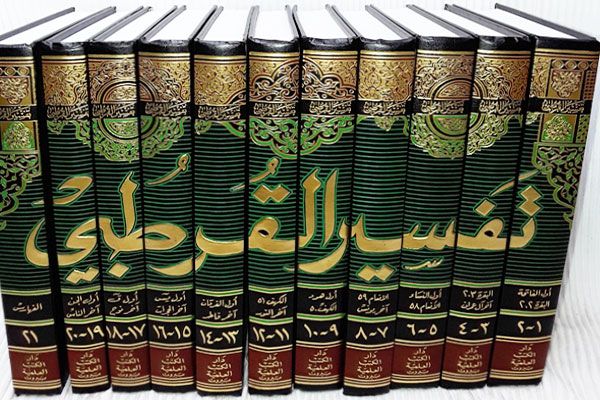
    Al-Jami‘ Li Ahkam al-Qur’?n
    [commonly known as Tafs?r al-Qurtub?]

    Undoubtedly the most famous of Imam Al-Qurtub?’s works, this is an exhaustive, encyclopedic commentary of the Qur’?n, of about twenty volumes, that has continued to enjoy wide support and acknowledgment among Muslims since its publication.

    Its title, which translates as “The Compendium of Legal Rulings of the Qur’an,” reveals its basic aim as a work—to deduce the practical, legal implications of the verses. And yet, while this work was intended to be a practical guide for the lives of its readers, it becomes much more than that due to the brilliant mind of the author, his broad knowledge, extensive travels, rich life experience and penetrating insight into the affairs that affect individuals and societies.

    What makes this work unique include the extensive correlations with authoritative Prophetic traditions (the work includes more than 6500 hadith of the Prophet, which is about the size of Saheeh al-Bukh?r?); discussions of finer aspects of Arabic grammar, linguistics and classical poetry; exploring the additional implications of the various modes of Qur’?nic reading (qir?’?t); weighing various opinions and possibilities in light of the evidences and choosing the strongest view, in the spirit of a true faq?h (jurist); considering the statements of the Companions, early Muslims and previous commentators; and finally, providing critical comments on the social issues and deviant trends in Islamic thought, in the spirit of a theologian.

    In sum, this is an evidence-based encyclopedia of the Qur’?n coming from the brilliant mind of one who is at once a muhaddith, grammarian, jurist, reciter, historian, theologian and social commentator. To quote the historian-scholar al-Dhahab?, “Im?m Al-Qurtub? has authored a Qur’?nic commentary in which he brings everything amazing.”

    The Era

    Im?m al-Qurtub? was a product of the great Islamic kingdom of al-Andalus in present-day Spain. This glorious civilization spanned nearly eight centuries, beginning in 711 with the Berber general Tariq bin Ziyad landing on the shores of Gibraltar until its fall in 1492 to King Ferdinand and Queen Isabella. Al-Andalus was a beacon of learning for the entire world and produced some of the greatest intellectual and scholarly minds of the ummah. This was a civilization that has much to teach us today in terms of intellectual and cultural vibrancy, regard for knowledge and literacy, public welfare and religious tolerance. Jews in particular flourished in Andalus and witnessed what is described as a golden age of their civilization.

    Of historical interest is the fact that Im?m al-Qurtub? lived during a historical period of relative decline and turmoil in the ummah. He witnessed the tragic fall of Cordoba in 633H/1236CE, the jewel of Andalus and the capital of the Islamic state for over 525 years. He witnessed with his own eyes the destruction of the Crusaders, who killed his own father. He was eventually compelled to flee Andalus and settle in Egypt, where he witnessed the struggle against the invading Mongols, including the famous battle of Ayn Jalut in 658H/1260CE. He escaped the Crusaders only to meet the Mongols!

    His was a time of military conflict, great turmoil and waves of Islamophobia, not unlike ours. Yet from our darkest times emerged some of our greatest minds. This, in essence, is the divine wisdom behind difficult times and behind human suffering— to distinguish heroes from others, the extraordinary from the ordinary.