بسم الله الرحمن الرحيم

Tag: social justice

  • Ferguson Tragedy: Lessons Learned About Race in America

    Ferguson Tragedy: Lessons Learned About Race in America

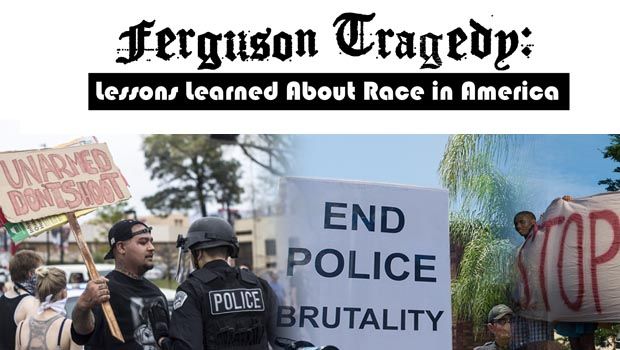
    Ferguson, a small suburban town in Missouri, has recently been the focus of global media attention for The August 9 shooting death of a black teenager, Michael Brown, by a Darren Wilson, a white police officer. The mostly peaceful protests that followed night after night turned violent at times, resulting in Missouri Governor Jay Nixon calling in the National Guard and imposing a midnight curfew. A vigorous debate on the intractable issue of race in America has been ignited once again by media outlets and in public policy forums, and on social media sites where the conversation becomes very intense and divisive at times. The Ferguson tragedy has raised several questions about the social fabric of American society.

    Laws and social norms attempt to regulate, always imperfectly, human behavior. Minds and hearts, though, can only be cleansed and elevated through divine guidance and spiritual practice

    The first issue is the social impact of changing demography. Ferguson, a suburban town of 21,000 people and a part of metropolitan St. Louis, is administratively included in St. Louis County. While most of the county population is white, Ferguson and neighboring towns are predominantly black. Blacks were once a minority in Ferguson, but the city’s demography has shifted in recent decades after white families moved out to surrounding suburbs. In 1970, whites were 99 percent of the Ferguson population. However, in 2010, 67 percent of the population was black and, according to Richard Rosenfeld, a professor of criminology and criminal justice at the University of Missouri-St. Louis, Ferguson has “a relatively stable, working and middle-income community but it does have its pockets of disadvantage.” Yet, the town’s executive leadership and its police force are predominantly white, almost 94 percent in 2014. This disparity can negatively impact the community as shown in a racial profiling study indicating that while blacks make up 67 percent of the city’s population, they account for 86 percent of traffic stops by the police, and 92 percent of all arrests in Ferguson. The Ferguson Annual Operating Budget Report states, “Municipal Court Fines are a product of the penal system. It is not the City’s policy to maximize its government finances through the use of the judicial process.” Yet, the sad irony is that one fourth of the town budget is collected through court fines, as in other small towns in Missouri, and mainly come from black citizens and other minority groups.

    Another sad fact is that, unfortunately, the shooting and killing of a black teenager was not an isolated event in American policing. It is a pattern. According to the latest available homicide data of the FBI, during the seven year period ending in 2012, nearly two times a week in the United States a white police officer killed a black person. Compared to white teenagers, black teenagers are twice as likely to be killed by a white police officer. The unjust American prison-industrial complex also presents the racial divide in a vivid manner. The prison population in the U.S. is larger than that in any other country in the world. Of the total 2.3 million, one million prisoners are black. Hispanics and African-Americans are 25 percent of the U.S. population. However, among the prison population, they account for 60 percent.

    The second issue raised by the killing of Michael Brown is the severe ethnic and political polarization on race issues in American society. According to the latest Pew Research poll, 80 percent of black people believe that the Ferguson case raises important issues about race. Thirty-seven percent of white people surveyed agreed. However, 47 percent of white people also said that race has been getting too much attention in America. The responses broke along political affiliation as well as racial lines, with 68 percent of Democrats thinking the shooting raises important racial issues but only 22 percent of Republicans think so. Some media commentators on Fox News even declared that talking about race issues is itself racism. Conservative pundits generally do not consider that there is a race problem in America and do not seem unduly concerned that young black males are too often subject to racial profiling and presumed suspicious just because of the color of their skin.

    The third issue raised by the killing of an unarmed black teen in Ferguson is that historically racial prejudices are deeply rooted in American society. There is no question that the U.S. has made great strides toward the achievement of racial equality, especially since the 1950s. Having an African-American president in the White House is the greatest testimony to this progress. Still, bigotry remains in the minds and hearts of too many Americans. In 1999, The American Assembly, a public policy forum established by President Eisenhower at Columbia University in New York City, presented a report suggesting that American society has not resolved four divisive issues despite tremendous technological and economic progress. These are economic disparity, racial inequality, family disintegration, and the role of religion in public life.

    Racism is an explosive issue and with increasing political polarization, especially after Obama was elected, it needs to be addressed at all levels. The Assembly in its report on race in America offered several measures to improve the situation. Dialogue, education, economic opportunities, better housing, reforming the prison system, and volunteerism are included in its list of recommendations. Let me also offer two suggestions, one practical and the other philosophical. On a practical level, it would facilitate trust and positive community relations if the racial makeup of law enforcement on the local level was reflective of the racial makeup of the community it serves. This can go far in precluding the deep distrust that exists in Ferguson and the festering tensions that arise out of that. On a more philosophical level, we would do well to consider the limitation of the human intellect in resolving human problems and miseries. Liberal western civilization, after rejecting any role of divine guidance in solving human problems, depends solely on man-made solutions to the big issues that societies face. Race in America is only one of the many gripping issues we are grappling with.

    Laws and social norms attempt to regulate, always imperfectly, human behavior. Minds and hearts, though, can only be cleansed and elevated through divine guidance and spiritual practice. Muslims are well aware of the last sermon of Prophet Muhammad (pbuh) during his last Hajj, when he profoundly declared, “All mankind is from Adam and Eve; an Arab has no superiority over a non-Arab nor a non-Arab any superiority over an Arab; also a white has no superiority over a black nor a black any superiority over a white – except by piety and good action.” The challenge is how such abiding wisdom can be embedded in the hearts and minds of all American citizens and, especially, in our younger generation so they can be liberated from the scourge of racism and realize a future of greater peace and harmony.

  • Stamp out Hunger

    Stamp out Hunger

    Amongst the most basic needs of human existence is sustenance. God talks about this in different places in the Qur’an, emphasizing that all people must eat and drink and that even the Messengers, who were sent by Him to mankind, ate and drank (Qur’an 5:75). God also mentions in various places in the Qur’an that He has provided for mankind sustenance from various sources and that His generosity is abundant (Qur’an 11:6). Nonetheless, we still see much hunger, and even starvation, around the world. In fact, roughly a quarter of children worldwide are stunted mentally and physically because of malnutrition. In some countries such as Burundi, Somalia, and Niger this rate is over 30 percent; and in Bangladesh it is an appalling 41 percent while in India this rate reaches as high as 48 percent of all children in that country. When we consider these statistics in light of the Qur’anic verses, we know that we are not talking about a material crisis; rather we are talking about a moral crisis.

    Sometimes Muslims living in the U.S. think that poverty and hunger are problems that only affect other areas of the world but are not local issues. This is an incorrect understanding

    In many different places and in many different ways in the Qur’an, God addresses the urgency of feeding the poor. It says multiple times that feeding the poor is an evidence of true belief (Qur’an 90:14, 89:18, 107:3). It talks about feeding the poor as expiation for certain misdeeds (Qur’an 58:4, 2:184). These verses put extra emphasis on the importance of this issue and show that it is foundational in the development and realization of faith, a part of which is to acknowledge the needs of our brothers and sisters. These verses also apply to all of mankind and not to needy Muslims only.

    When Prophet Muhammad (peace be upon him) first received the revelation, he was in a state of bewilderment. He ran home to his wife and told her to cover him up and explained what had happened to him. Her response was quick and measured, “Allah will never disgrace you. You unite family relations, you bear the burden of the weak, you help the poor and the needy, you entertain the guests and endure hardships in the path of truthfulness.” This was the way that she described her blessed husband, and one of these descriptions was that he helped the poor and the needy.

    When some of the Muslims fled to Abyssinia to escape the discrimination they were facing, they sought refuge under a just king who asked them what their message was about. In explaining the message of Islam, one of the things mentioned was the rights of the poor and the obligation to provide for the needy by giving in charity.

    Sometimes Muslims living in the U.S. think that poverty and hunger are problems that only affect other areas of the world but are not local issues. This is an incorrect understanding. If we take California as an example, especially considering that it is generally considered a wealthier state, we see some interesting figures. Almost 23 percent of children in California are living in poverty. Roughly 16 percent of households are suffering food insecurity, meaning they have difficulty procuring enough to eat. Almost 47 million Americans (nearly 15 percent of the population) rely on government support through the Supplemental Nutrition Assistance Program (SNAP, commonly known as food stamps) in order to fulfill their basic nutritional needs. Almost 60 percent of students in schools across America receive free lunches in order to supplement the limited food available at home. All of these figures show that hunger is a serious issue not only worldwide, but here in the United States. So what can we do?

    In response to that crucial question, we are starting a local campaign in the near future which we hope will be picked up by communities nationwide. Basically, we are calling on people to realize the plight of those who go hungry every day. In this campaign to Stamp Out Hunger, we are asking people to take a “food stamp challenge.” During this challenge, participants will limit their daily spending on food to what they would be able to purchase if they were on food stamps. This means no fast food, no prepared food, and no more than four dollars per day for the 12 days of the challenge. We hope that communities all over the country will hold locally organized and hosted town halls on hunger and poverty at the end of the 12-day “food stamp challenge.” Throughout the campaign, we ask our brothers and sisters to share their experiences and stories on Facebook and Twitter (@stamphunger). We hope that this brief, voluntary deprivation will help us build empathy for those that are suffering from hunger. We also hope that it will help initiate discussions about our role as people of faith in dealing with these issues, and how our choices impact the world around us.

  • Democracy and Religious Pluralism

    “Real pluralism always has an edge of risk especially where the past relations between ethnic groups or between nations in a state have been bad, as is the case in America. Plurality and freedom can let out long pent-up rage and thus destroy states. Or frankness can start negotiations where the groups already have in common things they want to preserve and tighten. In the end there is either freedom of association, cultures and speech for all groups in a wide state, or for none, or for only one. The survival of prospering Muslims in the USA will offer a way forward for all America, and a cultural and human link to the Third World that may help both these worlds in the long term” (Dennis Walker, from his introduction to Islam and the Search for African American Nationhood).

    The egalitarian atmosphere envisioned
    by the founding fathers did not ensure
    the absence of sectarian religious
    sensibilities spilling into the political arena

    In his 1987 book, The Second Message of Islam, M. Mohamed Taha describes what he considers to be the ideal society. “The good society is based on three qualities: economic equality…or the sharing of wealth, political equality or democracy, or sharing in political decisions which affect daily life… [and]… a lack of social classes and discrimination based upon color, faith, race or sex. In the good society people are judged according to their intellectual and moral character, as reflected in their public and private lives and demonstrated in the spirit of public service at all times and through every means.”

    Taha captures the aspirations of many societies, a vision of which no nation currently fits the description. Implementing and maintaining this high standard under such a lofty philosophy eludes most societies. Yet, as so eloquently enunciated in the Farewell Address of the Prophet Muhammad, Islam insists upon egalitarian social values. The Qur’an and the Prophet’s injunctions aim to eliminate immorality, racial superiority, and gender inequality; and in Umar Ibn al-Khattab’s caliphate, we find the features of the democratic spirit of Islam. Traditions relate that he made the pronouncement in the mosque, “O people! If anyone among you finds any crookedness in me, then he should correct it.” A Bedouin in the mosque stood up and said, “I swear by Allah, if we saw any deviation in you, we would correct it with our swords.” To this Umar replied, “All praise is for Allah, the One who made in this nation people who would correct the crookedness of Umar with their swords.”

    Democracy in America is in peril when it fails to embrace all its citizens regardless of race, or accommodate its diverse religious traditions, including Islam

    By the dawn of the eighteenth century, America was a fledgling British colony. Europe had already experienced the Enlightenment; however, it was more than a century away from the abolition of the international slave trade and the beginning of the Industrial Revolution. To a degree, France and Britain experimented with progressive social ideas, but would come to learn much about governing from distant cousins across the pond. In Virginia, for example, a small group of wealthy elites, with backgrounds in business, law, and government, envisioned a society much like the one outlined by Taha and Walker. From a handful of revolutionary ideas about government, the ambitious founding fathers created a foundation upon which this great nation depends. Familiar with the history of past civilizations with suppressive, monarchal rule which demolished many a society, they set forth the task of reducing to writing America’s founding philosophy. From this bold and soaring act, these sagacious authors catapulted America into the mainstream of world history.

    America continues to strive to achieve the principals of a great nation. While we have the luxury of basking in past achievements, at the same time, we cannot afford to simply embrace America’s successes. When reaching for the future, we must examine our failures, and for the betterment of this country, resuscitate the founding principals. The flag we wave is not for a singular religious or cultural entity; it flies for the cause of multiracialism, multiculturalism, and religious pluralism. Salient within the American vision for a diverse society, which evolved slowly from the first American thesis of relative egalitarianism, the founding fathers presented to the world a humanitarian blueprint which aspired to level the playing field and remove divisive class differences. Ralph Waldo Emerson wrote that America’s governing principles were designed to arbitrate differences between diverse groups, and that adherence to the founding thesis was so powerful he considered it a form of religious conversion.

    Benjamin Franklin, Thomas Jefferson, and John Adams, heartened by the colony’s determination to secede from Britain, were consumed by the notion of providing individuals their freedom to choose how to practice Christianity. And they strove to secure this right for a free European-expatriate citizenry, no longer subject to enforcement of an official religious creed by England’s oppressive authorities. The language scripted into the American Declaration of Independence later emboldened the drafters of the U.S. Constitution to guarantee freemen choice to traverse any spiritual highway, as long as overthrow of the government was no part of the creed. The crafters of the most revolutionary document in American history could not, of course, see the future and the 21st century waves of migrants of varying religious persuasion from all corners of the globe moving to the U.S. They could not have predicted the level of fear or the degree of violence perpetrated against Muslims. They could never have anticipated the impact of broad-based religious diversity, and even though some Muslims insist the Quran influenced Jefferson, none of the founding fathers saw the eventual emergence of Islam in America.

    The narrative of Muslims in America might help all of us to explore the greater good deep within the American consciousness

    In the course of time, what distinguished American Democracy from other forms of government was a melding of bold ideas, liberal beliefs, and charitable sensibilities born from a yearning for religious freedom, which, amidst much resistance, later evolved into tolerance for religious plurality. While conceding the ingenuity of the founding fathers, religious freedom for the various Christian denominations, rather than religious plurality, was their undertaking. The founding documents focused on personal liberties and the responsibilities and limitations of government. The writings of Montesquieu and John Locke’s Second Civil Treatise on Government were exceedingly more influential to the founding fathers than the Quran. Government as derived from the consent of the people and lodged in the agency of the body politic became the cornerstone of the nation. When driving the decisive wedge between church and state, the original authors settled the most pressing question haunting the first colonists; however, because of the predominance of Christianity, religious pluralism was not part of the debate. They passionately wrote of religious freedom, which eventually underscored the importance and constructed the space for religious plurality. The idea of freedom was specific: it meant separation from the Church of England, and signaled a resounding consensus for a new American nationality amid the cultural diversity of the European colonization. With indentured servitude at first and then slavery fueling the engine of nation-building, America was well on its way to establishment of institutional racism. Ironically, however, it was more dedicated to plurality (albeit that power and freedom was only for those of European descent) than any other nation.

    The Declaration of Independence was essentially a declaration of separation, between two bodies of land but more importantly as a casting off of the shackles of religious intolerance. As America conceived democracy, the world’s most profound human experiment, commitments to capitalism, slavery, religious and racial singularity were nonetheless made. This is part of what made the country unique and desirable to Protestant Europeans arriving in America. By the end of the nineteenth century, America’s pledge to “all men are created equal” would be tested. The new nation learned to manage diversity through the separation of races and of religions, even though such divisive cultural mores contradicted the idea of tolerating, and more than that, appreciating and celebrating differences. The sense of identity of most nations is based on a common history. America’s self-identity is based more on ideals and values. But as human beings too often fail to realize the ideal, it was not American high-mindedness, but American fears and prejudices that issued forth a society riven by racial and religious divides. The religious divisions, though, often lay beneath the surface.

    Democracy and the principle of religious pluralism within our national space exist because of the separation of “church” (representing any and all religions) from the state. This suggested but did not guarantee a tolerant society of “reinvented Europeans.” The egalitarian atmosphere envisioned by the founding fathers did not ensure the absence of sectarian religious sensibilities spilling into the political arena. In fact, both Catholicism and Judaism were at one time demonized religons.

    Indelible ideas were written passionately into the American Declaration of Independence — “…that all men are created equal, that they are endowed by their Creator with certain unalienable Rights, that among these are Life, Liberty and the pursuit of Happiness.–That to secure these rights, Governments are instituted among Men, deriving their just powers from the consent of the governed…” Yet, at that time in American history, democracy only served white, male property owners. John Adams, one of the Massachusetts signers of the Declaration of Independence, who became the second president, articulated the common view in 1776 that opening the vote to all people would “confound and destroy all distinctions, and prostrate all ranks to one common level.”

    Despite such viewpoints, a collective, more egalitarian and pluralistic American perspective grew dramatically over the next century. The early settlers searched for political unity, and honored the belief that America would unite them by common ideals. Gunnar Myrdal, the pioneering Swedish sociologist, in his two volume classic The American Dilemma, noted the hope of the founding fathers —“Americans of all national origins, classes, religions, creeds, and colors, have something in common: a social ethos, a political creed.” Still, by the close of the eighteenth century, the claim of patriotism was permitted to a single religious tradition. While being secular deists themselves, the founding fathers never anticipated the increasing numbers of non-Christians in America. Yet they built into American democracy a core belief in God which then expands outward in secular concentricity in order to check the predomination of any one religion. They created a paradigm in which government does not endorse or preclude religion, but focuses on protecting the rights of all citizens regardless of religious orientation. The founding fathers ventured far past satisfying the aspirations of the original Euro-American Christian society. They opened the door of religious expression, touted a new mission in early America — that the nation was divinely inspired, and they presented a newly defined nationalism that was religiously disconnected from Europe.

    The era of the first American Thesis, although incomplete, represented belief in not only the spirit of an independent nation capable of managing its diversity, but also in America’s role as a soft power in the world. This concept, in current times enunciated by Joseph Nye of Harvard University, describes a persuasive rather than coercive approach to international relations, typically involving the use of economic or cultural influence. As far as managing its heterogeneous citizenry, Canadian sociologist Sacvan Bercovitch describes American diversity as, “a hundred sets and factions, each apparently different from the others, yet all celebrating the same mission.”

    The dream of democracy’s promised equality began to open to minorities finally in the 20th century. Jim Crow laws maintained two worlds, with whites and blacks kept apart by blatant misinterpretations of Christianity and intentional “liberties” with various Bible verses to promote the idea that God supported racial segregation; by anti-black legislation and by unwritten, but strongly enforced local customs which enforced a racial hierarchy. The brilliant two-volume work written about America by Alexis de Tocqueville in 1835 depicts a deeply troubled early America, predicated on the clashes brought about by slavery. And we can infer from his observations the existence of intolerance of other religious traditions by mainstream Christianity. He attributed the social fragility in the new nation to the un-preparedness of white Americans to mix with those of other races and religions. He scripted a most poignant and stimulating critique of the American people, questioning if racial and religious intolerance would eventually undermine the American experiment.

    Ironically, even prior to the first half of the twentieth century, despite inequality, discrimination, and exploitation, the world viewed America as the progressive model for modernity. And just as ironic, until the 1950s, no other religious form ever challenged the dominant motif of Christianity which had been sewn into the American tapestry, interwoven with threads of liberty, pluralism, and unimpeded individualism, national moral fibers that remained more potential than actualized.

    Today, the right wing Republican party shamelessly continues to obstruct that actualization. Democracy in America is in peril when it fails to embrace all its citizens regardless of race, or accommodate its diverse religious traditions, including Islam. Within a pluralistic society, people of all persuasions have certain rights, including the right to privacy, access to health services, education, housing, and equal protection under the law. A secular, pluralistic state guarantees the right to practice the religion of one’s choice, to engage in political life, and to pursue one’s own selected occupation and favored leisure activities. Democracy also guarantees the right to vote within a free and frank public square where America’s direction and challenges are openly debated.

    Muslims, like Christians and Jews, bring a distinctive religious ethic into public life. Islamic ethics, like Judeo-Christian ethics, can remind America’s citizens to steer clear of that which corrupts. Thus traders might weigh with fairer measure, astronomers explore the cosmos with more reverence, police investigate and enforce the law with utter justice and more compassion.

    In scripting the American constitution, the original visionaries created a framework essential for a young nation of migrant farmers, aspiring entrepreneurs, and yet-to-be-emancipated slaves to co-exist under the American Thesis. That national proposal must reserve a space for the inclusion of Muslims and followers of other religious traditions to co-habitat the land.

    The narrative of Muslims in America might help all of us to explore the greater good deep within the American consciousness. What lies within is a rich diversity that promises a genuine actualization of liberty, pluralism, and unimpeded individual choice. Remember, it has been said, Men may get scruples in the future that they have not thought of now.

  • Injustice in Syria

     
    The Prophet Muhammad (peace be upon him) said:

    O My servants! I have forbidden injustice to Myself and I have made it unlawful for you, so do not oppress one another.

    [Sah?h Muslim 6524]

    Today Syria burns. Syria. The center of historical Sham, vibrant heart of the Islamic world for over a millennium.

    Since the dawn of the Islamic era, the faithful have flocked to this ancient land. Many made it their home. Others came seeking knowledge, wisdom or simply a better life. The first Muslim empire made it their capital for nearly a century. In turn, the region produced over time some of our brightest minds. After all, it was the Prophet himself who had advised, Go to Sham, for it is the chosen among God’s lands, and the destination of His chosen ones. [Abu Dawud, authenticated by al-Albani] And so it was naturally the Companions of the Prophet who were first to settle in Damascus, heart of Greater Syria, bringing with them the Prophetic legacy.

    The Quintessential Damascene Tradition

    Among these was Abu Dharr al-Ghifari, and among the Prophetic traditions he passed on was the hadith cited above on the subject of justice. It was taught from generation to generation until another great scholar of Damascus, Imam Nawawi, immortalized it for posterity. Consequently, it became a sort of quintessential Damascene tradition and was celebrated as such. In fact, Nawawi remarks, “The people in the chain of transmitters of this Hadith from myself to Abu Dharr are all from Damascus.” And Imam Ahmad before him made the claim, “There is no tradition that the people of Sham possess that is nobler than this one.”

    Justice is God’s Own Value

    This is a qudsi hadith, which means “sacred tradition” and refers to the statements of God as related by the Prophet Muhammad. The above hadith represents the initial words of a lengthier tradition instructing humanity on one of the most important values in Islam, a value that permeates all Islamic laws and teachings: justice.

    Its opening words are, at the same time, universal and intimate. My servants speaks to humanity in the broadest terms possible and addresses them in a warm and close manner that suggests the great care the Creator has for His creation. Only after such an introduction does God deliver the point—justice is His own value, His guiding principle.

    He declares that He forbade injustice—its exact opposite—upon Himself. Two of His Names have to do with justice: al-’Adl (“The Just One”) and al-Muqsit (“The Dispenser of Justice”). God created the world with justice, and it is self-evident all around us:  And the heavens He has raised up and established the scale of justice, so do not transgress the scale of justice. [Quran 55:7-8]

    Justice is an Islamic teaching which has its roots in God Himself. God is Just, created the world with justice, and enjoined the same standard on humanity. Unfortunately, far too few heed this call. Perhaps that is why the instruction given was to avoid injustice rather than to implement justice. Even the angels had recognized earlier that humans would bring injustice to the world:

    Are you going to place in the earth those who will inevitably sow corruption therein and shed blood? [Quran 2:30]

    Hence the reminders throughout our history, through Messengers, whose central message was to establish justice:

    Verily, we sent Our Messengers with clear proofs, and we revealed unto them the Scripture and the Balance in order that they lead people with justice. [Quran 57:25]

    Two Sides to Injustice

    So God made injustice unlawful and instructed us to avoid it. The term used (tazalamu) is in the reflexive form, which does not simply mean Do not commit injustice, as is commonly translated, but includes the involvement of two sides. That is because for every act of injustice there is a perpetrator and a victim. Oppression requires the oppressed. And institutionalized tyranny can only operate with a steady supply of victims, willing or unwilling. When victims refuse to be victims, then the system crumbles as the Arab Spring continues to demonstrate.

    With this same insight, the Prophet advised his followers, Help your brother whether he is an oppressor or oppressed. In response to how an oppressor could be helped, he replied, Stop him from his oppression!  So the meaning of these words is much deeper than they would appear: avoid injustice in all its forms, whether it is direct involvement or by becoming accessories, or whether it is by being perpetrators or becoming victims.

    It is ironic that Syria of all places has become a tragic stage for the most egregious injustices being played out in the world today—the same region that disseminated this lesson on justice! Both the perpetrators and victims are Muslim, which makes these violations all the more egregious.

    The justice maxim is quite clear in the Quran and in the life mission of the Holy Prophet. It was also clear in the minds of the early Muslims, such as the Muslim emissary to Persia who famously told the Emperor:

    We came to rescue God’s servants from being slaves to other men to serving the Creator of all men, from the constraints of this life to the vastness of the next life, and from the tyranny of other religions to the justice of Islam.

    The world needs this offer once more.