
بسم الله الرحمن الرحيم

Tag: Sabr

  • Building Resilience in Our Children

    Building Resilience in Our Children

    In a world where children constantly face new challenges — from academic pressures to social dynamics — resilience has become crucial for their overall well-being and future success. Resilience, the ability to bounce back from adversity and adapt to difficult situations, is not merely an innate trait but a learned skill that can be nurtured from a young age.

    Resilience is essential for children due to the daily obstacles they encounter. Consider a child who faces bullying at school, struggles with a complex academic subject, or experiences family upheaval. Without resilience, these challenges could have long-lasting negative effects on their mental and emotional well-being. However, with the right tools and support, children can learn to navigate these hurdles, emerging stronger and more capable. This article explores the importance of building resilience in children and offers practical strategies for parents, educators, and caregivers to foster this critical trait. Understanding and applying these techniques can help children develop the inner strength needed to thrive in an ever-changing world.

    From a psychological perspective, resilience refers to the ability to adapt and recover from stressors and challenges, maintaining positive mental health and well-being. It involves qualities such as optimism, patience, perseverance, problem-solving skills, and effective emotional regulation — all essential for children’s overall development. Resilience helps children navigate challenges, recover from setbacks, and succeed in various aspects of their lives.

    Research shows that resilience is linked to better mental health outcomes, with resilient children exhibiting lower levels of anxiety, depression, and other mental health issues. They cope more effectively with academic stress, engage more fully in school activities, and maintain emotional stability in the face of everyday adversity.

    Resilience in Islam

    In the Qur’an, the concept of resilience is closely related to the term “sabr,” which means patience and perseverance in the face of challenges. The Qur’an provides numerous stories of resilience that can inspire both us and our children. The stories of Prophet Ibrahim (alayhi as-salaam), Prophet Yusuf (as), and Prophet Ayub (as) exemplify remarkable resilience.

    Prophet Ibrahim (as) demonstrated unwavering faith when he was thrown into the fire for rejecting idolatry; and when was willing to sacrifice his son Ismail (as) in obedience to Allah’s command. Despite facing immense trials, he maintained hope and trust in God. Similarly, Prophet Yusuf (as) showed immense patience and integrity despite being betrayed, sold into slavery, and unjustly imprisoned. Through his faith, he overcame challenges and thrived. Prophet Ayub (as) also embodied resilience through severe physical ailments and the loss of his wealth and family, remaining patient and grateful to Allah, which led, ultimately, to the restoration and increase of blessings. These stories teach that resilience in Islam is rooted in unwavering faith, sabr, and tawakkul (trust in and reliance on Allah), even in the most challenging circumstances.

    Prophet Muhammad (peace be upon him) said, “Wondrous is the affair of the believer, for there is good for him in every matter, and this is not the case with anyone except the believer. If he is happy, then he thanks Allah and thus there is good for him; and if he is harmed, then he shows patience, and thus there is good for him” (Sahih Muslim). This hadith highlights the dual approach of gratitude and patience as powerful mechanisms for building resilience. By expressing gratitude during times of happiness and practicing patience during adversity, Muslims can find good in every situation. This approach not only strengthens faith but also helps navigate daily challenges with a positive and resilient mindset.

    Practical Strategies

    To build resilience in children, practical strategies are essential. Modeling resilience is key, as children learn by observing adults. Parents should demonstrate positive ways to manage stress and recover from setbacks. They should avoid overreacting to situations and refrain from giving in to negative emotions such as intolerance, resentment, or anger.

    Encourage problem-solving in children rather than solving problems for them. Problem-solving helps children think through challenges, consider potential solutions, and decide on a plan of action, boosting their confidence in handling difficult situations. Teach children that failures and setbacks are opportunities for growth. Praise their hard work and determination and help them find the positive aspects of challenging situations. This approach should be adopted by parents themselves.

    Equip children with tools to manage their emotions and stress. Teach self-soothing skills like deep breathing, mindfulness, or journaling. Introduce healthy coping strategies such as talking to someone they trust, engaging in physical activity, or pursuing hobbies.

    Spiritual Practices

    Building resilience is greatly empowered by incorporating spiritual practices. One key aspect is sabr, patience and perseverance, as mentioned above. Believers are encouraged to exercise sabr during challenges, hardships, and adversity. Many passages in the Qur’an highlight the value of sabr, which is seen as a fundamental virtue yielding immense reward and blessings.

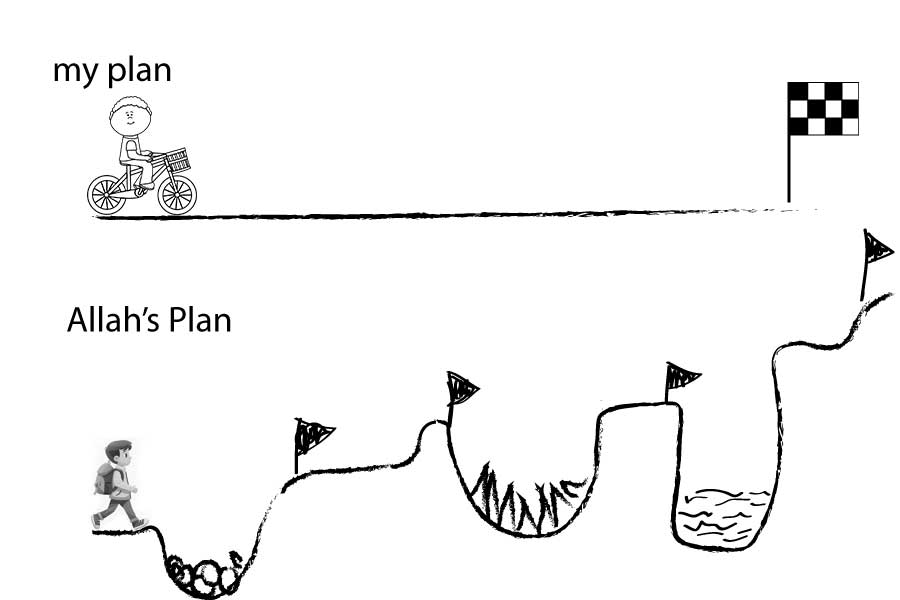
    During trying times, Muslims are urged to turn to prayer and ask Allah for wisdom, mercy, strength, and support. As the Qur’an says, “O you who have believed, seek help through sabr and prayer. Indeed, Allah is with those with sabr” (Qur’an 2:153). We can teach children the value of du’a and the importance of consistent salah. We can help them develop steadfast faith in God’s plan, supporting their resilience. Performing the five daily prayers offers regular opportunities to connect with Allah, seek guidance, and find solace in His presence. It is important to remind children to use these moments in prayer to seek strength and patience from Allah, especially during difficult times.

    Another important practice is trust in Allah (tawakkul). Genuine resilience arises from depending entirely on Allah while making full effort in all endeavors. The Qur’an advises, “And upon Allah let the believers rely” (Qur’an 3:122). Parents must teach children about tawakkul and demonstrate through their own actions that they trust in Allah. They should encourage them to face challenges with persistence and courage while trusting that Allah will guide and help them. Additionally, regular recitation of the Qur’an and dhikr offers guidance, comfort, and wisdom to navigate life’s challenges. Reflecting on the stories of the prophets and their unwavering faith can certainly inspire resilience.

    By incorporating these psychological, emotional, and spiritual practices into daily life, we can build a strong foundation of resilience and faith, in our families and in our homes. Adversities can then be viewed as opportunities to turn to our Lord.

    “O Allah, I hope for Your mercy. Do not leave me to myself even for a blink of an eye. Correct all my affairs for me. There is none worthy of worship except You” (Abu Dawud).
  • Tawakkul: Leading to the Fullest Reward

    Tawakkul: Leading to the Fullest Reward

    As Muslims, we believe that tawakkul, trust in and reliance on God, is one of the most important core principles and values in maintaining our spiritual identity and continued growth toward closeness to Allah. The concept of tawakkul is highly emphasized in the Qur’an and ahadith and by many great scholars. However, in this day and age, we have unfortunately come to oversimplify the meaning and understand it as a one-dimensional and depthless trust in God. But in reality tawakkul is a nuanced concept with far-reaching and profound implications. With everything going on in the world, it is important that we don’t lose sight of the foundation of relying on Allah and understanding that not everything is in our control.

    Tawakkul:  Qur’an and Ahadith

    Allah says in the Quran, “And whoever has tawakkul, then Allah is all that he needs” (Qur’an 65:3).  This verse illustrates how tawakkul is directly connected to reaching a state of contentment where we feel that God is all we need. Allah also tells us to “rely upon Allah, and sufficient is Allah as disposer of affairs” (Qur’an 33:3). The phrase “rely upon Allah” encourages believers to put their complete trust in Allah and rely on Him for guidance, help, and protection. It requires acknowledging that Allah is the ultimate source of strength and that He is fully capable of managing and taking care of all affairs. Truly tawakkul is one of the most important keys to living a life that is in accordance with the Qur’an and sunnah and gives us the security to thrive and flourish, to achieve our full potential.

    This tawakkul in Allah gives us the strength to stay steadfast in our decisions as well. Allah says in the Qur’an, “So when you have decided, then rely upon Allah. Indeed, Allah loves those who rely” (Qur’an 3:159). We get the comfort of knowing our decisions have God’s support when we have tawakkul. Making decisions and taking action, interwoven with tawakkul, earns Allah’s love! What more could we want for ourselves? It gives the understanding that no matter what happens, that is what was meant for us because that is what Allah decreed. It gives us the motivation to continually renew our faith in qadr (divine destiny).

    There is a beautiful hadith of the Prophet: “Strange are the ways of a believer for there is good in every affair of his, and this is not the case with anyone else except in the case of a believer. If he has an occasion to feel delighted, he thanks [Allah], thus there is a good for him in it; and if he gets into trouble and demonstrates sabr [patience and perseverance], there is a good for him in it” (Sahih Muslim). This hadith very clearly lays out how to construct our thoughts and attitudes around all types of events that befall us or surround us. If something good happens, we say “alhamdulillah,” and if something that we perceive as negative happens, we stay steadfast and patient and rely on Allah, knowing that this is what was written for us. The cultivation of these beliefs ensures that nothing can break our resolve and steadfastness in our belief in God and the meaning and purpose of our lives.  How amazing to live a life in which encountering both favorable and unfavorable conditions and circumstances leaves us surrendered to, and content with, the decree of our Lord.

    Prophet Muhammad (s) also said, “If you were to rely on Allah with the required reliance, then He would provide for you just as He provides for the birds. They go out in the morning empty and return full” (Sunan at-Tirmidhi). I may have nothing, come from nothing, and start the day with nothing, but with tawakkul, I know God will always provide what is needed.

    Our Prophet (s) also said, “If you ask, ask from Allah, and if you seek help, seek help from Allah” (Sunan Abu Dawood). Why should we turn to anyone other than God? In Surah Ra’ad (13:28) Allah says “…those who believe and whose hearts find comfort in the remembrance of Allah, surely in the remembrance of Allah do hearts find comfort.” We can choose to remember Allah constantly, and in times of trial and tribulation, we can find comfort in dhikr, ultimately leading us back to tawakkul. We know that this is what was meant for us and this is the best for us. Ibn Abbas reported that the Prophet (s) said, “Seventy thousand from my nation will enter Paradise without reckoning. They are those who do not rely on incantations, nor believe in omens, but rather they trust in their Lord” (Sahih al-Bukhari). Not only will this trust help us in our earthly lives, it will more than suffice us if we can enter paradise without reckoning!

    From this brief overview, we can conclude that tawakkul involves placing trust in and reliance on Allah in all aspects of our lives.  It is intertwined with other Islamic values such as patience, gratitude, and acceptance of Allah’s decree. Tawakkul also teaches Muslims to have faith in Allah’s wisdom, providence, and guidance, knowing that He truly is the ultimate provider and controller of all affairs. Tawakkul requires active and sincere effort, aligning our beliefs and behaviors in such way that trust in Allah’s wisdom and decree imbues our lives with ultimate meaning, purpose, resolve, and sustenance.

    From these ayahs and ahadith, we are encouraged to rely on Allah, seek His help through prayer and supplication, and trust that He will guide and support us. This belief then fosters inner peace, contentment, and a sense of surrender to the Divine Will.

    Tawakkul: Scholarly Commentary

    Ibn Taymiyyah

    Sheikhul Islam Ibn Taymiyyah discusses in his various writings the concept of tawakkul, a fundamental aspect of faith, and how it positively affects the believer’s heart and actions; and he emphasizes the significance of tawakkul in one’s relationship with Allah and in getting closer to Allah. Ibn Taymiyyah highlights the need for Muslims to trust in Allah’s decree and have full confidence in His wisdom and plan. He emphasised that tawakkul involves recognising that all matters are ultimately in Allah’s hands and that relying on Him is the source of true tranquillity and peace, especially through hardship. He also makes the point that tawakkul must rest upon a foundation of adherence to the teachings of Islam and striving to please Allah.

    Al-Ghazali

    Imam al-Ghazali addressed the topic of tawakkul within the broader context of Islamic spirituality and ethics in “Ihya Ulum al-Din” (Revival of the Religious Sciences). He emphasised the importance of trusting in Allah’s plan and submitting to His will. He stresses that true tawakkul involves recognising that everything happens by the decree of Allah and that the believer accepts His wisdom, even in situations that may appear unfavourable or challenging. Al-Ghazali views tawakkul as an integral part of one’s spiritual development. He believed cultivating trust in Allah deepens one’s connection with the Divine and brings inner peace and contentment. Tawakkul allows individuals to detach themselves from excessive worry and anxiety, relying on Allah’s power and mercy.

    Ibn Qayyim

    Ibn Qayyim al-Jawziyya discussed the concept of tawakkul in “Madarij al-Salikin” by stating “Tawakkul is half of the religion, the other half is inaabah, turning to Allah.” He also emphasised that tawakkul involves placing one’s complete trust and reliance on Allah in all aspects of life and trusting in Allah’s wisdom, and accepting His decree, even if at times it may not align with our desires or expectations. He asserts that tawakkul involves submitting to Allah’s will and believing that whatever He decrees is ultimately for our best interests and that tawakkul should be accompanied by seeking Allah’s assistance through supplication (du’a), seeking His forgiveness, and engaging in acts of worship.

    All three of these scholars maintained that there should be a balanced approach between human effort and reliance on Allah. While we should make sincere efforts and take practical steps, we should also understand that the outcomes are ultimately determined by Allah’s decree and we should find peace and contentment in that, expressing our tawakkul and faith in qadr, all the while still trying our best and making du’a. This action and expression of pure submission and reliance on Allah and an obedient lifestyle become the foundation upon which we can build character traits such as sabr (patience and perseverance), shukr (gratitude), and qana’ah (contentment with whatever Allah SWT bestows upon us). Striving in this way leads to emotional stability, mental resilience, and overall well-being. The ultimate result? — Allah SWT assures us of the fullest reward.

    “And that there is not for man except that for which he strives. And that his effort is going to be seen – then he will be rewarded for it with the fullest reward” (Qur’an 53:39-41).

  • The Immense and Innumerable Blessings of Sabr

    The Immense and Innumerable Blessings of Sabr

    Sabr is both patience and perseverance. That covers a lot of ground. In fact, Imam Abu Talib Al-Makky, in his book, Qoot ul-Quloob, writes that most people sin because of two things: lack of sabr with regard to pursuing what they love or aspire to; or lack of sabr with regard to what they detest (such as pain, poverty, illness, etc). In fact, sabr is the key to the inner power that enables us to respond with intention and purpose to life’s challenges. One of the great scholars, Imam ibn Qayyim, stated: “When a man controls his tempers and desires and yields to religious incentives, he finds the true kingdom; for then he attains freedom. On the other hand, a king who gives himself up to his desires and tempers becomes their servant, driven by them both. Only the fool mistakenly concentrates on outward sovereignty, while its reality is servitude.”

    It is enlightening to consider some of the immense and innumerable blessings of sabr as evidenced by the Qur’an and sunnah:

    • Sabr is a way of being successful in this life and in the Hereafter —”O you who believe, practice sabr and hold together firmly and love and fear Allah, so that you may be successful” (Qur’an 3:200).
    • Sabr is a way of being close to Allah SWT and earning His love — “…and Allah loves the those with sabr” (Qur’an 3:146).
    • Sabr makes an individual qualified for leadership — “And We made of them leaders guiding by Our command, when they were patient and certain of Our Signs…” (Qur’an 32:24).
    • Those who have sabr are rewarded without measure — “…those who patiently persevere will truly receive a reward without measure” (Qur’an 39:10).
    • Sabr is a way of attaining taqwa (righteousness, love and fear of Allah SWT, God-consciousness) — “…So persevere patiently, for the end is for those who have taqwa” (Qur’an 11:49).
    • Sabr is a far-reaching quality to have — Prophet Muhammad (s) said, “…No one is given that which is better and more comprehensive than sabr” (Saheeh Muslim).
    • Sabr is illumination of the mind and heart — the Prophet (s) said, “…Sabr is illumination…” (Saheeh Muslim).

    Unfortunately, many people equate sabr with resignation: inactive waiting, passively enduring difficult situations, or giving up. Far from that, sabr is mental and emotional diligence; it is active endurance of hardship while diligently working on changing a situation to the best of our abilities.

    Sabr Is Extremely Important in Marriage

    It is easy to understand why sabr is so important in marriage. Don’t we all want a spouse who is successful, close to Allah SWT, possessing good leadership qualities, imbued with taqwa, and whose mind and heart are filled with spiritual light? Sabr is also an important ingredient to a successful marriage because despite all the efforts made before marriage to guarantee the perfect match, there will always be differences. We are multi-dimensional beings and our outlooks on life are shaped by numerous factors related to genes, upbringing, life experiences, temperament, etc. It is a truism that a degree of mismatch exists in most, if not all, marriages. The question is: how should spouses deal with such inevitable differences? First, both spouses must be willing to accept feedback and make changes in their behavior.  Each must also adapt to, and accommodate as much as possible, the personality and mindset of the life-long partner.

    Yet, after doing all that is humanly possible to create harmony in a relationship, there will often remain some points of contention between spouses. One very important tool in dealing with this reality is the trait of sabr. In fact, spouses can exercise sabr concerning what is perceived as unchangeable shortcomings or weaknesses in the other. But how much easier and more fulfilling it is to exercise sabr with regard to the spouse when knowing all the Islamic benefits and blessings (listed above) found in practicing this trait.


    The Practice of Sabr in Daily Life

    Sabr is also needed when dealing with the countless contingencies of life such as disappointment, sickness, or joblessness. Regardless of the challenge faced, one cannot truly succeed without the daily practice of sabr with oneself, in our relationship with Allah SWT, with our spouses, in our extended family, and in community relationships.

    The practice of sabr actually enables other skills to be developed. One such skill is utilizing the pause. The pause is the space between the stimulus and the response. Someone says something that triggers anger in you, for example. The pause is the space you allow before replying. Whether it is 30 seconds or waiting until one cools off, it requires sabr. If we are patient, we are more than likely to fully experience the pause, giving ourselves time to take in the information in order to accurately perceive and interpret what is happening or being conveyed. In this pause we purify the intention and then choose how to respond, having contemplated the consequences of any action. The other option would be to react with habitual impulse or base egotistic desire. Then we are forced to live with the destructive ramifications of less than truly conscious choice.

    How Can We Acquire Sabr?

    Acquiring sabr entails thinking and acting with sabr even when we don’t initially feel it. The Prophet (s) said, “…Whoever practices sabr, Allah gives him sabr…” (Bukhari). So, we can say that sabr comes with practice and, in the beginning, it may feel unnatural and difficult. But with time the practice becomes easier and easier. Acquiring and maintaining sabr includes formulating the intention to acquire sabr; reflecting on one’s purposes for acquiring sabr; and taking action.

    It helps to ask ourselves questions such as “Am I already practicing sabr?” or “What areas of my life reflect a lack of sabr?” Making du’a to Allah (SWT) to help us realize sabr in whatever we do is also essential. We can also use a “disciplining the thoughts” technique by becoming aware of our inner chatter and determine if our thoughts support and enhance the practice of sabr or not. We can then increase our fluency in positive inner thoughts that support the habit of sabr and make a resolution to go through one entire day with no thoughts that defeat acting with sabr.

    We can also seek knowledge from the Qur’an and sunnah and record in a journal whatever material we find about sabr. Then we can reflect on the knowledge we have compiled. By reflecting on the rewards we can gain by practicing sabr, or the painful consequences of not practicing sabr, we reinforce our intention to continue practicing, looking for opportunities in everyday living to practice sabr. There are endless opportunities — waiting in line at a store, dealing with the shortcomings of people we work with, encountering adversity, illness, financial difficulties, disappointment, inconvenience — the list goes on and on.

    The Prophet (s) said, “Sabr is half of eman” (Abu Na’eem and Al-Khateeb). That makes perfect sense as it encompasses so much — restraining the self from any harmful influence or temptation; and directing the self toward goodness and everything beneficial. To do this with unwavering purpose and dedication, one begins to feel the will power, like a muscle, being strengthened day by day. Each time we catch the opportunity to pause and reach down into the primal core of our being and connect to the meaning and purpose of our lives, we take a further step on our journey of transformation. Behaving only in ways that serve our intentions and goals, we are well established on our journey toward success in this life and in the Hereafter.


  • Sabr: Achieving Closeness to Allah, Spiritual Growth, and Inner Peace

    Sabr: Achieving Closeness to Allah, Spiritual Growth, and Inner Peace

    In Islam, “sabr” refers to the concept of patience, perseverance, and steadfastness in the face of difficulties, challenges, or hardships. This concept is different than the concept of patience in the traditionally understood sense, where it has a more of a passive connotation. Sabr however emphasizes the importance of regulating oneself while remaining steadfast in one’s faith and trust in Allah, especially during times of adversity (Al-Jawziyyah, 1997). It also involves restraining oneself from impatience, anger, or despair in the face of adversity and, instead, trusting in Allah’s wisdom and plan for one’s life. As Muslims we believe that through sabr we can overcome trials, tribulations, and tests of life and ultimately attain success and reward from Allah (Al-Jawziyyah, 1997). We believe that we can achieve closeness to Allah, spiritual growth, and inner peace.

    Anas (r) narrated that The Prophet (s) said, “The real patience is at the first stroke of a calamity” (Sahih Bukhari). When we are faced with the most tragic situation, it is in that moment that we are supposed to emotionally and cognitively regulate ourselves and practice sabr.

    Mufassir Yusuf Ali comments on two verses (2:153-154) in surah Baqarah: “The Arabic word sabr implies many shades of meaning, which it is impossible to comprehend in one English word. It implies: (1) patience in the sense of being thorough, not hasty; (2) patient perseverance, constancy, steadfastness, and firmness of purpose; (3) systematic as opposed to spasmodic or chance action; (4) a cheerful attitude of resignation and understanding in sorrow, defeat, or suffering, as opposed to murmuring or rebellion, but saved from mere passivity or listlessness, by the element of constancy or steadfastness.”

    Ibn al-Qayyim al-Jawziyyah states in his book Patience and Gratitude (abridged version Uddat As Sabirin Wa Dhakirat Ash-Shakirin): “Patience (sabr), or patient perseverance, is obligatory, according to the consensus of the scholars, and it is half of faith (îmân), the other half of which is gratitude (shukr). Patience is mentioned in the Qur’ân around ninety times. The relation of patience to îmân is like the relation of the head to the body, and the one who has no patience has no îmân. Allâh has commanded patience for the Believers in the following âyah: ‘O you who believe! seek help with patient perseverance (sabr) and prayer…’ (Al-Baqarah, 2:153).”

    Ibn al-Qayyim eloquently states in the passage above that sabr is obligatory, and it is half of the faith of a believer. He goes on to illustrate the vital importance of sabr to faith and emphasizes the connection between faith and sabr. This highlights the importance of understanding the obligatory concept of sabr in order to internalize it within us to its maximum capacity which has influence on our eman as well. According to Ibn Al-Qayyim in his work Uddat al-Ṣābirīn, patience is divided into three components:

    1. Patience in worshiping Allah and adhering to His commands
    2. Patience in avoiding sins and acts of disobedience
    3. Patience with the decree of Allah and calamities

    The Magnitude and Pervasiveness of Sabr in Our Lives

    The three above components illustrate not only the magnitude but the pervasiveness of sabr when properly applied to the life of a Muslim. We express the quality of patience by fighting against Shaytan and following Allah’s commands. We demonstrate patience by resisting our lower nafs and restraining ourselves from committing sins. We illustrate patience by having eman bil qadr, or belief in destiny and fate. Everything that happens to us is meant for us, so we take comfort and have sabr in all our matters. The following hadith captures sabr in the most beautiful manner. The Prophet (s) said, “Wondrous is the affair of the believer for there is good for him in every matter and this is not the case with anyone except the believer. If he is happy, then he thanks Allah and thus there is good for him, and if he is harmed, then he shows patience and thus there is good for him” (Sahih Muslim).

    If you have sabr, in all of its entirety and glory, alongside with shukr, the Prophet essentially guarantees that not only will there be good for you, but you will only be able to see your life as good no matter what befalls you. What is more beautiful than being content with the decree of your Lord. Sabr then can be understood as an active concept. Sabr is not limited to stopping our impulses and controlling our actions, it is also about what we choose to do and choose to think at that moment, taking a more active approach rather than an inhibiting approach.

    Ibn al-Qayyim further explains in Uddat al-Sabirin that sabr is not just about enduring difficulties, but it is also a means of attaining closeness to Allah and increasing one’s faith. He emphasizes that through sabr, a person can develop greater trust in Allah, increase their reliance on Him, and improve their character and behavior. Additionally, Ibn al-Qayyim explains how sabr can lead to a successful and rewarding life in the Hereafter. The purpose of life for a Muslim is to worship Allah. Allah says in the Qur’an, “And I did not create the jinn and mankind except to worship Me” (51:56). This ayah emphasizes that the primary purpose of human existence is to worship Allah. Worshipping Allah includes obeying His commands, following His guidance, and striving to please Him in all aspects of life. Hence, as Muslims we believe that by fulfilling this purpose, we can attain closeness to Allah and ultimately achieve success in the Hereafter. And truly sabr is one of the pathways towards this goal. May Allah grant us all sabr, especially in our most difficult of trials. Ameen.

  • Striving for an Exalted Moral Character

    Striving for an Exalted Moral Character

    Among the greatest teachings of Islam is the importance of striving for an exalted moral character. The multi-faceted morality espoused in the revelation of Allah facilitates growth of a sound and pure character for individuals, families, and societies. While there are many facets to exalted moral character in Islam, one can study a part of it through Surah 41, verses 33 to 36, in the Qur’an. Allah says, “And who is better in speech than one who invites to Allah and acts righteously and says, ‘Indeed, I am of those who submit’” (41:33).

    After previous verses consoling the believers and reminding them of the paradise that is promised to them, Allah commands believers to fulfill their duty in inviting others to the truth, in performing righteous deeds, and in proclaiming their faith as Muslims. We can focus on three lessons apparent in this verse.

    Da’wah and Righteousness

    First, Allah classifies da’wah – inviting others to the truth – as one of the greatest forms of speech. Therefore, it is not enough to strive for religious faith and a good character; but rather one should love for others, as well,to have access to the truth and its fount of wisdom and guidance to personal betterment and salvation.Prophet Muhammad (s) was reported to have said, “If Allah guides a person through you, it is better for you than everything in this world” (Bukhari).

    Second, it is not enough for one’s character to be demonstrated in inviting others to Allah and the truth of Islam, but rather one must practice righteousness and practice what they preach. This verse profoundly emphasizes one touchstone of character that can be summarized as follows: practice what you preach and preach what you practice.

    Third, one of the greatest tests of character is standing for the truth in times of personal difficulty, or when worldly or societal challenges arise, such as during the early stage of prophethood. Likewise, today, proclaiming one’s adherence to Islam, in many societies, comes with its own trials. A test of character, thus, is found in being confidently Muslim and proclaiming it without reservation. The one who follows the truth should not be timid to share it with others, particularly when many people today unabashedly call toward falsehood and immorality.

    Respond with What Is Better

    In the next verse, Allah says, “Good and evil cannot be equal. Repel it [evil] with what is better, then the one, who between him and you is enmity, will become like a close friend” (41:34).The invitation to the truth was difficult during early prophethood because there was strong opposition and antagonism. The opposition itself was grounded in the mores of the era and the region which abounded in indecency, immorality, and social injustices. This is similar to the opposition of our times.Allah Almighty reminds humankind that good and evil are not equal. The one who does evil, who violates the rights of others, is not like the one who does good, who fulfills others’ rights.In this verse, believers are reminded that responding to evil with goodness can often break down barriers, soften hearts, and establish alliances.

    At a protest against Islam and Muslims in 2015 in Phoenix, Arizona, aman stood in front of the mosque wearing a shirt with a profane message insulting Islam.One of the mosque members invited him to join them for the Friday prayer. Later that day, he stated that he had taken off his shoes and kneeled in prayer with so many peaceful people. He insists that the experience changed him. He was treated with kindness, welcomed rather than castigated, and he ended up leaving with the profanity on his shirt covered up and a newfound respect for Muslims. A man who urinated in the mosque of Prophet Muhammad was treated with tolerance and mercy by the Prophet and ended up embracing Islam.

    How should we deal with insults and abuse? It is an opportunity to represent Islam. In fact, the verse suggests not only responding with what is good but what is better, and this for the believer is a reminder to contemplate one’s situation carefully before responding to evil. This does not imply that a Muslim is to be stepped on or physically abused, or that Islam encourages ongoing evil and harassment, but rather that many situations can be dealt with effectively by refusing to stoop to the low moral standards of the perpetrator. In many cases, the one who committed evil is moved by the high-minded response and this can lead to remorse, a softening of the heart and an apology, or even friendship.

    The Requisite of Sabr

    Allah then says with regard to the capacity to return something better,“And it is not granted except to those who have sabr; and it is not granted except to the one who possesses great fortune” (41:35). Sabr is patience and perseverance, both aspects needed when making da’wah and when responding to evil with something better. As to the great fortune mentioned in this verse, according to the tafsir (exegesis) of Ibn Kathir, it is “a great portion of happiness in this world and in the Hereafter.” This happiness comes from worshipping Allah and striving for purity of heart and an elevated character. One of the salaf (righteous predecessors) described this happiness: “There are moments that I say to myself, ‘truly if the people of Paradise feel what I feel here on earth, they are indeed living a good and joyous life.’”

    Although returning that which is better is effective and powerful, it is not so easy to implement and therefore the reward is significant. When someone wrongs you, it requires great restraint and self-control, as well as spiritual vision, to look beyond the moment and see an opportunity to demonstrate Islamic character and embody the message of Islam.

    In fact, sabr is one of the most crucial traits to be practiced by the believers, and it is one that connects the believer with other people in beneficial ways, and with God, with the afterlife and its eternal bliss. Allah says, “Verily, humanity is at a loss except those who believe and do righteous deeds; and enjoin one another to truth and enjoin one another to sabr” (103:2-3). An attachment to one’s desires, or to societal trends, or to this worldly life in general, is an attachment that prevents the cultivation and growth of moral character. An attachment to Allah and the Hereafter purifies one’s character of low standards, of defective character traits, and of base desires. The more we are attached to Allah and the afterlife, the better our character. The more we are attached to the truth of Islam, the greater our character. The greater our character, the more inclined we are to contribute to the improvement of society in ways that are mature, sensible, and rooted in truth.

    On the other hand, a corruption of moral character, unfortunately, ruins individuals, families (the building blocks of society), and society. Much of the corruption we see in politics and politicians today is due to a lack of morals. What we see are actions that are self-serving and politically expedient, often with no regard to morality. The more we uphold upright character in our everyday lives, and demand it of our leaders and institutions, the more we will see it normalized in society. The devil, however, strives to corrupt the character of mankind, and this is why Allah says in the next verse, “And if you are tempted by Satan, then seek refuge with Allah. Indeed, He alone is the All-Hearing, All-Knowing” (41:36).

    The Profound Effects of Good Character

    Beyond the fact that it is Allah who opens hearts, and that the truth has a compelling, transcendent quality, it was also the elevated character and graced personality of the Prophet (s) that motivated people to embrace Islam.Anas (r) reported, “A man once begged from the Prophet and he gave him enough sheep to fill a valley. The man returned to his people and said, ‘Enter Islam, for by God, Muhammad gives with no fear of poverty!’ People would go to the Prophet wanting only worldly goods and would find before the day was out that their religion had become dearer and more precious to them than the whole world” (Muslim). Those people went with a materialistic motivation, “wanting only worldly goods,” yet ended up experiencing a spiritual surrender “dearer and more precious to them than the whole world.”

    The Prophet (s) said, “Nothing is weightier upon the scale [of good] for the believer on the Day of Resurrection than good character…” (al-Tirmidhi).