
بسم الله الرحمن الرحيم

Tag: ramadan in america

  • Ramadan in the South: Traditions, Challenges, and Community Connections

    Ramadan in the South: Traditions, Challenges, and Community Connections

    In the heart of the South, where sweet tea and Sunday church gatherings are a way of life, Ramadan beats to its own rhythm. Despit the often-intense heat, the Muslim community comes together in large numbers to break its fast, filling masjids with warmth, devotion, and the sounds of shared prayer. Ramadan is observed across the world, but even within the U.S., the experience varies depending on where you live.

    For Texans and Houstonians in particular, the abundance of halal restaurants, Muslim-owned catering services, and masjids offering daily iftars and taraweeh prayer is a privilege. No matter what you’re craving, there’s always a place to find it. It’s one of the things I love most about living here, and why I always say I’ll never move. Of course, fasting in 109-degree heat with 15-hour days is no easy feat, but it builds a deep appreciation for sacrifice and commitment. Each day completed feels like a victory for the soul and a step closer to Allah.

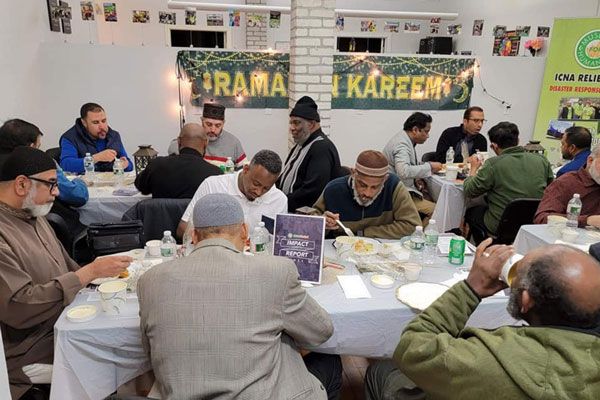
    Every family has its own Ramadan traditions, and ours revolve around the masjid. We love arriving just before Maghrib, breaking our fast in the company of others, and staying for taraweeh. Whenever there’s a qiyam program that lasts until dawn, chances are we’ll be there. You see, worshiping, praying, and eating in community has always been important to me. There is nothing like standing shoulder to shoulder with people who have all gathered for the same purpose – to worship Allah.

    Of course, food also looms large in our traditions. One of our family favorites is pitted dates stuffed with cream cheese and served with cashews and fresh fruit. It’s simple, but we look forward to it every year. In the past, we made it a point to visit different masjids around the city, exploring new cultures and cuisines while teaching my children about the diversity within our own communities. These days, the kids are older and just want to be with their friends, even if that means going to the same masjid every night.

    One thing I’ve learned about Muslims is that our physical location doesn’t change our cultural practices. No matter where we go, we bring our traditions with us. A black American Muslim home. whether in Brooklyn or Chicago, might have barbecue chicken, mac and cheese, candied yams, and greens for iftar. A Pakistani home will always have some variation of curry, roti, chai, and biryani. Our meals are just another way we stay connected to our roots.

    As a working Muslim, Ramadan comes with its own set of challenges. Regardless of where you are, colleagues will notice when you stop joining lunch runs. And, of course, there’s the universal question Muslims get every year – “Not even water?” Many people can’t grasp the idea of going without food and drink for so long, especially in the heat. I’ve learned to give a heads up before Ramadan starts, answering their questions early, because I definitely won’t be in the mood to explain when I’m running on an empty stomach.

    One of my favorite things, though, is when non-Muslim friends or coworkers show genuine curiosity and want to participate in Ramadan. Lately it’s become trendy for people to try fasting, and I’m not sure how I feel about that. However, when someone sincerely wants to experience what we do, it means a lot to me. Some have even asked to join me for iftar or attend Friday jummah prayer at the masjid. That kind of openness and respect is always welcomed.

    Ramadan in the South is special because of the diversity I’ve been blessed to grow up around; it feels like having the whole world in one city. I’ve met people from nearly every background, heard countless languages, and tasted global cuisines without even needing a passport. And the beautiful part? We’re all connected by Islam. The Prophet (peace be upon him) said in his last sermon, “Muslims constitute one brotherhood.” While not everyone gets to experience that sense of unity, I know how blessed I am to have it.
  • About Ramadan  From a Convert, With Love

    About Ramadan From a Convert, With Love

    A few years ago, I was sitting with a friend chatting just before the start of Ramadan, Islam’s holy month of fasting. Just as I was about to launch into what I would be preparing for suhoor, the pre-dawn meal, and for iftar when we break our fast in the evening, my friend, a born Muslim, said something very unexpected about the coming fast.

    “I’m dreading it.”

    I remember being a little thrown by her comment, then immediately confused and, ultimately, a bit sad. However, I didn’t make a harsh judgment about her; instead, I listened to how she felt, particularly about her experience fasting as a young mother of two small boys and considering the challenges she faced fighting fatigue while minding and keeping up with her very energetic sons.

    I also empathized with her. After all, at the time all three of my children were in school, and I worried how their grades would fare as they struggled through hunger, thirst, the occasional headache, and with simply being tired. In other words, we may all have some small sense of dread as we enter into a month that – let’s face it – shifts much of our schedule and can leave us feeling unmoored from our normal day-to-day lives as we navigate extra-early mornings, busy afternoons preparing food, and evenings spent eating and then rushing to the mosque for taraweeh evening prayers.

    All of our challenges in Ramadan are, of course, meant to be taken as blessings, and I believe most Muslims see them this way and offer thanks and praises to Allah (SWT) for every day we overcome hardship and successfully fast from food, water, and intimate relations for the primary purpose of living in obedience to Allah (SWT) and striving to be in a state of taqwa, or God consciousness.

    As Allah said in the Quran, “Believers are enjoined to fast, as were those before them, to become God-fearing.” (2:183)

    Since that conversation, I’ve often recalled my friend’s comment and, even though it demonstrated her negative mindset as she headed into Ramadan, nevertheless it’s helped me to remember how monumental the act of fasting during Ramadan is, a thought I’ve had numerous times since my conversion nearly 20 years ago, praise God!

    While I certainly recognize there are scores of born Muslims who deeply understand and appreciate the significance of fasting in Ramadan and what it means for our faith as well as feel deeply connected to the practice – it is, after all, one of the five pillars of Islam – let me explain what I, a convert, mean when I describe it as monumental.

    Like many converts, when I first learned what Ramadan is and how it’s practiced, I was astounded. I couldn’t believe anyone would voluntarily deny themselves food and water all day for an entire month! After all, I didn’t grow up seeing any of my family, friends, or community members fasting in any form or fashion. Even those of us who grew up in or were familiar with the Catholic faith have seen the 40-day Lenten season watered down from a fast similar to that of Muslims’ to most of the religion’s followers only abstaining from one type of food or activity during Lent. What’s more, others only forgo meat on Fridays. In other words, I’m not sure many born Muslims can truly understand how much of a shift it is for a convert to fast in Ramadan when most of us had no concept or example of it growing up.
    However, I don’t point this out to toot my own horn – I’m not – or to imply the fasts of converts are more difficult – they’re not; I say this to impress on my born Muslim brothers and sisters the absolute gratefulness I feel that Ramadan is such an important part of Islam. Because, trust me, if fasting weren’t part and parcel of our faith, I guarantee I wouldn’t do it, and I would surely be the loser as a result.

    What’s more, when I think of all the spiritual benefits and blessings of fasting, it fills my heart with even more love for my adopted faith.  Consider what Allah’s Messenger (peace be upon him) said. “Verily, there is a gate in paradise called al-Rayyan, through which only those who fasted will enter on the Day of Resurrection. No one else will enter it along with them. It will be said: Where are those who fasted? They will stand and no one will enter it along with them. When they enter it, it will be closed and no one else will go through it. (Sahih al-Bukhari 1896)

    This hadith describes for us Muslims the special standing those of us who fast will have when we meet our Lord. Our acts us discipline, self-control, and restraint, undertaken for the primary purpose of obedience to Allah (SWT) and to grow in piety and consciousness of Him, are ones I fear I surely would not have undertaken without the beautiful pillar of fasting.

    I am forever tremendously thankful fasting has been prescribed for us Muslims as it was for those of other Abrahamic faiths before us, and I pray that I and all Muslims will embrace this commandment and appreciate it for the profound mercy that it is.

    And as for my friend who suffered a moment of human weakness heading into Ramadan all those years ago, I pray she walks into this next Ramadan with excited anticipation and never again feels a moment of dread for this most sacred and holy month that we all hope to experience again and again, God willing.

  • Ramadan, A Multicultural Experience in America

    Ramadan, A Multicultural Experience in America

    Multiculturalism has been a topic of discussion in North America since at least the 1930s. America embraced the idea of a melting pot, with minorities maintaining their languages and cultural traditions to more or less extent while still assimilating into the larger American ethos. In the late 1970s, Canada switched to the salad bowl metaphor — keeping the uniqueness intact, even if it created ethnic pockets which were not integrated at all. According to ThoughtCo, “Multicultural societies are characterized by people of different races, ethnicities, and nationalities living together in the same community. In multicultural communities, people retain, pass down, celebrate, and share their unique cultural ways of life, languages, art, traditions, and behaviors.” Both the U.S. and Canada, while having made positive strides, have a long way to go in honoring and fully embracing the multitudes of cultures that thrive within their borders, and treating all minorities as equal members of society, particularly when it comes to indigenous peoples who lag behind in acceptance.

    Islam, at its founding, was an example of diversity and over time grew into a multicultural empire the likes of which the world had never seen. Various dynasties of non-Arabs ruled, and even today, the largest populations of Muslims are found outside Arab countries. Islam is unique today for the many cultures represented in the 50 Muslim-majority countries, but also by the presence of Muslims in virtually every country in the world, sharing and spreading their one commonality — faith. With the much-anticipated month of Ramadan here once again, that multiculturalism which flourishes within the faith, is on full display.

    The Qur’an was first revealed to Prophet Muhammad (s) in Ramadan in 610 CE, and its recitation during taraweeh prayers and at home during the 30 days is central to fully participating in the holy month. There are general rituals that all Muslim cultures practice. Each day of Ramadan begins with waking up to eat suhoor before praying fajr. Then Muslims fast during the day and break the fast at Maghrib. Many then pray taraweeh at their local masjid. The aim of this holy month of Ramadan is an increase in prayers, recitation of the Qur’an, a deeper reflection on one’s life, and strengthening the relationship with Allah. The religious rituals bond Muslims in a shared and profoundly meaningful experience.

    It is easy to forget that Islam came to North America long before the formation of the United States and Canada. What is left of these first Muslim footprints are found in letters, oral stories, and books in libraries and museums. In the 1500s, explorer Mustafa Zemmouri traveled the Gulf Coast, Florida, and New Mexico. Enslaved men like Omar ibn Sayyid, Ayuba Sulieman Diallo, Bilali Mohammad, and Salih Bilali all wrote letters in Arabic with those back home or to other slaves. Yusuf Ben Ali, Salem Poor, Joseph Saba, Bampett Muhammad, and Peter Salem fought in the Revolutionary War. Those first Muslims recited Qur’an and prayed their five prayers as best they could under the harsh conditions of antebellum slavery. They prepared the sahoors and iftars for their families based on their own cultural upbringing from back home. African American Muslims today have found their own way to Islam and have created their own traditions.

    Ramadan Traditions Around the World

    Each culture in Muslim-dominant countries has their own special way of observing Ramadan with particular foods, décor, and even clothing. These traditions have traveled abroad to Western countries with those who have immigrated and have been sewn into the cultural fabric, especially in the United States and Canada which have large populations of Muslims from around the world. Masajid hold taraweeh prayers where a Senegalese individual may pray next to a convert or a Lebanese next to an Indian. Potluck iftars may serve basi-salte, roasted lamb leg, samosas, and stuffed grape leaves. With bi-cultural marriages, families can share Ramadan within the home by blending traditions or even creating new ones.

    Muslim immigrants can be found living in nations around the world and engage in rituals and traditions during Ramadan rooted in their location. In Java, Indonesia, for example, Muslims soak their bodies in springs or other fresh bodies of water the day before Ramadan begins. Padusan (to bathe) is a cultural adaptation in Indonesia. In the UAE, children chant for sweets in Sha’ban, two weeks before Ramadan begins. Their translated chant is, “Give to us and Allah will reward you, and help you visit Makkah.” And in South Africa, the maan kykers (moon watchers) travel to Three Anchor Bay in Cape Town to physically observe the new moon’s birth and announce the start of Ramadan.

    The Musaharati beat drums and chant to wake residents up for suhoor in Saudi Arabia. Drumming is also used in Turkey for the same reason and the drummers wear traditional Ottoman dress. Residents peek out of windows as they pass by. There are over 2000 drummers in Turkey who uphold this tradition. In Morocco, the nafars wake townspeople up, chanting prayers, while Lebanon and the UAE shoot cannons each day to let everyone know it is time to break their fast. Egyptians put out fanous (lanterns) in kaleidoscopic colors. Children wander the streets carrying the lanterns as they ask for sweets and small gifts.

    Ramadan is a blessed month for many reasons. In Western multicultural Muslim communities, we have the opportunity to practice our own traditions and also to experience the traditions of other cultures. This occasion to share and learn from other cultures can enrich us. As it says in the Holy Qur’an, “O humanity! Indeed, We created you from a male and a female, and made you into nations and tribes so that you may know one another. Verily the most honored of you in the sight of Allah is the most righteous among you. Indeed, Allah is the All-Knower, All-Aware” (Qur’an 49:13). If that spirit of Islam is allowed to envelope us and enter our minds and, especially, our hearts, we can heal the racial and ethnic rifts within our communities. That is the only way to represent the profound beauty of diversity in our everyday living and through our interactions with family, friends, neighbors, and strangers. Ramadan is the perfect time to explore these possibilities.