
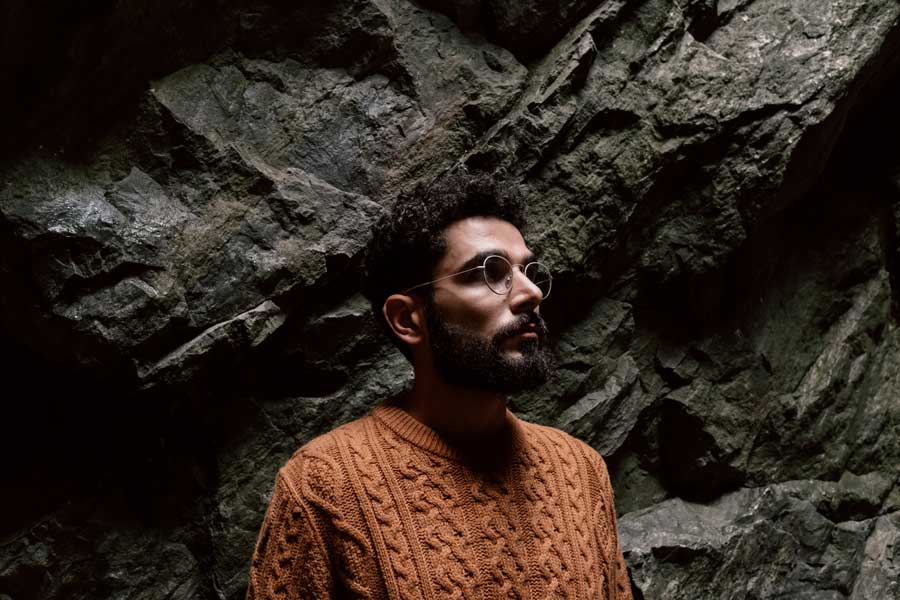
The world is a prison, and we are the prisoners: Dig a hole in the prison and let yourself out! – Rumi
Caves are hollowed portions of the earth that evolve over time, providing shelter within their underground or elevated spaces and offering protection from the elements. In Islamic texts, the cave offers a transformative potential, a place for muraqabah (meditation), dhikr (remembrance), and fikr (contemplation) – all practices that serve to draw a believer closer to their Lord. An important side note is that Islamic meditation always has the intent of deepening the connection to Allah SWT; whereas Western meditation can have various intentions, some of which have nothing to do with spiritual or religious objectives. Moreover, muraqabah, often translated as “meditation” as that might be the closest word in English, is more aptly described as a kind of watchfulness or mindfulness, that is, a vigilance about one’s thoughts, intentions, emotions, words, and actions. It is a form of self-awareness that can be practiced in solitude; it can also be practiced throughout one’s daily life as it is a striving to keep Allah’s presence uppermost in one’s awareness.
There are several instances mentioned in the Qur’an, the ahadith, and in the seerah, in which people, including the Prophet, himself, found themselves secluded in a cave. On every occasion, the cave provided the isolation its occupant needed to deepen or restore his faith and continue fulfilling his purpose.
The story of Islam as we know it began in a cave. When Muhammad ibn Abdullah ibn Abdul-Muttalib, peace be upon him, reached the age of forty, he regularly retreated to a cave called Hira on the Mountain of Light, Jabal al-Nour, on the outskirts of Mecca. He would spend his time there in reflection. His later wife, Aisha, may Allah be pleased with her, said that the love of seclusion was bestowed on his heart at the time. She narrated, “He used to go in seclusion in the cave of Hira where he used to worship continuously for many days… until suddenly the truth descended upon him while he was in the cave of Hira” (Sahih Bukhari).
Indeed, for Muslims, withdrawing from the commotion of everyday life to find solitude somewhere, or even just immersing oneself in nature, to reflect on the creation, is a means to connect with the Creator. Taking time to engage in periods of isolation and contemplation can reveal the trivialities of this world and the vastness of the Hereafter. Yet, as part of striving to achieve the goal of ihsan, or excellence in worship, a person must find a place where he or she can be alone and seek Allah’s guidance. The Prophet (s) found the perfect setting in the cave.
Prophet Muhammad (s) said, “Those in solitude have raced ahead, who are absorbed in the remembrance of Allah. Remembrance has lifted their burdens and they will come on the Day of Resurrection weightless” (Sunan al-Tirmidhi). In the Qur’an, it is mentioned that the hearts of human beings find rest in the remembrance of Allah (13:28). This can take many forms like prayer, supplication, reading the Qur’an, uttering phrases of praise, or reciting the Asma ul-Husna, the beautiful Names and Attributes of Allah. In a similar hadith, a man went to the Prophet (s) and said, “Which of the people is best?” He said, “A man who strives in jihad for the sake of Allah with his wealth and his self.” Upon hearing this, the man asked, “Then who?” The Prophet responded, “A believer in a mountain pass who worships Allah and leaves the people alone” (Sahih Muslim).
In his explanation of this hadith, Imam Al-Nawawi said, “This does not mean the mountain pass itself, rather what it is referred to is being alone and isolating oneself. A mountain pass is mentioned as a metaphor because it is usually devoid of people” (Sharh Saheeh Muslim, 13/34 – Al-Munajjid). Like a cave, a pass between a mountain is a place carved out in the earth where a person can wander alone and reflect on life and on his own self. Interestingly, Al-Haafiz ibn Hajar al-Asqalani said that this report indicates that isolation is preferable in the case of one who fears for his religious commitment (Al-Fath, 13/42 – Al-Munajjid). Such was the case of the youth of the cave mentioned in the Qur’an.
The Shelter and Seclusion of a Cave
Caves are a recurring theme in Islamic literature, and they serve many purposes. The eighteenth chapter of the Qur’an bears its name, Surah al-Kahf, the Chapter of the Cave. The Arabic word kahf is specific to Surah al-Kahf, only appearing six times in the entire Qur’an solely in this chapter. According to the Saheeh International English translation of the meaning of the Qur’an, however, the word “cave” is mentioned eight times, six of those occasions being in Surah Al-Kahf, while the other two verses that mention a cave occur in the ninth chapter, Surah Al-Tawbah, but a synonym is used. In that Arabic text, instead of the word “kahf,” Allah uses al ghar and its plural, maghaaratin. These two words refer to a small cave, cave entrance, grotto, or even a man-made cave. Curiously, the verses that speak about a cave in Surah al-Tawbah refer to instances during the lifetime of Prophet Muhammad (s), while the cave mentioned in Surah Al-Kahf refers to an event that happened before.
Surah Al-Kahf was revealed during the Meccan period of the Qur’an revelation – between the 8th and 10th year of prophethood. It opens in the same manner as the first chapter of the Qur’an, Surah Al-Fatihah, with the words Alhamdulillah, all praise is to Allah. Interestingly, Surah al-Kahf is the heart of the Qur’an, it is in the very center of the book. Whether the reader opens to the beginning chapter or the middle chapter of the Qur’an, they will begin by reciting God’s praises. The whole of Surah al-Kahf contains important reflections about how to overcome different trials in the worldly life and the rewards for those who are mindful of Allah. The story of the youth of the cave, however, is an example of how believers can seek protection from corruption, in solitude.
The cave provides shelter and seclusion that the worshipper seeks in efforts to gain closeness to the Divine. Surah al-Kahf holds a lofty status, not only serving at the time of its revelation as evidence of the prophethood of Muhammad (s) but also providing timeless lessons and protection for its reciters. The Prophet (s) said, “Whoever recites Surat al-Kahf on Friday, a light will shine for him between this Friday and the next” (Al-Sunan al-Kubra lil-Bayhaqi, 5996). Similarly, he said, “Whoever memorizes ten verses from the beginning of Surat al-Kahf will be immune to the False Messiah.” In another narration, he said, “…from the last ten verses of Surat al-Kahf” (Sahih Muslim, 809).
Allah says in the ninth through tenth verses of Surah al-Kahf: “… Have you thought that the companions of the cave and the inscription were, among Our signs, a wonder? — when the youths retreated to the cave and said, ‘Our Lord, grant us from Yourself mercy and prepare for us from our affair right guidance’” (Qur’an 18:9-10).
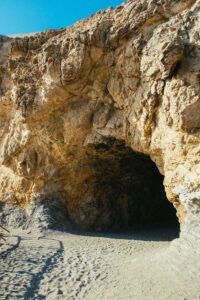
The “companions of the cave” were a group of young men who were believers in monotheism who lived among a polytheist society. The “inscription” was a plaque at the entrance to the cave, placed at some historical point, and told the story of these youth. The surah goes on to explain that they were fleeing persecution and thus they sought refuge in a cave. There were two actions that the youth took to change their situation – the first was to remove themselves from the threat to their faith and the second was to pray. There was a physical and spiritual effort to connect with their Lord and the cave provided the sanctuary they needed to protect their spiritual and religious devotion.
In the case of the youth, they were living in a society that was devoid of faith in the One God and that oppressed those who sought to connect with their Divine purpose. Continuing to stay in that land was guaranteed destruction. Allah mentions in the Qur’an that a person who is unable to practice their religion freely should find a way to leave. He says, “Indeed, those whom the angels take [in death] while wronging themselves — [the angels] will say, ‘In what [condition] were you?’ They will say, ‘We were oppressed in the land.’ The angels will say, ‘Was not the earth of Allah spacious for you to emigrate therein?’ For those, their refuge is Hell, and evil it is as a destination” (Qur’an 4:97). The cave served as the first step towards migration for the sake of Allah – to cultivate and maintain their faith.
Like the youth who sought refuge in a cave, Prophet Muhammad (s) was disturbed by the ignorance and corruption of his time. The Cave of Hira served as a place of solitude and contemplation for the Prophet (s) prior to prophethood. On another occasion, a different cave served as a place of refuge when he and Abu Bakr as-Siddique, may Allah be pleased with him, fled Mecca due to the persecution by the Quraish polytheists. Allah mentioned this story in the Qur’an: “If you do not aid him [the Prophet], Allah has already aided him when those who disbelieved had driven him out [of Mecca] as one of two [the Prophet and Abu Bakr], when they were in the cave and he [Muhammad] said to his companion, ‘Do not grieve; indeed, Allah is with us.’ And Allah sent down His tranquility upon him and supported him with forces you did not see and made the word of those who disbelieved the lowest, while the word of Allah, that is the highest. And Allah is Exalted in Might and Wise” (Quran 9:40).
Remarkably, this is one of the two other verses in the Quran that speak about a cave, using a synonym. The cave that housed the Prophet (s) and Abu Bakr, may Allah be pleased with him, is called “Ghar Thawr” located on Jabal Thawr, located in the southern part of Mecca. Ghar Thawr is a small cave they had to crawl into, unlike the cave mentioned in Surah al-Kahf that was able to house the youth and their dog. Both caves served the purpose of providing a hiding place and shelter, as well as having a miraculous outcome – being used to save their inhabitants from persecution and death. They also served as the haven in which its inhabitants deepened their tawakkul, trust and reliance on Allah.
In contrast, the word cave in its plural form is mentioned later in the same Surah at-Tawba, where Allah says, “If they [the disbelievers, Quraish] could find a refuge or some caves or any place to enter, they would turn to it, and they run heedlessly” (Qur’an 9:57). In this verse, Allah mentions a hypothetical situation in which disbelievers, in a desperate attempt to avoid Divine wrath, would try to hide anywhere, even attempting to crawl into a cave. However, Allah does not provide them with this protection, nor a hiding place, and much less a miracle. This should be taken as a warning that the cave is only a place for solitude, for refuge, and/or for transformation for those who seek to purify their own souls and pray for assistance from the Almighty alone, and with utmost sincerity.
Human beings who live in modern cities may have to find solace and seclusion as best they can in their own surroundings. A mosque, a hiking trail, or a room in a house can take the place of the cave as the location of introspection and enlightenment. It is a matter of attempting to temporarily abandon worldly affairs and concentrate completely on connecting to the Divine with a sincere heart. Perhaps through this practice, a person may be able to see the world more clearly and concentrate completely on his or her purpose.