
بسم الله الرحمن الرحيم

Tag: Pandemic

  • ICNA Relief: Serving During the Pandemic

    ICNA Relief: Serving During the Pandemic

    Through its numerous programs and services, ICNA Relief provides relief services for the larger American community and assists in the betterment and empowerment of people across the country. This year, in particular, such relief was especially important in light of the challenges, marked overwhelmingly by the COVID-19 pandemic. In spite of lockdowns and social distancing, COVID-19 brought people together, ultimately strengthening the bonds of humanity.

    Producing Masks for Hospitals, Medical Offices, and the Elderly

    Early during the pandemic, there was a shortage of PPE (personal protective equipment) everywhere. With unanswered questions about the airborne transmission of the virus, everyone needed masks and healthcare workers were reusing their PPEs. The shortage led the CDC to announce mid-March, “In settings where facemasks are not available, HCP [health care providers] might use homemade masks for care of patients with COVID-19 as a last resort.”

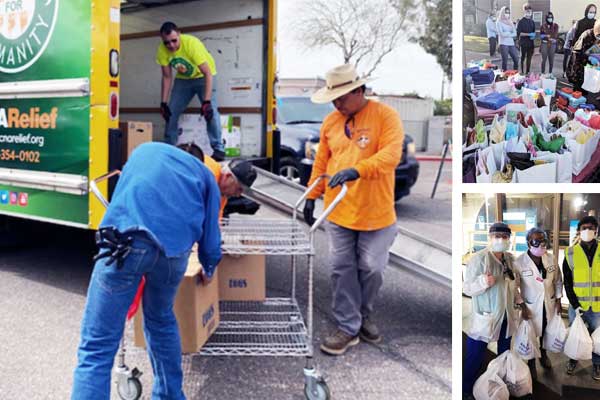
    ICNA Relief responded to this need. They operate 23 transitional homes across the country and their Dallas facility has an empowerment center, equipped with computers and sewing machines, to encourage residents to develop their skills and have a safe space for growth. The residents of this home who have sewing abilities took action. They joined with community members and volunteers such as Reem, a Syrian refugee who is a fashion designer who creates stunning bridalwear for a Texas boutique. They were not able to find the fabric and elastic needed to make masks due to the pandemic causing many shortages as well as many stores being closed due to the lockdown. The group, however, kept faith and instead bought high quality bed sheets, and ribbon instead of elastic, and created the bended nose section with pipe cleaners from the children’s craft section. Reem taught the volunteers and residents how to cut and sew the masks.

    The volunteers then announced their project on social media and news of their work traveled quickly. They started to receive multiple calls from medical offices and hospitals. A local community member also requested masks for elderly individuals in their community who didn’t already have them. Congresswoman Eddie Bernice Johnson heard of the initiative and asked for masks for her office and staff as well. She even sent a beautiful thank you letter to the ICNA Relief DFW office. Sheikh Omar Suleiman helped deliver masks to Parkland Hospital. This project gained much traction and many people donated to this particular project while others donated to the transitional home.

    Providing Relief for Native Americans

    The work of ICNA Relief during the pandemic also reached the various Native American tribes who live in Arizona. COVID-19 has caused enormous food shortages at Arizona food banks. This is a dire problem across the “food desert” areas of the Arizona Native American population, especially the Navajo Nation. As the virus spread, the Navajo Nation became the epicenter of the disease in that state as the number of cases increased. ICNA Relief was able to create accessible food pantries and deliver food boxes to these tribes. They spent over $30,000 to gather essential food items such as rice, flour, oils, pasta, pasta sauce, baking powder, salt, and more. A Facebook fundraiser for water raised about $2,800, allowing them to distribute about 15 pallets, 4,050 gallons, of water to the underserved tribes. With relief needs like these, in-kind donations of resources are tremendously helpful. ICNA Relief thanks Mohammad Elengery and his wife Yomnna for lending their 54 ft. eighteen-wheeler for the large shipments. Without this resource, ICNA Relief would have spent considerable funds renting a vehicle large enough to deliver such large amounts of food and water.

    Volunteers also conducted a distribution in Arizona’s White Mountains for over 173 families. These families received survival essentials and perishables like bread and fresh vegetables and fruit. There were other distributions in Yuma City to the Cocopah and Quechan tribes. Some of these distributions also included dairy products. ICNA Relief also assisted the Hualapai tribe in Valentine, Arizona and provided relief boxes for around 100 families. The vice mayor in Tempe, Arizona, Lauren Kuby, has been an avid supporter of ICNA Relief’s initiatives in these communities, even making her own Facebook fundraisers to help with funding for gas for transportation and for hygiene items for those in need. The local leadership such as the Cocopah tribal council member, Rosa Long, Quechan tribal council member, Charles R. Escalanti, and Anthony Allison from the Navajo Nation, along with Kyle Jim (a member of the Diné clan), and his sister, Bree Lameman, acted as COVID-19 relief coordinators, and they made all of these travels for distribution of relief possible.

    Combatting Misinformation About COVID

    ICNA Relief also worked extremely hard to combat the deluge of misinformation that coincided with the increased spreading of the coronavirus in order to best support and protect communities across the country. As a non-profit committed to serving diverse communities, ICNA Relief has produced informational pamphlets in multiple languages, containing health and safety guidelines from the CDC (Centers for Disease Control and Prevention). Early on, before the shelter-in-place order, these pamphlets were distributed in local mosques and community centers.

    Helplines and Telemedicine Services

    ICNA Relief quickly saw the need of being a voice of comfort and guidance and created the ICNA Relief National Helpline. The helpline offers support in multiple languages including English, Spanish, Urdu/Hindi, Arabic, and Bangla. This enables new immigrants, refugees, and elderly non-English speaking individuals to navigate this pandemic, being able to inquire about financial assistance, unemployment, and insurance.

    ICNA Relief Health Services also deployed a telemedicine line so that individuals can speak with a nurse or doctor to see if their symptoms require an ER visit or if they should just quarantine while monitoring their symptoms. ICNA Relief was thus able to lessen the burden on both emergency rooms and hospital personnel.

    This pandemic comes with a surge in the need for psychological support as well. The health services team has provided therapy by phone in a number of states. ICNA Relief has free health clinics in seven cities including Mount Pleasant, SC; Anaheim, CA; Athens and Duluth, GA; Philadelphia, PA; Oklahoma City, OK; and Dallas, TX. Tele-therapy allows the clients who come to the clinics to continue their mental health treatment and support through counseling sessions over the phone.

    An Overview of Services Provided

    Many of the ICNA Relief branches have also distributed hot meals to ER doctors and nurses. In New York City, ICNA Relief collaborated with the Latino Muslims of New York to deliver hot meals to Montefiore Hospital in the Bronx and Mount Sinai Hospital in Queens. In Atlanta, GA, volunteers delivered more than 250 hot meals to Emory Johns Creek Hospital, and in Sacramento, CA the team delivered to Methodist Hospital.

    In total, ICNA Relief, alhamdulillah, has served 885,828 individuals and 183,154 families nationwide through all its branches. Of these numbers, 357,841 children were served, as well as 51,026 elderly individuals. ICNA Relief distributed 239,204 food boxes and 104,609 hot meals. Overall, they delivered a massive amount, 9.6 million pounds, of food and groceries to those in need – a value of almost $12 million.

    ICNA Relief’s telehealth services have also been widely utilized. The ICNA Relief Helpline was able to help 148 clients, and the ICNA Relief telehealth services provided a value of about $91,000 worth of services and about $200,000 worth of counseling and educational services during this past year. ICNA Relief was also able to distribute 11,636 hygiene kits nationwide at a value of about $93,000. During Ramadan ICNA Relief distributed over 13,000 food boxes, about 47,000 iftar meals, and about 3,400 toys across the country. Overall, ICNA Relief was able to aid and care for 127,590 individuals in Ramadan alone.

    ICNA Relief cannot do this work without the help of our treasured volunteers. In our efforts to alleviate the shortages and suffering in the larger American community, 7,779 volunteers joined ICNA Relief and put in about 38,895 hours. This year, 2020, is by no means a usual year for Americans or for people around the world. Alhamdulillah, in the spirit of care and generosity, however, a spirit which we emulate from the example of Prophet Muhammad (s), ICNA Relief is confident that together we can keep the bonds of community, cooperation, and service strong, as we navigate these difficult times. To help with this important work, please visit https://www.icnarelief.org/.
  • Coping with the Pandemic and Opportunities for Good

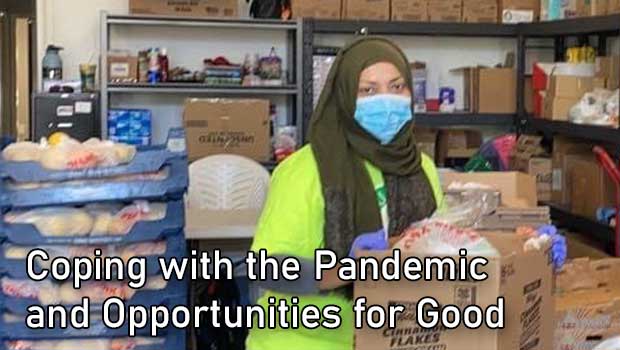
    Coping with the Pandemic and Opportunities for Good

    It has been around seven months since the World Health Organization declared the novel coronavirus disease, COVID-19, a worldwide pandemic. Sickness and the rising mortalities have devastated communities all over the world, and while we mourn the loss of every soul, a believer should always step back and try to see the power of God amidst the weakness of Bani Adam, and the wisdom of the Creator amidst the chaos of world circumstances.

    In a world of ever-increasing conflict and a secular disposition, it behooves our leaders to recognize that, in fact, ultimately, they are in control of nothing, and God truly has power over all things. While it is not correct to dogmatically say that the virus is a punishment from God, as no one knows God’s plan and wisdom, God says in the Qur’an that “…no one knows the soldiers of God except Him…” (74:31). If this is mankind being subdued through the smallest of creation, what then if God wanted to rein Bani Adam in with natural forces of nature, as He did with the people of ‘Aad, Thamud, and Lut? We ask Allah for the ability to see things the way they really are, and seek safety and refuge in Him, from our own shortsightedness and wrongdoing.

    Trusting vs Testing God

    Much of the grief and psycho-spiritual toll taken on the Ummah the last few months has been in seeing their community events cancelled, their mosques closed down, and even the most sacred mosque of all, the Kaaba, with its most sacred ritual, the hajj, closed to all but the locals of the region. One might feel a pious, visceral protest and impulse of objection to this. Who are they to close these sacred avenues? Should we not trust that God will protect us? We should, but there is a difference between tawakkul and tawaakul. Tawakkul is a dual act, trusting in God in one’s heart, while taking the appropriate means to achieve an end with one’s actions and/or resources. When asked if people should just trust in God and leave their camels to roam without being tied, the Prophet (S) said “Tie them, while putting your trust in God” (Tirmidhi). But tawaakul (note the slight phonetic difference) is essentially testing, not trusting God. It is also a dual act, but in the sense of neglecting the means that God provided you with, while expecting he will provide you with an outcome you want. This is a false sense of piety and a superficial demonstration of trust in God. God is not subject to anyone’s expectations, and throughout the Qur’an, He shows that trust and action must be put together.

    When Musa (AS) was cornered by Pharaoh’s army at the Red Sea, he trusted in God, saying “Truly my Lord is with me, and He will guide me” (Qur’an 26:62).Then God commanded him to take an action through which help and protection would come to him: “Then We revealed to Musa, ‘strike the sea with your staff…’”(Qur’an 26:63). If we look at our contemporary circumstances, with CDC recommendations like masks, physical distancing, temporary closures of events and gatherings including religious ones,we can see that these are all the means God has given us to protect ourselves from this virus. Doing so is a sign of understanding Islam and trusting in the Creator, rather than a lack of faith. To understand the significance of taking precautions in order to save lives, God tells us in the Qur’an, “…and if anyone saved a life, it would be as if he saved the life of the whole people…” (Qur’an 5:32).

    Once Umar (R), while the second caliph of Islam, led an expedition from Medina toward Syria and enroute, at a place called Sargh, he was informed of a plague that had broken out in Syria. After consulting with his companions, he decided to turn back, but was met with resistance from Abu Ubayda, a companion of the Prophet (S), who asked him, “Is this an attempt to flee from the decree of God?” Umar (R) responded, “We are fleeing from the decree of God to the decree of God.” Thus, Umar (R) is seen here taking precaution in staying away from the plague but also understanding that God’s decree is inescapable no matter what. This is the true application of tawakkul, and the kind of practical and theological balance the believer should apply to this pandemic as well.

    The Prophet (S) gave us advice on physical distancing to avoid transmission of sickness when he instructed that healthy animals should not be watered with sick animals (Musnad ibn Hanbal), and the one in a place of plague should not leave it, nor should anyone enter it (Bukhari). Thus, taking precautions and the means to preserve our health is from the sunnah of our very own Prophet (S).

    Anxiety and Uncertainty

    Along with the pandemic have come many questions and concerns that have understandably caused much anxiety and stress in people’s lives. But perhaps a good way to help us cope is taking the above statement of Umar (R) as a kind of psychological mindset, or perhaps a spiritual “heart-set”… that we are fleeing from God’s decree to God’s decree. We don’t know what the future holds for us, but we do know that God says in the Qur’an,“Say, nothing will ever afflict us, except what God has already decreed for us” (Qur’an 9:51).If we took every precaution in the world to protect ourselves from any sickness, and God had decreed it for us, we would get it. And if everyone in the world was sick with a virus, and God decreed us not to get it, it would not happen. The pens have been lifted, and the pages of destiny have dried, as the Prophet (S) teaches us (Tirmidhi). Not having a firm belief and understanding of this in one’s heart leads to constant imagining of “what if” scenarios that are the seeds of anxiety and distress. In fact, the Prophet (S) told us that just saying “what if” opens a door for Shaytan into your heart (Muslim).

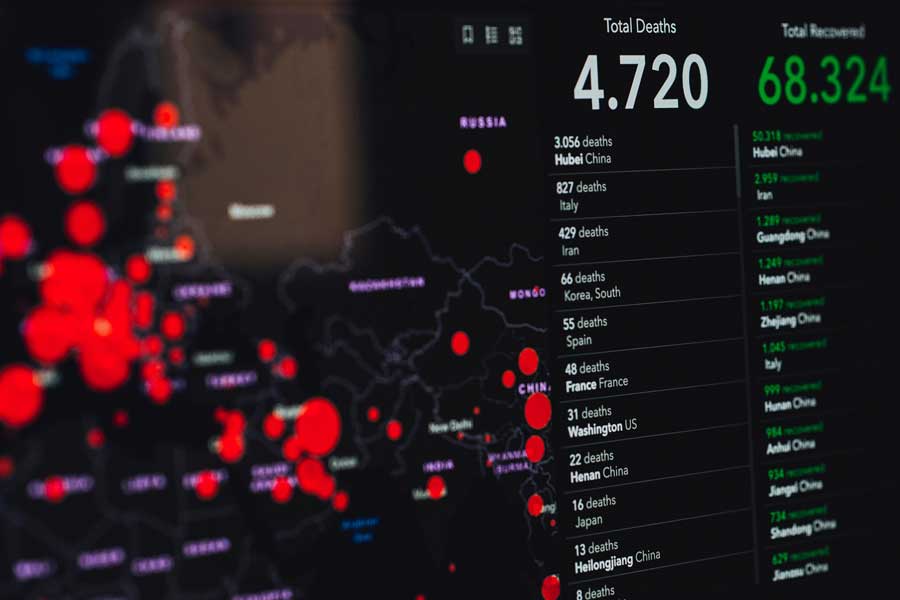
    Endless death count trackers on TV and over-politicized news coverage both from the right and the left, however, exacerbates our anxiety. Perhaps we also need a quarantine from news and informational outlets that use fear and speculation to glue viewers to their 24/7 coverage. Social media can have the same effect. It’s important to remember that what we look at and listen to is a form of consumption that can have an effect on our souls the same way food consumption has an effect on our bodies.

    It’s also important to be optimistic. The Prophet (S) said that “God has never sent down a disease, except that He also sent down it’s cure” (Musnad ibn Hanbal). Ibn Qayyim notes that this hadith can be applied to both the spiritual and physical worlds. Many potential vaccines are already in the final stages of testing, and we are learning more about the virus as every day goes by. Regardless, when a vaccine does arrive, we still maintain our faith that while the virus causes harm and the vaccine might prevent the illness and curb the spread of the virus , all is in the decree and power of God.

    We also should remember that the Prophet (S) said that no Muslim is afflicted with any harm, even if it were the prick of a thorn, but that God expiates his sins because of that, as a tree sheds its leaves. And God willing, believers who die as a result of the virus will be counted among the martyrs. Thus, even in adversity, a believer finds spiritual comfort to manage his/her anxiety.

    Opportunities for Good

    The stress has not been only spiritual and mental. The sharia sees the preservation of wealth— generating, guarding, and distributing of it — as higher objectives in the religion. And during this pandemic, many have experienced a financial disaster. Thus, this is a golden opportunity to do good. There are many people who have lost their jobs, and families who are in need of financial assistance. These are people we should seek out, so they don’t seek us out, being forced to ask. The best charity is that which is done in the greatest time of need, and in a most discrete and humble of ways.

    This is also an opportunity for one’s spiritual growth. While monasticism is not everre commended in Islam, there is a very strong tradition of khalwa (seclusion) and ‘itikaaf (retreat) for spiritual development. This is the perfect opportunity to read more Qur’an and to gain more knowledge of the Seerah of the Prophet (S). One should keep in mind that it was during the retreat and seclusion periods of meditation that the Angel Jibreel (AS) came to the Prophet (S) with the first revelation. It was in these early periods of rapid spiritual growth that the Prophet (S) was ordered to engage in tabattul (73:8), or the cutting oneself off from everything that is a distraction from God. Ibn Qayyim mentions this tabattul in his Madaarij as-Saalikeen (Stations of the Seekers) as one of the levels a believer must traverse to truly know God. Thus, instead of seeing opportunities taken away from us because of the virus, we can see this as an opportunity to facilitator spiritual growth by cutting off from things that would normally distract us from Him. Ibn Ata Allah mentions in his Hikam, “It may be that God is giving you something, and by it He is holding you back. And perhaps God is taking something away from you, and by it He is giving you.”

    Physical Distancing with Social Connectedness

    While it is good to use our time for personal seclusion and spiritual growth, we cannot escape our nature as human beings, as we are social creatures, in need of one another for comfort, cooperation, and mutual emotional and other support. One of the roots of the Arabic word insaan (human) is uns, which means intimacy. When Ibrahim left his family in the barren desert of Becca (now Mecca), he turned to prayer, asking that God make people’s hearts incline toward his family (Qur’an 14:37). This is such a fundamental human need and it was the first thing Prophet Ibrahim asked for in that situation. This internal inclination we have towards one another is a part of our spiritual health as well, and must be preserved in the best way we can during this time of pandemic, whether it be through picking up the phone, dialing into a zoom conference, or finding a way to safely gather in an open outdoor venue.

    While many masaajid remained closed, we can take to heart the advice that God gave to Musa (Qur’an 10:87), to make our homes places of worship, and establish the prayer. The Prophet (S), in fact, said that the whole earth has been made a masjid for him, and by extension, for his community. Thus, there is no excuse for a believer to miss any prayer. While we stay physically distanced from others, we should make our homes spiritually imbued with the reading and recitation of Qur’an and the teachings of our Prophet, in every way possible, making our homes abodes of tranquility.

  • The Coronavirus Beyond the Fiqhi Discourse

    The Coronavirus Beyond the Fiqhi Discourse

    All praises are for Allah, The Almighty, and may His peace and blessing be upon His true servant and final Messenger Muhammad, his Companions and his household.
    The world is currently facing one of the worse epidemics in modern times. The Coronavirus disease (COVID-19) was first announced the end of December in 2019. In Wuhan, the capital city of Central China’s Hubei province, a virus had emerged that has a very high mortality rate. Most people in the West didn’t pay too much attention to it, thinking it was confined to China. In fact, many people shrugged off any possibility of this virus going beyond the borders of China.

    But then came a rude awakening! Over 7,000 miles from China, every Masjid and Islamic center in the U.S. realized they were in the midst of a fiqhi quagmire a lot more intense than the sighting of the new moon at the end of the month of Ramadhan to determine Eid-ul Fitr. It is the first time the Muslim community is faced with the problem of deciding whether to pray Salaatul Jumu’ah in the Masjid or to cancel it altogether. This is not a simple decision.

    American Muslims remember that one of their most fearful periods was the months and years that followed 9/11. Despite the tremendous fears, Muslims never thought of cancelling Jumu’ah. They always found a way and continued one of the greatest symbols of Muslims coming together each week to worship Allah SWT. Masjids did whatever it took to keep the attendees safe, from local brothers providing security to hiring police officers to keep guard; but the Salaah, and particularly Salaatul Jumu’ah, went on.

    Now things are different. COVID-19, SARS, and MERS are all Coronaviruses that cause acute respiratory syndromes. During the SARS outbreak in 2003, only eight Americans were diagnosed. And in 2014 only two Americans tested positive for MERS. But now COVID-19 has a foothold in most countries throughout the world, and as of the middle of March, there were more than 8,500 known cases reported in the U.S. This poses a problem for Muslims, as all Americans have been asked to practice social distancing, keeping at least six feet away from people and staying home as much as possible

    But while this discourse goes on in the Muslim community, there is an aspect of the epidemic that is beyond a fiqhi perspective and it is about how we process these difficult times and seek the deeper meaning about what is happening and why. After all, nothing happens except by the will of Allah SWT. As we are told in the Qur’an, “No misfortune can happen on earth or in your souls but is recorded in a decree before We bring it into existence; that is truly easy for Allah” (57:22). So, beyond the issue of Salaatul Jumu’ah, let us contemplate the reality of this challenge we are facing.

    An Epidemic Is from the Qadr of Allah SWT

    According to a Sahih Muslim hadeeth, everything that was going to happen throughout time was written down 50,000 years before the heavens and earth were created. So, when a Muslim hears of a calamity such as the Coronavirus, there should be no panic or depression. Instead, we understand first and foremost that it is from the Qadr of Allah SWT. Allah SWT says: “No disaster strikes except by permission of Allah. And whoever believes in Allah, He will guide his heart. And Allah is knowing of all things” (64:11). This is further explained in the hadith of Jabir (RA) who reported that Rasoolullah SAS said: ”No slave of Allah will truly believe until he believes in al-Qadr; its good and bad from Allah, and until he knows that what has befallen him was not going to miss him, and that what missed him was not going to befall him” (At-Tirmidhi). Muslims should not believe that everything will be good in this world; and when calamity befalls him, he must not question the Will of the Creator.

    Another famous hadith that we hear often is the one in which Ibn Abbas (RA)says: “I was riding behind the Messenger of Allah, SAS, when he said to me, ’Young man, I will teach you some words. Be mindful of Allah and he will protect you. Be mindful of Allah and you will find Him before you. If you ask, ask from Allah. If you seek help, seek help from Allah. Know that if the nations gathered together to benefit you, they will not benefit you unless Allah has decreed it for you. And if the nations gathered together to harm you, they will not harm you unless Allah has decreed it for you. The pens have been lifted and the pages have dried” (At-Tirmidhi).

    Allah SWT Is the Ultimate Power

    Every form of epidemic is from the Qudrah (Power) of Allah SWT. Viruses are microscopic pieces of genetic material He SWT uses to remind us of our weakness while showing His power. He says: “…Mankind was created weak” (4:28). And in another verse, “And none knows the forces of your Lord except Him. And it is not but a reminder to humanity” (74: 31). He SWT also tells us, “And to Allah belong the forces of the heavens and the earth. And ever is Allah Exalted in Might and Wise” (48:7). Time and time again, when mankind deviates and forgets who has the real power, He sends some calamity for humanity to reflect.

    Balancing Between Tawakkul (Trust in Allah) and Taking the Asbaab (Means)

    Islam requires from us to do two things. First, a Believer must have tawakkul, or trust in Allah SWT, that He is sufficient as our help. He SWT says: “And whoever relies upon Allah, then He is sufficient for him. Indeed, Allah will accomplish His purpose. Allah has already set for everything a measure” (65:3).

    Second, a believer must seek the means, or asbaab, whether it is by seeking protection or seeking treatment and medical intervention. Abdullah ibn Abbas reported: “Umar ibn al-Khattab (RA) went out to Syria until he arrived at Sargh. The commanders of the army, Abu ‘Ubaydah ibn al-Jarrah and his companions, met him and told him that an epidemic had befallen the land of Syria. Umar announced to the people, ’I will turn back in the morning, so you must as well.’ Abu ‘Ubaydah said, ‘Are you fleeing from the decree of Allah?’ Umar said, ’Would that another had said so, O Abu ‘Ubaydah! Yes, we are fleeing from the decree of Allah to the decree of Allah.’” Another hadeeth describes this well: “Do you not see that if you had camels descending in a valley with two fields, one of them fertile and the other barren, you would graze in the fertile field by the decree of Allah or you would graze in the barren field by the decree of Allah?” (Al-Bukhari ).

    What Are Some of the Asbaab for the Coronavirus?

    • Cleanliness is vitally important. This cannot be overemphasized. This should be the norm for Muslims at all times. Even before the appearance of the Coronavirus, there have been some unhygienic practices at the Masaajid especially during the flu months and in the month of Ramadan. Cleanliness, according to a hadith is half of faith. Allah SWT says: “Indeed, Allah loves those who are constantly repentant and loves those who purify themselves” (2:222).

    • Frequent handwashing with soap is necessary.
    • Do not shake hands or kiss others as a greeting.
    • Cough or sneeze into your elbow rather than your hands. Discard tissues immediately.
    • Stay at home except for necessary reasons such as work, food shopping, or trips to the pharmacy.
    • When you are out, keep six feet away from others.
    • Those who are sick must stay at home and contact their doctor for instructions on what to do.

    An Epidemic Can Be a Punishment from Allah SWT or a Trial in Life

    Allah SWT has prepared for those who deny Him and His Messengers punishment both in this world and the Hereafter. ”But those who strive against Our Signs, to frustrate them, for such will be a penalty, a punishment most humiliating” (34:5).

    Pharaoh called himself god and forced his people to worship him. Today, how many pharaoh-like leaders think they are unstoppable? Then comes something so minute, microscopic, among the minutest of Allah’s creation, and the entire world is impacted in every possible way, changing everyone’s life for the foreseeable future. When the Signs from Allah SWT came to Pharaoh including lice, locusts, and frogs, he was helpless. What an irony that when death approached while he was drowning, Pharaoh called upon Allah SWT for help!

    Muslims must understand that when a punishment comes, it may affect both believers and deniers of Allah SWT. Allah SWT says: “And fear a trial which affects not exclusively those of you who do wrong; and know that Allah is strict in punishment” (9:25). For believers it can be a test of faith. Trials and tribulations are part of life. Allah SWT informs us of, and warns us, that when we are afflicted, we should remember that it is ultimately He who controls all of our affairs. It is He who will provide help, as He says in the Qur’an: “Do you think that you will enter Paradise without such [trials] as came to those who passed away before you? They were afflicted with severe poverty and ailments and were so shaken that even the Messenger and those who believed along with him said, ‘When [will] the help of Allah [come]?’ Yes! Certainly, the help of Allah is near!” (2:214).

    How Should We React Spiritually When Such Calamities Appear?

    Be patient for patience in such time is very necessary.

    Allah SWT says: “We will certainly test you with some fear and hunger, and some loss of possessions and lives and crops. But give good news to the steadfast. Those who, when a calamity afflicts them, say, ’To God we belong, and to Him we will return’” (2:156-157).

    Aisha RA (the wife of the Prophet) reports that she asked Allah’s Apostle about plague, and Allah’s Apostle informed her saying, “Plague was a punishment which Allah used to send on whom He wished, but Allah made it a blessing for the believers. None [among the believers] remains patient in a land in which plague has broken out and considers that nothing will befall him except what Allah has ordained for him, but that Allah will grant him a reward similar to that of a martyr” (Al-Bukhari).
    Don’t give up on the Mercy of Allah SWT.

    Allah SWT tells us, “Say, ’O My servants who have transgressed against themselves [by sinning], do not despair of the mercy of Allah. Indeed, Allah forgives all sins. Indeed, it is He who is the Forgiving, the Merciful” (39:53). We learn from the example of Prophet Ayyub (AS). He was tested with a great illness. He lost everything — his family, wealth, and health. Yet he persevered and did not give up on the mercy of Allah SWT. Allah SWT says: “And Ayyub, when he called to his Lord, saying, ‘Adversity has afflicted me and You are the Most Merciful.’ So, We answered him and removed his affliction and We gave him his family and the like thereof along with them, as a mercy from Us and a reminder to worshippers” (21:83-84).
    Make lots of du’as.

    Du’a is the power and source of strength for the believers. Allah SWT commands by way of invitation and warning: “And your Lord says, ’Call upon Me; I will respond to you.’ Indeed, those who are too proud to worship Me will enter Hell in humiliation” (40:60). We are reminded that du’a is not always answered on our terms but by the Mercy and Wisdom of Allah SWT. Rasoolullah SAS said: “One of you may be answered so long as he is not hasty and says, ‘I made du’a but I got no response’” (Al-Bukhari, Muslim).
    Finally, Only Allah SWT Removes Calamities

    Allah SWT says, “And if Allah should touch you with adversity, there is no remover of it except Him; and if He intends for you good, then there is no repeller of His bounty. He causes it to reach whom He wills of His servants. And He is the Forgiving, the Merciful” (10:107).
    We pray that Allah SWT protect us all and save us from such calamity.