

بسم الله الرحمن الرحيم

Tag: our future

  • My Child Has Wandered off the Straight Path

    My Child Has Wandered off the Straight Path

    Editor’s note: The author of this article has chosen to write anonymously in order to protect the identity of their child.

    I’ll admit it. I used to be complacent. A decade ago, my children were young and happily attending Islamic school. They were memorizing Qur’an, socializing with other Muslim kids, willingly joining us for salat in our home and activities in the masjid. In those days when I would hear about a Muslim teen in our community who had started dressing immodestly. . . or one who had been caught with a boyfriend or girlfriend behind the school. . . or one who consistently skipped prayers . . . I thought, alhamdullilah my kids are not like that.

    If I’m being completely honest, deep down inside I also sometimes thought, What did their parents do wrong to get such a misguided child? This assumption, of course, implied that I was doing something right. That my children’s current acquiescence to the rules of their faith was my doing. That my husband and I could take all the credit for their innocence and love of Islam.

    So often in life we find that the very thing we judge others for – the thing we smugly think could never happen to us – will come back to bite us. And in my case, sadly, it did.

    My daughter wore hijab until she was seventeen. Then one day she removed it, not with hesitance or regret, but with grim determination. In retrospect, I guess I should have seen it coming. She had been dropping hints for a long time. She had cried about the tactless and hurtful comments about her Islamic dress that she’d heard from non-Muslim peers and complete strangers. She had complained numerous times about the inconvenience of wearing modest swimwear at the beach because all the material weighed her down, and she felt she looked like a “freak” amongst her bikini-clad contemporaries. She had argued countless times that Muslim men had it easy: they could blend in with Western society and wear almost anything they wanted. They usually did not face the same harassment that Muslim women did. No matter how many times I tried to explain the reasoning behind Islamic rulings, remind her of Allah’s wisdom and love, and encourage her devotion to her faith, my words increasingly fell on deaf ears.

    Still, the fact remains that I was surprised and heartbroken when my daughter decided to remove her hijab. Even more concerning, her faith started slipping away bit by bit – missed prayer by missed prayer – over the subsequent months. I tried many times to change her mind, but ultimately, I felt powerless to stop the downward spiral. At this point, my intelligent, strong-willed daughter was listening only to her peers, social media influencers, and even the books she read in school. All of these made her feel like her faith was a prison that she needed to escape.

    I was a teen once. I remember the allure of the “freedom,” “independence” and “glamor” that the world promises to individuals who follow their whims and desires. I realize that as an adult, it is far easier to embrace modesty, humility, and submission to God; but for many adolescents in the modern world, adhering to Islam can indeed feel like grasping a burning coal, as our Prophet (peace and blessings be upon him) predicted.

    Eventually, due to my daughter’s deviation from the Straight Path, I realized that my children’s guidance was not in my hands. Yes, I have a responsibility to do my best to be a good Islamic role model and teacher, but my efforts are not necessarily enough to secure my children’s hearts to Allah. Only He SWT can guide, and He is the Turner of Hearts. “Verily, you [O Muhammad] guide not whom you like, but Allah guides whom He wills. And He knows best those who are the guided” (Quran 28:56).

    I grieved privately for months. Finally, I hesitantly opened up to some close Muslim friends about my experience. I was immensely relieved when they confessed similar stories: many of them also had teens who were struggling to practice, or barely practicing, or not practicing at all. Of course, I was not happy to hear this news, but I admit it gave me some solace to know I wasn’t alone. Those parents, my friends and contemporaries, were excellent Muslims. They prayed and worshiped as a family, led a wholesome life, set a good example, and invested in Islamic schools, homeschooling, and Qur’an lessons. And yet, many of their teenagers had still drifted from their deen. It was a tragedy, yes, but clearly it wasn’t entirely the fault of us parents.

    Talking with other moms, I also realized that the Muslim community’s reaction to misguided youth is, generally, very unhelpful. The teens feel so judged and unaccepted that they stop attending Islamic events and start avoiding practicing Muslims altogether. One friend’s daughter noticed that when she stopped wearing hijab, some of the “aunties” who had known and loved her for years were suddenly cold and distant. In part, I can’t blame them. They were probably saddened to see a young woman abandon an important act of worship. Perhaps they were even worried that she would influence their daughters and encourage them to stop dressing modestly. I don’t entirely fault them, but I do know the community’s rejection hurts teens deeply and pushes them even farther away from the deen.

    Whether you can relate to my situation or not, if you are a Muslim parent, I have some words of advice. These are words from a distraught mother whose own child has wandered off the Straight Path and whose constant prayer is for her child’s repentance.

    • Don’t get complacent. If your young children are enthusiastically practicing their faith, that is wonderful. But do not mistake that for a guarantee of future adherence. No matter how much they seem to love Islam now, still make du’a for your children’s guidance on a daily basis. Their faith will likely be tested in the teen years, and peer pressure is perhaps worse than ever because of social media.
    • Never be arrogant if your children are “good Muslims.” If they love Islam, and if they continue on the Straight Path, it is a blessing from Allah, not a bragging right.
    • Don’t condemn people silently or, even worse, backbite them verbally. We know that speaking badly about someone is like “eating the flesh of your brother,” according to the Prophet (peace and blessings be upon him).
    • Keep in mind: we never know who might stray from the Straight Path. It could be me, or you, or any of our children. We all must work continuously to maintain and strengthen our faith. Even the Prophet (s) who was the most perfect human and the most beloved by Allah SWT, continually made the du’a: “O Turner of Hearts, keep my heart firm on your deen.” If the Prophet (s) supplicated Allah SWT to help him keep his faith strong, who are we to be complacent about our iman?!
    • Supplicate for any wayward child. The best thing you can do for a youngster who has stopped practicing is to make sincere du’a for them. Do it with compassion, sincerity, and humility. Know that each prayer we make for another person is answered by an angel saying, “And the same to you.” By making heartfelt du’a for another child, then, we are also protecting our own, insha’ Allah.
    • Continue to treat them like your brother or sister in faith. Even though they might not look or act like a “proper” Muslim right now, they still have a seed of iman in them, insha’ Allah. We do not know what lies in another person’s heart. Errant Muslims still deserve our kindness. Indeed, perhaps because of their precarious situation, they need even more of it.
    • Be supportive of that child’s parents. Do not treat them differently, nor presume that their child’s behavior is their fault. Remember that some of the strongest Muslims of all time had family members who did not embrace Islam. Prophet Nuh had one son who remained a disbeliever, refused to board the ark, and eventually drowned. Even Prophet Mohammad (s), whose beautiful example inspired countless individuals to accept Islam, could not convince his uncle Abu Talib to acknowledge the truth.
    • Guidance is in the hands of Allah SWT, and a person’s current behavior does not necessarily reflect the quality of their upbringing. Remember that there are many forces working against Muslim parents’ best intentions. Keep in mind that teen rebellion is a common – if not justified –phenomenon.
    • Do not assume this is the end of their story! Insha’Allah their period of disobedience, rebellion, and confusion will end, by the grace of Allah. Insha’Allah their parents’ fervent du’as will be answered, and these children will repent and turn back to the Straight Path. Perhaps today’s misguided teen will become tomorrow’s pious adult who knows exactly how to reach confused Muslim youth because she has been in their shoes. There is always hope, insha’ Allah, and a believer is always optimistic about Allah’s mercy and guidance.

    May Allah SWT guide our children, forgive our shortcomings, and protect our ummah from anything that turns us away from His love and forgiveness. Ameen.
  • Investing in the Youth and Addressing Their Challenges

    Investing in the Youth and Addressing Their Challenges

    Our youth are the future of the ummah of the Messenger of Allah, peace be upon him, and as such, we want them to excel in obtaining knowledge of Islam and discharging their religious obligations. However, at times we are unaware of the hardships they face such as internal struggles, challenges at school, bullying, alienation at the mosque, and social media addiction. As Muslims, our aim in life, no matter what age we are, is to obtain the ultimate success through worshipping Allah as stated in so many verses of the Qur’an; and our responsibility is to be vicegerents on the Earth, as the Qur’an tells us, “And it is He who has made you vicegerents upon the earth and has raised some of you above others in degrees that He may try you through what He has given you. Indeed, your Lord is swift in penalty; but indeed, He is Forgiving and Merciful” (6:165).

    Vicegerency requires us to care for the Earth and those residing in it, beginning with our families. As such, we must work together to find solutions to the problems of the youth, and not just ignore seemingly complex or uncomfortable issues, or sweep them under the rug. Allah says in the Qur’an, “And let there be among you a people inviting to the good, enjoining the right and forbidding the wrong, and those are the successful ones” (3:104). The command to enjoin the good and forbid evil is a recurring message in the Qur’an. When our youth stray, we must find ways to bring them back into the faith. And we must establish preventive measures so as to protect them from temptations. Many corruptions pull at them including celebrity culture, faithless ideologies, gender confusion and “fluidity” (going way beyond homosexuality), pornography, drugs, etc.

    How is the community and the masjid we frequent addressing these and other important issues?

    Even if it is just a corner inside the masjid, do our youth have a place where they can vent or even dare to speak about the challenges they face?

    And we should not be fooled. The challenges our children are grappling with are both in the inner cities and the suburbs. And these serious issues exist both in public school settings and Islamic schools. Moreover, we should also keep in mind that our children are growing up in a culture and era that may be completely different from our own childhood experiences. Parents must be engaged with their children and lines of communication should always be open. During the teenage and young adult years especially, we must not overreact when they tell us something outside the scope of faith, good behavior, and God-consciousness. We do not want them to shut us out. We need to listen to them actively and hear them out. Then we can engage them in discussion and explain, from our point of view, from an Islamic point of view, what is right and what is wrong. If there is any chance that they will listen to us, it will be because we assume a mature and caring attitude and demeanor. If we come across as judgmental and harsh — always shouting “haram!” — we will lose them. We listen to them and guide them, with the hope that they might become God-conscious individuals who responsibly choose the good and reject what is wrong or sinful.

    A Practical Solution

    Our Islamic centers are in need of imams who are trained in traditional Islamic sciences, but who are also professionally equipped to deal with youth matters. There is a lot of research and experience from churches about this need. One pastor I know said: “I have been serving the youth for 15 years and I am still reminded of the importance of youth ministry.” A youth pastor in a church can be a young adult or older adult, needs a sound religious education, has a strong affinity for young people, and has the knowledge and experience to deal with the issues and challenges of youth. In our masjids, a leader or coordinator for the youth might best fit the role if he or she is a young adult, but they must have a solid Islamic education and strong eman. A young leader is more relatable for the younger generation. They can maintain the status of role model, while still being flexible and “cool” enough for the youth to feel like they can be themselves. The youth leader can act like a mentor for the community’s children and youth. He or she can be someone to confide in when the youth feel like they cannot approach a parent or the imam with a personal problem. In their role, they can aid the youth who is facing the challenges of emerging adulthood, religious obligations, and spirituality.

    It is important for the older generation to never minimize or negate the importance of programs for our youth, as they are the future adults of the Muslim ummah. The youth will inherit the Earth after us, so how do we teach and guide them? How do we reach them amidst all the cultural noise and confusion? How do we protect them from some of the issues and temptations they encounter? A viable solution is that alongside the imam who deals with the overall affairs of the masjid, marriage, divorce, Quran education, etc., the community can invest in a youth leader or coordinator with the qualifications and training necessary to mentor, aid, and support our future generation. We should never forget that our children are a trust, given to us by Allah. That applies to parents as well as communities. It is our duty to love them, to guide them, and to protect them. Again, our youth are the future of the ummah of the Messenger of Allah, peace be upon him.

  • Precious Gems in Our Community

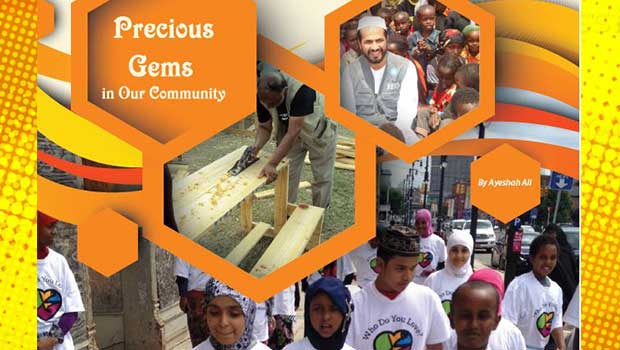
    Precious Gems in Our Community

    Altruism is like a human cell. It exists naturally in all of us in a dramatically subtle form that makes it easy for us to forget its existence. Cells are the basic building blocks of living things, including human beings, and they are microscopic and number in the trillions in the body so that we would not even be aware of it if we lost one, or even hundreds of them. Yet, the human cell has ability to unify itself with other cells in numerous combinations and complex arrangements. When the human cell applies itself towards this end by the will of Allah (SWT), it exhibits a tremendous amount of potential, capable of creating a complete human body, essentially delivering an impact of its ability in a truly magnified form that is much larger than itself.

    The altruistic nature of an individual is also of a subtle form, easy to be overlooked and underutilized. Each one of us has shown our altruistic side to others at some point in our lives and continue to do so, if not regularly or very consciously. Now imagine if we gathered this disposition in us into collective form and channeled it in a more organized and proactive way. Imagine the possibilities; imagine the impact it could create on society around us. We only need to look at the stories of individuals in our communities who have a heightened consciousness about utilizing and developing their altruistic tendencies to grasp the unlimited potential.

    The American Muslim community began the process of organizing themselves to serve others during our parents’ and grandparents’ time, laying out foundational elements that would serve as the stepping stones for the next generation. By the grace of Allah (SWT), the next generation took the reins and made huge leaps and bounds since then, dramatically transforming the landscape from a few select opportunities into a diverse and flourishing composition of humanitarianism and voluntarism. Through the efforts of dedicated Muslim individuals, today we have organizations that are thriving, and as they strengthen, they are able to deliver ever more service to the greater community.

    Progress has been in many areas, including the organizations that help the needy, those that empower and train the youth, others dedicated to countering the negative narrative about Islam, and those individuals and groups that reach out to communities beyond our own such as our neighbors of different faiths and beliefs. Collectively, these efforts have created a source of goodness, caring, and service that grows within our communities and reaches out to touch others. Thousands of individuals contribute to this dynamic environment and each one has his or her unique story. Presented here are a number of brief profiles that highlight the many different faces of service and volunteerism.

    ICNA Relief-USA Women’s Shelter Network

    The personal story of Malika MacDonald is a difficult one, yet enlightening. Her journey through abuse, poverty, and struggle for self-esteem eventually led to her current esteemed role of the National Director for ICNA Relief USA Women’s Shelter Network. She has served to help numerous other women in similar circumstances, suffering from emotionally and/or physically destructive relationships and experiences. Her commitment to give back to society is infused with her ability to understand and closely relate to their situations. She described her path in her recent article, “Sex, Drugs and the Redemptive Power of Islam-A Ramadan Lesson,” and highlights her motivation to help women: “My work allows me the opportunity to, in shaa’ Allah, inspire and foster hope where there is none. Similar to that of a caterpillar becoming a magnificent butterfly, I get to witness all of the transformational stages women go through during their own metamorphosis. But their healing is easier when the rest of us obey His decree.”

    Helping Hand for Relief and Development / ICNA Relief

    In the distinguished league of those dedicated to the needy and less fortunate are Irfan Khurshid of Helping Hand Relief and Development and Dr. Mohsin Ansari, ICNA Relief CEO and Medical Director. Irfan Khurshid has been a very visible figure, steadfast in his relief work and providing assistance in some of the most devastating natural disasters, including the 2010 earthquake in Haiti and the one in Nepal in April of this year. He has witnessed unimaginable destruction, and the fear and desperation that follow. His compassion and determination to bring relief to those affected have earned him recognition as a person thoroughly dedicated to help and serve people.

    Dr. Mohsin Ansari served as ICNA Relief Medical Director for many years and recently resigned his post due to health issues. Under his watch, ICNA Relief USA served 112,000 needy people in 2014 alone. ICNA Relief’s disaster program has provided relief in 34 disasters since 2005, the year of Hurricane Katrina. With 21 halal food pantries, 13 women’s shelters, a Back-2-School Giveaway program, and 5 free health clinics that served more than 6,000 patients last year, Dr. Ansari has made it his life’s mission to serve those in need.

    Serving Society- Faatimah Knight

    In addition to the dedicated volunteers and activists who work with charitable organizations to serve the needy, others work to address social justice causes.Knowing all too well the feeling of being targeted as a minority, Faatimah Knight understood the suffering of the victims, their families, and the larger African-American community, after the June shooting at the Emanuel African Methodist Episcopal Church in Charleston, South Carolina. Following this brutal hate crime, Sr. Faatimah, an alumna of Zaytuna College, wanted to help. What started as a modest attempt to raise some money to send flowers to the church turned into a wider campaign to raise funds to help rebuild the eight churches that were destroyed by fires following the Charleston shooting.

    Sr. Faatimah spoke to NBC news, stating, “We wanted to show that as a Muslim community, their pain did not go unnoticed by us—that we did, in fact, feel deeply for their loss.” She noted that“The Muslim community and the Black community are connected in integral ways; one cannot tell the story of one in America without telling the story of the other.”She further commented, “We must always keep in mind that the Muslim community and the black community are not different communities. We are profoundly integrated in many ways, in our overlapping identities and in our relationship to this great and complicated country. We are connected to Black churches through our extended families, our friends and teachers, and our intertwined histories and convergent present.”

    Serving Society – Azra Baig

    A resident of South Brunswick and a nurse by profession, Azra Baig is extensively involved with her local community, serving as member of the PTO at her daughters’ schools, as volunteer nurse at health-focused events, volunteering at the South Brunswick Municipal Alliance, an organization dedicated to fighting substance abuse among the youth, and serving as a member of the Board of Education in South Brunswick. Being the only female and the only hijabi member on the panel, Sr. Azra brings a unique vision and viewpoint to the discussions and policy decisions that are entrusted to the Board.

    She also serves regularly at a Trenton area soup kitchen as part of Muslims Against Hunger. She has initiated a new program, organizing events to prepare bags of food for the needy and visiting urban areas where homelessness is common, to deliver packaged meals directly to the people. Sr. Azra also has membership with the Human Relations Commission, a township agency that helps foster goodwill among the diverse groups residing in the community. As part of this endeavor, she organized an event at her township library to present information on Prophet Muhammad (pbuh) shortly after the Charlie Hebdo shootings in France in early January. Her goal was to help offset the misinformation and misrepresentation that was being generated about Islam and Muslims. She also started a campaign called “Cards of Condolences” after the attack on a school in Peshawar, Pakistan in December of 2014. She collected over 2000 cards from the members of the community, Muslims and non-Muslims alike, to send to the victims and their families.

    Her thoughts on volunteerism are clear and concise: “It is important for everyone to volunteer in whatever capacity they are able to in order to help one another, your neighbors, and your community. It is critical to give back to your community utilizing your time, resources, and knowledge. And especially as Muslims, we all are ambassadors of our faith, living examples of our faith, and need to use our disposition to start positive dialogue and informative conversations with our fellow community members.” She refers to Martin Luther King Jr.’s words to complete her thought, “Everybody can be great…because anybody can serve….you don’t need a college degree to serve…you only need a heart full of grace. A soul generated by love.”

    WhyIslam-Asim Khan, Jr.

    WhyIslam is an outreach project of ICNA.Asim Khan, Jr.talks about its objectives and successes:
    “The project’s foremost aim is to provide accurate information about Islam primarily to non-Muslims. In doing so, it hopes to dispel common stereotypes and persistent misconceptions about Islam and Muslims. WhyIslam realizes that Islamophobia is a characteristic more frequently expressed by those who have little or no exposure to Muslims or Islam. WhyIslam has implemented campaigns recently to promote interaction of Muslims with their non-Muslim colleagues, neighbors, and even strangers. One of the many successful multi-faceted approaches of WhyIslam’s outreach campaign is the social media front which it operates. WhyIslam’s Facebook page has over 300,000 followers and the posts by the WhyIslam social media team are meant to be engaging. Some of our posts have gotten over a million views and over 10,000 comments. The fruits of this effort are manifested by the private messages we receive from people who are ready to accept Islam or want to learn more seriously about Islam and perhaps visit a local mosque. Recently, we had a gentleman named Patrick send us the following private message on Facebook: ‘I thought I would storm to this page and start trolling but I just could not. You answered so many questions I had about the Islamic faith. Maybe you guys are not so bad. ISIS is bad but not all Muslims are ISIS.’Messages like these keep the volunteers’ enthusiasm high and reminds us that we are only doing this because we want to please our Creator.”

    Young Muslims- Brothers

    Ghayoor Arshad speaks of his involvement with his Muslim brothers through Young Muslims.He describes an organization that empowers the youth and helps and supports them as they grow in their iman:
    “Young Muslims’ goal as an organization is to provide Muslim youth across America with genuine brotherhood and a deep connection with Islam that spans across the various facets of their lives. In the sense that we don’t try to distinguish Islam from the secular world in the hearts and minds of our members, but we hope to have them navigate their lives with an overlying Islamic perspective. To achieve this goal, YM’s main initiative is the NeighborNet, which is a simple weekly halaqa (Islamic discussion), followed by an activity of sorts, whether it’s playing sports or grabbing some dinner. This humble weekly meeting often serves as the crux that supports the “Islamic sanity” of many of our members. The NeighborNet serves as a place of welcoming and brotherhood that allows Muslim youth to break down the dualistic wall that separates their Islamic and secular halves. YM focuses on the internal balance in the average Muslim youth in an attempt to secure Islamic values that will aid them in their struggle with their Islamic identity amidst our demanding society. Instead of looking towards celebrities and pop culture for morals and ideals, YM gives Muslim youth an alternative in the form of upstanding Muslims that have achieved success in this society by following Islamic values.

    Personally, YM has given me almost everything I can call an asset in my character. By attending weekly meetings without fail for nearly a decade, I was able to forge a connection with Allah that ushered in a new era in my life. Rather than constantly looking towards media and pop culture for purpose or meaning in life, I was able to find peace in my prayer, and happiness in doing work for the sake of Allah. In this society in which one’s “crew” and “posse” define them in their success and respect, YM gave me a second family in the form of lifelong friends that share my passion for this Deen and imparting this very feeling with the Muslim youth in our area. All of this was achieved not through a curriculum or books or some type of schooling, but simply by establishing Islamic brotherhood amongst friends and learning from each others’ character and manners. Just as many of our members, the reason I tried my very best to be at our weekly YM meetings every single week was because, for the first time in my life, I was looking forward to meeting with Islamically-motivated youth from whom I could learn the Deen simply by spending time with them. Whether it was playing sports or grabbing dinner, I could feel my iman climbing in the company of my Muslim brothers. And that, that is the goal of Young Muslims.”

    Young Muslims- Sisters

    Kainat Hamid, 22, is a Dallas resident and the coordinator for her local NeighborNet, a circle of Muslim friends who connect regularly for purposes of Islamic discussion and sisterly bonding. She has been involved with her NeighborNet since the age of 14 and feels it has become an integral part of her life, a source of support, strength, and motivation as she faces her daily struggles and pursues life’s opportunities.

    Sr. Kainat states, “I think Young Muslims is a unique organization because it provides an outlet for the Muslim youth to create spiritual bonds with each other and Allah (SWT) as they strive through the everyday challenges of living in the American society. It gives us the opportunity to build strong brotherhood and sisterhood bonds as we come together weekly for the sake of Allah’s pleasure through halaqas, volunteering, fun outings, dawah opportunities, conferences, and more. What do the youth need most while living in this society? We need good companionship and YM is an organization that provides just that. Specifically for young sisters, YM gives us the opportunity to do so much more than what society has limited us to doing. We are able to put ourselves out there, do dawah work, give halaqas, and lead the community. In my YM NeighborNet we work to teach the young girls the necessary skills to succeed in this life and the Hereafter. Last year we held a conference titled Empowering Women: Freedom in Islam where we discussed the skills Muslim women need to learn in order to succeed — the rights of Muslim women, the history of successful Muslim Sahabiyat, self-defense tips, and balancing deen and dunya as working Muslim women. Something else really special about YM is that it provides opportunities. A non-profit organization cannot work efficiently without its dedicated volunteers and that is what YM provides opportunities for. It creates and molds leaders and Muslim workers. The Muslim ummah desperately needs the youth to step up and take charge and YM gives the youth the opportunity to make a difference and volunteer their youth for the sake of Allah. Whatever opportunity we find ourselves in…just remember…Allah SWT placed us there. It is through His mercy we do the volunteer work that we do. He has chosen us to do work for His sake. As a result, we should take volunteerism seriously, the same as paid time and, in reality, we are getting paid. The only difference is that our pay will be given to us in the Hereafter in the form of a currency that truly matters.”

    Final Thought

    These examples of Muslims active in volunteerism and service truly highlight not just the benefits of helping others but also the scope of positive influence we can generate simply by demonstrating creativity and determination, coupled with love and concern for the individuals and communities around us. After all, our beloved Prophet Muhammad (pbuh) is a perfect example of a human being whose life was dedicated to serving his Creator and His purpose. We need to embody those very attributes that will help facilitate us to serve in the same manner, in shaa’ Allah.