
بسم الله الرحمن الرحيم

Tag: Muslim celebrations

  • The Beauty of Eid al-Fitr in America

    The Beauty of Eid al-Fitr in America

    I’ve never spent Eid al-Fitr — the celebration that ends the holy month of Ramadan — in a Muslim country, but I have heard stories. It is remarkable that more than 2 billion Muslims around the world celebrate Eid al-Fitr and friends have shared with me wonderful memories of Eids abroad where people celebrated in the streets, sometimes with parades, playing drums, and singing nasheeds. They describe the mountains of food they share with family members and neighbors. They talk about how the children are on a long holiday break and receive their Eid money in between getting hugs and kisses from elders. Many people say that there is no place like Eid in a Muslim country because as soon as you leave your home, you feel the radiance of the people’s joy at every corner.

    In the U.S, where I’ve spent all my Eids since childhood, I have found that Americans have a harder time trying to find unique and creative ways to mark the ending of Ramadan. Although Muslims in America, being a minority, have to create their own experience of celebratory joy and fun, different from their Muslim counterparts abroad, the day still manages to be beautiful in so many ways. So how do American Muslims generally celebrate the blessed holiday?

    First, because it’s not a holiday recognized by the federal government, we don’t all automatically have the day off. We must communicate with employers in advance of the holiday to request it off. Depending on the moon sighting, it is even sometimes challenging to know which date to request off from work or school due to the uncertainty of the sighting. However, you can use an official letter from the local mosque announcing the holiday and potential days for Eid to provide you with some support. In the case of a day off from school, the school should mark it as an excused absence and allow the child extra time to turn in assignments. In some school districts where Muslim students are high in number, there has been success in petitioning the school district to recognize Eid al-Fitr and mark it as an official school holiday.

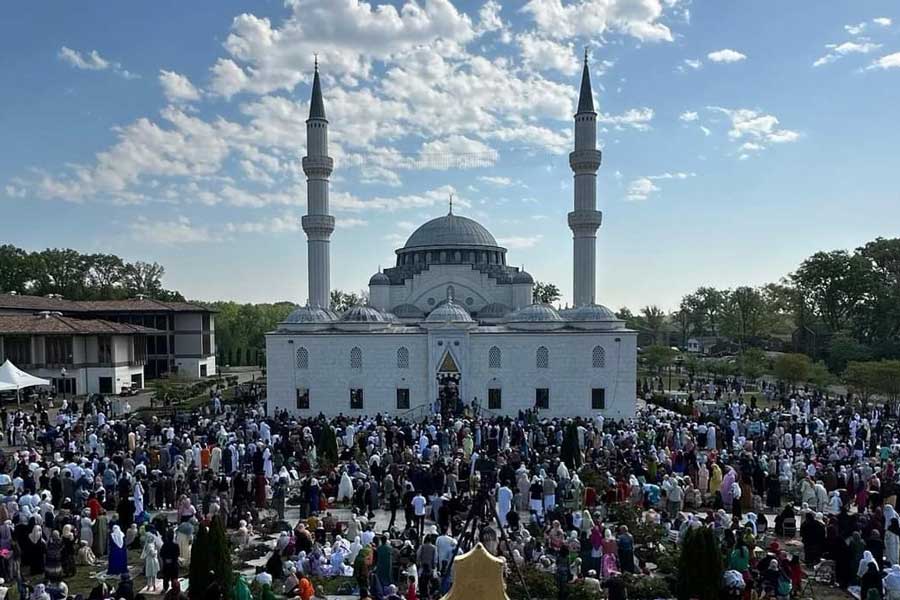
    If the day off is secured, most individuals and families will pray in congregation, the special Eid salat at the local mosque. Some mosques even rent out big venues like convention halls or football stadiums, or parks to pray in large numbers. Before leaving the house, people put in effort buying new clothes, planning their outfits, and putting on new scents. After the salat, Muslims take time to greet one another and take photos with their families. Depending on the mosque, there are various activities, pastries and tea, toys, and maybe even a mini carnival for the kids.

    After festivities at the mosque, my family usually goes out to eat for breakfast. Some years it was as simple as IHOP, other years it turned into a hunt for the best brunch in the city. We would keep our fancy clothes on and sit together happy to be eating pancakes during daylight hours, as this was a day of celebration, not fasting. With breakfast finished, we sometimes go home for a quick “Eid nap.” Based on social media mentioning, the instituting of an Eid nap seems to be a quintessential part of the American Eid tradition: fill your stomachs in the morning and then take a pause in celebrations for a quick nap. This allows your body to catch up on sleep since you probably stayed up after Fajr to prepare for festivities.

    If there are small children in the house, it also may be the time when gifts are opened. My parents always wanted us to feel the joy of Ramadan even if we weren’t old enough to understand it’s significance or could partake in fasting. So, from a very young age we would open our gifts that would be stacked in the middle of the living room with our names written on the wrapping paper. I know many of my friends growing up would instead receive “eidies” which were envelopes of money that they could use on whatever toys or gadgets they wanted.

    The post Eid activities vary from household to household. If people live close to relatives, they’ll spend the evening hopping from one home to the other to share a meal or give Eid greetings. If they don’t have family around, maybe they’ll choose to gather in a big community group and go for fun activities like miniature golf or bowling. I’ve seen some masajid organize groups specifically for singles or new Muslims who may not have anyone to spend the day with. I think organizing within the community to figure out how people are spending the day and encourage people to invite community members to their homes, is necessary to ensure no one feels alone on a joyous occasion.

    Regardless of which way you choose to celebrate Eid al-Fitr, it’s important to take stock of all the great habits you cultivated during Ramadan. It’s often said that the mosque is most empty the days following Eid because people are no longer entranced in the practice of praying daily salats at the masjid. It’s important that we not only celebrate on Eid al-Fitr, but we think about all the good we busied our time with during Ramadan and what of those newly formed good habits we can continue. We must not just go back to our old habits, allowing our eyes and ears to get thrown quickly back into dunya affairs. We should take time to do things like fasting the six days of Shawwal in the days following Eid al-Fitr. If we can extend and reinforce the blessings from Ramadan, we are demonstrating our devotion and gratitude to Allah SWT. And we can pass on good traditions and practices to future generations.
  • A Message on Eid Al-Fitr

    A Message on Eid Al-Fitr

    All praise is due to Allah (SWT) for all our blessings. We offer sincere and complete gratitude for His guiding us to Islam; and truly it is sufficient as a blessing. All praise and all glory are to Allah, the One, and none is comparable to Him. He is the Exalted, the Majestic, the Creator, the Sustainer, the Provider, the Helper, the Maintainer, the Protector, the Merciful, the Oft-forgiving, the Most Loving, the Most Kind, the Most Wise, the Magnificent! He is an-Noor, the Light of the Heavens and the Earth, guiding us out of the darkness and into the light of truth. The First and the Last, He is al-Waasi’, the All-encompassing, and His Mercy is vast. He is as-Salaam who sends His peace and blessings, Lord of the worlds, King of all kings. And may the peace and blessings of Allah be upon His beloved and final Messenger, Muhammad (s) and all of his family and all of his companions and all who follow him correctly until the Day of Resurrection.

    Eid al-Fitr mubarak to our brothers and sisters around the world! May Allah accept our prayers, fasting, charity, Qur’an recitation, good deeds, and the fulfillment of all our responsibilities for His sake. We celebrate Eid with gratitude, and we emphasize the happiness and joy of this day. Let us be joyful for the vast blessing, the powerful and unimaginable enlightenment and rewards we are able to access during the month of Ramadan. Let us be joyful for the countless blessings of Allah upon us that we cannot begin to numerate. As He (SWT) tells us, “If you tried to count Allah’s blessings, you would never be able to number them. Surely Allah is All-Forgiving, Most Merciful” (Qur’an 16:18). Let us be happy for the vast number of believers who found hope and solace and renewed energy during this month to excel in worship. Let us be happy and spread this happiness to our loved ones, our families, our friends, our communities, the old and the young, believers from all walks of life.

    Happiness and Gratitude on This Day

    We should be happy on this day, as was the Prophet (s), but this happiness doesn’t mean that we’re forgetting our brothers and sisters struggling around the world. We make dua for them that they also can celebrate and find happiness on this day, and we wish for the entire Ummah to be happy. Our happiness today is because Allah has allowed us to live to enjoy another Ramadan, to worship once again in Ramadan, and to potentially be of those whose worship and fasting and deeds are accepted in Ramadan. Indeed, the more a person worshipped and strived with dedication during Ramadan, the more happiness they experience on this blessed day of Eid. Still, no matter one’s state, he or she should never lose hope in Allah and should continue to strive towards Him, for when we take one step towards Allah, He takes many towards us. He does so because He (SWT) loves us and wants us to succeed. He wants us to be happy.

    A precondition of that happiness is gratitude. In the verses about fasting during Ramadan, Allah says: “…so that you may complete the prescribed period and proclaim the greatness of Allah for guiding you, and perhaps you will be grateful” (2:185). Our gratitude to Allah, of course, should be year-round. Some Muslims wonder why so many enter the masjid during Ramadan and on Eid but do not enter the mosque the rest of the year. They try to understand why many Muslims recite the Qur’an in Ramadan in abundance, but they do not look at this treasure throughout the rest of the year. They wonder why many people give generously, repent passionately, increase their good deeds significantly, but just in the month of Ramadan. There are some who are judgmental and condescending and think, “These are just terrible Ramadan Muslims.”

    There is a prophetic etiquette, however, of beautiful compassion and true genuine desire for everyone to succeed, and that we look for the best in each person. Someone who finds hope and solace in Ramadan should not be pushed away by being negatively perceived, but brought closer to Allah by our encouragement and, if appropriate, our advice. Who are we to prevent someone from finding hope in this month, from praying more and fasting and reciting the Qur’an and finding the capacity to finally ask for forgiveness? We should focus on his or her fasting in Ramadan with faith and heartfelt hope for redemption and ultimate reward. For each and every one of us, Allah gives opportunity after opportunity to receive His forgiveness and mercy, and this beautiful month in which some people found hope can remind them that Allah is always present and ready to guide and help, not just in Ramadan. The doors of mercy are open throughout the year, every day and every moment of our lives.

    Allah is the Lord during the entire year, not just Ramadan. If you found the capacity to do even slightly more during this blessed month, then have hope and confidence and conviction that you can certainly change for the better, but it must begin with a sincere and strong intention and yearning for His closeness and guidance. This Ramadan has passed and will never return, but Allah is forever present, Ever-Living, and will continue to be there for us, wanting to forgive us, waiting for us to ask of Him in sincere humility, and submission. Allah, the one we submit to with love, hope, and fear, intending to develop our taqwa for His sake during Ramadan and throughout the year.

    Allah Is Greater!

    We submit because Allah is greater than our desires, our worldly attachments, our worldly concerns, and the entirety of His creation. Allah is greater, Allah is greater. This is why we express takbir (“Allahu akbar”) frequently on Eid and throughout the year in our prayers and acts of worship. Allah is greater than our future uncertainties, our pain, our setbacks, and the enemies of the Ummah. Allah is greater, Allah is greater.

    This is a time for us to reflect on the state of the Ummah and the state of humanity, and to return back to the reality that God is greater. This pandemic has been a powerful reminder of Allahu Akbar, for people to return to Him, to humble themselves before Him, and to fulfill their purpose in life. A difficult reminder and trial in this world is actually a blessing preventing much of humanity from regrets and difficulties on the Day of Resurrection.

    The Muslim Ummah has all the tools necessary to be successful in this life and the next, and yet our quantity is greater than our quality, if we’re being honest with ourselves. The Speech of Allah that’s known to us is a solution for the world’s problems, oppressions, injustices, and struggles, and yet as Muslims we don’t connect to it enough, understand it deeply, or implement it in our daily lives. And because of that, the rest of humanity does not see the precious blessing of Islam and its truthfulness as the religion of God. If we truly desire to be people of success, then we are required to fulfill the rights of Allah in our everyday lives, to helping and supporting His plan for us and humanity. He (SWT) tells us “O you who believe! If you help [the cause of] Allah, He will help you and will make your foothold firm (Qur’an 47:7).

    In one hundred years, those who are currently alive will likely be dead, having departed to the Creator, as every human before us has. When we’re long gone and our names are forgotten on earth, we won’t be thinking in the graves about the worldly status we held, the brand name clothes or jewelry we bought, or the type of car or house we owned. We’ll be reflecting only on our deeds, the eternal currency, that which leads to punishment or reward. The believer never loses hope and continuously strives to accumulate good deeds while alive, for life is too short to waste on limited pleasure.

    As we celebrate Eid al-Fitr, we pray for those who are suffering and prevented from practicing Islam openly, and for those who are unable to ever pray in a mosque or wear hijab or exemplify any teaching of God. We celebrate the day joyously while keeping the Ummah in our prayers, advocating for their relief from oppression or injustice of any kind, and living by – and spreading – the true message of Islam in order to celebrate eternally in a blissful home in Paradise.

    Eid Mubarak to our brothers and sisters around the world. May Allah accept all that we have done for His sake and keep us consistently growing and striving throughout the year.