بسم الله الرحمن الرحيم

Tag: Make America Great Again

  • Un-Islamic, Radical Terrorists: A Tool for Election Hype

    Un-Islamic, Radical Terrorists: A Tool for Election Hype

    Neighbors were frightened of Mohamed Lahouaiej-Bouhlel, the man who plowed a truck into a celebratory crowd in Nice, France, killing more than 80 people and injuring over 200. People who knew him explained that he was anything but a devout Muslim. He had a record of petty crime, often displayed unrestrained bouts of anger, drank alcohol, used drugs, and neglected to pray or fast. Bouhlel, in recent times, was convicted of assaulting a motorist, and abused his estranged wife. In fact, he had a history of mental illness documented by visits to psychologists in Tunisia. What remains unclear is whether or not he had any direct links to terrorist networks.

    Inflammatory speech invariably has a negative impact on the unity of our nation

    Gunman Omar Mateen, who opened fire inside a nightclub in Orlando Florida, had a long history of behavioral problems, documented by school records over the years. He was expelled, arrested and eventually enrolled in an alternative high school after numerous fights in which he injured other students, and what one of his teachers noted as his “inability to show self-control.” According to witness Patience Carter, who survived the Orlando rampage, Mateen announced his motive as he murdered club-goers, saying he wanted “Americans to stop bombing his country.” His parents were originally from Afghanistan.

    Richard Reid, also known as “the shoe bomber,” attempted to take down an American Airlines passenger plane in 2001 by igniting explosives contained in his shoes. Upon his arrest, he told officials conducting his interrogation, “Your government has sponsored the torture of Muslims in Iraq and Turkey and Jordan and Syria with their money and weapons. It’s in your hands.” Like the others, Reid had a history of delinquency and criminal offences. When he was born, his father was absent, having been incarcerated for car theft. After dropping out of school at the age of 16, Reid pursued a life of crime, often winding up in prison himself.

    “Do you think that you will enter Paradise without such [trials] as came to those who passed away before you? … Yes! Certainly, the Help of God is near!” (Quran 2:214)

    ISIS entry form documents of roughly 4,000 foreign recruits recently released to the Associated Press prove what Muslims have been saying for years. In an August 19 article in the Times of Israel, the authors note that the terrorist organization known as ISIS, “preys on those with minimal connection to Islam, because the more they know the less likely they are to endorse its methods.” Recruiting members largely ignorant of Islamic teachings, allows extremist organizations to indoctrinate them with a distorted version of Islam, designed to help advance its aggressive territorial expansion and slaughter of innocent men, women, and children.

    Compulsive Use of Misnomer: ‘Islamic’ Terrorism

    According to these and many more examples, it appears that an overwhelming number of terrorists display similar characteristics: ignorance and lack of devotion to Islam, mental illness, recurrent criminal behaviors, and violence towards innocent people. They are motivated – not by religion – but by geopolitical grievances and a thirst for vengeance. Despite these glaring facts, and their availability to the public, we continue to witness the term “Islamic” consistently being attached to heinous terrorist crimes and their perpetrators.

    Certain politicians, TV personalities, and pundits help form public sentiment surrounding attacks, branding them as “Islamic” while the shock and horror are fresh, and details that undermine the “Islamic terror” narrative are yet unavailable. Information acquired in the investigations following attacks, in most of the cases, tends to paint an entirely different picture: individuals with a criminal history and psychological and behavioral issues, who are motivated by anger and driven by very real and disturbing geopolitics.

    The confidence with which the initial speculations were presented, and the subsequent time that elapses in which people return to their daily routines, inevitably renders subsequent investigations and analysis far less newsworthy. The lack of sensation and inconsistency with the favored theme of “Islamic terror” renders almost inconsequential the ensuing findings such as non-existent religiosity, lack of clear ties to terrorist networks, no overtly political motivations, records of criminal activity, and/or histories of mental health problems.

    A Tool for Election Hype

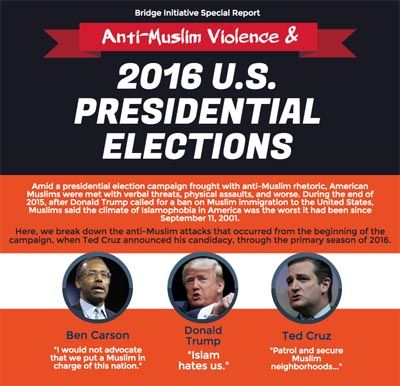
    While we can’t always assume that the statements made by political candidates are intentionally misleading, this election season is a perfect example of disinformation about Islam and Muslims being used for political gain. From the inflammatory rhetoric of reality star and now presidential candidate, Donald Trump, to the attempts to garner attention by former Republican Speaker of the House Newt Gingrich, we are seeing a lot of very strong words being thrown around without much concern for the real consequences they have for average Muslim citizens. And inflammatory speech invariably has a negative impact on the unity of our nation. Polarizing rhetoric such as Trump’s infamous call for Muslims to be banned from entering the United States, and his blanket (and frequently grammatically challenged) statements like “I think Islam hates us,” have done more than raise eyebrows.

    Newt Gingrich, on national television went so far as to say, “Western civilization is in a war. We should frankly test every person here who is of Muslim background and if they believe in sharia, they should be deported. Sharia is incompatible with Western civilization.” Statements like these have proven to elicit intense levels of bigotry, hatred, and violence that have apparently been pent-up in a portion of the American electorate.

    The Pressure of Polarization

    These alarmist calls from powerful people to equate Islam with terrorism urge the general populations of Western countries to associate all Muslims with violence and danger, thus engendering distrust and fear of all things Islamic. Consequently, we are seeing an unprecedented rise in crimes against Muslims in the United States and elsewhere ranging from verbal abuse and discrimination to physical assaults, and sadly, hate-motivated murder. We can sense the increasingly negative sentiments in our neighborhoods and communities. Many of us feel awkward, ashamed, and even frightened to go to public places immediately after tragedies such as the recent attacks in France, San Bernardino CA, and Orlando FL. The pressure may be felt even more by those of us who outwardly appear to be Muslim, primarily women who cover and men who choose to wear ethnic clothing and kufis.

    David Lisnard, mayor of Cannes in southern France, fueled controversy with incendiary statements regarding Muslim women who choose to go swimming, yet insist on covering their bodies while doing so. Referring to a ban on Muslim swimwear he said, “I simply forbid a uniform that is the symbol of Islamic extremism.” Thierry Migoule, Cannes’ head of municipal services, echoed the mayor’s sentiments, saying, “We are not talking about banning the wearing of religious symbols on the beach… But ostentatious clothing, which refers to an allegiance to terrorist movements which are at war with us.” Yes, they both just said that any Muslim woman who chooses to cover her body while swimming is displaying support for terrorism and extremism. Do they hope to force Muslim women to acquiesce to their standards of fashion and stop standing out so confidently in their voluntary modesty? Whatever it is behind those words, the result is the same: an increasingly polarized population, pitting the general population against Muslims.

    These politicians have whitewashed the complexity of reality and presented a simplistic picture to the public: good vs. evil – and they are defining what means good and what means evil. People are afraid for their lives, for their futures. These politicians are capitalizing on that fear and telling all of us: choose a side – or else. This, in turn causes innocent people to appear guilty.

    The Heat is On

    Being under constant suspicion can cause individuals to feel guilty – even when totally innocent. Dalia Mogahed explained how she felt after 9/11, saying, “Not only had my country been attacked, but in a flash, somebody else’s actions had turned me from a citizen to a suspect… for the first time in my life, [I was] afraid for anyone to know I was a Muslim.” This guilt by association is advanced and reinforced by few, but very loud voices. After the Nice attacks, Kelvin Mackenzie, a columnist from the UK’s Sun newspaper, wrote a controversial column questioning why a “young woman wearing a hijab” had been allowed on television to report on the attack in Nice. He was horrified that the reporter, Fatima Manji, was visibly Muslim. He asked. “Was it appropriate for her to be on camera when there had been yet another shocking slaughter by a Muslim?”

    Avoiding the Herd Mentality

    More than one-third of those killed by the attacker in Nice were Muslims. According to a report published by the Counter Terrorism Center at the US Military Academy, Al-Qaeda kills over seven times more Muslims than non-Muslims. The majority of ISIS’ victims are Muslims. If it’s offensive for a Muslim to report a terror attack on television, is it also offensive for us to mourn our dead? We have to reject this idea outright and think critically: was it wrong for a Christian to report on the murder of Dr. George Tiller by anti-abortionist terrorist Scott Roeder in 2009, or the Centennial Olympic Park bombing in 1996 by Eric Rudolph who had ties to the white supremacist “Christian Identity” theology and movement? In fact, both Roeder and Rudolph had ties to another Christian terrorist group, The Army of God. To suggest that a Christian reporter should not cover a terror act committed by a fellow Christian is clearly, easily, and immediately recognized as preposterous.

    In the face of this monumental and growing problem, I refuse to allow others to determine how I feel about myself. As Muslims, we have to be the masters of our own thoughts and allow no one to convince us we are guilty by association due to our faith. That our modest attire or names or beards are incriminating, that the word “Islamic” must appear next to its antithesis, terrorism… No! The Quran differentiates between human beings who reason and those who follow the crowd without intelligent thought: “Or do you think that most of them listen or use their reason? No, they are but like cattle. Rather, they are even less conscious of the right way” (Quran 25:44).

    Fighting Doubts

    Prophet Muhammad said, “The people will see a time of [much-needed] patience in which someone adhering to his religion will be as if he were grasping a hot coal” (Tirmidhi). It’s becoming clearer that this applies to our current time. Some of us feel like giving up. Being under constant scrutiny, guilt-tripped, cursed at, ridiculed, and hated – it is exhausting. It might appear easier if we just took our headscarves off, shaved our beards, and changed our names. The thing is, though, the solution is in the same hadith – the heart of the issue — that we adhere to our faith. Letting go of it will never lead us to success or ease.

    We’ve Got a Choice to Make

    It’s election season. Time to make a decision. And while it’s important to exercise your right at the polls, there’s an even more important choice to make, right now. Allah says, “The truth is from your Lord, so whoever wills – let him believe; and whoever wills – let him disbelieve” (18:29). Our akhirah is waiting and the choices we make today will be there for us to see, either as witnesses against us or in our favor. It helps to remind ourselves again and again:

    “Do you think that you will enter Paradise without such [trials] as came to those who passed away before you? … Yes! Certainly, the help of God is near!” (Quran 2:214). All of this life is intended to be a test. If it weren’t this or that test, it would be something else. So, remember the advice of Jacob to his sons, “Despair not of relief from God. Indeed, no one despairs of relief from God except the disbelieving people” (Quran 12:87).

    All the Information We Need

    It’s about time that we turn off our TVs, sign out of our social media accounts and turn to the Quran. The Quran provides the bigger picture and lays out a plan for the future – putting everything into proper perspective: “So be patient. Indeed, the promise of God is truth. And ask forgiveness for your sin and exalt with praise of your Lord in the evening and the morning. Indeed, those who dispute concerning God’s signs without authority having come to them – there is not within their hearts except pride, [the extent of] which they cannot reach. So seek refuge in God. Indeed, it is He who is the Hearing, the Seeing” (Quran 40:55-56).

    Allah’s plan is geared towards our success, if we choose to follow it. With Allah’s help, we can make our ummah great again. “O you who believe! Persevere in patience and constancy; vie in such perseverance; strengthen each other; and fear Allah that you may be successful” (Quran 3:200).

  • Anti-Muslim Rhetoric and Its Violent Consequences

    Anti-Muslim Rhetoric and Its Violent Consequences

    It’s been a volatile summer for American Muslims.

    In New York, an Imam and his assistant were brutally murdered outside a local mosque shortly following prayer services. In Oklahoma, a 37-year-old Arab American man was gunned down on his porch by his neighbor who presumed he was Muslim, less than an hour after contacting police to express fear that his soon-to-be murderer would harm him. The neighbor had previously run over the family’s matriarch with his vehicle, and then left the scene of the crime where the victim was seriously injured.

    election2In Illinois, two American Muslim women were assaulted by another female in a parking lot. The perpetrator called them “ISIS” and bystanders encouraged her. In Texas, a caller threatened a local mosque, saying, “We will cut all of your heads off,” while describing Islam as a “violent religion” and calling for a “Christian crusade.” In South Carolina, a postcard threatened an attack against a mosque unless Dylan Roof, the white supremacist responsible for a mass shooting at a black church last year, was released.

    And, that’s just a snapshot of the most egregious acts or threats of anti-Muslim violence reported in the news media during the first few weeks of August, 2016. The month commenced with Republican presidential nominee Donald Trump’s disparaging statements about Khizr and Ghazala Khan, Gold Star parents of an American Muslim soldier who lost his life while serving his country in a controversial war in Iraq, a war premised on a claim of WMDs that never were.

    As you may recall, Khizr Khan had publicly criticized Mr. Trump at the Democratic National Convention for consistently attacking the character of the American Muslim community. He questioned Mr. Trump’s sacrifices for our nation and his knowledge of the U.S. Constitution while, now famously, offering to lend his copy after pulling it out from his suit jacket pocket. Significantly, the harrowing acts and threats of anti-Muslim violence described above fit a larger pattern that has emerged during the current 2016 U.S. presidential election season.

    election4Indeed, earlier this year, Georgetown University’s Bridge Initiative, where I research, write and speak about Islamophobia, released a study titled, When Islamophobia Turns Violent: The 2016 U.S. Presidential Elections. Our study examined the relationship between anti-Muslim political rhetoric by presidential candidates and acts and threats of violence targeting the minority faith community, from March 23, 2015 through March 2016.

    We made the following key findings:

    • The 2016 U.S. presidential season began against a backdrop of already rising Islamophobia in 2015, threatening American Muslim religious freedom.
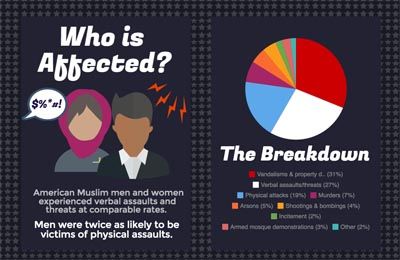
    • During the course of 2015, there were approximately 174 reported incidents of anti-Muslim violence and vandalism, including: 12 murders; 29 physical assaults; 50 threats against persons or institutions; 54 acts of vandalism or destruction of property; 8 arsons; and 9 shootings or bombings, among other incidents.
    • Anti-Muslim violence remained significantly higher in 2015 than pre- 9/11 levels with American Muslims approximately 6 to 9 times more likely to suffer such attacks. The number of incidents in 2015 is also higher than the total number of anti-Muslim hate crimes reported in 2014: 154.
    • In 2015, American Muslim men were twice as likely to be victims of physical assaults and 5 to 6 times more likely to be victims of murder than American Muslim women.
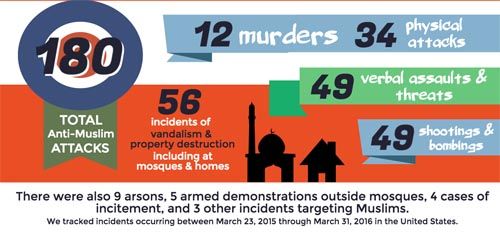
    • Since the first candidate announced his bid for the White House in March 2015, there have been approximately 180 reported incidents of anti-Muslim violence, including: 12 murders; 34 physical assaults; 49 verbal assaults or threats against persons and institutions; 56 acts of vandalisms or destruction of property; 9 arsons; and 8 shootings or bombings, among other incidents.election3
    • Since the start of the presidential election cycle, American Muslim men have been twice as likely to be victims of physical assaults and about 11 times more likely to be the victims of murder than their female counterparts.
    • Also during each period, Muslim murder victims were most likely to be aged 18 to 24.
    • Children and youth – as young as 12 years old – were among those responsible for acts and threats of anti-Muslim violence.
    • Although Islamophobia made an appearance during the first GOP debate in August 2015, the first surge of anti-Muslim political rhetoric occurred in September 2015.
    • It corresponded with an international development: the Syrian refugee crisis. The deepening crises dominated news media headlines in the U.S. and Europe potentially highlighting the media impact on political discourse.
    • This surge in September 2015 was accompanied by approximately 10 reported incidents or threats of violence, including 3 murders. In comparison, there was one (1) such incident in August 2015 representing a significant increase in anti-Muslim violence over the course of one month.
    • Donald Trump escalated anti-Muslim vitriol in the wake of the terrorist attacks in Paris, France in November 2015 rather than urge calm or international unity. The attacks signify an international event that triggered a second surge in Islamophobic rhetoric in addition to the uptick in bias attacks.
    • Trump made many anti-Muslim statements during televised appearances on mainstream news media outlets, impacting millions of viewers across the U.S. and around the world.
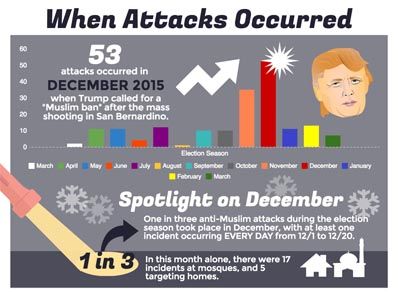
    • As Mr. Trump called for shutting down mosques in the wake of the Paris terrorist attacks and the mass shootings in San Bernardino, California in December 2015, anti-Muslim attacks initially tripled with nearly half of those attacks directed against mosques.
    • Anti-Muslim attacks surged once more in December 2015. There were 53 total attacks that month, 17 of which targeted mosques and Islamic schools and 5 of which targeted Muslim homes. By comparison, when the presidential election season began just 9 months earlier, there were only 2 anti-Muslim attacks. Attacks on Muslims during this month constitute approximately 1/3 of all attacks last year. In fact, in December 2015, anti-Muslim attacks occurred almost daily and often multiple times a day.
    • At least three separate incidents of violence involved perpetrators who were public supporters of presidential candidate Donald Trump. There was otherwise a strong perception among American Muslim leaders that political rhetoric created fertile ground for threats and acts of anti-Muslim violence.
    • While anti-Muslim political rhetoric gives cause for alarm, the ensuing violence has inspired expressions of solidarity with the American Muslim community, too.

    Several additional observations are worth noting here. First, as highlighted above, our research demonstrated a spike in anti-Muslim violence post-Paris attack in November 2015 and again in December 2015, in the aftermath of the San Bernardino mass shooting. While the violence appeared to level off in the beginning of 2016, it still remained 3 to 5 times higher than pre-election levels. Significantly, the Paris and San Bernardino attacks by self-identifying Muslims were also accompanied by anti-Muslim political rhetoric and policy posturing by GOP presidential candidates, including now Republican presidential nominee Donald Trump.

    election1In the immediate wake of the San Bernardino attack, Trump issued a public statement calling for his now notorious ban on Muslim immigration that he continues to revisit and expand upon during press interviews and campaign rallies. It is important to highlight that many of his discriminatory remarks and proposed policies have received massive coverage in the news media, thereby amplifying the reach and impact of Trump’s Islamophobic message. His rhetoric is not only impacting hundreds or thousands of attendees at political campaign events or rallies, but millions of Americans across the country and even more people around the world.

    Second, the violence our report exposes is part of a larger trend of growing Islamophobia that pervades so many aspects of American life today. Indeed, research suggests that there has been a steady rise in Islamophobia in recent years. The FBI’s 2014 hate crime statistics, for example, show that bias crimes generally went down across the board except where American Muslims were concerned. Similarly, in 2015, the Equal Employment Opportunity Commission (EEOC), the federal government agency responsible for handling employment discrimination cases, experienced an increase in religious discrimination claims involving Muslim employees. While Muslims constitute approximately 1% to 2% of the entire U.S. population, their claims account for 40% of cases.

    In addition, anti-Muslim bullying in our schools seems to be getting worse, if not evolving. A recent report from the Southern Poverty Law Center examining the impact of the presidential elections on students found that at least a 1/3 of the teacher respondents saw an increase in anti-Muslim sentiment in their classrooms. Some reported suicidal ideation among some Muslim students related to bias-based bullying. But there is an alarming trend that goes beyond conventional bullying. Whereas we typically think of school bullying as peer-on-peer harassment, research suggests that adults – essentially the very people responsible for ensuring a healthy learning environment – are increasingly the perpetrators of Islamophobia. Indeed, all of these indicators evidence Islamophobia as a growing American problem.

    Finally, as our report suggests, anti-Muslim political rhetoric during the course of the presidential election season has contributed to this very real religious-freedom challenge. It is important to acknowledge other factors, however, that may help contribute to this dangerous phenomenon. The rise of ISIS, as well as actual terrorist attacks on U.S. and European soil, has also played a role, for example. This, together with foreign military interventions in Muslim majority countries such as Iraq and Afghanistan, has contributed to American fears concerning a potential enemy within our borders that constitutes a potential national security threat.

    Additionally, news media coverage of terrorism as an exclusively Muslim phenomenon — even though study after study suggests that a greater domestic threat lies with far right extremists and white supremacists — helps perpetuate the stereotype of Muslims as the “terrorist other.” When an American knows a Muslim or Muslims personally, this helps counter the negative media depictions. Since Muslims only represent about 1% to 2% of the total population, however, the chances of an average American encountering Muslims at work, school or in their neighborhood is slim. Most Americans get their information about the minority faith community from whatever they consume on the computer, TV and smart phones. Research shows that last year alone, 9 out of 10 news media stories about Muslims and Islam in the U.S., U.K. and Germany were in the context of violence: war or terrorism.

    So, is it truly surprising that there is a palpable fear of and hostility towards Muslims, or those perceived to be, particularly in absence of any alternative positive portrayals of the minority community? And, of course, there is the multi-million-dollar Islamophobia industry that has been exposed in the Center for American Progress’s report, Fear Inc., as well as in various CAIR publications. If there is a silver lining to growing Islamophobia in the U.S., it may be the responses of American Muslims — which have proven just as diverse as the community itself — to the stereotyping, bigotry, and threats of violence, which have proven just as diverse as the community itself. During the election season alone, we have witnessed heroic efforts to counter anti-Muslim prejudice and discrimination by the most ordinary citizens, from Rose Hamid to Khizr and Ghazala Khan. We have witnessed social media campaigns from American Muslim women, like #CanYouHearUsNow, to challenge stereotypes about, and attacks against, the minority faith community. We have also seen increased political engagement, from more voter registration drives to visible participation of Muslims at the Democratic National Convention and other political forums. We have also seen American Muslim youth showing extraordinary strength and resiliency in the face of bigotry, from Texan “clock boy” Ahmed Mohamed to Oklahoman Samantha Elauf who took her religious discrimination claim against the popular retailer Abercrombie & Fitch all the way to the U.S. Supreme Court — where she won.

    It’s rather extraordinary.

    election0

  • Scaremongering Around Online Speech Makes No One Safer

    Scaremongering Around Online Speech Makes No One Safer

    The world of social media is a frightening place for many parents of Muslim children. Domestically and internationally, prosecutions of teenagers for terrorism-related offenses often cite social media activity as evidence. Police have created fake profiles to “friend” people on Facebook in order to further investigations. And Black Lives activists have been surveilled online by the Department of Homeland Security. Against this backdrop, some Muslim parents seek to prevent their children from using social media at all, or urge them not to post political views online. Parents should of course care what their children do on social media, as they care what they do offline, for many reasons. Children may not yet fully contemplate the possible repercussions of expressing views or sharing photos or location information publicly. Ultimately, any social media activity presents some reputational risk for anyone, as does any public speech. Privacy settings can alleviate some risk, but certainly not all. Ultimately, parents and families have to make their own decisions about privacy, and weigh how best to encourage children to identify and express their political voices while being aware of the risks.

    Yet we must not confuse our personal choices, even if those choices are to restrict our online presence, with acceptable limits to enforce on society as a whole. While parents are wise to model and encourage awareness of online privacy for youth, we should not abdicate our rights to free speech online, or elsewhere, out of a misguided belief that some rights are superfluous or just too risky in the current political atmosphere. Doing so would seriously undermine public access to information and, consequently, prospects for advancing peace and justice domestically and internationally.

    Capitalizing on Fear to Police Dissent

    Some current efforts to regulate and control dissent disingenuously play upon Muslim parents’ understandable worries about social media, influencing them to push for more surveillance and policing of speech. “Countering violent extremism” (“CVE”) campaigns, for example, are sometimes claimed to provide “off-ramps” from prosecution for Muslim youth who might otherwise be charged with terrorism-related offenses. In this storyline, federal law enforcement has no choice but to prosecute youth who have given indications of potential “extremist” views. Social media is presented as an exceedingly dangerous place for Muslim youth due to terrorist recruiters’ sophisticated use of online platforms. CVE, it is claimed, could provide a safe haven where law enforcement avoid sting operations and prosecutions targeting those who express “vulnerabilities to extremism” (which could perhaps include anger at Western governments, interest in traveling to a conflict zone, or sympathy with victims of the war on terror) and instead engage mental health professionals, imams, and others to implement “interventions” — effectively, political and/or religious deprogramming — upon such a youth.

    What these claims about CVE “off-ramps” overlook or obscure is that law enforcement agencies already have prosecutorial discretion. This prosecutorial discretion empowers federal investigators and prosecutors to avoid engaging in entrapment or overly aggressive prosecutions of every Muslim youth who might subjectively be labelled a potential “extremist.” Yet, in spite of this authority, many prosecutions for terrorism-related offenses are pursued in circumstances constitutional lawyers and other advocates have noted are not only constitutionally unsound but appear to be predatory upon those with mental health or other challenges. It is highly doubtful, then, that CVE collaborations between law enforcement and trusted social service professionals would protect Muslim youth who could otherwise be targeted for terrorism-related prosecutions. It is entirely possible such collaborations could increase the number of youth on law enforcement’s radar who have mental health or other challenges, or who express political dissent on social media.

    At the same time as CVE “interventions” are being promoted to our communities by the FBI and other federal law enforcement agencies, Western governments have pressured social and other tech media companies to regulate speech deemed “extremist” — in ways which are unaccountable to the democratic process or formal channels for redress. In a joint statement criticizing a recent “code of conduct” in which adhering IT companies agree to police controversial online content, European Digital Rights, Access Now, and allied organizations noted the code “creates serious risks for freedom of expression as legal but controversial content may well be deleted as a result of this voluntary and unaccountable take down mechanism.” Allowing our fears about “extremist” speech and of law enforcement targeting of that speech to persuade us to relinquish speech and privacy protections would be deeply misguided. A campaign to counter vague and subjective concepts like “extremism” are not only likely to be used predominantly against dissidents in the most “suspect” of communities — including Muslim communities, Black communities, environmentalists and others — they are deeply harmful to society as a whole.

    Online Speech is Speech

    Limits on permissible speech online should and do exist, but they should remain consistent with limitations on free speech limits offline. For example, in the U.S., “true threats” of violence against someone, incitement to violence (speech “directed to inciting or producing imminent lawless action” and “likely to incite or produce such action”), and libel are all illegal. But the U.S. government may not constitutionally regulate speech based on political viewpoint. Similarly, social media, as with all communications, may provide evidence of a crime. However, in the U.S., constitutional Fourth Amendment protections must apply to protect against unreasonable search and seizure of private communications.

    The First Amendment protects not only our ability to share information, but seek and receive it as well— with good reason. When governments are permitted to treat people as suspects for seeking information, the results are foreseeably discriminatory. States are unlikely to treat all people who seek information about a controversial topic as criminals and suspects. After all, governments employ many analysts who study terrorist movements and rely on the research of others. But in a landscape in which seeking knowledge makes you a potential “extremist,” identity-based distinctions, as to who is permitted and who is not, are likely to be drawn among those who seek knowledge. As the case of a Muslim terrorism researcher in the U.K. illustrates, being a member of a suspect community may consign you to be perpetually the subject of other people’s studies, never permitted to conduct your own.

    Punishing Online Dissent

    One of the primary ways social media differs from traditional media and spoken speech is in its democratizing impact. Social media theoretically provides anyone, regardless of funds or viewpoint, with an opportunity for a broad audience. Activist movements whose views do not align with the dominant print, television, and radio outlets can and do share information — including evidence of human rights abuses, and practical information to help keep activists safer — through social media.

    Social Media therefore plays an essential role in spreading information about social justice struggles, including through drawing international attention more rapidly than otherwise results from traditional media channels. Yet as social media has become more popular, online speech has also been aggressively regulated in many countries in ways that criminalize viewpoints.

    The prosecution of Azhar Ahmad, a young British Muslim, is one prominent example. In 2012, Ahmad was convicted of “sending a grossly offensive communication,” for having posted on Facebook his views following the killing of six British soldiers, citing his anger at the inattention to the violence against innocent Afghanis and stating he believed the soldiers deserved to die. Many readers of Ahmad’s post would find it deeply offensive. But whether something offends is an inappropriate and dangerous test for whether it is criminal. We cannot, and should not attempt to, criminalize disagreement into silence. Discussing Ahmad’s prosecution in the Guardian, Ralph Seymour observed, “it [was] disloyalty that [was] being punished, in a racialised way. The action of the police and courts is about constituting a new field of punishable conduct. And when disloyalty is punished, there really isn’t much that can’t be included under its canopy.”

    It is entirely foreseeable that governments that prosecute political speech do not prosecute all speech that offends. Unsurprisingly, the viewpoints governments criminalize tend to be those that dissent from the official state narrative. Reflecting on Ahmad’s prosecution and on the 20,000 cases of social media postings investigated by UK police between 2012 and 2015, Glenn Greenwald noted, “It is … extremely difficult to imagine that Facebook users who sanction violence by the UK in Iraq and Afghanistan, or who spew anti-Muslim animus, or who call for and celebrate the deaths of Gazans, would be similarly prosecuted. In both the UK and Europe generally, cases are occasionally brought for right-wing ‘hate speech’ … [but t]he real punishment is meted out overwhelmingly against Muslim dissidents and critics of the West.”

    When we recognize the reality that regulations on political speech are not, and perhaps cannot be, applied equitably, it is easy to predict that states that police political speech will target activists who challenge their own state violence. And indeed they have. Bahraini human rights activist Nabeel Rajab, who heads the Bahrain Center for Human Rights, was arrested in April, 2015 for tweets criticizing the war on Yemen by a Saudi-led coalition, of which both Bahrain and the U.S. are a part. Charges against him include spreading “false or malicious news, statements, or rumors,” “offending a foreign country” (Saudi Arabia), and “offending national institutions” (the last charge based on his speaking out about torture in the prison in which he was held).

    While outspoken human rights activists are generally aware the regimes they criticize may seek to silence them, including through speech regulations where possible, the questions, issues, and fears that speech regulations present for the general population are also destabilizing and counterproductive. The ability of governments to impose fear and uncertainty on a citizenry about the permissible limits of their speech is a powerful tool for enforcing social conformity and political control. This consequence has been observed in Russia where, according to the Associated Press, in 2015, at least 54 people (out of 233 convicted) were sentenced to prison for social media “hate speech.” Russia’s extremism law criminalizes promotion of, among other things, the “exclusivity, superiority or inferiority of citizens” based on religion, and according to the U.S. Commission on International Religious Freedom, the weight of this law has been borne primarily by Muslims. The Director of Sova, a Russian human rights group, described the impacts of arbitrary prosecutions for “extremist” social media speech: “No one knows where the red line is: It’s like roulette.”

    The Right, and Responsibility, to Speak

    In the U.S., guarding against efforts to restrict dissenting speech — many of which focus on “hate speech” or “extremism” — has been an ongoing necessity. Neither “hate speech” nor “extremism” are currently criminalized in the U.S. — nor should they be. Due to our robust First Amendment, speech may not constitutionally be restricted based on viewpoint. And there are multiple dangers in criminalizing “hate speech” or “extremist speech.” Not only are subjective terms like “hate speech” and “extremism” difficult to define, governments tend not to apply them equitably. Such regulations also drive radical dissent, including hateful dissent, underground where it is more difficult to challenge, undermining the ability of society to advocate in an informed way for just and peaceful solutions to societal problems.

    But recognition that restricting adversarial political speech — whether by labeling it “hate speech,” “extremist” or otherwise — would be unwise, impractical and unethical does not counsel in favor of our own silence. A corollary to robust speech protections is a responsibility to challenge hateful ideas with which we disagree — and not only when they emanate from the fringes of the political spectrum. As the writer Kenan Malik observed in an interview for The Content and Context of Hate Speech: Rethinking Regulation and Responses, “[W]e should be clear that what often legitimizes bigotry are the arguments not of the bigots but of mainstream politicians and intellectuals who denounce bigotry and yet accept bigoted claims… Challenging bigotry requires us to challenge the mainstream ideas that give it sustenance, and to campaign against those discriminatory social practices and laws that help make the arguments of the racists, the sexists, and the homophobes more acceptable.”

    This principle is particularly apt in our current political climate, where in the U.S., election year rhetoric has led many to condemn various politicians’ bigoted statements, but comparatively little corresponding attention has been paid to current policies and practices — such as racialized policing of Black, Latino and Muslim communities under “public safety” or “national security” pretexts — which are supported by identical, if unspoken, racism. In ostensibly democratic societies, governments rely on an informed and active populace to operate in ways that promote peace and justice. Informed members of the public can more effectively advocate than those who are terrified of accessing information or expressing “extreme” views. We must therefore reclaim and maintain strong protections for social media speech, as for traditional speech. This reclamation requires us to have the courage to reject attempts to paint “extremist” views as criminal, and instead to advocate vocally for the kind of government and policies with which we want to live.

  • Latinos Make America Great Again, and Again

    Latinos Make America Great Again, and Again

    The current presidential race has left many unbiased Americans stunned and not-so-broadminded others rejoicing, as we all witness a surge in derogatory attacks by candidates against entire minority groups, such as Muslims, African-Americans, and immigrants, particularly Latinos/Hispanics. The drama continues to unfold in what could potentially be the most controversial election in the history of the United States of America. While unity has often been declared the focal point in shaping American society, this election has polarized the American people and contributed to a rise in racially-driven violent hate crimes, xenophobia, and islamophobia.

    Republican nominee Donald Trump and his GOP rivals who fell to the side during the primaries, like Ben Carson and Ted Cruz who are, ironically, descendants of immigrants or minorities themselves, have all contributed their share of attacks against members of the Islamic community and Latinos, through their campaigns, town hall meetings, news interviews, and even through social media. Their xenophobic and Islamophobic rhetoric questioning the allegiance and morality of Muslims and Latino immigrants, is reminiscent of the Second Red Scare during the McCarthy era, in which a hysterical fear of communists (Reds) caused panic throughout the U.S.

    Of course, the most vocal of the GOP presidential hopefuls and the most controversial has been Trump, the business tycoon and former reality TV personality who starred in NBC’s The Apprentice from 2004 to 2014. Trump has since laid to rest his famous catch phrase, “You’re fired!” and replaced it with his campaign slogan, “Let’s Make America Great Again.” He began his primary race for the Republican nomination with harsh criticisms of Mexican immigrants. Speaking from the Trump Tower Atrium in Manhattan on June 16, 2015, he said, “When Mexico sends its people, they’re not sending their best. They’re not sending you. They’re not sending you. They’re sending people that have lots of problems, and they’re bringing those problems with us. They’re bringing drugs. They’re bringing crime. They’re rapists”; after smearing almost the entire Mexican population, he sympathetically added, “And some, I assume, are good people.” One of Trump’s diehard political plans to curb illegal immigration from Mexico is to build a wall separating the border between the U.S. and Mexico. He claims that the Mexican government will be paying for the construction of the wall, and Trump has even outlined exactly how they will be persuaded to do so on his promotional website.

    History Provides a Deeper Perspective

    In order to understand the level of absurdity in the statements about Mexico and the Mexican people, it becomes necessary to explore the history of the United States and its southern neighbor. What is today Mexico, Texas, Arizona, New Mexico, Colorado, Utah, and California were once colonies belonging to Spain. In 1822, Mexican settlers, following the example of the American Revolution, rebelled against the Spanish government and won their own war of independence. Less than 25 years after Mexico became a free nation, by 1846, the U.S. had invaded and entered into war with Mexico in order to obtain their territories north of the Rio Grande River and westward all the way to California. In 1848 Mexico surrendered to the terms set by the U.S., transferring ownership of New Mexico, California, Texas, Utah, most of Arizona, Colorado, and Wyoming, for $15 million (An Historic Overview of Latino Immigration and the Demographic Transformation of the United States, David G. Gutiérrez, PhD., University of California).

    These states were already populated by Mexicans; 75,000 to 100,000 former citizens of Mexico chose to remain north of the new border at the end of the war and were granted automatic citizenship by the U.S. government (The Treaty of Guadalupe Hidalgo: A Legacy of Conflict, Norman: University of Oklahoma Press, 1990). In reality, while Trump and his followers blame Mexicans for stealing jobs from Americans, bringing crime to the U.S., and causing other problems, the fact is that much of the Western part of the U.S. was built and inhabited by Mexicans. It was, in reality, Americans who first sent troops over the border in order to incite a war against Mexico and gain territorial dominance.

    Immigration from Mexico into the U.S. thereafter became a complicated love-hate relationship, where the U.S. government would open its borders and welcome Mexicans to come and perform jobs that Americans were either unable or unwilling to do, and later would begin mass deportation when Mexicans were no longer needed or desired. Beginning in the late 1800s, U.S. companies began to fill a rising demand for labor in agriculture, mining, construction, and transportation with Mexican laborers. During the Great Depression, when average Americans were struggling to find jobs, local, state, and federal government agencies began forcing Mexicans out. A short time later, when the U.S. entered World War II and experienced a farm labor shortage, the Federal Government signed an agreement with Mexico to allow Mexican workers to again enter the U.S. and work. Much the same pattern has ensued ever since.

    This is America, Speak Spanish!

    In a childish move during the GOP primaries, Donald Trump insulted former opponent, John Ellis “Jeb” Bush, by tweeting, “Jeb Bush is crazy, who cares that he speaks Mexican, this is America, English !!” (Twitter account, @realdonaldtrump, Donald J. Trump, 7:14 PM – 24 Aug 2015). There are many things wrong with this ignorant statement. First of all, Trump confused the nationality, Mexican, with the language, Spanish, a simple fact that everyone hopes a candidate to the presidency of the U.S. would know. Secondly, the statement, “this is America, (speak) English!” implies that as Americans, everyone should give up their native tongues and trade them for English only. It is a matter of fact, however, that America consists of both North and South America, and the vast majority of the Americas is Spanish-speaking. Not to mention that hispanophones (those who speak Spanish) inhabited or explored territories of the present-day U.S. way before English settlers stepped foot on the land.

    Spanish is the second most widely spoken language in the world and, more specifically, in the U.S. It is also the language most studied by Americans. The Spanish influence in the nation is everywhere from the names of states, counties, and cities, such as Florida, Colorado, Montana, Nevada, Las Vegas, Santa Fe, El Paso, etc., to the names of bodies of water, valleys, forests, mountains, and forts. American English has borrowed common, everyday words from the Spanish language as well, such as rodeo, ranch, banana, alligator, armadillo, barbecue, and chocolate. The bottom line is this — not only the Spanish language, but Latino/Hispanic culture as well, are deeply woven into the fabric of U.S. history and heritage.

    Understanding the Latino/Hispanic Identity

    Some people not so well-versed in geography, often categorize all Latin-Americans as Mexican. However, there are a total of 21 countries in the world where Spanish is the official language. The majority of those are in Central and South America, as well as the Caribbean. Mexico is the only Spanish-speaking country that shares a border with the U.S. Thus, the majority of Hispanics in the U.S. are Mexican or of Mexican origin (64.6 percent in 2011 according to the Pew Research Center). However, all Spanish-speaking countries are represented throughout the U.S.

    The Merriam-Webster dictionary defines a Latino as “a person who was born or lives in South America, Central America, or Mexico or a person in the U.S. whose family is originally from South America, Central America, or Mexico”; whereas Hispanic means “coming originally from an area where Spanish is spoken.” Hispanic origin is based on ancestry, lineage, heritage, nationality and/or country of birth and, therefore, Hispanic people come from a variety of countries, backgrounds, and social strata. Whites, blacks, and Asians are all considered racial groups. Hispanics are an ethnic group, which means that although they share a common language and heritage, they do not share a common race. They can be black or white or Asian, or be descendants from indigenous peoples of a place colonized by Spain.

    South American and Caribbean Hispanic immigration in the U.S. experienced the fastest growth beginning in the mid-1900s until the present day. According to the U.S. Census Bureau, as of 2013 more than one-quarter (28 percent) of the foreign-born population in the U.S. came from Mexico, 9.6 percent from the Caribbean, 7.7 percent from Central America, and 6.7 percent from South America.

    Latin-American Contributions to the US

    Hispanic immigrants, as well as second and third generation immigrants from Latin America, have had a major impact on shaping the course of U.S. history. They strengthen the economy, serve in the military, defend the country during times of war, and hold offices in government. In addition to influencing the political sphere, they have also had significant imprint on American culture, arts, sciences, and education. Entrepreneurship in the Latino community helps the U.S. economy tremendously. According to the American Immigration Council, “One out of every five people in the country is Latino or Asian. Together, Latinos and Asians (both foreign-born and native-born) wield $2 trillion in consumer purchasing power, and the businesses they owned had sales of $857 billion and employed 4.7 million workers at last count. Immigrant, Latino, and Asian workers, taxpayers, and entrepreneurs are integral to the U.S. economy—and they are a potent electoral force” (Strength in Diversity: The Economic and Political Power of Immigrants, Latinos, and Asians, January 1, 2015).

    Back in June of 2013, Donald Trump tweeted, “Sadly, the overwhelming amount of violent crime in our major cities is committed by blacks and hispanics-a tough subject-must be discussed” (Twitter account, @realdonaldtrump, Donald J. Trump, 4:05 AM – 5 Jun 2013). He reiterated this sentiment in 2015 when he accused Mexicans of being rapists and drug dealers. However, nothing can be further from the truth. In a special report, published on July 13, 2015 by the American Immigration Council, entitled The Criminalization of Immigration in the United States, researchers affirm that, “immigrants are less likely to commit serious crimes or be behind bars than the native-born, and high rates of immigration are associated with lower rates of violent crime and property crime. This holds true for both legal immigrants and the unauthorized, regardless of their country of origin or level of education.” In addition, Census data from 2010 found that the incarceration rate of undocumented immigrant men from countries such as Mexico, Guatemala, and El Salvador is significantly lower than that of males born in the U.S. In other words, what the American people are witnessing during this presidential election are outright lies and sensationalist propaganda used to sway public opinion and stir controversy in order to garner attention, support, and votes from a xenophobic sector of the American constituency.

    Just as all racial, ethnic, and religious groups are part of the diverse and vibrant fabric of the U.S., Hispanic Americans are revitalizing the nation’s diversity as contributors to society, doing their part to uplift and uphold the standards that make this country great. There are countless Latinos and descendants of Latinos serving the nation as government officials, lawyers and judges, advocates and activists for social justice, and military personnel. There are Latino athletes, with immigrant parents, who proudly competed for Team U.S.A. in the just-completed 2016 Olympics. There are Hispanics contributing to all sectors of society, from the laborers who work to build the residences and commercial spaces where businesses thrive to the entrepreneurs providing opportunities for countless Americans to work; from the Latino teachers who contribute to the education of our youth to the doctors who provide healthcare. All are working for the benefit of themselves, their families, and the collective American success story.

    Immigrants in this country work hard to make a better life, and they do not take their new home for granted, but rather cherish the opportunities it provides. This is the United States of America, and they are an integral part of the whole, striving to fulfill the U.S. potential as a tolerant and inclusive land of great hope and opportunity for all its inhabitants, as well as a beneficial force for good throughout the world.

  • Model for Civic Engagement – Dar al-Noor Masjid (MAV) in Manassas, VA

    Model for Civic Engagement – Dar al-Noor Masjid (MAV) in Manassas, VA

    Civic engagement for America’s Masajid could not be more crucial than now. America is facing challenges that can only be overcome by propelling the voices of reason into public and civic life and driving the voices of bigotry and closed- mindedness out of the public spotlight. We are facing the public rise of anti-Islamic sentiment while some of the country’s political leadership, both at the local and state levels and in Washington, D.C., have become detached from reality. Consequently, the safety and security of our families have become a growing concern for everyone. Muslim-Americans must engage in the civic arena in order to ensure, by Allah’s permission and will, that we contribute to the betterment of America, something that we, and all fair and decent citizens, want for ourselves and for our children.

    With civic engagement, your Masjid will have a voice in government decisions both big and small; your Masjid can achieve solutions for issues in the community; and your Masjid can do its part to ensure social justice and equality for all – with Allah’s guidance and help. Muslim-Americans’ civic engagement with their communities and our participation in the political process is a mutually beneficial affair. Engaging with our elected and public officials guarantees that the voices of Muslim-Americans are heard, especially on topics such as presenting accurate information about Islam, countering terrorism and violence in our communities, and finding sensible solutions to community issues.

    The Muslim Association of Virginia (MAV) has, in fact, been active in the civic arena for some 16 years now. Alhamdulillah, MAV has been successful in achieving major accomplishments for our community including the successful defeat of the anti-Sharia legislation in the Virginia Congress; the introduction and passing of a Halal bill in Virginia to regulate the labeling, identification, and sale of Halal products; lobbying for legislation granting students a religious holiday for Eid; and active voter registration which resulted in registering over 200 voters during Ramadan this year.

    MAV has identified some crucial steps and activities in a successful civic engagement program, and encourages all Masajid and Muslim organizations who have not already done so, to develop their own civic engagement program. Some of the steps and activities include:

    Set Up Voter Registration

    Your primary leverage with elected officials is demonstrating that you represent a large group of voters. In order to effectively represent your Masjid, you must ensure that its members are registered to vote. There are two ways to accomplish this goal: (1) your Masjid can set up its own voter registration team with registration tables at Jumu’ah prayers; or (2) you can bring in an outside organization that focuses on getting voters registered.

    Provide a Forum for Community Engagement

    The Masjid is a perfect space for school board or town hall meetings, and for debates between local, regional, and even national candidates. Not only does this benefit your community by bringing the information directly to your Masjid, but this also allows some non-Muslim members of the community an opportunity to set foot inside a Masjid for the first time in their lives. That opportunity to introduce community members of other faiths to your Masjid and their Muslim neighbors is critical to the success of your civic engagement program.

    Assist Homeless Shelters

    Show your community how vital charity is in Islam. Assist with food drives, help find shelter for families in need, visit the elderly at senior centers, become mentors/tutors for disadvantaged youth, volunteer at local schools or hospitals — your involvement in charity outside the Masjid demonstrates that you are dedicated to improving the community and, more importantly, that we care about our fellow citizens, Muslims and non-Muslims alike.

    Build a Relationship with Local Law Enforcement

    The security, good will, and community building that your Masjid receives from fostering a good relationship with local law enforcement is vital to the success of your civic engagement program. When a tragic event injures or takes the life of an officer protecting your community, be proactive about supporting the police station and the families of the officers. Your support of law enforcement events, memorials, and parades establishes a relationship of trust between the Masjid, its community, and local law enforcement. Inviting local law enforcement leaders to the Masjid is a great way to begin that relationship.

    Encourage Members of your Masjid to Get Involved

    Members of your Masjid should strive to serve on school boards, commissions, and civic associations, and to run for elected office. Having Muslims in those positions amplifies the voice of your Masjid and the Muslim community, from the grassroots level and up.

    Participate in Public Events

    Announce at your Masjid public events like parades and 4th of July celebrations and encourage attendance. If possible, provide transportation to such events to ensure turnout and that your community supports these events as a unified group. The more the wider community interacts with the members of your Masjid, the more successful your civic engagement program can, and will be, insha’Allah.

    Offer Elected Officials Speaking Time During Jumu’ah and Eid Prayers

    Invite local, state, and federal elected officials and candidates to speak at your Masjid. This benefits your Masjid in the following ways: 1) gives your members an opportunity to hear directly from officials and candidates; and 2) offers an opportunity for your members to speak directly to their elected official, asking questions to learn where that official stands on important issues. Set aside time (approximately 10-15 minutes) before the start of prayers to allow elected officials to speak to your community (for those officials who did not get to speak, acknowledge them and their attendance). It is vital that you make every effort to invite all candidates who are running for an elected office, regardless of party affiliation. Ensure that you are keeping a record of those invitations so that the non-profit status of your Masjid is protected and not placed in legal jeopardy.

    Support Sensible Elected Officials Regardless of Party Affiliation

    Do not engage with only one side of the political spectrum. Not every issue your Masjid encounters will be a shared concern of the major political party you (may) typically affiliate with. There are sensible elected officials in every party and it is important to have the opportunity to speak with them and raise issues, regardless of their political affiliation.

    Work Towards Common Goals

    When you engage an elected official, work towards achieving common goals rather than debating divisive issues. Your Masjid’s civic engagement program cannot solve every issue. Identify what issues are feasible for that elected official to accomplish and focus on those. Aggressively pursuing issues that the elected official is strongly opposed to, or where an agreement cannot be achieved, will usually result in little being accomplished and can burn rather than build bridges of understanding and cooperation. Choose your battles carefully.

    Organize with Others When Meeting Elected Officials

    Communicate with other Masajid, interfaith organizations, civic organizations, and local entities to encourage leaders from those organizations to attend meetings with elected officials alongside you. Showing unity and representation of a large voting bloc is important when speaking with elected officials. Don’t show up at the elected official’s office with a mob, however. Carefully choose leaders that represent a variety of organizations with goals and concerns in common with your Masjid.

    Know your Strengths and Abilities

    If you know you have large numerical or widespread support in the community – and can demonstrate or document it – strategically and tactically let officials know. Do not be hostile or overbearing at any time. Do not exaggerate your capabilities and strengths. Accentuate your good relations with other elected officials who support your position(s) and who may be allies to the particular official you are meeting with. Be organized in your presentations, making sure to highlight the key objectives or issues on your list.

    Establish Interfaith Engagement

    Reach out to other faith organizations in your area and work with them in all aspects of your civic engagement program. They likely already have some activities and strategies in place and may be willing to share what they have learned. And many faith organizations share similar values with Muslims. Remember, the more unity, the better!

    Promote on Social Media

    Remember that most Americans get their news and social views from what is on their social media feeds. Promote your Masjid and community events on social media and connect with other local organizations and your wider community.

    Determine the Intentions of Those Who You Engage With

    There are three reasons why another organization or an elected official is engaging with your Masjid:

    • They are focused on the best interests of the community
    • They are there for their own self-interest
    • They just need your Masjid for a photo opportunity
    • Know what you want to accomplish with those your Masjid engages with and focus your efforts on those who can produce positive results.

    Designate a Credible Spokesperson

    Your Masjid’s civic engagement program must have a credible spokesperson who can meet with elected officials, other organizations, and the wider community to successfully engage in the civic arena. The designated spokesperson does not need experience in politics; they just need to be able to accurately and effectively convey the community’s issues and messaging to elected officials.

    REMEMBER:

    In order for 501(c)(3) organizations to participate in civic political engagement, they must invite all candidates who are involved in an election and they must announce that they do not endorse or oppose any candidate.
    ——
    This article is compiled by Dar al-Noor Masjid (MAV) in Manassas, VA.