بسم الله الرحمن الرحيم

Tag: Latino Muslims

  • Why Muslims Need to Talk About Hispanic Heritage Month

    Why Muslims Need to Talk About Hispanic Heritage Month

    One of my earliest experiences at an Islamic conference was when I attended the ISNA Convention in Washington D.C. over two decades ago. It was the first time the Islamic Society of North America held its annual convention in D.C., after establishing it in Chicago for the previous 38 years. It was also its first large event after the attacks of September 11, 2001. The inaugural session of the 39th Annual Convention in 2002 opened with a solemn prayer for the victims of the 9/11 terrorist attacks. The theme of the convention was “A Call for Peace and Justice,” and began with moving speeches from a multitude of Muslim leaders from around the country. Among the many leaders who made statements during the opening session was Imam Benjamin Pérez, whom I would later meet at a session by and about Latino Muslims.

    Prior to leaving my house for the conference, I grabbed a pin with a Puerto Rican flag and secured it on my hijab, above my heart. I had only been Muslim for three years, and I was living in Maryland at the time. I did not know many Latino Muslims personally, so I held the hope that if there were any present at the ISNA convention, they would notice my pin and approach me. As I zigzagged through the crowd of Muslims, hoping to spot another Puerto Rican or Latin American, I was utterly disappointed. In the sea of familiar-looking faces, there was not one that shared my background. But just when I started to lose hope, a friend pointed out a session on the convention’s printed program.
    There was a panel discussion about Islam among Latino Americans whose speakers included Muslims with Spanish names. When I checked the session’s time, I realized that it had already started, so I took note of the hall number and sprinted there. When I made it to the conference room completely out of breath, it was packed. There were only a few seats left, so I made my way to an empty chair and sat down to listen, in awe of the mostly Latino Muslim panel. It was the first time I heard Muslim leaders who shared some of my cultural background. The panelists included Mexican American Imam Benjamin Pérez (may Allah have mercy on him), a Dominican brother named Isa Contreras, and others. They spoke about the growing number of Latin Americans embracing Islam, their own experiences embracing Islam in their respective communities, and the work that still needed to be done to bridge the gap between Muslims and our Spanish-speaking neighbors.

    After their presentations there was a question-and-answer session, so I eagerly stood up, approached the available microphone, told them my story, and asked how I could get in touch with other Latino Muslims. I think I was still catching my breath when I suggested I get the contact information of the Latin American Muslims on the panel so I could stay in touch with them. Finding others like me was important, because even though Muslims all constitute one brotherhood and sisterhood, human beings tend to seek out people of similar backgrounds and experiences. Through this meeting, I was introduced to the Latino American Dawah Organization (LADO) led by Mexican American Juan Galvan, whose online presence on Yahoo! Groups allowed me to connect with Latino Muslims from around the country.

    In the following years, I would develop relationships, join dawah efforts, and volunteer at different organizations to translate material into Spanish. Eventually, when I married another Hispanic convert, together we founded an organization called Hablamos Islam(We Speak Islam) with the purpose of creating educational resources about Islam in the Spanish language, with Latino families in mind. Eventually, it also evolved into creating programming and literature for children. Dawah organizations often forget to factor the youth into their outreach efforts, but when Latino families are entering the faith in rising numbers, it is only natural that they need educational tools for their children. I learned this firsthand. During this whole process, I had children of my own, and now my eldest is in his late teens. Although Latino Muslims were becoming increasingly visible– seeking higher Islamic education and forming their own organizations and programs – there were (and still are) areas of outreach that are lacking.

    Fast-forward over twenty years later to 2023. Allah has a way of bringing things full circle. A few months ago, I had the pleasure of helping to organize and participate in the Spanish sessions at the ICNA-MAS Convention 2023 in Baltimore, Maryland. I was not a newcomer, having been involved in the planning of Spanish language, convert, and sisters’ programs since 2010. Yet after over a decade of involvement in the weekend-long, eman-boosting conference, I noticed something different in the audience. This time as I sat on a panel with two other Latino speakers, I saw something incredible. Two young couples walked into the hall, and I recognized the wives – both were South Asian and daughters of two sisters I knew personally but I had not seen since the Covid lockdowns began in early 2020. I would have wondered why they were walking into a Spanish-only session had it not been for the gentlemen beside them. The girls had gotten married recently and both their husbands were Latinos. The two young men had converted to Islam, one Mexican and the other Guatemalan.

    The theme of this past year’s convention was “Preserving Faith, Building the Future,” and I was speaking about the importance of educating our families about Hispanic Heritage. And there in front of me was an example of what a future looks like where Latino Muslims and those of all different backgrounds come together to not only coexist but accept one another as equals. Twenty years after that panel of Latino Muslim speakers called for the Muslim ummah to recognize and reach out to Latinos, we have a thriving community of intercultural couples, generations upon generations of Latin American Muslims, Latino organizations, imams, and even Latino-led Islamic centers serving the needs of our community. Nevertheless, there is still much work to be done.

    The Importance of Learning About Hispanic Heritage

    As Muslims, we have an obligation to seek knowledge. Prophet Muhammad (peace be upon him) said in an authentic hadith: “The seeking of knowledge is obligatory for every Muslim” (Ibn Majah).This teaching emphasizes the importance of acquiring knowledge to strengthen our faith and deepen our understanding of Islam.

    Part of this knowledge entails examining our own history, including Hispanic heritage, and understanding its relevance within the broader context of Islamic history. By doing so, we not only honor our diverse cultural roots but also forge a stronger connection with our Latino brothers and sisters. Just as there are initiatives to honor other members of our community, we should also highlight the stories of Latino Muslims. I even dare say we need to prioritize Spanish outreach in every American masjid.

    Preserving and sharing our faith is part of our collective responsibility. We have a graphic description of what happens when we ignore this sacred duty. Allah says in the Qur’an: “O believers! Whoever among you abandons their faith, Allah will replace them with others who love Him and are loved by Him. They will be humble with the believers but firm towards the disbelievers, struggling in the Way of Allah, fearing no blame from anyone. This is the favor of Allah. He grants it to whoever He wills. And Allah is All-Bountiful, All-Knowing” (5:54).

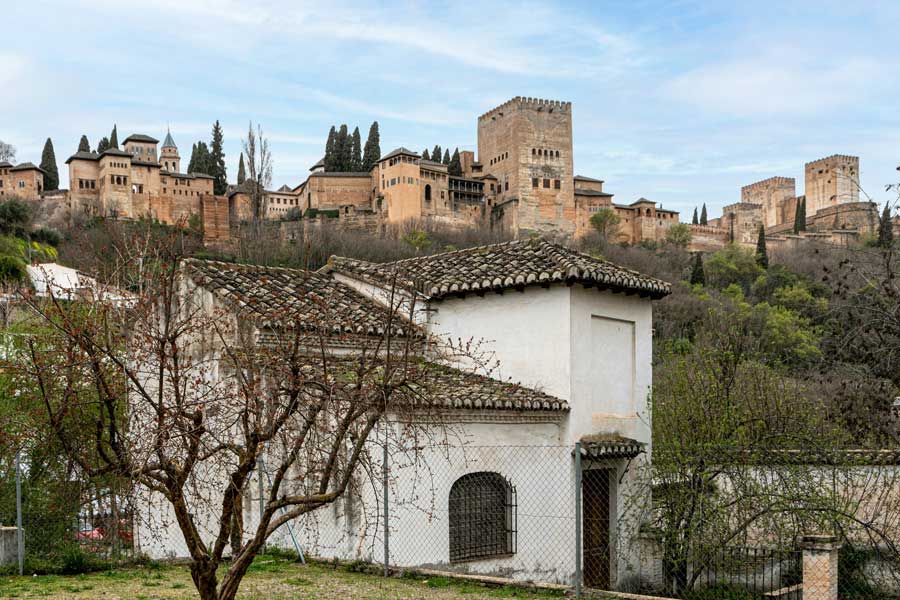
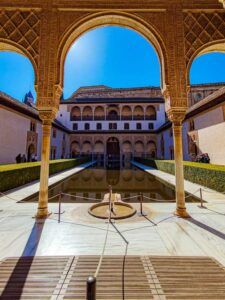
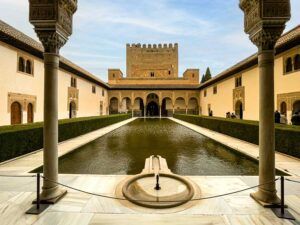
    We cannot continue lamenting what was lost and ignoring the blessings and opportunities we have in front of us. For example, despite the expulsion of Muslims from Spain, the influence of their culture and knowledge is reflected in the architecture, art, and traditions of Latin America. Although many Muslims from Al-Andalus were banished or forced to hide their faith, some found refuge in Latin America. Likewise, when enslaved African Muslims landed in the New World, they brought their faith with them. Over time, their practice of Islam faced challenges due to persecution and the necessity for discretion.

    When the hope of Islam’s survival in the Americas seemed lost, later waves of Muslim migrations from various parts of the Islamic world reintroduced Islam in every Latin American country. This is evident in the hundreds of mosques towering over cities in countries like Brazil, Venezuela, Uruguay, Mexico, and the Dominican Republic, and the millions of Muslims currently living in those various places. The Latino Muslims in America can trace their ancestry to Al-Andalus, North and West Africa, as well as to the Muslim immigrants who continue to contribute to the mosaic of Islamic heritage in Latin America.

    Remarkably, the descendants of the Muslims who suffered persecution and gradually lost their faith in a strange world walk among us and are reconnecting with their Islamic roots. Perhaps they are the answer to the prayers of our ancestors in Spain and Africa. How do we honor them? It takes more than just Hispanic Heritage Month.

    Doing Our Part

    To effectively pay tribute to our ancestors and nurture our growing Latin American Muslim community, we should consider the following course of action:

    As Non-Latino Muslims

    1.  Extend your support to Latin Muslim organizations, recognizing them as invaluable assets for advancing Islamic education among Latino Muslims and nurturing a strong sense of community and belonging. There are Latino-led groups offering their unique talents and services all over the U.S. Find an organization in your area, and contribute your time, energy, and/or other resources.
    2.  Show your backing for Latino Muslim-owned businesses and products to support their economic growth and sustainability.
    3.  Raise awareness about the rapidly increasing population of Latino Muslims in the United States. Host open houses and community events to engage both Latino Muslims and non-Muslims.
    4.  Consider offering scholarships that enable Latino Muslims to gain a deeper understanding of Islam and prepare them to assume leadership roles within their communities.
    5.  Invest time in learning about Latin America and the presence of Latino Muslims in the U.S. Explore their contributions, diverse cultures, and varied backgrounds, to gain a greater appreciation for the rich tapestry of their heritage. Be open-minded if your son, daughter, or other relative wants to welcome a Latino Muslim into your family. It may be the beginning of a beautiful connection like the two I witnessed recently.

    As Latino Muslims

    1.  Develop tailored resources and educational institutions that cater to the specific needs of our community, from the youngest to the oldest.
    2.  Educate others about our unique experiences and the essence of being Latino/Hispanic within the context of Islam.
    3.  Facilitate the dissemination of information and organize classes conducted in Spanish to ensure accessibility for everyone.
    4.  Pave the way for the establishment of mosques, Islamic centers, and schools dedicated to providing Islamic education within Latino Muslim communities.
    5.  Foster collaborations with like-minded organizations to furnish essential tools and curricula, and to provide scholarships to develop proficient educators, thereby enriching educational opportunities for Latino Muslims and their families.
    Understanding Hispanic Heritage should extend beyond a mere month of commemoration. There should be a year-round effort to educate our communities about the importance of outreach to Hispanic/Latinos. In addition, Islamic centers need to reach out to dedicated Latino Muslim leaders, educators, and volunteers to organize inclusive programs that can consistently promote awareness and appreciation. There is a wealth of materials including books, online resources, programs, and courses available in both Spanish and English, specifically catering to, and celebrating Latin American Muslims. Many of these have been created by and for Latinos and deserve our support. As we look ahead, let us aspire to further advancements in acknowledging this growing community within our ranks over the next twenty years. For additional reading, here is a list of books about Latin American Muslims.

  • Representation Matters: Islamic Books for and with Latino Children

    Representation Matters: Islamic Books for and with Latino Children

    Fifteen years ago, my husband and I, both Latino converts to Islam, welcomed our first son to this world. Alhamdulillah, he was the first Muslim child born into our families, a blend of Puerto Rican and Ecuadorian heritages, and born here in the U.S. His fitra, that innate faith in one supreme creator, was untainted, unlike ours had been. He does not have to discover Islam in his teens or twenties like his parents did. We named him Uthman, after the third khalif in Islam, who was married to Ruqayyah, and upon her death, married Umm Kulthum. Both were daughters of Prophet Muhammad (s). So, Uthman was the son-in-law of the Prophet two times. He was thus given the name “the bearer of two lights.” And so began our Muslim parenting journey, one that we are still striving to navigate efficiently as more and more challenges and blessings present themselves.

    As convert parents, our objective is to raise righteous Muslims by Allah’s will. As Latinos, we endeavor to preserve our culture within the parameters of Islam. We learned early, despite what we heard from some well-intentioned Muslims, that Islam does not require us to give up our cultural identity. In fact, Islam is part of our rich history as Latinos – an inheritance bequeathed to us by our ancestors, but one that has been buried and almost forgotten. Unfortunately, this reality has not been explored enough in contemporary circles of knowledge. Muslims from other parts of the world do not consider Latin America part of the Islamic narrative. Yet, as more of us return to Islam, we are unearthing this truth and we are eager to pass it on to our children with pride.

    When we began searching for Islamic books and material to teach our first son in our native language, we were unsuccessful. However, as a mother who wanted to instill a love of reading in my child, I settled with purchasing books in English and translating them into Spanish simultaneously as I read them to my son. Soon I began reaching out to publishing companies that specialized in Islamic books and offered to translate their children’s books. After receiving no response or downright rejection because, according to them, there was “no market for Spanish material,” I realized that if I wanted books for my children in Spanish, I would have to create them.

    Thankfully, I love writing as much as I love reading, but I knew from my experience with traditional Islamic publishers that it was unlikely my manuscripts would be accepted. My husband and I investigated self-publishing, and after investing our own capital, we published our first bilingual Islamic children’s book in 2010, titledA Veil and a Beard. Other books followed, including a series on the Prophets, a book about Ramadan and one on Friday prayer, an artistic representation for children of the hadith of the angel Gabriel, and others. We sought support from friends and family through our non-profit social project and dawah organization, Hablamos Islam, Inc. Due to a high demand for these books all over Latin America, we have been able to supply needy communities with Islamic children’s books in their own language in over a dozen countries. Alhamdulillah, we also began creating children’s programming in Spanish on our YouTube channel, Hablamos Islam, that has been viewed in over 40 countries worldwide. Nevertheless, this was not enough.

    The Only Latino Children in Their Islamic Schools

    After my first, then second, then third child entered school, I began to see another concerning trend. The three of them were the only Latino children in their Islamic schools. As such, they experienced some alienation and bullying. My eldest was often taunted by his classmates who called him Mexican and said he ate tacos, despite him telling them that he was half Puerto Rican, half Ecuadorian and tacos are not a staple of either country. My second son’s teachers complained about his behavior and suggested that the reason for his troubles in class were due to him not having many Muslim relatives as role models (because we were converts). She did not consider that perhaps his issues resulted from him feeling alienated from his peers. My sons’ last name, Guadalupe, was always mispronounced and ridiculed. In fact, the name is a blend of Arabic and Latin (wadi – valley, al – the, and lupus – wolf).Despite bringing these issues to the attention of the school’s administration, little was done to curb these occurrences and the misconceptions that fueled them.

    At this point, I understood that it was not just Islamic books in Spanish that were missing for Latino children, but also Islamic books with Latino characters. This Latino representation would be beneficial for all Muslims – children, parents, and educators as well. Latino-American Muslims needed to see themselves represented in Islamic literature and it is imperative that other Muslims accept them as part of the general Islamic community. Later, when we moved and we were forced to put our children in public school, there emerged a need to also educate non-Muslims about my Latin American Muslim family. This is when the idea for my most recent books was born.
    My mission is to be a voice for the under-represented Latino American Muslim community, and especially for our children. It is very important that Latino American Muslim children feel represented and an integrated part of the larger community. They need, like all children, to feel validated and welcomed rather than alienated and outside the norm.

    Insha’Allah, books and other literature that represent our experiences as Latino Muslims, both inside and outside the Muslim community, will help us understand each other and be more welcoming to those we do not know. After more than a decade being involved in this work, my family and I are now beginning to see other authors and even publishing companies starting to work towards filling this serious need for Spanish material and representation for Latino Muslim children. For that, we are profoundly grateful. However, there is still a lack of awareness and support in the greater Muslim community for these important resources. I hope that you, my dear reader, will aid us in raising awareness for this cause by discussing diversity within the Islamic community with your children or students, sharing this article for others to benefit, and possibly, insha’Allah, adding these books to your home library or giving as gifts. May Allah bring back the unity in our community. Ameen!
    Please follow me on social media @authorwendydiaz. All the books I have written and published can be found on amazon.com/author/wendydiaz.

  • Latino Muslim Fast Facts

    Latino Muslim Fast Facts

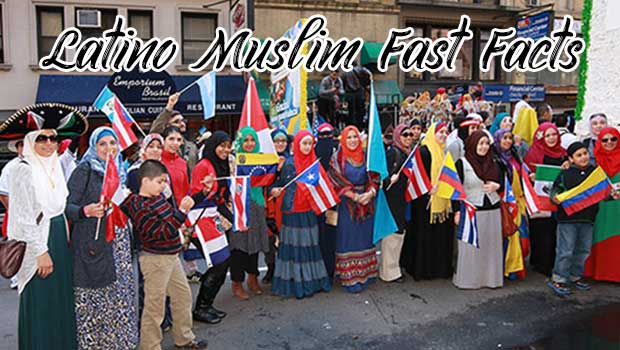
    September 15 to October 15 marked the 30th National Hispanic Heritage Month in the United States, a month-long tribute established by President Ronald Reagan on September 14, 1989. It is, therefore, worth reflecting on the important presence of Latin American Muslims who represent the fastest growing population of Muslims in the United States. The seeds of Islam continue to be planted across the nation and Muslims from the Latino community play a great role in helping to make the deen accurately known and easily accessible to ever-widening numbers of Americans.

    A Latino is a person who was born or lives in South America, Central America, or Mexico or a person in the U.S. whose family is originally from South America, Central America, or Mexico (Merriam-Webster Dictionary). Latino origin is based on ancestry, culture, nationality and/or country of birth. Therefore, Latino people come from a variety of countries, ethnic backgrounds, and social traditions. Hispanic refers to a person of Latin American descent or relates to the people, speech, or culture of Spain (Merriam-Webster Dictionary). According the U.S. Census Bureau, as of 2017 there were an estimated 58.9 million Hispanic people in the U.S., which is equivalent to 18.1 percent of the entire population. Only Mexico has a larger Hispanic population than the U.S.!

    Latinos find that Islam resonates with their spirituality, morals, family values, social struggles, and traditions

    The ten states with the largest populations of Hispanics are Arizona, California, Colorado, Georgia, Florida, Illinois, New Jersey, New Mexico, New York, and Texas. In a map developed by the Spanish department of ICNA’s WhyIslam project, the team identified prominent Latino Muslim organizations and active individuals and found that the majority were in one of these ten states.
    Not surprisingly, Spanish is the second most widely spoken language in the United States. There are 21 countries in the world where Spanish is the official language. Most are in Central and South America, and the Caribbean. Brazil is considered part of Latin America even though the official language is Portuguese. Mexico is also the only Spanish-speaking country that shares a border with the U.S. One fascinating and little-known fact about the Spanish language is that it shares a special bond with Arabic. Muslims ruled Spain for eight centuries, from 711 to 1492. During that time, Spanish was even written in Arabic script, and it borrowed countless words from Arabic. About 30 percent of the words in the Spanish language have Arabic roots. A few examples are algodon in Spanish/al-qutun in Arabic (cotton), fulano in Spanish/fulan in Arabic (so and so), and aceituna in Spanish/zaytun in Arabic (olive).

    There were Muslims in the Americas before the arrival of Christopher Columbus, and African Muslims who were brought to this country as slaves. The Muslim population in Latin America is over 4 million. Latinos are also the fastest growing minority in the U.S., and the fastest growing minority within Islam, and it is estimated that 12 percent of converts to Islam in the U.S. are Latinos.

    Among the many reasons why Latinos are drawn to Islam is the belief in tawhid, or the natural inclination to believe in the Oneness of God; putting faith into practice; the importance of balance and moderation in everyday life; and there being no intermediaries needed (such as clergy) between a human being and God — each individual seeks a personal relationship with Allah. There are many cultural similarities between Islam and what Latinos hold dear, including family values and morals (the proper upbringing of children, respect for elders, and adult children caring for elderly parents) and community ethics such as support for the poor and underprivileged, and the promotion of social justice and affirmation of equality in human worth regardless of religion, gender, race, or ethnicity (yet, one can distinguish himself or herself through piety and virtue).

    Some of the most popular sayings in Latin America have Islamic roots or are very similar to Islamic values or teachings. For example, the saying, “Al que madruga, Dios le ayuda (God helps the one who wakes up early) is like what the Prophet (peace be upon him) said, “O Allah, bless my nation in their early mornings” (Sunan Ibn Majah). Another is “Donde comen dos, comen tres (Where two eat, three eat); this is similar to what the Prophet (pbuh) said, “The food of one person is enough for two, the food of two is enough for four, and the food of four is enough for eight” (Muslim). ”Díme con quién andas y te diré quien eres” (Tell me who you hang out with, and I will tell you who you are) is similar to the Prophet’s advice, “A man follows the religion of his best friend, so each one of you should look at whom he befriends” (Tirmidhi).

    Latinos find that Islam resonates with their spirituality, morals, family values, social struggles, and traditions. The internet and social media have made information about Islam more accessible to Latinos. Furthermore, Latinos and Muslims have come together in solidarity in the face of recent injustices and oppression of their groups. Latinos have a lot in common with Muslims, and that is perhaps because many are descendants of European, African, and indigenous Muslims. Islam is in our blood!

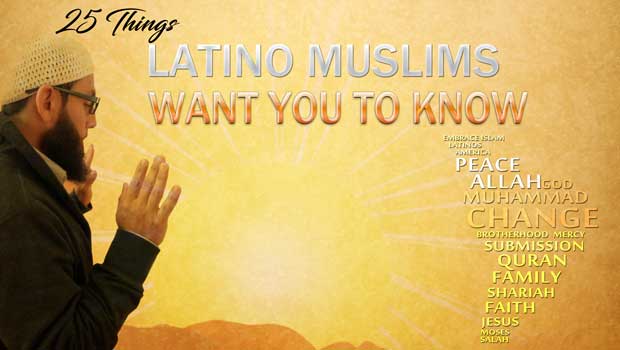
  • 25 Things Latino Muslims Want You to Know

    25 Things Latino Muslims Want You to Know

    You may have heard that Latinos are the fastest growing minority in the United States, but they are also the fastest growing minority of Muslims. However, the history of Latinos is just as rich with Islamic roots and influences as their future promises to be. Not all Latino Muslims are converts; many come from families who have been practicing Islam for generations, and some are even descendants of Muslims from faraway lands. Since Latinos have been involved in Islamic and civil rights movements in the United States as far back as the 1960s and ‘70s, and may have been here for even longer, one would think that non-Latino American Muslims would do their best to familiarize themselves with the culture, traditions, and geography of Latin America to better understand their brothers and sisters. However, the non-Latino Muslim community still knows very little about Latin America, what it really means to be Latino or Hispanic in America, and what it means to be Latino and Muslim. The following list are things that Latino Muslim leaders all over the U.S. want you to know.

    1. We want to feel accepted.

    “As a Muslim Latina, I would like to let non-Latinos know that we are very open and accepting individuals. We have a lot to share, and I would love to share my Dominican recipes that add some spunk to any dish! Most importantly, I want non-Latinos to know that we just want to be accepted, not rejected by the (Muslim) community.” – Sahar Amada Quesada, teacher, New York

    2. We want to be treated as equals.

    “Muslim Latinos want to be seen on an equal footing of respect, admiration, brotherhood, and affection. This requires work on our parts, as well as that of our communities… We want others to know that many of us feel hurt and that we are being treated [by non-Latino Muslims] as we have been treated by non-Muslim society — like second class citizens. Still, we stand with our brothers in religion even though our social and political agendas may be different.” – Hajj Yahya Figueroa, Alianza Islámica, Pennsylvania (formerly in New York)

    3. We come from good families.

    “Many, if not most of us, came from very moral families. The idea that we converted from some horrible background simply because we’re Latino is not our narrative.” – Shinoa Matos, journalist, New York

    4. We can be Muslim and keep our Latino identity.

    “I would like others to be able to understand and identify the difference between the true practices of our religion, Islam, versus the diverse cultures that Muslims belong to. For example, someone can be Mexican and Muslim, and nowhere in the religion are we encouraged or obligated to choose between the two. We can be proud of our faith as well as our culture. We do not need to compromise.” – Nahela Morales, ICNA Dallas, Texas

    5. Latinos helped to establish Islam in the U.S.

    “Latino Muslims were instrumental in establishing Islam in the U.S. and they have a role in Muslim American history not known to many. Unfortunately, despite this fact, not enough has been done to assist the growth and continuity of the Latino Muslim community by the larger body of Muslims. So, the community is forced to struggle to address its needs with very little support.” – Imam Yusuf Rios, 3 Puerto Rican Imams Project, Ohio

    6. Our community can relate to both the indigenous and the immigrant experience.

    “Latino Muslims offer a unique experience within the narrative of Islam in America. We can be a bridge between the African-American Muslim community and the immigrant Arab and South Asian Muslim communities. For many of us, we understand and are affected by many of the issues that affect the African-American community due to our long history within the U.S. Yet, at the same time, we understand the immigrant experience and the notion of what ’back home’ means. Latino Muslims are at a crossroads and we are still defining who we are.” – Hazel Gómez de Crain, Organizing Fellow at Dream of Detroit, Michigan

    7. We are a collage of cultures and customs.

    “The ethnic mix of Latino Muslims reflects a broad spectrum of people including Africans, Native peoples, Europeans, etc. This has increased because of the diaspora, the Triangular Slave Trade, and the pre- and post-Colombian exchange. We should find strength and common ground in our diversity, and explore why we look like we do, eat what we do, speak like we do, and all those other traits that make Latino Muslims a unique group of individuals.” – Jamal Abdul-Karim, M.Ed., teacher, Maryland

    8. All of us deserve to learn about Islam.

    “We have the right to know and learn about Islam just like everyone else. Not all of us are blue collar immigrant workers. A Latino or Hispanic person should never be regarded as inferior because of where they are from or their occupation. It is so sad to see a Latino person cleaning the mosque or working on landscaping outside a mosque and he doesn’t know anything about Islam or Muslims because no one bothers to talk to him. There is no excuse.” – Wendy Díaz, Co-Founder, Hablamos Islam, Maryland

    9. We are just like you.

    “We came to Islam because it appeals to our very Latino-ness (Latinidad). We are converts, just like born Muslims are nothing more than the descendants of converts.” – Shinoa Matos, journalist, New York

    10. We have been inspired by our predecessors.

    “As Latino Muslims, our inspirations are the non-Arab great scholars who learned the deen and became prominent, including Bukhari (Uzbekistan), Imam Muslim (Nishapur), and Imam Qurtubi (Spain).” – Imam Daniel Hernandéz, Pearland Islamic Center ISGH, Houston, Texas

    11. We want you to acknowledge that we are valuable.

    “We are not second-class citizens, rather we are servants of the Most High and that makes us brothers/sisters under His Mercy and Grace. Affirm our specialties and acknowledge that we are no less than you in our professions.” – Imam Wesley Abu Sumayyah Lebron, Misericordia Para La Humanidad (Mercy for Humanity), 3 Puerto Rican Imams Project, New Jersey

    12. We want you to get to know who we are.

    “Latino Muslims coming to Islam just add feathers to the beautiful peacock. We are many nations who are diverse in culture and custom. Please take the time to personally get to know and understand the Latino Muslims you encounter; we are whole human beings, not just our conversion stories.” – Imam Daniel Hernandez, Pearland Islamic Center ISGH, Houston, Texas

    13. Latinos are diverse.

    “We are not all Puerto Rican or Mexican. Latin America is very diverse.” – Nivia Martinez, Grassroots Dawah, New York

    14. We do not want to confuse culture with Islam.

    “Don’t bring us your cultural baggage and confuse it with Islam. Islam is just as much a part of our heritage as it is of yours. We are equal because we share this deen with you, and we follow the footsteps of the best generations because we accepted Islam based on authentic Islamic doctrine and not culture.” – Hernán Guadalupe, M.Eng., doctoral student, business administration, Maryland

    15. Please do not believe the stereotypes.

    “I would want non-Latino Muslims to know that we are no less than them. Those of us who are not born into a Muslim family have a certain push and devotion in the Islamic direction. The last point, sad that I have to say it, is that most of us are not bad or criminal just as most Muslims are not terrorists or extremists.” – Alex Robayo, ME, physics instructor, New York

    16. We learn about Islam in various ways.

    “Some people believe that most of us have come to [learn about and convert to] Islam in prison. Most of us have come to know about Islam through friends or family, our own study, or Muslim outreach efforts.” – Juan Alvarado, caseworker, Pennsylvania

    17. Our conversion stories are just as diverse as we are.

    “Many of us did not become Muslim through marriage. Not to shame those who did, but some of us made this choice on our own.” – Nivia Martinez, Grassroots Dawah, New York

    18. We deserve respect.

    “Just as every Latino is not Mexican, every Latino is not a drunkard. Almost all immigrant Muslims who contact me are trying to marry a Latina. Many of them see us as no more than a Tinder (dating app). Maybe they could ask to help in dawah, instead.” – Juan Galvan, Co-founder, LADO, Illinois

    19. Our women are not for sale.

    “Unfortunately, we Muslim Latina sisters are fetishized and sexualized amongst some of the men in our ummah. They consider us cheaper alternative brides and we get tricked out of having a legitimate wali and then offered less in dowry, dignity, and honor. It’s not right and these conversations need to be had.” – Paulina Rivera, MSW candidate, USC, California

    20. Rather than criticize, lend a hand.

    “Do not criticize the Latino once he is learning about Islam; instead, you should help him, get to know him, befriend him, and learn from him all the things you do not know about our culture.” – Sonia García, The Latina Muslim Foundation, California

    21. If you want to know more about us, just ask.

    “Do not assume to know who we are, what we have been through, or how we got here. If you want to know our story, just ask. We will be happy to tell you. And when we do, don’t judge us; just listen.”
    – Melissa Barreto, homeschooling educator, New Jersey

    22. We are proud of who we are.

    “After coming to Islam, Latino Muslims truly appreciate their home countries and who they are because they get to have Islam and be Latino at the same time.” – Dr. Julio Ortiz-Luquis, Professor of International Relations, New York

    23. We want you to learn about our rich history and contributions to society.

    “There is much to celebrate in our Latino customs, from our past indigenous contributions in pre-colonial American history to the more recent contributions throughout Latin America. Islam is as transformative to Latino Muslims as it is to non-convert Muslims. Find out how to make a more meaningful impact in our communities by getting to know our histories, our people, our values.” – Nylka Vargas, P.I.E.D.A.D National Coordinator, NHIEC Dawah Committee, New Jersey

    24. Just as we have a shared past, we have the same goals.

    “We aspire to belong to the ummah of Muhammad, the mercy for mankind. I would like for the Muslim community to accept us as Muslims with an Andalusia flair.” – Imam Yusef Maisonet, Masjid As-Salaam, Alabama

    25. We are here to stay.

    “We exist, and we are here to stay. Islam is for everybody; it is universal and not confined to one place or time.” – Imam Danny Khalil Salgado-Miralla, Masjid the Abrar, New York

    The Quran tells us, “O mankind, indeed We have created you from male and female and made you peoples and tribes that you may know one another. Indeed, the most noble of you in the sight of Allah is the most righteous of you. Indeed, Allah is Knowing and Acquainted” (Quran, 49:13).
    Historically, Latino Muslims have sought refuge in Islam because it resonated with our spirituality, morals, family values, and traditions. There is so much to learn from our “Latinidad,” what makes us innately Latino. We are a people from various countries and backgrounds, bound together by a shared language and moral principles and a history of being subjected to colonization, oppression, and injustice. Mexico is the only Spanish-speaking country that shares a border with the U.S. However, there are a total of 21 countries in the world where Spanish is the official language. The majority of those are in Central and South America, as well as the Caribbean. All Spanish-speaking countries are represented throughout the U.S.
    Now, we have been united with you under the banner of Islam. We have so much to offer the greater Islamic community, but this begins with acceptance. Make a conscious effort to get to know your Latino brothers and sisters today.

    Note: The Merriam-Webster dictionary defines a Latino as: “a person who was born or lives in South America, Central America, or Mexico or a person in the U.S. whose family is originally from South America, Central America, or Mexico,” whereas Hispanic means: “coming originally from an area where Spanish is spoken and especially from Latin America.” Latino origin is based on ancestry, lineage, heritage, nationality and/or country of birth; therefore, Latino people come from a variety of countries, backgrounds, and social statuses.

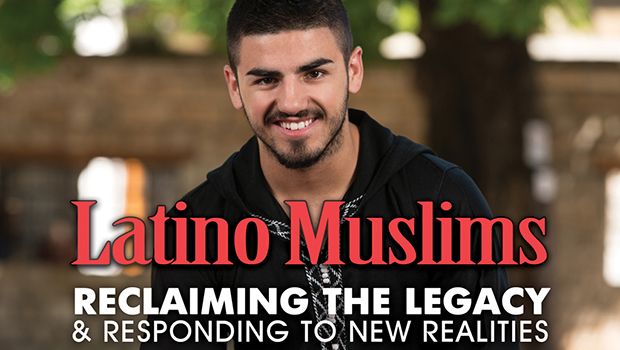
  • Latino Muslims: Reclaiming Legacy & Responding to New Realities

    Latino Muslims: Reclaiming Legacy & Responding to New Realities

    Back in 2000 when I accepted Islam, I used to think that I was the only Muslim Latina in the world! I learned about Islam through an Egyptian family and met Muslims from other countries like Palestine and Pakistan, and even came across some American Muslims. However, it wasn’t until almost two years later that I met a handful of others like myself, Latin-American converts living in the US. When I finally visited Puerto Rico, where I was born and lived for the first eight years of my life, as a Muslim, I was surprised to learn that there were about nine mosques on the tiny island – which is smaller than Rhode Island – and thousands of Muslims. Although the majority of Muslims living in Puerto Rico are Arab immigrants, there is also an ever-growing number of converts.

    In Islam deeds are judged by their intentions, hence the aim of righteous actions should be pleasing God in order to obtain Paradise in the Hereafter. If a person’s objective is to gain fame or fortune or to satisfy his ego, then he will be left with what he intended and his rewards will only go as far as this life

    Now with a greater sense of determination, I continued my search for more Latino Muslims, so we could share our experiences, our struggles with non-Muslim family members, our quest for knowledge, our joys of finding Islam, and our frustration of being misunderstood by both our blood relatives and brothers and sisters in faith. As time went on, I met more and more Latino Muslims and we began trying to form an Islamic identity true to the legacy which our Muslim ancestors in Spain left behind centuries ago. This issue of The Message International is a tribute to that legacy and an appeal for our new brothers and sisters to leave behind a legacy of their own.
    But what is a legacy? Celebrities, sports icons, thinkers, or political figures of the past are remembered for some contribution they have made to their respective field or to society as a whole. A doctor or scientist may be remembered for discovering a beneficial drug, a king may be honored for having been a powerful ruler, a musician revered for their impact on popular culture, a baseball player idolized for the number of home runs he batted during his career; whatever the case may be, a legacy is built upon some type of influence. In Islam, a person is honored because of his or her piety and good actions, and their good deeds are immortalized in the minds of the people due to their contributions to society and to Islamic history. This is the legacy of a Muslim.
    By the same token, Muslims must remember to strive in the Cause of Allah only for the sake of pleasing Him and not to please or impress people, or even with the intention of leaving a legacy of fame. A legacy should be the consequence of one’s sincere, heartfelt conviction and actions, not the result of striving for it. The point here is that the focus should not be on the appearance of one’s striving or its outcome. The focus must be on purifying our intentions and deepening our eman. Faithful and righteous action emerges naturally out of that. There is a hadith in Sahih Bukhari about a man who fought in a battle alongside the Muslims, who, although the people praised his bravery, the Prophet said he was destined for the Hellfire. The companions were surprised because they had witnessed his seemingly flawless courage, yet news reached them that after he was wounded, the man had killed himself, confirming the prediction. The Prophet, peace be upon him, said, “A man may seem to the people as if he were practicing the deeds of the people of Paradise while in fact he is from the people of the Hellfire; another may seem to the people as if he were practicing the deeds of the people of Hellfire, while in fact he is from the people of Paradise.”
    In Islam deeds are judged by their intentions, hence the aim of righteous actions should be pleasing God in order to obtain Paradise in the Hereafter. If a person’s objective is to gain fame or fortune or to satisfy his ego, then he will be left with what he intended and his rewards will only go as far as this life. Although as Muslims we hope to leave behind a legacy of goodness on this earth as a result of our piety, the goal is not to be deceived into focusing on what we are building in this world, but rather what we are investing for the Hereafter.
    We pray that Allah accepts our good deeds and forgives our sins and pardons our mistakes, and that He admits us to Paradise so that we may be reunited with the pious. Amen.