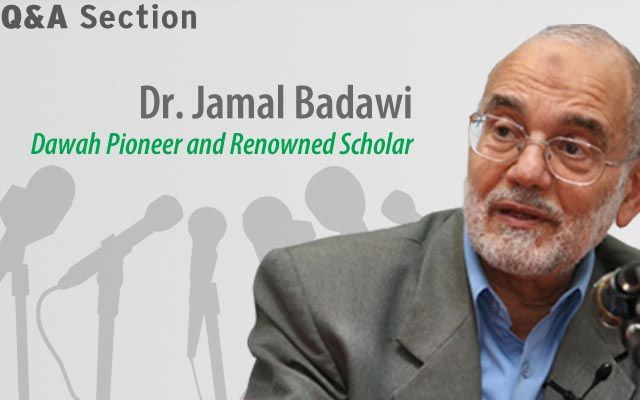
Understanding and Misunderstanding about Jesus:A Conversation with Dr.Jamal Badawi
Q: How many times was Jesus mentioned in the Qur’an and what is the extent of coverage given to his life in the Qur’an?
Jamal Badawi: There are at least eleven chapters in the Qur’an where the name of Jesus or mention of him, his birth and life are mentioned. This is nothing extraneous or exterior to the belief of a Muslim. The chapters that contain mention of Prophet Jesus are 2, 3, 4, 5, 9, 19, 21, 23, 43, 57 and 61. There are one hundred and fourteen chapters in the Qur’an and eleven of them mention Jesus. This shows the substantiality of Prophet Jesus.
The nineteenth chapter in the Qur’an is titled after Jesus’ mother, Surah Maryam or Chapter of Mary. Chapter three is titled after Mary’s family and is called Al’Imran or The Family of Imran. Chapter five is titled Al Ma’ida or The Table and tells the Islamic version of The Last Supper. So the titles of three chapters in the Qur’an are related in some form or another to the story of Jesus (PBUH) as is presented in the Qur’an.
Q: Did Mary, according to the Qur’an, predict her predicament? Did she know beforehand that she was going to be with child, and that child was going to be Jesus and that his status in life was going to be that important?
JB: According to the Qur’an, she did have some notion or at least an idea of the kind of miracle that was going to take place through her. According to the Qur’an, there is no dispute on the birth of Jesus as a virgin birth. She gave birth before she married Joseph the carpenter. As I said, the way he was born is the most outstanding miracle of Prophet Jesus (PBUH).
The summary of the verses in regards to Jesus, show that at one point Mary was alone in a place secluded from her family and there appeared to her the angel of God in the form of a human being. In the beginning she was scared since she was alone. She implored him not to get near her if he really feared God. He told her not to be afraid, he was not there to hurt her and he was simply coming to bring her the news of the birth of a noble and pure child.
The translation from the Qur’an says, “Relate in the Book (the story of) Mary, when she withdrew from her family to a place in the East. She placed a screen (to screen herself) from them; then We sent her our angel, and he appeared before her as a man in all respects. She said: ‘I seek refuge from thee in (Allah) Most Gracious: (come not near) if thou dost fear Allah.’ He said: ‘Nay, I am only a messenger from thy Lord, (to announce) to thee the gift of a holy son.’ She said: ‘How shall I have a son, seeing that no man has touched me, and I am not unchaste?’ He said: ‘So (it will be): Thy Lord saith – That is easy for Me, and (We wish) to appoint him as a Sign unto men and a Mercy from Us:’ It is a matter (so) decreed’” (19:16-21). This is how the news of the future birth of Jesus was related to Mary.
Q: Did Mary deliver Jesus in the normal way- was her childbearing and delivery like everyone else? Were there any miracles in this respect again?
JB: There is no evidence in the Qur’an that the delivery was unusual. The pregnancy was just like any other woman’s pregnancy. In fact, the Qur’an talks about Mary suffering the agony of childbirth like any other woman. The Qur’an also says that she was very distressed psychologically because she was worried about what her people would think of her and how she was going to explain this virgin birth. She was afraid nobody would believe her. The Qur’an also indicates that something miraculous happened immediately after Jesus was born. Jesus assured her and told her what to do when people asked her questions or made accusations against her.The Qur’an states, “So she conceived him, and she retired with him to a remote place. And the pains of childbirth drove her to the trunk of a palm-tree: She cried (in her anguish): ‘Ah! If only I had died before this! If only I had been a thing forgotten and out of sight!’ But (a voice) cried to her from beneath the (palm-tree): ‘Grieve not! For thy Lord hath provided a rivulet beneath thee; and shake towards thyself the trunk of the palm-tree: It will let fall fresh ripe dates upon thee. So eat and drink and cool (thine) eye. And if thou dost see any man, say: I have vowed a fast to (Allah) Most Gracious, and this day will I not enter into talk with any human being’” (19:22-26).
The Qur’an continues, “At length she brought the (babe) to her people, carrying him (in her arms). They said: ‘O Mary! Truly an amazing thing hast thou brought! O sister of Aaron! Thy father was not a man of evil, nor thy mother a woman unchaste!’ But she pointed to the babe. They said: ‘How can we talk to one who is a child in the cradle?’ He said: ‘I am indeed a servant of Allah. He hath given me revelation and made me a prophet; And He hath made me blessed wherever I be, and hath enjoined on me Prayer and Charity as long as I live; (He) hath made me kind to my mother, and not overbearing or miserable; So peace is on me the day I was born, the day that I die, and the day that I shall be raised up to life (again)!’ Such (was) Jesus the son of Mary: (it is) a statement of truth, about which they (vainly) dispute. It is not befitting to (the majesty of) Allah that He should beget a son. Glory be to Him! When He determines a matter, He only says to it, ‘be’, and it is. Verily Allah is my Lord and your Lord; therefore serve Him: this is a Way that is straight. But the sects differ among themselves: and woe to the unbelievers because of the (coming) Judgment of a Momentous Day! How plainly will they see and hear, the Day that they will appear before Us! But the unjust today are in error manifest! Warn them of the Day of Distress, when the matter will be determined: for (behold,) they are negligent and they do not believe! It is We Who will inherit the earth, and all beings thereon; to Us will they all be returned” (19:27-40).
Q: Does the Qur’an say that Jesus had only a mother and no father?
JB:Who is Eve’s father (the first woman)? Who is Adam’s father? If a person doesn’t have a physical human father, does this imply that he is divine or he is God? Then Eve must have been God and Adam must have been God, because they both don’t have parents! The Qur’an answers this question in one verse, “The similitude of Jesus before God is as that of Adam; He created him from dust, then said to him, ‘be.’ And he was. The truth (comes) from God alone; so be not of those who doubt” (3:59-60). In accordance to this verse, it simply says that God, who was able to create Adam and Eve without a father or mother, can just as easily create Jesus without a father. Indeed we should remember it is not only the birth of Prophet Jesus (PBUH) that is miraculous;the birth of any human being is miraculous. If we study how the various genetic characteristics are passed on, from parents and each of their larger family gene pools to the couple’s children, we should view that as a miracle in itself. All we can say is that it is both miraculous and unusual in the case of Prophet Jesus.
The point to remember here is that God isn’t bound to follow the same laws that we consider to be laws of nature, because God himself created nature and these laws. He can break the rules whenever He wishes; this of course may not necessarily be the pattern as most of the time there is harmony between what we see as natural laws and the will of God, but He has the power whenever He wants to give us certain DivineSigns that break from the norm.
The Qur’an says, “Behold! The angels said: ‘O Mary! Allah giveth thee glad tidings of a Word from Him: his name will be Christ Jesus, the son of Mary, held in honor in this world and the Hereafter and of (the company of) those nearest to Allah. He shall speak to the people in childhood and in maturity. And he shall be (of the company) of the righteous.’ She said: ‘O my Lord! How shall I have a son when no man hath touched me?’ He said: ‘Even so: Allah creates what He wills: When He hath decreed a plan, He but saith to it, ‘be,’ and it is! And Allah will teach him the Book and Wisdom, the Law and the Gospel, and (appoint him) an apostle to the Children of Israel (with this message)’” (3:45-49).
It is obvious from this that the will of God doesn’t need a human medium to create a pregnancy. If He decides it He can just order that a child be conceived by a virgin. God has various unusual methods in creation and the creation of Prophet Jesus (PBUH) completes the picture. First, was the creation of people without a father or mother, which is the case with Adam. Then there is the creation of a human being from a man’s rib (side), which is obviously Eve. Third, there is the normal creation of a human being, both from a mother and a father and that is every one of us. Last, is the creation of a human being from a mother and not a father. This beautifully completes the various miracles of God, which are all equally important and stunning.
Q: What is the difference between Islam’s understanding of the phrase ‘Holy Spirit’ with that of Christians?
JB:The general understanding of the Holy Spirit is influenced by Greek philosophy, particularly the Platonic ideologies. The gospel of John shows this influence quite extensively. The whole idea of God as the Father, the Son and the Holy Ghost is based very closely on this same Greek philosophy that the Spirit of God or the Holy Spirit or Holy Ghost is a component of God.
The Qur’an has two different kinds of expressions for the word spirit. The equivalent Arabic word for the word spirit is rooh’. In reference to Jesus, in particular, we find that the Qur’an mentions that Jesus was a spirit proceeding from God. There is also the expression of Holy Spirit/Ghost and each has a different meaning.First, let’s take what the Qur’an means when it says that Jesus was a spirit proceeding from God. Is it exclusive to Jesus or does it apply to other people as well? The answer is that it applies to all because the word rooh’ appears in the Qur’an in meanings that relate to the context of the verse. For example, in 42:52 the word spirit is used to refer to revelation (the Holy Book) and that it is a spirit from God. In 58:22, for example, the spirit is used in a sense of support from God -“and strengthened them with a spirit from Himself.” It is also used as the secret of life or the source of our spirituality. This is what is referred to in the Qur’an in respect to Jesus (PBUH) as well as to other human beings. Chapter 4 verse 171 mentions the spirit in reference to Jesus. It was also mentioned in a general sense to refer to all human beings because all of us have something of the spirit of God in us. The Qur’an says, “But He fashioned him in due proportion, and breathed into him something of His spirit” (32:9). This refers to the creation of all human beings. This means that every human being derives his spirituality, his instinctive natural feeling of a connection with his Creator, from the spirit of God that was breathed into him at the time of creation.
The other usage of the term Holy Ghost or Holy Spirit is actually used specifically for archangel Gabriel. He is called Roohul Qudoos which means Holy Spirit or AlRoohul Ameen which means Honest Spirit. The Qur’an mentions him as the angel who brought revelation to prophets in the past, including Prophet Muhammad.The Qur’an says,“We gave Moses the Book and followed him up with a succession of apostles; We gave Jesus the son of Mary Clear (Signs) and strengthened him with the Holy Spirit. Is it that whenever there comes to you an apostle with what ye yourselves desire not, ye are puffed up with pride? Some ye called impostors, and others ye slay!” (2:87).
And in another verse, we are told:“Then will Allah say: ‘O Jesus the son of Mary! Recount My favor to thee and to thy mother. Behold! I strengthened thee with the Holy Spirit, so that thou didst speak to the people in childhood and in maturity. Behold! I taught thee the Book and Wisdom, the Law and the Gospel and behold! Thou makes out of clay, as it were, the figure of a bird, by My leave, and thou breathes into it and it becomes a bird by My leave, and thou halest those born blind, and the lepers, by My leave. And behold! Thou brings forth the dead by My leave. And behold! I did restrain the Children of Israel from (violence to) thee when thou didst show them the clear Signs, and the unbelievers among them said: ‘This is nothing but evident magic’” (5:110).All of these verses show that Roohul Qudoos is actually referring specifically to Gabriel. According to Islam, Gabriel and all other angels are creations of Allah- they are not part of Him. They are all servants of God just as the prophets are.
Q: Is there any way that a Muslim can reconcile himself with the ideas of the son of God or ‘Lord’ as they are explained in Biblical literature (The New Testament)?
JB:In all fairness to our Christian brothers and sisters, I cannot answer that question unless I explain, first, how the Bible uses the term Lord and the term son of God. This might be the most conclusive evidence, not from a Muslim’s point of view, but from the Bible itself.Take the word Lord, everybody knows that this term doesn’t necessarily mean divine. In England, there are many Lords but no one would say that there are so many Gods there. Lord means master. It is believed that this was the exact meaning people meant when they addressed Jesus as Lord in the New Testament.
The second term is the son of God. There is ample evidence in The Old Testament that son of God is used for a person who is close to God because of his spirituality and faith, but never because of his divinity. The Book of Exodus says that Israel was called the first born son of God (4:22-23) but nobody says that he is divine. In the psalms of David, David is referred to as the son of God (2:7). In the first Chronicle, Prophet Solomon is also referred to as the son of God (2:10).Ezra (Uzair in the Qur’an, see 9:30) is referred to in the Old Testament. He lived in 450 B.C. and was regarded as a son of God because of his crucial role, during the Babylonian exile, in recollecting the law of the Torah about a thousand years after Moses. Evidence from The Old Testament itself shows that the term son of God was used in a metaphoric sense,not in an exclusive or divine sense.
Even The New Testament uses it in a similar way as The Old Testament. For example, the book of Matthew says, “Blessed are the peacemakers, for they will be called sons of God” (5:9). There are similar quotations in Matthew (5:45 and 23:9). In fact, The Old Testament even uses theterm “sons”of God. In the book of Job, this term is used as a plural. It is quite apparent that when Jesus (PBUH) used the term father to refer to God or son to refer to himself, he only meant it in the metaphoric sense. He meant it in the same way that all human beings are children of God because we depend on Him and that God is the father because he loves and cares for all of us.
Q: What does the Qur’an have to say about the scope of the mission of Jesus Christ on earth?
JB: The Qur’an is very clear about the fact that the mission of Prophet Jesus (PBUH) was explicitly and exclusively to guide the people of Israel. The Qur’an says, “And (appoint him) an apostle to the Children of Israel, (with this message)” (3:49). It also says, “O Children of Israel! I am the apostle of Allah (sent) to you” (61:6). Also, it discusses the various Israelite prophets saying, “And in their footsteps We sent Jesus the son of Mary, confirming the Law that had come before him” (5:46). Therefore, the Qur’an is very clear about what the mission of Jesus was, and the information found in The New Testament itself attests to this fact.
Two very explicit quotations regarding Prophet Jesus (PBUH) show the similarity between the Bible and the Qur’an on this point. The Gospel of Matthew tells the famous story of the Canaanite woman who wanted Jesus to cure her daughter. He says, “I was sent only to the lost sheep of Israel.” He was very explicit and refused, and later on responded because of her faith (15:24). In Matthew, Jesus was giving instructions to the five disciples: “These twelve, Jesus sent out with the following instructions: ‘Do not go among the Gentiles or enter any town of the Samaritans. Go rather to the lost sheep of Israel” (10:5-6). Again, he is repeating the same principle that he was sent as an Israelite prophet. This is also implied in Matthew with a very similar confirmation (19:28). Indeed one can say that there is no evidence in the three synoptic Gospels, Matthew, Mark and Luke, of any clear and decisive statements quoting Jesus that his message is universal and that he was sent for all human beings.
In fact, I would like to make two comments here to avoid any misunderstanding of these quotations. The conclusiveness of the expressions of the words of Jesus as quoted in the Gospels definitely overshadow any claim that was developed much later on. The words of Jesus are more credible than what developed later on when the notion of deifying Jesus gained momentum.The other observation is that although both the Qur’an and the Gospels support that Jesus’ mission was to the children of Israel, it doesn’t mean that none of his teachings can be valid and applicable for those who are not from the Israelites. In fact, the teachings of all the prophets are relevant for all time and all people, especially concerning the moral aspects and the knowledge of God. Even though the mission is valid for all time and people, God decided to send one final and universal message with Prophet Muhammad roughly 600 years after Prophet Jesus, may peace and blessings be upon them both.
Q: What are the miracles of Jesus? Does the Qur’an touch upon that?
JB:Well of course the discussion of the virgin birth as one of the miracles has already been covered. He was also given miracles, like other prophets, to support his mission. The Qur’an states, “And (appoint him) an apostle to the Children of Israel, (with this message): ‘I have come to you, with a Sign from your Lord, in that I make for you out of clay, as it were, the figure of a bird, and breathe into it, and it becomes a bird by Allah’s leave. And I heal those born blind, and the lepers, and I quicken the dead, by Allah’s leave.And I declare to you what you eat, and what you store in your houses. Surely therein is a Sign for you if you did believe’” (3:49). Prophet Jesus’ miracles, include healing, bringing people back from the dead, and knowing what people store in their homes, are each qualified by Jesus saying“by Allah’s leave,” because God gave him this knowledge and ability.
Q: Does the Qur’an mention that Jesus was given a divine book or the Gospel?
JB:The Qur’an mentions a number of Holy Books or scriptures given top articular prophets. These include specific books like the Zaboor (normally interpreted as the psalms from David), the Suhoof (leaves of Prophet Abraham) and the Torah. The Qur’an mentions the Gospel as Al Injeel, which in Arabic translates to The Good News. The Qur’an mentions Al Injeel not only once but twelve times in six different chapters.The Qur’an mentions,in the context of other Holy Books,Al Injeel or the Gospel as a book given to Jesus.This leaves a distinct impression that the Qur’an is not referring to The Good News in general but to this specific one given to Jesus. This may sound quite fascinating that most of our Christian brothers believe that the Gospel simply is the biography of Jesus written by the four writers and not necessarily something that was explicitly revealed to Jesus the same way it was to Muhammad or Moses.
I have gone through some references that address, as part of Biblical studies,the comparison of the Synoptic Gospels (Matthew, Mark, and Luke) to find what sources they are drawn from. In one reference they refer to a Gospel called “Q”which, it is hypothesized, was a source of information for the Synoptic Gospels. This means, in accordance with Biblical studies, not Muslim sources, that there was probably an earlier Gospel from which the Synoptic Gospels were sourced. This could possibly be the original Gospel Muslims believe was given to Jesus.Let’s not forget that there is also the issue of the canonized Gospels. The history of the Church shows that there have been large numbers of Gospels and it was only in the fourth century that the church canonized the four Gospels and the others were burned. It is quite possible,based on both Christian and Muslim sources, that Jesus did have a separate, independent Holy book that was unfortunately lost to history.
Q: What about the end of his mission? Do Muslims agree with the Christian version of Jesus’ crucifixion and ascension?
JB:There is very little information available concerning this question; therefore I’ll stick to what the Qur’an has to say. Many of the early Christian sects disputed whether it was Jesus or Judah who had been put on the cross.The Qur’an says, “That they rejected Faith; that they uttered against Mary a grave false charge; that they said (in boast), ‘We killed Christ Jesus the son of Mary, the Messenger of Allah’- but they killed him not, nor crucified him, but so it was made to appear to them, and those who differ therein are full of doubts, with no (certain) knowledge, but only conjecture to follow; for of a surety they killed him not. Nay, Allah raised him up unto Himself; and Allah is Exalted in Power, Wise” (4:156-158). According to this specific text of the Qur’an, it’s conclusive that Jesus was not the one put on the cross, no matter how commonly believed it may be.
Q: Has Jesus personally denied his divinity?
Jamal Badawi: The response to this question could be found in the following Qur’anic verses:“At length she brought the (babe) to her people, carrying him (in her arms). They said: ‘O Mary! Truly an amazing thing hast thou brought! O sister of Aaron! Thy father was not a man of evil, nor thy mother a woman unchaste!’ But she pointed to the babe. They said: ‘How can we talk to one who is a child in the cradle?’ He said: ‘I am indeed a servant of Allah. He hath given me revelation and made me a prophet; And He hath made me blessed wherever I be, and hath enjoined on me Prayer and Charity as long as I live; (He) hath made me kind to my mother, and not overbearing or miserable; So peace is on me the day I was born, the day that I die, and the day that I shall be raised up to life (again)!’ Such (was) Jesus the son of Mary: (it is) a statement of truth, about which they (vainly) dispute. It is not befitting to (the majesty of) Allah that He should beget a son. Glory be to Him! When He determines a matter, He only says to it, ‘be’, and it is. Verily Allah is my Lord and your Lord; therefore serve Him: this is a Way that is straight. But the sects differ among themselves: and woe to the unbelievers because of the (coming) Judgment of a Momentous Day! How plainly will they see and hear, the Day that they will appear before Us! But the unjust today are in error manifest! Warn them of the Day of Distress, when the matter will be determined: for (behold,) they are negligent and they do not believe! It is We Who will inherit the earth, and all beings thereon; to Us will they all be returned” (19:27-40).
Actually, the Quranic verses cited above point out that Jesus, himself, proclaimed his humanity and that he was a servant of Allah and a prophet, clearly not divine. He actually rebuked the people who would develop those philosophical ideas after he is gone. An example is when Satan came to Prophet Jesus and tried to tempt him as it appears in the book of Matthew (4:1-11). Now the question is how can Satan tempt God? This is only conceivable if the person who is subjected to temptation is a human being and that is what Jesus spoke of. Also, on many occasions Jesus had gone to the wilderness or mountains to pray. Now what does it mean that Jesus is praying? He is praying to someone who is greater than himself. He is praying to his God and Lord, and in accordance to the definition of the Trinity this doesn’t make sense. Nobody prays to himself; so why would Jesus pray to himself if he was God?
In the book of Matthew, Jesus denies any knowledge of the unseen or the last hour (24:36). Again the knowledge of the unseen is definitely one of the divine attributes and if somebody doesn’t know the future then he is not God – he is a human being. He may be pious, he may be a messenger, but he is not God. Additionally, the Gospel of Mark says that when someone ran after Jesus and said ‘Good Master’ Jesus would reply, “Why do you call me good? No one is good—except God alone” (10:17- 18). Here this doesn’t mean that Jesus is not good but that goodness, in the absolute sense, is a divine attribute and that is not to be used as a description of him. In the Gospel of John, Jesus admits and says that “father is greater than I” (14:28), which is very clear evidence he never meant that he is divine and even denied it and clarified that he is simply a human and messenger of God. That is exactly what the Qur’an, 600 years later, confirms.