
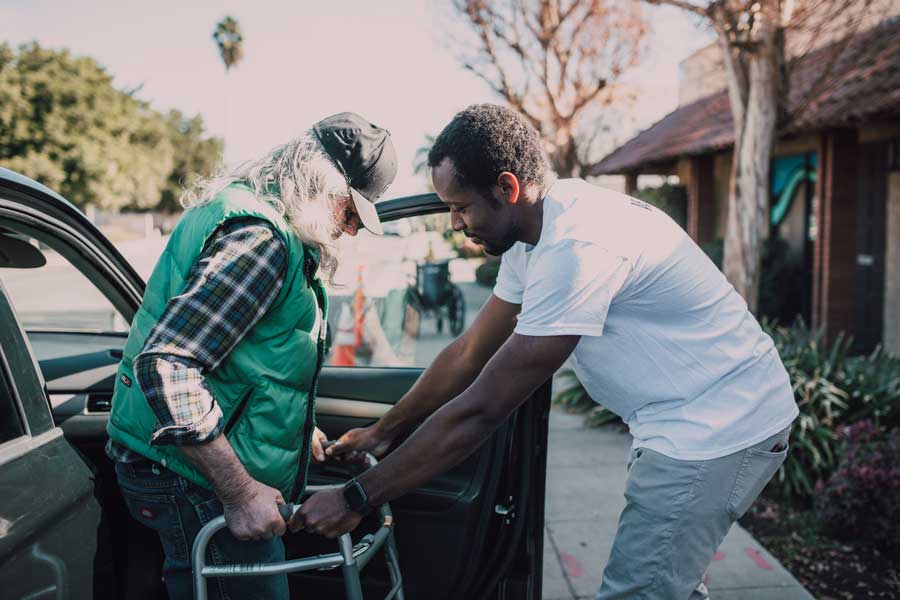
By the year 2035, there will be roughly one million more older adults than children in the United States. America is catching up to what Japan is already experiencing, as that nation’s population is expected to decline by 20 million by 2050. Italy, Spain, Germany, and France have older populations than the U.S., and some Eastern European countries outpace Western Europe. The aging population can be attributed to the Baby Boomers. “Starting in 2030, when all boomers will be older than 65, older Americans will make up 21 percent of the population, up from 15 percent today” (Census.gov). The article goes on to say that because of that explosion in seniors, there will be an increased need for specialized healthcare, assisted living, and home care services.
If Muslims parallel the larger society, then Muslims will face the same challenges and families may already be contemplating what healthcare options are available. With the last, substantial influx of Muslim immigrants taking place in the mid-1960s, they fall either within the Silent Generation or the Baby Boomers. Most African American Muslims today also fit within these two generations. Yet, as rapidly as Muslims are building mosques and schools, facilities for senior care are sadly lagging or almost non-existent. There could be several reasons for this: Muslims feel guilty about putting their parents in elder-care facilities, seeing it as representing lack of love and duty towards them and a failure to adhere to the tenets of Islam; there could be a small number of senior Muslims in a particular location so that building a senior facility is not possible; or the Muslim community is separated by ethnic divides, standing in the way of a collective, cohesive answer to address the needs of their aging population.
The Rights of Parents and Elders
Islam enjoins respect, care, and compassion toward parents by adult children. There are at least a dozen ayat and many ahadith that address the treatment of one’s nuclear and extended family members. Breaking the ties of kinship, the cornerstone of community and society, leads to conflict and demoralization. According to the book, Rights of Parents, parents even have rights upon their children after death. They are entitled to prayers for mercy and forgiveness, settling their outstanding debts, giving charity on their behalf, and reciting Qur’an at their gravesites.
The Qur’an states in verses 17:23– 24, about parents: “Your Lord has decreed that you worship none but Him, and that you be kind to parents. Whether one or both of them attain old age in your life, say not to them a word of contempt, nor repel them, but address them in terms of honor. And, out of kindness, lower to them the wing of humility, and say, ‘My Lord! Bestow on them your mercy even as they cherished me in childhood.’” Another ayah (4:36) summarizes all those who have rights upon a Muslim. “Serve Allah, and join not any partners with Him; and do good—to parents, relatives, orphans, those in need, neighbors who are near and neighbors who are farther away, the companion by your side and the traveler, and what your right hands possess; for Allah loves not the arrogant, the vainglorious…”
Several ahadith address the relationship of child to parent as well. Ibn Umar (r) said, “Making parents weep is part of disobedience and one of the major wrong actions. “So, it is evident that Muslim Americans with aging parents have a legitimate concern over how to care for their parents without ignoring religious duties or slighting parental rights. In the past, the extended family was in place to help with child rearing and caring for aging or ill parents. In Muslim-majority countries, there is still some semblance of that, although they too are losing ground in adhering to this long-held tradition. In the U.S., there are Muslims who don’t have extended family, are divorced, have an abusive family, or are the only Muslims in their families. It is time that Muslims tackle the concerns of those who, for one reason or another, are not able to physically take care of their elderly parents and/or other relatives.
Facilities for Seniors For the general American population, there are options available for seniors if they are fully independent and relatively healthy. They can remain in their own homes or continue living with adult children or other relatives. Possible modifications may be needed such as mobility aids or at-home nursing visits. There are senior-only communities where one can either rent or buy a residence. These typically have a community center for socialization and outdoor amenities so that residents can remain active. The other commonly known types of senior housing are assisted living facilities and nursing homes. The level of assistance needed determines which an individual (or their family) would choose. The costs associated with either type of facility depends upon the location and the services available. The average costs nationally, for assisted living, are $4000 monthly. Nursing homes, however, can cost upwards of $7500 per month and are determined by the degree of care, services, location, and occupancy. Other supplementary services for seniors include memory care for those experiencing dementia; rehabilitation care for those recovering from severe illness or surgery; and hospice care for terminal patients.
There have been a few attempts in major cities to either establish a facility for Muslims or to integrate Islamic components into existing facilities. Sajda and Rahmat Khan opened Fonthill Gardens, “a six-bed assisted-living home in Hawthorne, Calif., for the Los Angeles area’s aging Muslim population.” In Maryland, there is a women’s only assisted living facility, and in Dallas, the Texas Muslim Women’s Foundation (TMWF) opened a senior women’s facility for independent living in 2022. These three efforts are limited in the number of individuals they help, but their work is admirable and certainly can be duplicated. In Chicago, the Chicago Muslim Medical Alliance (CMMA) has advocated for halal meals, prayer areas, and Friday prayers at area nursing homes. The AMITA Health Adventist Medical Center Glen Oaks, in Glendale Heights (about 30 miles west of Chicago), has created a room for interfaith worshippers, including wudu space, multimedia Qur’ans, and prayer rugs.
Taking care of elderly parents in one’s home is the most compassionate way to provide for them, as it keeps everyone together. There are cases, however, where in-home care is not possible, for one reason or another. This can especially be challenging when the elder individual has medical needs that are complex or demanding such that only a staffed medical facility can provide. For the past fifty years, institutional building in Muslim communities has been focused on the spiritual, educational, and social priorities — masjids, schools, community centers. These are all essential and good. Perhaps now, though, Muslim communities should start considering additional institutions that meet their aging populations’ medical, spiritual, and social needs – sooner rather than later.