
بسم الله الرحمن الرحيم

Tag: extremism

  • Islam Condemns Extremism

    Islam Condemns Extremism

    Anyone who is familiar with Islamic teachings knows very well that Islam forbids the killing of innocent people. Allah SWT says in the Qur’an: “And do not slay the life which God has made sacred, except rightfully. This is what He has charged you with that perhaps you will understand”(6: 151). It is indeed a clear violation of Islamic guidance to slay a soul—any soul—because he or she does not believe in Islam. As we know from the seerah, Prophet Muhammad (pbuh) himself led many expeditions and never engaged in any coercive action, let alone threatening with death, those who did not believe in the religion he preached.

    Those who are confused about heinous acts of terroristic death and destruction should review commandments that Allah SWT enjoins upon Muslims that make perfectly clear the egregiousness of such actions

    Allah SWT says in the Qur’an, “On that account [Cain’s killing of Abel] We ordained for the Children of Israel that if any one kills a person – unless it be for murder or for spreading mischief in the land – it would be as if he killed all mankind. And if any one saved a life, it would be as if he saved the life of the all mankind. Then although there came to them Our messengers with clear signs, yet, even after that, many of them continued to commit excesses in the land” (5:32).

    Upholding Justice

    Islam, of course, prescribes punishments for serious wrongdoing, as does every society and most religions. However, Islam posits certain qualifications regarding offenses and punishment. For one thing, people must be made aware of what constitutes an offense; that is, there must be exhortation to abide by the law and warning about punishment. Also, punishment is not to be applied in a cruel manner. And very importantly, if there is any doubt about whether an individual committed a wrong, punishment is not to be applied. This was the way of the Prophet (pubh) and he has said, “Avoid applying penalty if there are doubts.” Also if there are extenuating circumstances, that is taken into account such as when Omar ibn Al-Khattab suspended the punishment for theft during a famine.

    The importance of law and order, however, matches the enjoinment to fairness and mercy in a society so that Muslims are admonished to uphold justice in incontrovertible terms. The Qur’an tells us, “O you who believe! Stand out firmly for justice, as witnesses to Allah, even as against yourselves, or your parents, or your kin, and whether it be [against] rich or poor: for Allah can best protect both. Follow not your own desires lest you swerve, and if you distort or decline to do justice, verily Allah is well-acquainted with all that you do” (4:135). The universal profoundness of the wisdom in this verse is proclaimed on a conference room wall at the Harvard Law School Library, along with testimonies to the human quest for justice such as a quote from the Magna Carta, and statements by Thomas Aquinas, Benjamin Franklin, Martin Luther King, Jr., and Nelson Mandela.

    Reviewing Allah’s Commands

    The absolute requisite of justice for a peaceful and prosperous society has been preserved in the Islamic doctrine and legal code and in the minds of ordinary Muslims over the course of fourteen centuries. Hence the killing by ISIS of journalists, aid workers, or common citizens is nothing less than treacherous, entirely contrary to the teachings of Islam, the religion of mercy brought by the messenger of Allah (pbuh) to humanity. Those who are confused about heinous acts of terroristic death and destruction should review commandments that Allah SWT enjoins upon Muslims that make perfectly clear the egregiousness of such actions.

    First, as stated above, coercing an individual to accept Islam is forbidden. Allah SWT says: “There is no compulsion in religion. Rectitude has become clear from error …” (Qur’an 2: 256). In addition, the Qur’an declares, “And if your Lord willed, all who are in the earth would have believed together. Would you then compel people until they are believers?” (10: 99). Islam, indeed, came with a message for all humankind and it’s followers are asked to invite others to join in belief. But the decision is one which is voluntary and must come from the heart.

    The Qur’an says, “And say: The truth is from your Lord; so whoever will, let him believe, and whoever will, let him disbelieve” (18: 29).

    Second, Muslims are enjoined to be tolerant, moderate, and balanced in their understanding and practice of religion. The Qur’an declares: “And thus We have made you a moderate nation, so that you become witnesses over mankind and so that the Messenger becomes a witness over you” (2: 143).

    The third point is that we are warned to avoid pronouncing our belief while not making effort to ensure that our words are backed up by our actions. The Prophet (pbuh) has warned us that “There will definitely be a people after me from my nation who recites the Quran yet it will not even reach beyond their throats. They will pass through the religion as an arrow passes through a target; then they will not return back to it [the target, i.e., the religion]. They are the worst of people, the worst of all creatures.” Al Hasan al Basri warned us that “religion will be lost as a result of the practice of both the excessive and the negligent.”

    The Prophet (pbuh) specifically mentions that extremism in faith leads to its destruction. Ibn ‘Abbas reported, “The Prophet told me ‘Come, pick some pebbles for me!’ I picked some pebbles fairly huge. When I gave these pebbles to him, he said, ‘Use pebbles similar to these [in throwing], and beware against exaggerating in your religion, for those before you were destroyed because of their exaggeration in religion.”

    Abu Hurayrah relates that the Prophet (pbuh) said “This religion is easy. No one becomes harsh and strict in the religion without it overwhelming him. So fulfill your duties as best you can and rejoice. Rely upon the efforts of the morning and the evening and a little at night and you will reach your goal” (Sahih al-Bukhari).

    Factors Leading to Extremism

    When we examine the factors that can lead to extremism, the first and most obvious one is weak knowledge of the deen. This article has presented basic Islamic precepts that every Muslim should know, including the idea that unjustly killing one individual is akin to killing all humanity; that one has to be just and work for justice broadly even when it impugns one’s own action or position, or that of one’s relative (and by extension, one’s group by affiliation whether religious, political, tribal, or national – honesty and fairness trump loyalty to the group when it does wrong); that Muslims are to be a nation of the middle way, that is, moderate, tolerant, and balanced in all things; that being excessive, harsh, or strict in religion brings ruin; and finally, that there must be no coersion with regard to matters of religion and certainly not in forcing a person to accept Islam.

    We must make sure that our youth are advised by parents, teachers, and imams to not be fooled by those with extreme views, whether about religion or worldly circumstances

    A second factor that can lead to extremism is the tendency of human beings to pick and choose what suits their lower desires rather than making effort to understand the Qur’an, the sunnah and the seerah as a whole. That is the only way to avoid the costly mistake of approaching any particular verse in isolation, without the context, qualification, and nuance that is brought to light when counterpoised with other related verses and relevant ahadith of the Prophet (pbuh).

    A third factor that can lead to extremism is lack of sabr and the impulse to vent rage at the oppression that many Muslims are enduring at the hands of dictators and tyrannical ideologies that threaten their survival, let alone any semblance of peace and prosperity. The story of Abu Jandal is instructive in this regard. A Muslim in Makka, Abu Jandal (RA) was suffering great persecution by the Quraish. They kept him constantly in chains. On hearing about the arrival of the Prophet (pbuh) in Hudaibiyah, he managed to escape and reach the Muslim camp just when the truce was about to be signed. His father, Suhail (till then a non-Muslim), was the Quraishi envoy in the negotiations for the treaty. When he saw his son, he smote him on his face and insisted on taking him back to Makka. The Prophet (pbuh) asserted that since the treaty had not till then been signed, its application in Abu Jandal’s case was premature (a clause of the treaty was that if a Quraishite, wanting to pledge his Islam, went to Muhammad without the permission of his guardian, he was to be delivered back to the Quraish). Suhail, however, would not listen to any argument and was not inclined to leave his son with the Muslims, even at the personal request of the Prophet (pbuh), and would even have renounced the truce if it was not agreed that his son would return with him to Makka. Abu Jandal (RA) complained vehemently about the hardships he endured from the Quraish but, much to the grief of the companions, the Prophet (pbuh) agreed to the demand that he be returned to Makka. The Prophet enjoined patience on Abu Jandal and comforted him, saying, “Do not be distressed, O Abu Jandal, Allah will shortly open a way for you.”

    Guiding Our Youth

    We must make sure that our youth are advised by parents, teachers, and imams to not be fooled by those with extreme views, whether about religion or worldly circumstances. They must be taught that extremism leads to bigoted and immoderate madness, utterly far from the way of the religion and the Prophet (pubh). Our youth must be guided to learn only from authentic Islamic sources and to be duly cautious about what they find on the internet so as to not get trapped by people whose ideas wreak havoc and bring only misery and devastation.

    Rather, they should be taught to live their lives according to the beautiful principles of Islam and to make sincere du’a for themselves, the ummah, and humanity at large for resolution of conflicts and the path to peace being illuminated by the wisdom provided by Allah SWT and His messenger (pbuh). They need to remember that the Prophet (pbuh) warned: “There will come towards the end of time a people who will be young in age, having reckless and deficient intellects. They will speak with the statements of the best of creation, yet they will pass through Islam just as an arrow passes through a target. Their faith will not even reach beyond their throats….” And parents need to take more interest in, and maintain awareness of, our children’s views on issues pertaining to the deen. They must make sure to set a proper example in word and action so that extremist sentiment has no place to grow within the minds and hearts of our children and youth.

    Finally, the masajid and Islamic centers have an important part to play in combating extremism. Khateeb must address these issues in unequivocal terms and clarify areas of confusion and remind all members of the congregation of the Islamic teachings that oppose extremist thought or action. We must express conspicuously and decisively that extreme views are un-Islamic and lead to severe consequences.

    It is time that we avert and collapse all forms of extremism by exemplifying the true mercy of God, whose religion and message are distinguished by caring, compassion, and overriding humaneness.

    Prophet Muhammad is the superlative example and teacher of such nobility, saying, “… Be merciful to those on the earth and the One above the heavens will have mercy upon you (Al-Tirmidhi). And to those who dare think that he intends us to understand that such mercy is to be extended only to those who profess Islam, let them reflect on this: Some companions said to the Prophet during a time of great persecution, “Pray to God against the idolators and curse them.” The Prophet replied, “I have not been sent to lay a curse upon men but to be a blessing to them” (Sahih Muslim).
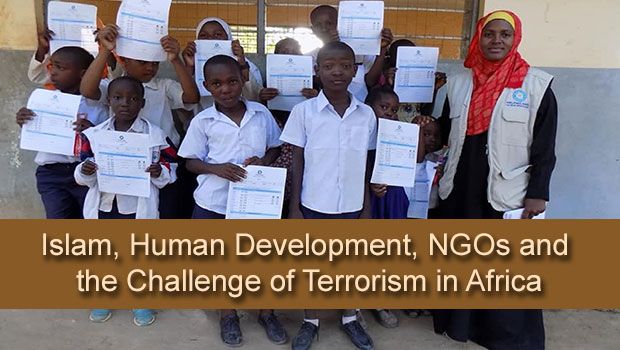
     

  • Islam, Human Development, NGOs and the Challenge of Terrorism in Africa

    Islam, Human Development, NGOs and the Challenge of Terrorism in Africa

    Africa is the second largest continent on the planet.   It is the home of early man; it is the cradle of life from which human beings branched out to populate the globe. Yet, despite being the fountainhead of civilization, the continent of Africa ranks today at the bottom of the totem pole of social progress. Why is this the case? What are the factors and forces responsible for this state of affairs?   How can one explain this phenomenon of economic underdevelopment?  And finally, what is the role of African religions in this state of affairs?   In writing about Islam and its connection to African development, one must examine these issues to find out what can be done to change the conditions for the better. Along these lines of thought, one must focus on the divide between African Muslims and the Western world with regard to modernization and globalization. We must look at the theological, sociological, political, and economic factors involved in the phenomenon of Islam in Africa and how these play into the perception of the role of Islam and Muslims in the arena of civic responsibility and economic development.  It is for these and other related reasons that we will here examine the relations between Islam and the development of Africa.

    Religion and Human Development

    In our attempt to shed some light on the problem at hand, let us first look at the geography and history of religion in Africa.  John Mbiti, in his Introduction to African Religions and in many other of his writings, has described the African as notoriously religious. Kwame Nkrumah of Ghana makes the point in his book, Consciencism, that Africa is the theater where three strands of religious thought compete for primacy.  In his view, however, the only way Africans can deal effectively with the existential and political challenges they face is to develop a socialist framework within which they can organize themselves for political and economic liberation. It is this author’s view that Africa must, in fact, find a renewed modus vivendi if her people are not to be torn apart by the ideological conflicts arising out of their religious divisions. More than one thousand ethnic groups are caught in the web of globalization. Science and technology, telecommunications, and market forces have penetrated the borders of Africa, challenging the Africans to address the ethnic and religious cleavages that foment conflict and create a breeding ground for the new wave of violence now identified with international terrorism.

    Thousands have died because of religious riots, and the poisonous rhetoric and religious intolerance, with or without foreign backers, have continued unabated

    Africa’s religious heritage has both an Abrahamic and non-Abrahamic face. The Abrahamic aspect is now the dominant one as Judaism, Christianity, and Islam have taken center stage in the African choice of religious ideas and practices. In fact, historically there is an African connection to all of the three Abrahamic religions. Judaism is connected to Africa as seen by the fact that Jews around the world still celebrate their Seder, a ceremonial dinner that commemorates the exodus of Moses and the Hebrew people in their long journey out of slavery in Pharoanic Egypt. Christianity too has its African connection. Reading the Christian gospels one is struck by the fact that young Jesus, Mary, and Joseph had to flee to Egypt to escape King Herod’s persecution of new-borns for fear that any one of them could be a future threat to his throne.  This episode in the Christian scriptures serves as an important reminder to Christians that Jesus was a refugee in Africa. In the modern context, this fact can serve as an effective impetus for global Christian understanding of the plight of Africans in refugee camps today. Welcome or not, the fact remains that Christianity in Africa is a force to be reckoned with, and both advocates of Islam and traditional religions are fully aware of the necessity to co-exist peacefully with their Christian neighbors. This “live and let live” modus vivendi is more evident in Yorubaland than in any other place on the African continent. The sense of inter-religious solidarity among the Yoruba people has been attributed to the “hegemony of culture” by American scholar David Laitin.

    Finally, we find that Islam too has its African connections. At its infancy, this religion that came out of Arabia found refuge from persecution by its own kinfolk with African Christians living in Ethiopia who offered succor. From the sirah of the Prophet, as well as the hadith literature, one can cite evidence showing that Islam is deeply connected to the African experience. African Muslims have always made reference to Bilal Ibn Rabah, the Ethiopian slave who gained manumission in the early stages of Islam in Mecca, and later became the Muezzin of the Islamic movement.

    With scriptural evidence of Africa’s primal connection to all three of the Abrahamic religions, the reality of religious diversity and plurality on the African continent must not be dismissed lightly. If what Samuel Huntington said about the clash of civilizations is true — that cultural and religious identities will be the primary source of conflict in the post-Cold War world — then Africa might be destined to be cannon fodder for the clash between the West and Islam.

    It is only in this context that one can discuss seriously the challenges of modernization and economic development, the expansion of international terrorism, and most importantly, the role and place of Muslim non-governmental organizations in African development.  By development I mean the successful transition of an agrarian or pastoral society into a scientifically conscious and technologically skilled dynamic community.  This would be a society which is progressively committed, through the guidance and support of their leaders, to the study and understanding of natural processes and the establishment of institutions that are sufficiently organized to meet the challenges of ignorance, superstition, natural disaster, material poverty, and cultural deprivation vis-a-vis the Euro-American paradigm generally identified as Westernization.

    Armed conflict has not solved Africa’s political and economic problems

    In this definition of development, the cultural factor must be highlighted as crucial in the self-definition of the people.  Because of the cultural deprivation and the poverty of science and technology in Africa, the people have yet to cross the threshold of industrialization. This fact, indeed, underscores the plight and dilemma of the African continent and its people.  Therefore, when we address the question of religion, economic development, and NGO activities within the sphere of social justice and social change, we find ourselves confronting the paradoxes of the African condition.  African scholars such as Ali A. Mazrui, Claude Ake, George Ayittey, and many others have addressed these paradoxes over the years.  In an essay written for a volume published by the World Bank almost a decade ago, I argued that Africa’s economic and political development has been radically affected by the neglect of culture in the policy-making process of African governments. President Julius Nyerere’s policies of social and economic development in Tanzania after it gained independence from Britain in 1961 (based on a socialist concept and vision called ujamaa), and Kwame Nkrumah’s Consciencism (a philosophical and ideological system calling for the decolonization of Africa) failed due to their unwillingness to engage their respective traditional cultures.  In African society, ethnic, religious, and geopolitical boundaries separate citizens within a nation, in contrast to the U.S., for example, where citizens share bonds of fidelity to the nation through a uniting Constitution and a long tradition of political membership and social identity,  exercise of the vote, and military service.

    Islam, Africa and Non-Govt Orgs (NGOs)

    African societies have dealt with non-governmental organizations in three separate and distinct periods. During the pre-colonial period, individual African societies and communities organized the lives of their peoples according to traditions and the necessities of communal life. With the onset of European colonialism, the patterns of life were gradually changed. For example, in the Senegambian region of the African continent, the people had ruling families and clans; however, communal life necessitated the establishment of Kafo systems (indigenous self-help village  groups) among the Mandinka and parallel structures among the Wolof, Serrere, Jola, Fulani and others. The Kafo system was, and still is, known for its mobilization of young people. Once a child reached puberty, he became a Kambano, an acknowledged member of the council of adults. By then going through certain rites of passage, he is confirmed as a full-fledged member of society with certain responsibilities relating to the welfare and development of the community, and is thus seen as an agent of social change and development. The Kafo was an NGO for its time.  The coming of the Europeans also gave rise to the Boy Scouts, the Girl Guides and other cooperative groups through the churches and secular orders of the society. Independence led to the formation of various civic organizations such as labor movements, political groups such as those advocating socialism or Marxism, and religiously motivated groups such as an Arabic instructor association or a Sufi order. Such civic organizations have gone through a new incarnation in the form of national or regional NGOs. In Gambia, for example, there is a national organization called Tango (The Gambia Association of Non-Governmental Organizations) which caters to the needs of Gambians who embrace the ideas, concepts and activism of the day.

    We can identify a number of different areas of action where the NGOs in Africa and the Islamic organizations, both national and international, share an interest and have grounds for cooperation.

    Development in African societies is inextricably linked to the stability of the international system

    With respect to education and moral development, NGOs could collaborate with Muslim leaders to come up with a wide range of viable options and programs of action. Before colonial rule, local African societies, in their varying ways, set up systems for the educating of the young people before marriage.  Through these systems, the rites of passage served as an effective way of passing the knowledge and wisdom of the elders to the younger generation. These avenues of education were taken to greater heights when Islam and Christianity were introduced. In the Senegambian narratives, for example, the arrival of the Sufi orders led to the organization “of the tongue, the hand and the feet” in the community, of fidelity to Allah and the satisfaction of the “politics of the belly.” This is to say, among the members of the Muridiyya Brotherhood of Senegal and beyond, the followers of Shaykh Ahmad Bamba put forth a new concept of social organization which made their civic engagement comparable to what Donal Cruise Obrien described of the Pilgrims in the American narratives:  serving God and doing hard work were conjoined to create the meaning of life.

    During the colonial period, the closer association between the Christian missionaries and the imperial powers made it possible for these missionaries to more effectively compete for attention among the Africans. With material advantage, they constructed schools, dispensaries, clinics, and hospitals in towns and villages.  By the end of the colonial period, Africa found herself with hundreds if not thousands of NGOs. Muslim leaders, activists for social justice, and relief agencies ought to pay close attention to the history of NGOs in Africa and the varying African opinion about, and attitude toward, NGOs. These considerations could enhance the capacity to understand the state of affairs in individual countries and, thus, better design programs for cooperation and development around the continent.

    Islam, Development, and Intl. Terrorism

    It must be noted that armed conflict has not solved Africa’s political and economic problems. The nationalist movements in Africa succeeded in creating new states that have now reconstituted themselves under the banner of the African Union, the successor to the old Organization of African Unity. Yet, it is abundantly clear that political independence has not translated into economic development. In fact, analysis of Africa’s fifty-five years following independence reveals a drama of civil wars, persecution and violence against the weak and the helpless, failed states, political kleptocracy, and the tragedy of missed opportunities. Poor governance has been rampant in Africa, whether the late Mobutu Sese Seko of Zaire who is scornfully remembered as Africa’s greatest villain and kleptocrat, or Idi Amin of Uganda, or the butchers of Kigali, Rwanda, remembered as the most notorious perpetrators of brutality.

    It is against this background that we look at the nexus of Islam, international terrorism, and development.  The issue of international terrorism was brought to global attention during and after the September 11 attack. In my testimony on Africa and international terrorism before the U.S. House of Representatives subcommittee on Africa several weeks before the end of 2001, I made it categorically clear to the U.S. government that “Africa is the weakest link in the chain of anti-terrorism.” This argument was based on a number of reasons. The first is the weakness of the African states which have little to no military power to withstand internal or external subversion.  Unwise policies, intended to hamper any political resistance or rebellion, deny the calls for democracy and reform, with leaders desperately holding on to power at all costs. This creates a breeding ground for terrorism.

    The second reason why Africa is so vulnerable to terrorism is the continent’s economic conditions. Statistical data from the United Nations and the World Bank have painted a bleak picture. The huge number of Africans who are living miserable lives, subsisting on less than one dollar a day, creates ample possibilities for the political manipulation of African youth. They are recruited by foreign or domestic groups that care nothing about African peace and prosperity, who tap the wells of frustration and then exploit the reality of little to no economic opportunity available to these young people.  The likes of Charles Taylor of Liberia, Foday Sankoh of Sierra Leone, and Joseph Kone of Uganda create armies of child-soldiers.  There must be developed practical means of weaning young Africans from the tentacles of domestic terror groups like those just mentioned or international terrorist organizations such as al-Qaeda.  Africa’s political, social, and economic development is inextricably linked to security and stability. This can only be established by the containment, if not outright elimination, of domestic and international terrorism.

    The third reason why Africa is the weakest link in the war against international terrorism lies in the low level of political and social cohesion, with African society split into varied ethnic, regional, religious, and class formations.  One evidence for this state of affairs is the growing divide between the different religious communities. Thousands have died because of religious riots, and the poisonous rhetoric and religious intolerance, with or without foreign backers, have continued unabated. There is a growing presence of non-governmental organizations (NGOs) rooted in, and financed by, religious groups that are stalwart not only in the propagation of their beliefs but also in the stigmatization of their rivals. This state of affairs is more prevalent in some countries more than others. Where such practices prevail, opportunity is created for al-Qaeda and other terrorist groups.

    The fourth reason that Africa is a weak link in the efforts against international terrorism lies in the opportunistic willingness of African intellectuals to compromise their ideals. Struggling to maintain a respectable lifestyle in the face of declining economies, and determined to be relevant in the social narrative, many  African intellectuals and scholars have consciously or unconsciously mortgaged their souls and imaginations to foreign organizations whose visions may or may not tally with the dreams and aspirations of African society. What makes the betrayal by the educated classes so tragic and deadly is that their flirtation with those NGOs, secular or religious, drafts them into the role of an accomplice in the exploitation of the masses and radicalization of some of their fellow citizens.  NGOs that go beyond propagation of their ideologies and policies and engage in divisive activities foment dissension, impeding cooperation and collaboration. Such NGOs continuously plant the seeds of discord in order to gain advantages over their rivals.

    It is important to consider the phenomenon of global solidarity of Muslims. Upon examination, we note that North Africa, Nigeria, the Horn of Africa, East Africa and South Africa have been consistent in the affirmation of support to other Muslims whose societies are undergoing severe political upheavals. This faith-based connectedness can be used for good, for purposes of the pursuit of development and peace; or for ill by groups that agitate and divide. There is need for an enquiry into the nature of such networks and how they can be tapped for peaceful purposes, for development. Without taking action, these groups, such as Hizb ul Tahrir and the affiliates of al-Qaeda, will continue peddling their destructive propaganda. The evidence is strong that many of the foreign insurgents in Iraq were African Muslims, mainly from the east Africa coast. This fact is known to U.S. authorities and attempts have been made to stem the flow.  Although scholars are not in a position to ascertain the numbers and extent of African involvement, they can shed light on the conditions that obtain in the region, the attitudes and policies of the ruling elites, and the receptivity of the Muslim groups to political engagement —  all are crucial elements in the fight against international terrorism in Africa.

    Concluding Remarks

    First, it should be stated that Islam, as a belief system and a way of life, cannot be linked doctrinally to terrorism. Hiraba, unlawful warfare or the perpetration of violence by those who seek to challenge the social or political system, is behavior that falls beyond the pale of the Sharia. Such activities are associated with “spreading disorder in the land,” whether as insurrectionists or highway robbers.  Secondly, terrorism has been demystified and disconnected from its metaphysical roots largely because of the activities of the nationalist/leftist groups that emerged during the liberation struggle in the Third World. Since the rise of the Iranian Islamic Republic in 1979 and the collapse of the Soviet Union in 1989, the groups that are described as terroristic have become more heterogeneous.  Now, however, we are witnessing the return of metaphysical-based terrorist activity after its displacement by the secular forces of the last century.

    The third important point to note is that development in African societies is inextricably linked to the stability of the international system. Africa cannot survive without the international system because of its precarious position politically and economically. Somalia is an interesting example of the paradoxical nature of the interconnectedness of nations, particularly of the U.S. and the Muslim world. As a result of the American humanitarian involvement in Somalia under Operation Restore Hope, Somalis are now scattered across the face of the earth. This unprecedented development of a Somali Diaspora has potentially positive and negative consequences for both the U.S. and Somalia.

    Finally, it is important to note that international terrorism of the al-Qaeda variety is not likely to gain ground in Africa. Although the continent is vulnerable to external penetration, the legitimacy of Osama Bin Laden is bankrupt, as his theological arguments are counterfeit. While al-Qaeda taps on the frustrations of Muslims across the globe, its indiscriminate and un-Islamic violence will ultimately undermine its success.