
بسم الله الرحمن الرحيم

Tag: evil

  • Defeating Our Common Enemy

    Defeating Our Common Enemy

    After the arguing back and forth had ceased, he was looking at the floor, while tears rolled down her face. “Why is this happening?” she asked herself, too scared to say a word. It seemed like a nightmare, but she knew it was too much of a reality. She and her husband had just had the worst fight in all of their six years of marriage. Images of good times kept flooding her mind in those sad, silent moments. “But, wait!” she thought. Something inside of her gave her the strength to speak for the first time after the dead silence: “Shaytan is probably really happy right now. He gets the happiest when a husband and wife fight like this…” She waited a few moments, giving her other half a chance to speak. He remained silent, so she went on: “Why are we fighting each other? We should both be working together to fight Shaytan, because he’s our eternal enemy, not each other.” For a miraculous moment, truth came to light, and they both understood their goal from that moment on—to strive with all of their might to fight their common enemy.

    It is imperative that we know what things can harm us.

    About this very fact, Allah (SWT) has spoken in many places in the Qur’an: “Indeed, Shaytan is an open and manifest enemy to mankind” (5:12). Our Rabb, the one who nourishes us and sustains us, who knows us better than we know ourselves, has made it clear exactly who our enemy is. Should we not then take Shaytan as our adversary? Knowing who our enemy is makes it easier to oppose him. But, even then, fighting Shaytan is not easy. It is definitely difficult, because, as the Rasul (S) said, “Indeed, Shaytan flows in the son of Adam like blood” (Bukhari, Muslim, and others). Fighting a being that flows through our veins like blood seems a bit impossible, but we know that although it is not easy, it is definitely doable. Knowing our enemy does not only entail having the knowledge of who possesses that title, but knowing our enemy includes striving with all of our capacity to defeat him, no matter what the sacrifices.

    Protecting Ourselves from Harm

    It is imperative that we know what things can harm us. By being aware of the fact that alcohol is not only harmful, but dangerous if we consume it, it gives us the incentive to completely steer clear of it. Especially as Muslim women, and particularly the mothers of the ummah, we would never give our child a bottle filled with wine to drink. Not only does the commandment of Allah (SWT) hold us back, but our knowledge of the fact that it would harm our child prevents us from placing him or her in harm’s way.
    Why, then, do we not treat ourselves in the same protective manner? Shaytan is harmful to us—not only physically, but spiritually as well. And the spiritual harm can most certainly do the worst kind of damage. This damage does not only affect us as individuals, but can most definitely affect our marriages in the worst possible way as well. And this is one of Shaytan’s main goals—to break the marriage bond, the strong bond that Allah (SWT) describes as a binding contract in the Qur’an, a meethaqun ghaleedha, a binding oath, a solemn pledge, something that is firm and difficult to break.

    Shaytan Targets Marriage

    Shaytan is trying every day to break our marriages. Why is it that he focuses on marriage? Because it is the core of society, the foundation on which society is built. If marriages do not endure, society becomes weak and corrupted. This is why Shaytan makes it his ultimate target. The Prophet (S) said, “Iblees [Shaytan] has placed his throne above the water [sea], and then he sends his detachments. The closest of them to him are those who cause the greatest trial. One of them comes back to him and says, ‘I did such and such.’ Shaytan replies, ‘You have not done anything.’ Then another comes to him and says, ‘I did not leave him alone until I caused division between him and his wife.’” The Prophet (S) said, “So Shaytan brings him closer to himself and says, ‘You did well’” (Muslim).
    What makes this hadith so frightening is that it really shows us how dedicated Shaytan is to breaking the union between a husband and his wife. No matter what other evil deed he entices a person to do, whether lying, cheating, backbiting, or stealing, it does not compare to what is a truly “successful” deed to him, which is that of a husband and wife engaging in destructive conflict of any sort. The fact that Shaytan is determined to destroy our marriages puts much fear into our hearts. However, as true Muslims, we must always try to be in a state between the feelings of fear and hope. With that in mind, the hope comes from this very same hadith. Now that we know how determined our eternal enemy Shaytan is to break our marriages, we should be even more determined to defeat him in that endeavor and to never let him succeed.

    Become a Solid and Implacable Team

    We must make the greatest effort when it comes to our relationships with our life partners to turn tears into smiles, hurtful words into compliments, distance into closeness, silence into communication, and most of all, to turn resentment, anger, and intolerance into forgiveness, self-restraint, and compassion. These are attributes of taqwa, of God-consciousness and virtue for His sake. If husband and wife strive, together, to get through the hard times with patience and a strong will to defeat Shaytan, they will defeat him, insha’Allah. Instead of turning on each other, let’s turn as a solid and implacable team to face our common enemy. The odds are against him. It’s two against one.
  • Editorial: Repel Evil with What is Better

    Editorial: Repel Evil with What is Better

    Once again a depraved and dangerous game is being played, one with the aim of increasing religious tensions across the globe. This time it’s a film that defames the Prophet of Islam. Predictably, too many Muslims have reacted with fierce intensity, and with deadly consequence. We deplore and condemn both the audacious bigotry of the film-maker as well as the inexcusable violence of the protestors. The protesters cannot counter the fraudulent claims of the film, “Innocence of Muslims” — no matter how profane and bigoted it is — with behavior that itself harms the image of Islam and its Prophet, and Muslims everywhere. The treachery of the Islamophobes defies sanity; but that does not justify reactions that disregard all civility.

    The Islamophobic campaign is nothing new in America. It is even worse in Europe. The film made by Nakoula Basseley Nakoula, a California man who was convicted in 2009 of bank fraud, is not the first effort to denigrate Islam and Prophet Muhammad (pbuh), nor will it be the last. In the recent past, there have been countless attempts by Islamophobes to incite a fierce reaction in the Muslim community. In some cases, the provocateurs succeeded in eliciting a violent response. On other occasions, their hate-mongering plots faded into obscurity, especially when Muslims decided to ignore them or chose to counter/correct them through dialogue and other civil means. The results were obviously positive: the challenges soon turned into opportunities where Muslims were able to present the truth of Islam to their fellow citizens.

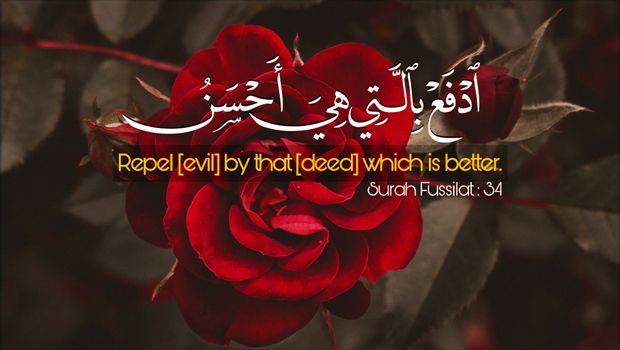
    Those who seek to inflame passions will continue their brazen incitements, hoping that Muslims will take the bait. They can then say, “See how violent the Muslims are.” The incitements will remain unabated; but Muslims must stop reacting and instead respond to the evil with something that is civil and intelligent, that which puts the bigotry to shame. In fact, the Quran itself commands Muslims to “repel evil with what is better” (surah 41: verse 34). The Quran also says: “O you who believe! Be steadfast in the cause of Allah, bearing witness in equity; and let not a people’s enmity incite you to act otherwise than with justice. Be always just, that is nearer to righteousness. And fear Allah. Surely, Allah is aware of what you do” (surah 5: verse 9).

    The overzealous Muslims, who claim to be defending the honor of the Prophet by attacking the embassies and committing acts of mayhem and destruction, and even murder, need to reflect on how Prophet Muhammad (pbuh) would have responded to a provocation like the film. The Prophet was a man of patience, peace, and mercy. Even though he was attacked and insulted many times throughout his life, he responded with a high-minded and measured perspective, always inclined to compassion and forgiveness, and never acting out of revenge or in a violence-driven way. Engaging in wanton acts of violence and senseless killing can only serve to defile his sublime legacy in the minds of those who don’t know him. Muslims in the Middle East and around the world must remember this: We honor the Prophet by following his example of tolerance and patience in the face of hostility.

    It is true and unfortunate that some biased individuals and organizations are stirring up hatred against Islam and Muslims with unrelenting persistence. The film that is center stage in the current turbulence is a manifestation of exceeding ignorance and the most ignoble foolishness in its scandalous attack against the Prophet, Islam, and Muslims. To make it worse, some people are defending this insanity calling it “freedom of expression.” However, there are huge numbers of people in America and elsewhere who have condemned this film and among them are leaders of various faiths, especially Christianity and Judaism.

    Muslims must think deeply before reacting tempestuously. For overreacting to such provocations will only make things worse. Resorting to violence shouldn’t be an option at any time. The maker and sponsors of the anti-Prophet film have undoubtedly put forth a piece of propaganda promoting the worst kind of bigotry; still, this should never be an excuse to commit any act of violence against a person or any destruction of property.

    We are certainly not suggesting that Muslims stop defending the Prophet. But the best way to defend the Prophet is by conveying to people who he really was, and by emulating his sublime character. We cannot become emotionally overblown and act irrationally every time an Islamophobe insults Islam. We should act with utmost maturity and deal with caution, care, and prudence. The Prophet (peace be upon him) is loved and respected by hundreds of millions of people around the world, and no one can take this veneration from our hearts. So we should not fall into the trap of those who want to use our anger as a way to instill hatred in the minds and hearts of non-Muslims. Indeed, there is no God-conscious faith or love for the Prophet in reacting in a brutal and destructive way.

    We call on Muslims around the world to “repel evil with what is better.” That might entail ignoring a provocation, like the film in question, that is ugly in its purpose but supremely foolish in its content. It might require presenting a reasoned argument as to why some anti-Islam talking point is erroneous. In all cases, repelling evil with what is better demands speech and behavior that is measured, civil, and judicious.