
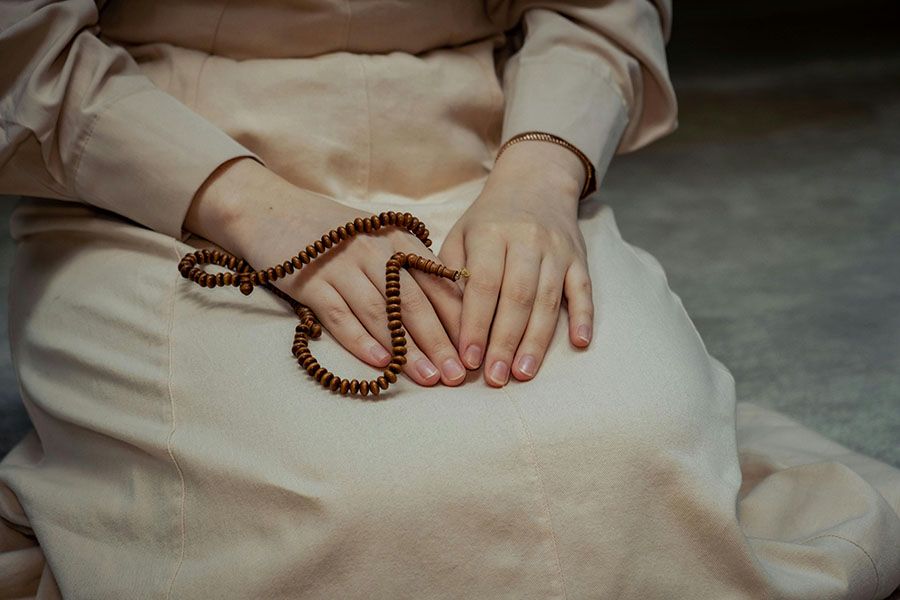
This is the second article in a series entitled “Under the Throne of Allah: Dua and Dhikr.”
Dhikr, the remembrance of Allah (SWT), is one of the most powerful practices a believer can cultivate. It nourishes the soul, strengthens the heart, and anchors us in times of both ease and difficulty. Truly, it is one of the best ways to become more aware of Allah and connect our hearts to Him! It is not just mere repetition of words; instead, if done intentionally and sincerely, it leads to a beautiful state of tranquility and serenity within our hearts, minds, bodies, and souls.
In His holy book, Allah (SWT) reminds us: “Verily, in the remembrance of Allah do hearts find contentment.” (Quran 13:28) Take a moment and think when was the last time you felt true contentment in your heart, when you felt stillness and peace.
Allahu alum. Only Allah (SWT) knows.
But with dhikr, this is attainable. This ayah points to a truth that resonates in the lives of all of us – that our hearts yearn to be connected to their Creator. Just like a compass unsettled until it points north, our hearts struggle until they recalibrate to Allah (SWT), and, once they do, we develop a sense of contentment and peace that can only be found in His remembrance.
Below are five motivations for making dhikr a continuous practice in our lives.
-
Source of tranquility
Dhikr is food for the heart. It nurtures peace, serenity, and contentment by aligning us with the One who created us. Many reverts to Islam describe their journey in this way: Their hearts were restless, searching, until they discovered Islam, and then they finally felt peace. Once they found Allah (SWT), their hearts felt at home. Dhikr allows every single believer to taste that same tranquility.
-
Strengthening and purifying the heart
Through consistent remembrance, the heart is cleansed of diseases like arrogance, envy, and anger. A heart filled with dhikr and remembrance of Allah cannot comfortably hold on to resentment, heedlessness, or fall in to continued temptation and distraction. As Shaykh Hamza Yusuf explains in “Purification of the Heart,” the treatment for spiritual disease is to act with the opposite quality. Dhikr motivates us to embody gratitude over ingratitude, humility over pride, and love over hatred. We remember Allah and we call upon him from His beautiful names, striving to embody the qualities we so desire within our lives as well.
-
Protection and guidance
When the heart is busy with dhikr, it is shielded from Shaytan’s whispers. The morning and evening adhkar are beautiful ways to enrich this shield within our lives. Instead of living in fear from nazar – people’s judgement, or any harm that may befall us – we fortify and solidify our hearts and bodies via the remembrance of Allah in the morning and in the night.
Remembrance builds this fortress of God-consciousness (taqwā), guiding us in our decisions and even strengthening our ability to resist harmful influences. A simple practice like pausing to ask, “What would the Prophet (peace be upon him) do?”, can serve as a moment of calibration to Allah in everyday choices, helping us align our actions with prophetic character and garner the reward that comes from following the Sunnah.
-
A source of strength
By its nature, life is filled with obstacles, but dhikr transforms how we face them. The Prophet (peace be upon him) taught us the affair of the believer is always good: When something favorable happens, they show gratitude, and when difficulty strikes, they practice patience. Dhikr nurtures this resilience. The Quran and Sunnah remind us people often turn to Allah (SWT) only when hardship strikes. While trials naturally awaken us to Him, the true gift is remembering Allah in both prosperity and difficulty. Gratitude in times of ease strengthens our faith, while remembrance in hardship gives us comfort and direction. As Allah said: “If you are grateful, I will surely increase you [in favor].” (Quran 14:7) By remembering Allah in times of ease, we build spiritual muscles that sustain us through hardship. Then, for the believer every moment, whether joyful or painful, becomes beautiful as it is seen as an opportunity to draw closer to Allah.
-
Reviving the soul
Just as healthy food fuels the body, dhikr fuels the soul. It revitalizes our spiritual energy and deepens our sense of purpose. When we live with constant remembrance, worship transforms from routine obligation to a pursuit of excellence (iḥsān). Each act of prayer, service, or kindness becomes infused with vitality because it is rooted in remembrance of Allah.
Living a life of dhikr
 To live with dhikr is to weave remembrance of Allah into daily life, not through rigid checklists or guilt-driven goals, but through sincerity and consistency. Dhikr can be a whispered “subḥānAllāh” while washing dishes, a heartfelt dua in the car, or a moment of reflection in silence. The connection is what matters.
At its core, dhikr is about a relationship. It is how the heart speaks to its Creator, how the soul heals, and how the believer finds both strength and surrender. By remembering Allah in all of our states, in ease and in hardship, we develop resilience, gratitude, and an unshakable trust in His plan and decree.
So today, take a moment to look into your heart and ask, “What does my soul need right now?”, then offer it the nourishment of remembrance.
With dhikr, you are never alone, and your heart will always find its true north—Allah.
 However, in this modern age, our everyday lives are filled with distractions, making it difficult to always remember Allah (SWT). Nevertheless, the best thing we can do is to remember Allah (SWT) as much as we can because that is what our heart wants.