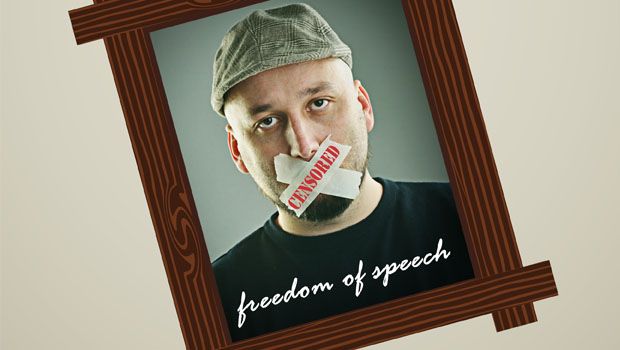
The attack on the office of the Charlie Hebdo satirical magazine, killing 12 people and injuring others, was the terrorist act of two brothers, Said and Cherif Kouach. According to the media reports, they were seeking revenge for the frequent publication of cartoons that ridicule and disparage Islam, Muslims, and Prophet Muhammad (peace be upon him). A groundswell of support erupted everywhere for the Charlie Hebdo victims (hebdo is short for hebdomadaire which means “weekly” in French, and Charlie refers to Charlie of the Charlie Brown comics). Signs were held by saddened and shocked people in France and elsewhere, “Je sui Charlie,” meaning “I am Charlie.” Commentators in the U.S. unanimously expressed the need for unity in the face of this murderous attempt to quash freedom of expression. Many pointed out that the satirical magazine is an equal-opportunity fault-finder, ridiculing and denouncing what their cartoonists and writers see as absurdities or other elements deserving of criticism in any and all religious traditions, but the magazine is also renowned for racist and sexist cartoons, with one portraying France’s black Minister of Justice, Christiane Taubira, as a monkey. According to U.K.’s The Daily Telegraph, previous Charlie magazine covers depicted “Pope Benedict XVI in amorous embrace with a Vatican guard; former French President Nicolas Sarkozy looking like a sick vampire; and an Orthodox Jew kissing a Nazi soldier.” The League of Judicial Defense of Muslims (LDJM) sued the satirical magazine in early 2014 for “provocation and incitement to hatred on the basis of religious affiliation and insult.” Jean-Marie Charon, a sociologist whose focus is the news media, says that the magazine has been sued numerous times by various complainants, including 14 times by the Roman Catholic Church, for its intentionally offensive cartoons and content.
While the media hyper-focuses on the brutal murders as an attack on freedom of expression, many people have mounted a counter campaign. Time.com notes, “Others have joined the Twitter conversation through the #JeNeSuisPasCharlie (I am not Charlie) hashtag, arguing that Charlie Hebdo‘s cartoons are not to be condoned, despite Wednesday’s attacks. Many of them condemned the murders but criticized what they saw as the newspaper’s racism, sexism and Islamophobia.” Chloe Benoist tweeted, “Lumping together extremists and French Muslims is a national disgrace. #JenesuispasCharlie [I am not Charlie] and I denounce all acts of violence.” Another posted, “Condemning a brutal murder? Yes. Condoning racism, xenophobia & intolerance? Never.” Another twitter user wrote “No, most of us are not Charlie. A *very* narrow class has end-to-end state support for its speech, and you are probably not in it.” These comments highlight the double standard, decontextualization, and omission of important facts and distinctions that thread throughout the discourse following the tragic murders.
Lellouche Law – Glaring Double Standard
The Lellouche Law was passed in France in 2003 to counter rising anti-Semitism. The bill was also presented as a needed response to increasing anti-Arab and anti-Muslim sentiment. Lellouche stiffens the penalties for discrimination or attacks on persons or destruction of property when committed with anti-Semitic or racist motive. The law, however, has been used as a legal limitation on free speech in very particular cases. It was used to criminalize the political protests of BDS (boycott, divestment, and sanctions) activists who criticize Israel and Israeli policy toward Palestinians. Ten cases against BDS supporters have been brought to trial to date under the Lellouche Law. One such case saw the conviction of Farida Trichine and eleven other BDS activists who entered a grocery store wearing “Boycott Israel” T-shirts and applied BDS stickers to vegetables imported from Israel. It would be no problem if police were called and Trichine and her fellow activists were escorted out of the store and charged with a misdemeanor for something like posting political content stickers on objects that are privately owned. While the BDS campaign targets almost universally-criticized Israeli policies, not individual Jews or the Jewish people in general, the BDS protestors have been charged as if they committed hate crimes. Nicole Kiil-Nielsen, a French member of the European Parliament, has stated, “These convictions are unconscionable,”pointing out that “Governments are doing nothing to end Israel’s illegal occupation and the French court is wrongfully denying citizens from acting through BDS.”
The Charlie Hebdo magazine directed its scathing, often hateful and intentionally offensive and provocative cartoons and written content toward individuals, institutions, and religions and is protected under French law. But most Americans would find the representation of a black politician as a monkey or another magazine cover depicting the young girls kidnapped by Boko Haram as pregnant welfare queens as hate speech, racist, mean-spirited, and contemptible. It is shameful that French law protects that “freedom of expression” while demonstrably political protest speech and action by BDS supporters against Israeli occupation and oppression of Palestinians is prosecuted as inciting racial hatred. (As side note: according to Haaretz, Israel’s daily newspaper, pro-Israel supporters are trying to enact a similar law in Belgium, but no other European countries have followed suit.)
Then there was the 2009 lawsuit against Maurice Sinet, now 85 years old, who was a writer for Charlie Hebdo until he wrote in his column in the magazine a remark about Jean Sarkozy, the son of Nicolas Sarkozy (president of France from 2007 until 2012). Sinet wrote that Jean “has just said he intends to convert to Judaism before marrying his fiance, who is Jewish, and the heiress to the founders of Darty [an electronic goods chain].” Sinet then wrote, “He’ll go far, that kid.” So for associating Jewishness with a guaranteed path to success, Sinet was asked by the editor of the satirical magazine to issue a public apology, and when he refused, he was fired. Sinet was then charged with “inciting racial hatred” and put on trial. Philippe Val, the editor of the magazine at the time, later said that Sinet’s remarks were printed by mistake and were “neither acceptable nor defendable in court.” Interestingly, in 2008 twenty writers and politicians wrote an open letter to Le Monde defending the decision to fire Sinet from Charlie Hebdo. The letter charged Sinet for having “crossed the line between humorous insult and hateful caricature.” While the remark by Sinet was relatively mild and well within the purview of Charlie Hebdo satire, the many depictions of Islam, Muslims, and Muhammad would certainly, by any fair and balanced observer, be seen as having crossed way over, exceedingly so, that same line.
Jumping on the Bandwagon
Crossing the line, speaking in a racist, sexist, or otherwise crassly offensive way, can get you fired from your job (hypocritical in the case of Sinet since he worked for a satirical magazine where nothing, supposedly, is sacred or immune to criticism). It should not get you killed. But in the media discussions following the murders it’s been made to seem that either you support free speech and therefore must support the Charlie Hebdo magazine, or you are encouraging further terror acts carried out to intimidate and thus curb the freedoms of the West. On mondoweiss.net, Brian Klug posted a well-argued piece that lures the reader out of that small comforting cradle of black and white thinking. In “The moral hysteria of Je suis charlie,” he points out that the mass support for freedom of expression fails to account for the reality that almost all people have their own sacred symbols which they hold in reverence, and regard, with fervor, as rightfully immune from violation of any sort, whether mocking, belittling, or vilification. When these symbols are offended, fast and sometimes furious reactions follow. Klug is not in any way excusing or minimizing the abominable murders of the cartoonists but is simply pointing out that most of the demonstrators themselves have boundaries across which one dare not tread.
Klug offers up an interesting thought experiment: “Suppose that while the demonstrators stood solemnly at Place de la Republique the other night, holding up their pens and wearing their ‘je suis charlie’ badges, a man stepped out in front brandishing a water pistol and wearing a badge that said ‘je suis cherif’ (the first name of one of the two brothers who gunned down the Charlie Hebdo staff). Suppose he was carrying a placard with a cartoon depicting the editor of the magazine lying in a pool of blood, saying, ‘Well I’ll be a son of a gun!’ or ‘You’ve really blown me away!’ or some such witticism. How would the crowd have reacted? Would they have laughed? Would they have applauded this gesture as quintessentially French? Would they have seen this lone individual as a hero, standing up for liberty and freedom of speech? Or would they have been profoundly offended? And infuriated. And then what? Perhaps many of them would have denounced the offender, screaming imprecations at him. Some might have thrown their pens at him. One or two individuals — two brothers perhaps — might have raced towards him and (cheered on by the crowd) attacked him with their fists, smashing his head against the ground.”
Klug, of course, is not condoning the imagined violent reaction of some in the crowd. He is making the point that people are not thinking through the issue and thus rendering “freedom of expression” as if it has no limits even though, as the thought experiment shows, the supporters of free speech have and impose their own personal, moral limits but don’t realize that about themselves. They know that vigilante killing of someone who has crossed someone else’s line, besmirching their sacred symbols, is unarguably brutal criminal behavior. But they have jumped on the bandwagon rolling through the countryside, noisily drowning out the nuances and distinctions that must be made if we are to have intelligent and honest conversation about the heinous Paris attacks. But those intellectually honest conversations are as yet to materialize in the mainstream. As Glenn Greenwald says in an Intercept article, “…last week’s celebration of the Hebdo cartoonists (well beyond mourning their horrifically unjust murders) was at least as much about approval for their anti-Muslim messages as it was about the free speech rights that were invoked in their support -at least as much.”
Limits Drawn on Free Speech by Convention
Greenwald is referring to the rights and limits attached to freedom of expression that are blotted with hypocrisy and selective morality: “As always, it’s free speech if it involves ideas I like or attacks groups I dislike, but it’s something different when I’m the one who is offended.” There are also selective boundaries put in place based on a nation’s dominant narrative and these are often unspoken, but very powerful. In the U.S. for example, any pundit who strays outside the established boundaries of commentary on American foreign policy is for all intents and purposes excluded from contributing his or her analysis to the mainstream discussion. If one were to suggest that the U.S. political and military interventions since WWII in Latin America, the Middle East, Africa, and elsewhere around the world have served American corporate and economic interests, that would plausibly fall within acceptable parameters of discourse. But assert that the U.S. has interfered in the internal affairs of countless nations, carrying out covert operations that flout international law, frequently orchestrating coups de’etat against leaders who don’t support the American agenda, training and supporting autocratic regimes in instruments of repression – that would get one flagged as anti-American and banned from the public conversation. Even though those cited foreign policy actions are empirically true and broadly researched and documented, and indisputably reflected in declassified internal documents from the CIA and other government agencies, communicating those things in the mainstream public square crosses the Rubicon, characterizing the speaker as having abandoned the sacred symbols of America as “exceptional,” “indispensable,” and always having the moral high ground.
In addition to the touting of free speech as if it is completely free when in fact there are legal, moral, and conventional boundaries in place, there is the discriminatory demand placed upon Muslims, leaders and ordinary citizens across the globe, to denounce every terror act committed by a Muslim.
Prove to Us that You Denounce Violence
In addition to the touting of free speech as if it is completely free when in fact there are legal, moral, and conventional boundaries in place, there is the discriminatory demand placed upon Muslims, leaders and ordinary citizens across the globe, to denounce every terror act committed by a Muslim. Free speech is “don’t tell me what I can say or can’t say.” The flip side is coerced speech. This talking point is very much in play after every terror incident: “Tell me what I want to hear or else we will designate you as indirectly complicit.” So following the Charlie Hebdo murders, we heard over and over again on the mainstream media the calls for Muslims to speak out against terrorism. This near-accusation of complicity in terror acts, guilt by association (same religious tradition), has been repeated ad nauseum since 9/11.
The commentators on CNN, MSNBC, and FOX News, and the pundits who make appearances, certainly have access to the internet and, in some cases, have the advantage of research assistants. So it is hard to understand that they are unable to find the copious evidence of Muslim denunciations of terrorism, that started within days after the 9/11 attacks and have continued unabated since. One can view the statements, forthright and unequivocal, of close to a thousand Muslim leaders, scholars, organizations, and prominent individuals who have issued condemnations of terrorism, starting on September 13, 2001, on http://kurzman.unc.edu/islamic-statements-against-terrorism/. These include American Muslim organizations such as Muslim American Society (MAS), Islamic Circle of North America (ICNA), Council on American Islamic Relations (CAIR), Muslim Alliance of North America (MANA), Muslim Student Association (MSA), Islamic Association for Palestine (IAP), United Association for Studies and Research (UASR), Solidarity International, American Muslims for Global Peace and Justice (AMGPJ), American Muslim Alliance (AMA), United Muslim Americans Association (UMAA), Islamic Media Foundation (IMF), American Muslim Foundation (AMF), Coordinating Council of Muslim Organizations (CCMO), American Muslims for Jerusalem (AMJ), and Muslim Arab Youth Association (MAYA).
Also listed is a statement issued by more than 500 British Muslim scholars, clerics, and imams. The index goes on and on, with Shaykh Yusuf Al-Qaradawi; Shaykh Muhammed Sayyid al-Tantawi, imam of al-Azhar mosque in Cairo (through 2010); the Muslim Brotherhood in Egypt; Abdulaziz bin Abdallah Al-Ashaykh, chief mufti of Saudi Arabia; Tahirul Qadri, head of the Awami Tehrik Party, Pakistan; the League of Arab States; Mehmet Nuri Yilmaz, Head of the Directorate of Religious Affairs of Turkey; Syed Mumtaz Ali, President of the Canadian Society of Muslims; and the list goes on. Keep in mind that this is just one compiled list posted on one website. This and many other lists are readily available online to any person who genuinely wants to know if Muslims have condemned terrorism.
Empirical Data and Stats Instead of Propaganda
A 2007 article in The Christian Science Monitor cited a survey done the previous year by the University of Maryland’s Program on International Public Attitudes. Of the American respondents, 46 percent thought that “bombing and other attacks intentionally aimed at civilians” are “never justified.” The article then presents the results of a survey by Terror Free Tomorrow, a non-partisan, not-for-profit organization that researches attitudes toward extremism worldwide. People in various Muslim countries were asked if “bombing and other attacks intentionally aimed at civilians” are ever justified. In Indonesia 74 percent indicated “never justified,” as did 86 percent in Pakistan, and in Bangladesh, 81 percent. These are Muslim majority countries which showed an average 80 percent of people rejecting attacks on civilians, indicating they are “never justified,” compared with 46 percent of Americans.
The point here is that terrorism, rightfully seen by Westerners as barbaric because its perpetrators intentionally target civilians, is the primary fuel of Islamophobia. The view that many Muslims support or at least don’t condemn terrorism is a dominant theme that Islamophobes repeat again and again. But what we have seen is that the Muslim denunciations of terrorism are loud and clear but the mainstream media for the most part ignores them. And then one looks at the two polls and sees that 46 percent of Americans see attacks on civilians as never justified compared to 80 percent of Muslims polled. Islamophobia is a propaganda tool that fosters fear and hatred. It blames Muslims everywhere for the actions of extremists and conflates a radical interpretation of Islamic tenets with the authentic religion. It is imperative that those Muslim leaders and spokespersons who are invited to speak to the media have a ready and articulate mastery of the relevant teachings. One such area regards the guidelines put in place by the Quran and the Prophet (pbuh) with regard to armed conflict (which according to Islam is sometimes unavoidable, and is permissible when Muslims are attacked and thus are defending their lives and property).
The principle of war in self-defense is enumerated in multiple verses in the Quran such as 22:39-40, “Permission [to fight] is given to those against whom war is being wrongfully waged…” as well as 2:190-193, 4:91, and 60:8. In Yusuf Al-Qaradawi’s book “Fiqh of Jihad,” the eminent shaykh mentions the Quranic forbidding of transgression. He quotes the verse, “Fight in the way of Allah against those who fight against you, but begin not hostilities. Lo! Allah loves not aggressors” (2:190). Aggression is an unprovoked, offensive attack and violation of the rights of others. It is a transgressing of limits and includes, as Shaykh Al-Qaradawi makes clear, the killing of non-combatants, i.e., any who is not waging war or fighting against the Muslims. To minimize the deadly and destructive horrors of war, the Prophet also pronounced prohibitions, including the following:
“Do not kill any child, any woman, or any elder or sick person.” (Sunan Abu Dawud)
“Do not practice treachery or mutilation. Do not uproot or burn palms or cut down fruitful trees. Do not slaughter a sheep or a cow or a camel, except for food.” (Al-Muwatta)
“Do not kill the monks in monasteries, and do not kill those sitting in places of worship. (Musnad Ahmad Ibn Hanbal)
“Do not destroy the villages and towns, do not spoil the cultivated fields and gardens, and do not slaughter the cattle.” (Sahih Bukhari; Sunan Abu Dawud)
“Do not wish for an encounter with the enemy; pray to God to grant you security; but when you [are forced to] encounter them, exercise patience and perseverance.” (Sahih Muslim)
The authentic Islamic guidelines regarding military action and war repudiate the extremist ideology that steers some Muslims to terror acts, as well as totally discrediting the Islamophobic propaganda that equates Islam, Muslims, and the Prophet with extremism, terrorism, inclination to violence and aggression. It is imperative that terrorism be stopped, for it is a scourge upon the earth and the human population. But part of combating terrorism is also making every effort to end the Islamophobia campaign that only adds fuel to the fire, alienates Muslims and feeds the radicalization of some, and puts Muslims in the West at risk of attack by those who are enraged by Islamophobic mongering of fear and hatred.
The February 10th murders of three Muslim college students in Chapel Hill, North Carolina point to the tragic outcomes of fomenting contempt and hostility toward Islam and Muslims. CAIR National Executive Director Nihad Awad captures the core issues in what looks likely to be a crime motivated by hate: “Based on the brutal nature of this crime, the past anti-religion statements of the alleged perpetrator, the religious attire of two of the victims and the rising anti-Muslim rhetoric in American society, we urge state and federal law enforcement authorities to quickly address speculation of a possible bias motive in this case.” The terribly sad irony is that all three victims, Deah Shaddy Barakat, 23, his wife Yusor Mohammad, 21, and Yusor’s sister, Razan Mohammad Abu-Salha, 19 were all actively involved in spreading goodness. Deah regularly volunteered to provide free dental care to the needy in the U.S., in Turkey, and in Syria. Yusor accompanied Deah on the humanitarian mission to Turkey. And Razan was a creative artist involved in making a video portraying a positive and hopeful message about being Muslim and American.
Elephant in the Room
Muslims have repeatedly, earnestly, clearly, stood up in the room and pronounced terrorism as “against all human and Islamic norms,” that “terrorizing innocent people and shedding blood, constitute a form of injustice that cannot be tolerated by Islam, which views them as gross crimes and sinful acts.” Again and again they state that Islam requires that humans “oppose all aggression on human life, freedom and dignity anywhere in the world” and that “Islamists who live according to the human values of Islam could not commit such crimes.” These are some of the countless statements made and available on the site mentioned above. But there is a black hole somewhere in the room sucking out these pronouncements. That nothing-can-escape gravitational pull has left only one thing standing. Yes, there’s an elephant in the room.
Despite all the shouting of invectives – “anti-American,” “unpatriotic,” “naive about the dangers in the world” – those who thoughtfully critique U.S. foreign policy are simply applying democratic principles. Inherent to those principles is the responsibility to dissent from the official discourse and criticize one’s government when it strays outside of rational, lawful, ethical, or humane boundaries. As such, we, the citizens of the United States, should always demand as a first principle that our country apply to itself the same standards and expectations of moral and law-abiding behavior that is demanded of other nations under the auspices of international law and the Geneva Conventions.
Within the high-principled dissident tradition, Noam Chomsky notes that there is a propagandistic treatment of terrorism that almost always holds sway in the mainstream discourse: “We begin with the thesis that terrorism is the responsibility of some officially designated enemy. We then designate terrorist acts as ‘terrorist’ just in the cases where they can be attributed (whether plausibly or not) to the required source; otherwise they are to be ignored, suppressed, or termed ‘retaliation’ or ‘self-defense.’”
Muslims, the “officially designated enemy” after the collapse of the Soviet Union, have been forced into an apologetic, defensive stance since 9/11. The 3000 Americans murdered in September, 2001 was a horrific and tragic event. Americans were shocked and angry. Rightfully so. But how many are also shocked and angry that close to 500,000 Iraqi men, women, and children died following the U.S. invasion and bombing of that sovereign nation?
The Iraq War, as acknowledged by most pundits, was launched based on a lie about weapons of mass destruction. Simply put, it was a war of aggression as defined by international law. A PLOS Medicine study estimates that 460,000 Iraqis died through mid 2011, of which roughly 60 percent of those deaths were “directly attributable to violence, with the rest associated with the collapse of infrastructure and other indirect, but war-related, causes.” That’s nearly half a million people dead, equivalent to the number of deaths on 9/11, 166 times. That is only the tip of the iceberg as to why Muslims are equally, understandably, shocked and angry (the tedious but always required “this is not a defense of reactionary terror” is stipulated here). But context, as well as applying the same standard to all parties, is usually missing in the discussion of terrorism.
Changing the Narrative
After the U.S. started bombing Afghanistan following 9/11, ICNA and MAS hosted an emergency summit in Washington, D.C. with 15 national Islamic organizations. The statement they issued denounced terrorism in unequivocal terms and included the following, valuable to reiterate here, almost fourteen years later: “As American Muslims, we stand ready to help our government in building bridges of understanding with Muslim countries, and assist in removing root causes of misunderstanding, grievances and conflict. We also express our opposition to the extension of bombing to other countries. Such attacks will aggravate an already explosive and destabilizing situation. As Americans, we believe that it is not only our right but also our civic duty and responsibility to express our sincere views of what is in the long-term interest of our country. We strongly reject any suggestion that opposing a certain policy of our government is tantamount to disloyalty. This suggestion is undemocratic, unfair and un-American.”
Yet, the Muslim community has been the favored scapegoat for myriad impulses of national chauvinism, xenophobia, racism, and misanthropy – all in the name of anti-terrorism. Without doubt terrorism is an entrenched, monstrous problem and it must be denounced, shown as morally bankrupt…it must be stopped. But that has to include, if we are to ascribe to our discourse and activism any moral consequence, all terrorism, whether it is the terrorism of economically desperate and politically alienated young Muslim men, violence-prone religious fanatics who join ISIS, or the terrorism of nation states. Changing the narrative about Islam requires the continued push, in sincere, honest, and well-reasoned ways to include indispensable context in the conversation about terrorism, to require intellectual honesty so as to reject double standards and guilt by association, and to stand united for justice for all people in the world.
For the most part, justice is guaranteed if one is a member of the ascendant group who dictate what is deemed offensive or defensive, aggression or retaliation, diplomacy or coercion. But the guarantee must be extended to those who are without power or influence, those who are marginalized and mostly ignored during considerations and decisions about policy, political action, and national security operations. The guarantee of justice must be extended to those at the receiving end of hate, exploitation, and domination.
“O you who have attained to faith! Be ever steadfast in your devotion to God, bearing witness to the truth in all equity; and never let the hatred of people make you swerve to wrong and depart from justice. Be just: this is closest to piety. And remain conscious of God: verily, God is well-acquainted with all that you do” (Quran 5:8).