
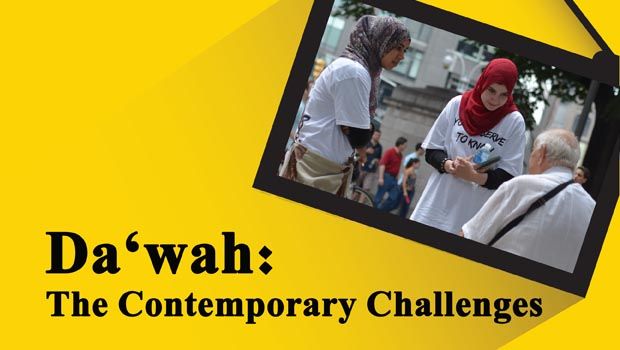
Da‘wah or calling people towards submission to none but the Creator is one of the major themes of the Qur’an. A Muslim, male or female, is visualized by the Qur’an as a da‘iyah whose behavior, speech, and interactions with others convey the Islamic message and invite people towards belief in, submission to, and serving of the Creator. Prophet Muhammad (peace be on him) is designated by the Qur’an as the last messenger, calling people toward all that is good and warning about the consequences of rejecting the truth. The Muslim ummah is commissioned to play a proactive role in creating peace, justice, balance, moderation, and fairness within the Muslim community (ummah) as well as in the human society at large. In fact, the terminology, ummatan wasaat, which the Qur’an uses to describe a distinguishing feature of the Muslim ummah, conveys a characterization of the ummah as one of moderation, balance, and the middle way. The Qur’an, accordingly, strongly condemns an excessive or exaggerated attitude in any aspect of life, and considers extremism of any sort to be misguided.
This paper seeks to delineate major da‘wah challenges, both internal and external, the ummah faces today and how to respond to these modern challenges from a proper Islamic perspective. This author believes that each challenge comes with huge prospects and opportunities for advancement of the da‘wah work.
The Internal Challenges
The internal challenges, for convenience of discussion, can be associated with the following strategic issues.
Internal Challenge #1: Disunity
The ummah spans over 57 sovereign Muslim states. Their rulers and elites all face towards the same Ka‘bah in prayer but they fail miserably in establishing a unified policy on strategic goals in regards to social, political, economic, legal, educational, and cultural issues. How to create unity or at least move toward unity remains a core da‘wah issue and challenge. The responsibility for disunity, while in part caused by external forces, must be placed squarely upon our own shoulders. It is only common sense to expect other geopolitical players to use economic, political, and cultural, and even military means to protect their own national interests, and at times this involves intentional or collateral harm to, or exploitation of, Muslims. Ultimately, the campaign to unify Muslims must center on our own internal dynamics, resources, and shared goals.
Internal Challenge #2: Ghuluw
The second internal challenge that da‘wah faces is a global rise in ghuluw in the ummah. Ghuluw can be defined as exaggerating any part of Islam beyond its actual specified limits or, likewise, downplaying any part of Islam below its actual specified limits. Unfortunately some da‘wah workers focus on particular aspects of Islam – religious, legal, social, political, or economic – while some equally important teachings of Islam skip their attention. Islam provides necessary instructions in all aspects of human life. Therefore, a call toward Islam implies following Allah’s instructions not only in one or another or some particular aspects of life but in all affairs and all aspects of religious, legal, social, economic, and political matters. It is a call for a holistic and comprehensive change. It is a call to serving Allah alone and becoming His true ‘abd or obedient servant in the totality of one’s existence. In brief, da‘wah is the adoption of, or return to, the straight path, and the righteousness that entails, in all spheres and affairs of life.
Excessiveness or ghuluw is also manifested in considering one’s maslak or madhhab as the only authentic interpretation of Islamic injunctions, and to look down upon others as if they are misguided. This attitude is totally in contradiction to, and in negation of, the methodology followed in the fiqhi matters by the Prophet’s Companions which was duly approved by the Prophet himself (peace be on him). Some idealists assume that if they succeed in ascending to political power and declare establishment of khilifah, the economic exploitation, political corruption, social decay, and moral decadence will automatically cease and attitudes and behaviors of the people shall spontaneously change. This political idealism is also a form of ghuluw in the sense of overlooking the practical reality of the human condition with its weaknesses and its propensity for self-delusion, and the corresponding challenge of bringing about personal and societal transformation which can only be established through a gradual and progressive process.
Some spiritualists or mystics, on the other hand, claim to utilize a means of coming closer to Allah through contemplation, dhikr, and strict self-discipline, with some choosing to withdraw entirely from involvement in worldly life. The Prophetic Sunnah on the contrary provides us with a holistic model which takes care of the total needs of a human being. We do not have any evidence in the Prophetic Sunnah for being given to excessive meditation or for living a life of withdrawal from family and society and other worldly affairs; rather we find the Prophet (peace be on him) strongly denouncing such a life of withdrawal.
Internal Challenge #3:
The Islamic knowledge deficit
The third major internal challenge facing da‘wah today is an educational one. The key to progress and excellence lies in a knowledge-based society that engenders a fair and equitable economy and a just and ethical state. A dynamic commitment to and knowledge of Qur’an and sunnah must be deeply embedded in the social fabric but this requires that accurate and authentic Islamic knowledge be disseminated amongst the Muslim masses. This does not exist today and this deficiency is a handicap that must be fixed.
Internal Challenge #4:
Methodology
The fourth internal challenge that da‘wah faces has to do with methodology. Some of those who engage in daw’ah activities do so when afforded time and opportunity outside the constraints of their job or career. This would be fine if those individuals understood that Islam does not bifurcate life into “religious” and “worldly” activities. Therefore, the behavioral and ethical requirements of Muslim life and da’wah in particular are the same whether one is in the workplace, engaged in street da’wah, or part of a professional and organized da’wah effort. The Qur’an and the Sunnah establish a holistic approach to life wherein one’s profession and mission do not belong to different realms.
Another dimension to this challenge relates to the misunderstanding of da‘wah as an invitation or call to Muslims only. Under the influence of this mindset some very sincere and devout du‘at travel thousands of miles to talk to fellow Muslims, while da‘wah to non-Muslims remains outside the scope of their interest or concern.
The objective and means of Islamic da‘wah can be summed up in three points:
Knowledge of the truth (al-haqq) and a proper working knowledge of Islam.
Preparedness of the da’iyah through the building of his/her own Islamic character, devotion to purification of the heart, and ability to communicate the truth and convey the message of Islam in an effective way (i.e., with confidence, humbleness, conviction, and heartfulness).
Taking into full account the cultural mindset of the target demographic so as to best address their needs and provide the most relevant information that potentially might open their hearts and minds to the truth.
The External Challenges
There are several external challenges facing Islamic da‘wah. The first and foremost of these external challenges is the globalization of economy, education, society, and culture. Not many da‘wah workers are fully aware of the far-reaching effects of globalization on contemporary society. Islamic da‘wah by its very nature is a comprehensive da‘wah. It calls for vision, point of reference, and a paradigm of its own in economic, political, social, educational, and cultural realms. In all human activities it is a matter of inviting towards what is ethically good (khayr) and warning about what is ethically bad or evil (munkar). The impact of global media on the Muslim family and society is becoming visible even in very conservative homes. Untold numbers of Muslim youth are hooked on facebook. Putting a ban on it is no solution. The youth demonstrate a genuine yearning to share their ideas, feelings, and aspirations with others throughout the world. It is the challenge for Muslim scholars, parents, teachers, and activists to draw up and share with our Muslim youth a code of ethics and guidelines for Islamically appropriate behavior and written word expression when engaging in social media.
The western policy planners in the post cold-war era have put Islam and Muslims in the place which was earlier reserved for the Marxist threat. This scenario is further worsened by the western misperception of Islam as a faith which inherently subscribes to violence, extremism, and anti-democracy tendencies,though history bears witness to the opposite. The fact is that Muslims who are struggling to free their own lands from occupiers, imperialists, and/or corporate-globalist exploiters are labeled “terrorist” by Western policymakers and media.
The perception of Islam and the Muslims as extremist, fundamentalist, and terrorist needs to be corrected by Muslim scholars and academics who understand the mindset of the West. They must also expose the falsity of the claim that Islam is unfair to women. Issues such as law of inheritance, status of women as legal witness, the political role of women, polygamy, and other gender related issues need to be addressed in a knowledgeable, sincere, and non-apologetic manner. The role of women in the family, economy, education, political life, and da’wah needs to be elaborated and disseminated.
The strategy of da‘wah has to be proactive and not reactive. Modern challenges to da‘wah are both methodological and phenomenological. The so-called age of globalization and modernity has its own peculiar challenges. A successful da‘wah strategy cannot be developed for our contemporary world and its circumstances, let alone for the future, without taking the internal as well as the external challenges in full consideration in a realistic and comprehensive manner. Finally, serving Allah through serving humanity needs to become the rallying cry of da‘wah movements and their advocates and activists.
Da‘wah or calling people towards submission to none but the Creator is one of the major themes of the Qur’an. A Muslim, male or female, is visualized by the Qur’an as a da‘iyah whose behavior, speech, and interactions with others convey the Islamic message and invite people towards belief in, submission to, and serving of the Creator. Prophet Muhammad (peace be on him) is designated by the Qur’an as the last messenger, calling people toward all that is good and warning about the consequences of rejecting the truth. The Muslim ummah is commissioned to play a proactive role in creating peace, justice, balance, moderation, and fairness within the Muslim community (ummah) as well as in the human society at large. In fact, the terminology, ummatan wasaat, which the Qur’an uses to describe a distinguishing feature of the Muslim ummah, conveys a characterization of the ummah as one of moderation, balance, and the middle way. The Qur’an, accordingly, strongly condemns an excessive or exaggerated attitude in any aspect of life, and considers extremism of any sort to be misguided.This paper seeks to delineate major da‘wah challenges, both internal and external, the ummah faces today and how to respond to these modern challenges from a proper Islamic perspective. This author believes that each challenge comes with huge prospects and opportunities for advancement of the da‘wah work.The Internal ChallengesThe internal challenges, for convenience of discussion, can be associated with the following strategic issues.
Internal Challenge #1: DisunityThe ummah spans over 57 sovereign Muslim states. Their rulers and elites all face towards the same Ka‘bah in prayer but they fail miserably in establishing a unified policy on strategic goals in regards to social, political, economic, legal, educational, and cultural issues. How to create unity or at least move toward unity remains a core da‘wah issue and challenge. The responsibility for disunity, while in part caused by external forces, must be placed squarely upon our own shoulders. It is only common sense to expect other geopolitical players to use economic, political, and cultural, and even military means to protect their own national interests, and at times this involves intentional or collateral harm to, or exploitation of, Muslims. Ultimately, the campaign to unify Muslims must center on our own internal dynamics, resources, and shared goals.
Internal Challenge #2: GhuluwThe second internal challenge that da‘wah faces is a global rise in ghuluw in the ummah. Ghuluw can be defined as exaggerating any part of Islam beyond its actual specified limits or, likewise, downplaying any part of Islam below its actual specified limits. Unfortunately some da‘wah workers focus on particular aspects of Islam – religious, legal, social, political, or economic – while some equally important teachings of Islam skip their attention. Islam provides necessary instructions in all aspects of human life. Therefore, a call toward Islam implies following Allah’s instructions not only in one or another or some particular aspects of life but in all affairs and all aspects of religious, legal, social, economic, and political matters. It is a call for a holistic and comprehensive change. It is a call to serving Allah alone and becoming His true ‘abd or obedient servant in the totality of one’s existence. In brief, da‘wah is the adoption of, or return to, the straight path, and the righteousness that entails, in all spheres and affairs of life.Excessiveness or ghuluw is also manifested in considering one’s maslak or madhhab as the only authentic interpretation of Islamic injunctions, and to look down upon others as if they are misguided. This attitude is totally in contradiction to, and in negation of, the methodology followed in the fiqhi matters by the Prophet’s Companions which was duly approved by the Prophet himself (peace be on him). Some idealists assume that if they succeed in ascending to political power and declare establishment of khilifah, the economic exploitation, political corruption, social decay, and moral decadence will automatically cease and attitudes and behaviors of the people shall spontaneously change. This political idealism is also a form of ghuluw in the sense of overlooking the practical reality of the human condition with its weaknesses and its propensity for self-delusion, and the corresponding challenge of bringing about personal and societal transformation which can only be established through a gradual and progressive process. Some spiritualists or mystics, on the other hand, claim to utilize a means of coming closer to Allah through contemplation, dhikr, and strict self-discipline, with some choosing to withdraw entirely from involvement in worldly life. The Prophetic Sunnah on the contrary provides us with a holistic model which takes care of the total needs of a human being. We do not have any evidence in the Prophetic Sunnah for being given to excessive meditation or for living a life of withdrawal from family and society and other worldly affairs; rather we find the Prophet (peace be on him) strongly denouncing such a life of withdrawal.
Internal Challenge #3: The Islamic knowledge deficitThe third major internal challenge facing da‘wah today is an educational one. The key to progress and excellence lies in a knowledge-based society that engenders a fair and equitable economy and a just and ethical state. A dynamic commitment to and knowledge of Qur’an and sunnah must be deeply embedded in the social fabric but this requires that accurate and authentic Islamic knowledge be disseminated amongst the Muslim masses. This does not exist today and this deficiency is a handicap that must be fixed.Internal Challenge #4: MethodologyThe fourth internal challenge that da‘wah faces has to do with methodology. Some of those who engage in daw’ah activities do so when afforded time and opportunity outside the constraints of their job or career. This would be fine if those individuals understood that Islam does not bifurcate life into “religious” and “worldly” activities. Therefore, the behavioral and ethical requirements of Muslim life and da’wah in particular are the same whether one is in the workplace, engaged in street da’wah, or part of a professional and organized da’wah effort. The Qur’an and the Sunnah establish a holistic approach to life wherein one’s profession and mission do not belong to different realms.Another dimension to this challenge relates to the misunderstanding of da‘wah as an invitation or call to Muslims only. Under the influence of this mindset some very sincere and devout du‘at travel thousands of miles to talk to fellow Muslims, while da‘wah to non-Muslims remains outside the scope of their interest or concern. The objective and means of Islamic da‘wah can be summed up in three points: Knowledge of the truth (al-haqq) and a proper working knowledge of Islam.Preparedness of the da’iyah through the building of his/her own Islamic character, devotion to purification of the heart, and ability to communicate the truth and convey the message of Islam in an effective way (i.e., with confidence, humbleness, conviction, and heartfulness). Taking into full account the cultural mindset of the target demographic so as to best address their needs and provide the most relevant information that potentially might open their hearts and minds to the truth.
The External Challenges There are several external challenges facing Islamic da‘wah. The first and foremost of these external challenges is the globalization of economy, education, society, and culture. Not many da‘wah workers are fully aware of the far-reaching effects of globalization on contemporary society. Islamic da‘wah by its very nature is a comprehensive da‘wah. It calls for vision, point of reference, and a paradigm of its own in economic, political, social, educational, and cultural realms. In all human activities it is a matter of inviting towards what is ethically good (khayr) and warning about what is ethically bad or evil (munkar). The impact of global media on the Muslim family and society is becoming visible even in very conservative homes. Untold numbers of Muslim youth are hooked on facebook. Putting a ban on it is no solution. The youth demonstrate a genuine yearning to share their ideas, feelings, and aspirations with others throughout the world. It is the challenge for Muslim scholars, parents, teachers, and activists to draw up and share with our Muslim youth a code of ethics and guidelines for Islamically appropriate behavior and written word expression when engaging in social media. The western policy planners in the post cold-war era have put Islam and Muslims in the place which was earlier reserved for the Marxist threat. This scenario is further worsened by the western misperception of Islam as a faith which inherently subscribes to violence, extremism, and anti-democracy tendencies,though history bears witness to the opposite. The fact is that Muslims who are struggling to free their own lands from occupiers, imperialists, and/or corporate-globalist exploiters are labeled “terrorist” by Western policymakers and media.The perception of Islam and the Muslims as extremist, fundamentalist, and terrorist needs to be corrected by Muslim scholars and academics who understand the mindset of the West. They must also expose the falsity of the claim that Islam is unfair to women. Issues such as law of inheritance, status of women as legal witness, the political role of women, polygamy, and other gender related issues need to be addressed in a knowledgeable, sincere, and non-apologetic manner. The role of women in the family, economy, education, political life, and da’wah needs to be elaborated and disseminated. The strategy of da‘wah has to be proactive and not reactive. Modern challenges to da‘wah are both methodological and phenomenological. The so-called age of globalization and modernity has its own peculiar challenges. A successful da‘wah strategy cannot be developed for our contemporary world and its circumstances, let alone for the future, without taking the internal as well as the external challenges in full consideration in a realistic and comprehensive manner. Finally, serving Allah through serving humanity needs to become the rallying cry of da‘wah movements and their advocates and activists.