

بسم الله الرحمن الرحيم

Tag: care for others

  • Gratitude: A Central Part of Every Muslim’s Life

    Gratitude: A Central Part of Every Muslim’s Life

    Jabir (ra) reported that the Prophet (s) said, “Whoever is not grateful for small things will not be grateful for large things.” And the companion of the Prophet (s), Abdullah Ibn Masood (ra) said, “Eman is two halves, half sabr (patience and perseverance) and half, shukr (gratitude).”

    Gratefulness is an essential aspect of Islam. The Prophet (s) said, “Whoever does not thank people, does not thank Allah” (al-Tirmidhi). It should be a central part of every Muslim’s life. Not only is it an important part of our worship, but it also has a profound effect on our mental health and well-being. Research shows that it can reduce stress, improve sleep, and enhance interpersonal relationships. When engaging in negative or counterproductive thoughts, expressing gratitude can shift the mind to a more positive, beneficial outlook. Gratitude for even small things keeps you more satisfied with what you have instead of focusing on what you don’t have. Gratitude reduces feelings of regret, envy, resentment, and frustration, all of which weigh us down mentally and emotionally. A study done by Harvard Health showed that people who reflected on the things they were grateful for were more optimistic about their lives and had fewer doctor visits than those who focused on things that caused them irritation.

    Effects of Gratitude on Stress

    We all know what some of the most common stressors are —an exhausting work or school schedule, parenting, a tumultuous relationship, loss of a loved one, experiencing abuse, a serious health diagnosis, and the list just goes on. While it is natural to feel fatigue or disappointment or fear when challenged with life’s inevitable stressors, we should aim to stay centered and God-conscious, realizing that the ups and downs of life are part of the test of our faith. Striving to maintain some degree of equanimity is important as stress can cause high blood pressure, erratic heart rhythm, higher stress hormone levels, increased blood pressure, depression, anxiety, difficulty sleeping, and/or irritability.

    Even with the daily small inconveniences, disappointments, frustrations, and other challenges, gratitude can offset stress. Dr. Emmons, author of “The Little Book of Gratitude,” states that gratitude can reduce cortisol, a stress hormone, by 23 percent, thereby reducing the health problems associated with high levels of stress. When we express gratitude, our brain releases the chemicals serotonin and dopamine. Serotonin causes us to feel happier, calmer, and more focused. Dopamine is a reward chemical that makes us feel more motivated and productive. These are commonly known as the “happy hormones” that give us overall positive mood and emotions. Thanking others and the Almighty can open the doors to a happier life.

    Gratitude and Everyday Relationships

    Everyone likes to feel appreciated by those around them, whether spouses, children, friends, or co-workers. The best way to show appreciation is to express it, and there are countless ways to do that. Expressing your gratitude for those around you fosters stronger, healthier and more loving relationships with those people. A 2011 study done by psychologist Nathan Dewall demonstrates that showing appreciation enriches and increases your social circle. People like being around those who make them feel good. One of the ways to show gratitude to your closest loved ones is learning their love language. It may be words of affirmation, acting in ways that help them or serve them, or physical touch and show of affection. Giving gifts, however small, is of course a show of gratitude. The Prophet (s) said: “Give each other gifts and you will love each other” (al-Adab al-Mufrad).

    Overcoming Trauma Through Gratitude

    Gratitude has also been shown to help people overcome trauma. A 2006 study published in Behavior Research and Therapy found that war veterans who routinely expressed gratitude showed lower rates of PTSD. The practice of gratitude demonstrated a positive effect on motivation and higher self-esteem, and an overall increase in days experienced as pleasant. The study suggests that gratitude “may have salutary effects on everyday functioning.”

    We go through many emotions after a traumatic experience, and many people keep their emotions bottled up and then withdraw from social interactions. Gratitude can help people climb out of that state of isolation and work through their emotions. You don’t necessarily have to change how you feel about your situation. You can still feel angry or sad. These emotions aren’t abnormal and ignoring them can put you right back into feelings of withdrawal, but there has to be a balance of emotions. You have to “look on the bright side,” to put things in a more positive perspective, if you want to move forward. Practicing gratitude can be an important part of that process.

    The Prophet said, “How wonderful is the affair of the believer! Indeed, all of his affairs are good for him. This is for no one but the believer. If something good happens to him, he is grateful to Allah, which is good for him. And if something bad happens to him, he has patience, which is good for him” (Muslim). We should never stop being grateful for what we have, for our blessings both big and small, and for the people around us, family and friends, who we care about and who care about us.

  • Dawah Through Caring and Sharing

    Dawah Through Caring and Sharing

    “Have you ever seen a tornado up close? It’s the most awesome thing I’ve seen in my life. It’s like coming face-to-face with God in a bad mood.” That was what a professor of mine said when I was still in college some three years ago and since then Al-humdu lillah, I’m happy to say I’ve still never seen a tornado except on TV or in a movie. But, I did see the aftermath of one in late April in rural Mississippi a few days after a series of tornadoes had barreled through the southern United States, causing extensive damage in four states.

    As a resident of New York City, I had experienced two hurricanes in the past few years – the latter one with a benign-sounding name being particularly ferocious. Sandy flooded my neighborhood but thankfully it didn’t reduce any houses to a pile of planks. So, while I thought I knew what to expect once I landed in Tupelo, Mississippi, the state’s seventh largest city, seeing the damage with my own eyes was surreal.

    Whole sections of restaurants, hotels, and other businesses were obliterated, leaving nothing but a mass of upturned wood and broken furniture scattered nearby, their once towering sign boards now lying flat on the dirt. Many homes had trees fallen through their roofs while the neighboring house was untouched by damage. Seeing one building’s roof blown off and its structure reduced to tragic ruins while the one only a few yards away stood as perfectly charming as a quaint Southern home would be, baffled the mind. You saw an ayah, a sign, of Allah’s Power and Wisdom right in front of you. While one family would be crying out to Him in devastation, the other would be thanking Him as they breathed out sighs of relief. As the Qur’an says, Quran 2:155).

    Across the state of Mississippi 14 people died, mostly in rural areas. Through ICNA Relief USA, a domestic Muslim faith-based agency actively participating in disaster response, I was on the ground in the state to document their work as they began their post-tornado recovery efforts. By the grace of Allah, ICNA Relief has helped many and its work has been recognized at the federal, state, and local levels of government and by their VOAD (Volunteer Organizations Active in Disasters) partners.

    ICNA Relief always makes sure to reach out to the local Muslim community anytime its Disaster Response Team is deployed for recovery work in any particular area. This time it was very difficult to make contact with an Islamic center ahead of time because tornado warnings were in effect in the South in the following days after the tornadoes had first hit. Br. Arif Ali, ICNA Relief’s Disaster Response team Lead, drove all the way from Florida to Masjid Abraham, in Tupelo. When he pulled up to the masjid, a man came rushing out to his car.Br. Arif says that he thought he was perhaps parking in the wrong area. But the man, Br. Abdul Raheem Khan, acting imam of a masjid whose congregants consist of only 20 families, simply said, “Alhumdulillah, you’re here. How did you know we needed help?”

    The masjid was more than happy to let ICNA Relief’s Disaster Response Team, along with volunteers from Florida, set up camp in its facility while they began tornado recovery work in the surrounding towns like Marietta. The team, working alongside NECHAMA, a national Jewish disaster response agency, cleared up debris from damaged houses and used chainsaws to get through thick fallen trees. They also tarped houses whose roofs were damaged. One homeowner was so grateful, telling Imam Rafiq Mahdi, another ICNA Relief Disaster Response Team Lead from Tennessee, “You’ve really changed hearts and minds. You changed my heart and mind.”

    Living in the North you hear many things about the South being ultraconservative and the people being close-minded, wary of outsiders. Though I definitely got more stares due to my hijab, there was barely a person who did not smile at me after I greeted them. After a particularly hot day working on a mobile home that had flipped over on to its topside and crashed into an electric pole, the homeowners provided sandwiches for all 15 of us, including Br. Abdul Raheem Khan and his mother-in-law who had turned out to volunteer. The homeowners’ kids (who were very polite, calling us sir and ma’am) rushed to supply us with paper plates and cups, while their father Robert, who went by “Bubba,” offered us yellow-frosted cupcakes to top off our meal. Southern hospitality is real! The homeowners were so appreciative of the work the volunteers did. “I’ve had a tremendous amount of help. ICNA Relief has done a great job,” Bubba said. “They’re very nice and have done so much work that I can’t explain.”

    So what is the purpose of sharing this story? This isn’t a travelogue on my trip to Mississippi. I want to convey the point that there are plenty of “Bubbas” out there, many people who need help in all sorts of way. As Muslim Americans, as citizens of this nation, we can extend our help  while building bridges of understanding and fellowship. This year, instead of only donating money, please consider donating your time as well, to be of active service to your faith and this country. Sharing your time with those who need it by helping them to clean up after a natural disaster, or providing them with food when they are hungry or clothing when they are cold, offering shelter when they are homeless or solace when they feel lost and alone – this is dawah from the ground up, without even having to utter one ayah of the Qur’an. As Br. Abdul Raheem Khan has said, “I was looking to do dawah through practical work and I found it.”

  • Feel Like Complaining? Try Caring for Others

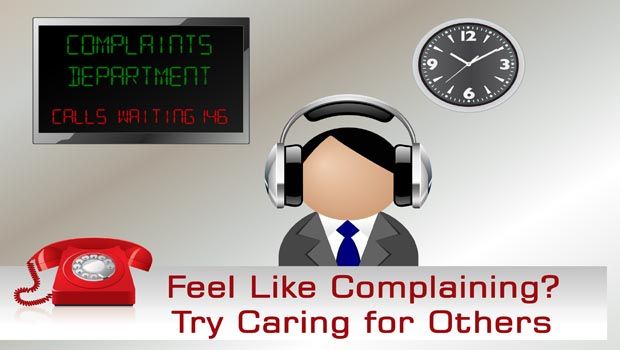
    Feel Like Complaining? Try Caring for Others

    There is a common sentiment that humans feel when a calamity or misfortune strikes -“Why me? Why did this happen to me?” In that moment there is a sudden surge of emotions – confusion, devastation, and fear. But in the face of trials and tribulations, we must be steadfast and remind ourselves of our duty towards Allah, our trust in Him, and our belief that every test is a means to increase our faith and earn the ultimate reward: “Whoever works righteousness, man or woman, and has faith, verily, to them will We give a new Life, a life that is good and pure, and We will bestow on such their reward according to the best of their actions” (Qur’an 16:97).

     It is certainly understandable that it helps to be optimistic when extending care to another person.

    The Qur’an tells us that the path of belief and righteousness is one that requires strength and fortitude: “And what will explain to you what the steep path is? It is the freeing of one from bondage; or the giving of food in a day of hunger to an orphan, relative, or to the needy in distress. Then will he be of those who believe, enjoin patience and perseverance, and encourage kindness and compassion. Such are the Companions of the Right Hand” (90:12-18). These verses elucidate the importance of good deeds, of kindness, compassion, helping others and caring about other people when they suffer. And the reward promised to those who persevere on the steep path of purifying the heart and building a good character is to be among the”Companions of the Right Hand.” These are the people who will be in gardens of bliss in the Hereafter (see 56:27-40). A fundamental provision for the journey on the steep path is being content with the decree of Allah. This enables us to cope with tough situations in a way that accords with the teachings of the Qur’an and Sunnah. Then, rather than asking “Why me?” we are prompted by our faith to say “Indeed we belong to Allah , and indeed to Him we will return” (Qur’an 2:156).

    Even at times when we are facing more minor difficulties, some people fall into a negative mindset, feeling sad, hopeless, or bitter. They are apt to complain about their plight as if they expected every day to be smooth and easy and without challenge. One of the best ways to combat such a mindset which is excessively focused on self and feeling like a victim, is to help others and find ways to ease their burdens. This inevitably puts things in a larger perspective and brings a sense of purpose and fulfillment.

    Caring for Others – A Gate to Goodness

    Our beloved Prophet (pbuh) demonstrated simple yet exceptionally effective ways to care for others that had a profound effect on the community. Abu Dharr (may Allah be pleased with him) reported that the Prophet (pbuh) said, “Indeed the gates to goodness are many: glorifying God, praising Him, magnifying Him, saying ‘There is no god but Allah,’ enjoining the good and forbidding the wrong, removing [any source of] harm from the road, making the deaf hear [by helping them in things that are obstructed by their deafness], guiding the blind, showing the seeker his need, striving as far as your two legs can carry you and with deep concern to give succor to him who asks, carrying with the strength of your arms [the burdens of] the weak. All these are charity.” And he added, “And your smiling in the face of your brother is charity, your removing of stones, thorns, and bones from people’s paths is charity, and your guiding a man gone astray in the world is charity for you” (Authenticated by Al-Albani).

    We want to enter the “gate of goodness” and how simple is it to remove impediments from people’s paths? Wintertime is a great opportunity to shovel for neighbors especially the elderly. We can help by running errands for the those who are old or frail or sick. And certainly we can smile often, spreading an upbeat attitude and good cheer.. All these and countless other acts are doable and they are opportunities to earn Jannah-the ultimate reward.

    With respect to neighbors, Prophet Muhammad (pbuh) preached and practiced exemplary caring behavior. Ibn Umar and Aishah (may Allah be pleased with them) reported: “The Messenger of Allah (pbuh) said, “Jibril kept recommending treating neighbors with kindness until I thought he would assign a share of inheritance [to them]” (Bukhari and Muslim). Abu Dharr (may Allah be pleased with him) reported: “The Messenger of Allah (pbuh) commanded me thus, ‘O Abu Dharr! Whenever you prepare a broth, put plenty of water in it, and give some of it to your neighbors’” (Muslim).

    Aishah (may Allah be pleased with her) reported: “I said, ‘O Messenger of Allah (pbuh), I have two neighbors. To which of them should I send a present?’ He replied, ‘To the one whose door is nearer to you’” (Bukhari). Abdullah bin `Umar (may Allah be pleased with him) reported: “The Messenger of Allah (pbuh) said, ‘The best of companions with Allah is the one who is best to his companions, and the best of neighbors to Allah is the one who is the best of them to his neighbor’”(Tirmidhi).

    Altruism, Optimism, and Patience – Essential Traits

    Islam teaches us to cultivate altruism, to have unselfish caring for the welfare of others. The Prophet (pbuh) said: “No one of you [truly] believes until he loves for his brother what he loves for himself” (Bukhari and Muslim). He also said: ”The most beloved of people to Allah is he who brings most benefit [to others], and the most beloved of deeds according to Allah SWT is that you bring happiness to a fellow Muslim …” (Al-Tabarani). A quintessential example of altruistic behavior is that of the Ansar, the people of Madina who welcomed and hosted the Muslims from Makkah (“ansar” means “helpers”). Abu Hurayra narrated (may Allah be pleased with him): “The Ansar were so generous that they said to the Prophet, ‘Please divide the date-palm trees between us and them (with the Muhajirin or the emigrants from Makkah).’ The Prophet (pbuh) said, ‘No.’ The Ansar said, ‘Let them do the labor for us in the gardens and share the date-fruits with us.’ The Emigrants said, ‘We accepted this’ [as they did not want things for free]” (Bukhari). Such was the extent of the altruistic attitude and behavior of the Ansar and the mutual love and caring that grew between the Ansar and Muhajirin.

    It is clear that Islam enjoins upon us to be caring about others and help them in any way we can. In addition to a foundation of altruism, another trait that is essential when we endeavor to help others is optimism. Knowing that the one in need is likely to be under duress and feeling burdened, interacting with him or her with an optimistic attitude is beneficial. Of course one must take into account the seriousness of the difficulty they are facing and not overdo the optimism. Otherwise it could backfire and come across as inappropriate and insensitive. But maintaining a demeanor that is calm, hopeful, and encouraging – all aspects of optimism – is certainly beneficial. Keep in mind that optimism is contagious and research shows that people who are optimistic lead happier and healthier lives.

    There is another interesting point about optimism. It is certainly understandable that it helps to be optimistic when extending care to another person. However, optimism comes full circle because when a person helps another in need, he comes to more appreciate the countless blessings of Allah (swt) bestowed upon himself, thus augmenting his already positive, optimistic outlook. And his state of gratefulness only increases his blessings. The Qur’an states: “If you are grateful, I will certainly give you more …” (14:7).

    Another essential trait to cultivate in order to empathically and attentively extend help and care to others is patience. In the verses mentioned above about the “steep path” (90:12-17), helping one’s own relative or the orphan or the needy is associated with sabr, which is patience and perseverance.

    The Qur’an also states: “Seek Allah’s help with patient perseverance and prayer. It is indeed hard except for those who are humble” (2:45). What is noteworthy here is that Allah points out to us that it is hard to be patient and alerts us to the reality that only through humbleness might we be patient and inclined to supplicating Him for help. This makes sense that humbleness yields patience, both of which are necessary and predispose a person to expend of time and resources to help others. Those who are arrogant, impatient, and intolerant are not likely to feel compelled to help those in need.

    Array of Benefits and Blessings by Caring for Others

    What we can see is that caring for others, in addition to supporting the welfare and well-being of others, provides a wide array of benefits and blessings for ourselves. It is an antidote to feeling sad, hopeless, or bitter. Rather than complaining about our own difficulties or setbacks, we can take action by first resolving as best we can our personal challenges and then leaving it up to Allah (swt) to take care of the rest. Then we can offer some of our time and energy and resources to help others. We’ve also seen that caring for others is a gateway to goodness and an opportunity to earn Jannah. And finally, we see that the duty to care about and help others as ordained by Allah (swt) requires us to cultivate altruism, optimism, and patience – all indispensable traits for those who navigate the steep path of purifying the heart and building a good character. Each day is a new journey, an opportunity to seek the pleasure of Allah (swt) by performing heartfelt acts of kindness and caring.