
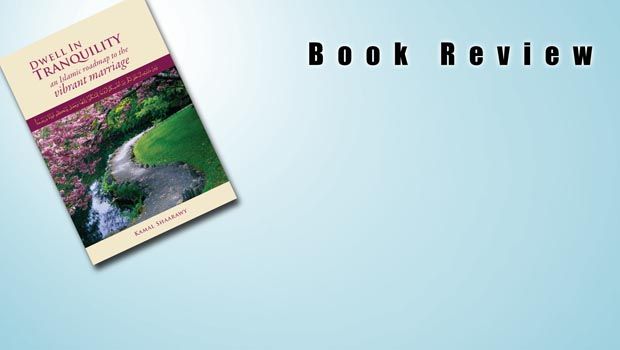
Title: Dwell in Tranquility: An Islamic Roadmap to the Vibrant Marriage
Paperback: 344 pages
Author: Kamal Shaarawy
Publisher: Salaam Hearts, Inc.
Price: $17.95 (order at livingeman.com)
ISBN-13: 978-1885677006
Our marriages are what we make them. With proper mindset and manner, we can make the marriage relationship peaceful and joyous. The opposite is also true: when we ignore the fundamentals that support and nurture successful marriage, we risk living in misery. The success of a marriage depends on more than physical chemistry; it requires cooperation, commitment, and know-how from both partners. Seldom do couples realize that knowing how to make the marriage work is necessary, and that the know-how is available for those who seek it.
Unfortunately, people in troubled marriages are quick to blame their spouse, and just as ready to overlook their own issues that contribute to the dysfunction. The notion that a happy marriage is simply a matter of luck, or a guarantee by default, is put to rest by Kamal Shaarawy, author of Dwell in Tranquility: An Islamic Roadmap to the Vibrant Marriage. The author is a certified counselor, based in Phoenix, Arizona, who has provided help and support to countless couples for more than 20 years.
The book has three parts and twelve chapters. Part one addresses the significance of marriage and the importance of preparing oneself for married life. It also provides guidelines for a smart, principled, and safe spouse-selection process. Part two addresses the origins of an unhealthy relationship, including influences from one’s family of origin, one’s own negative habits in daily living, and unhealthy relationship dynamics that can sabotage the marriage. Part three highlights the foundation of an Islamic model of marriage, and the many blessings that flow from such a union when properly understood and implemented. The author presents some essential tools such as communication skills (including listening skills), patience, gratitude, and the very Islamic practice of silence and reflection. What is at the heart of the successful marriage? Br. Shaarawy offers two overriding principles: honoring the spouse; and commitment to lifelong growth and change.
Dwell in Tranquility is very distinctive in its content, style, and the quality of the author’s understanding based on extensive research and counseling experience. He shares a multitude of real-life counseling stories (with names and some details altered to protect privacy) to illustrate the back story of what went wrong, as well as, and most importantly, how the couples worked hard to gain knowledge and skills to correct their course and start to build a foundation for success and happiness.
Br. Shaarawy rightly points out that Islam signals the importance of compatibility (“kufu”) in choosing a spouse; and then highlights how essential are “mawaddah” and “rahmah” (love, compassion, understanding, cooperation, tolerance, etc.) to nourish the marriage relationship. The author also points out that a husband or wife could be outwardly pious, performing all his or her religious rites and rituals, and yet be ignorant, negligent, or ineffective in contributing to a God-conscious, mature, and loving, relationship.