By Omar Afzal
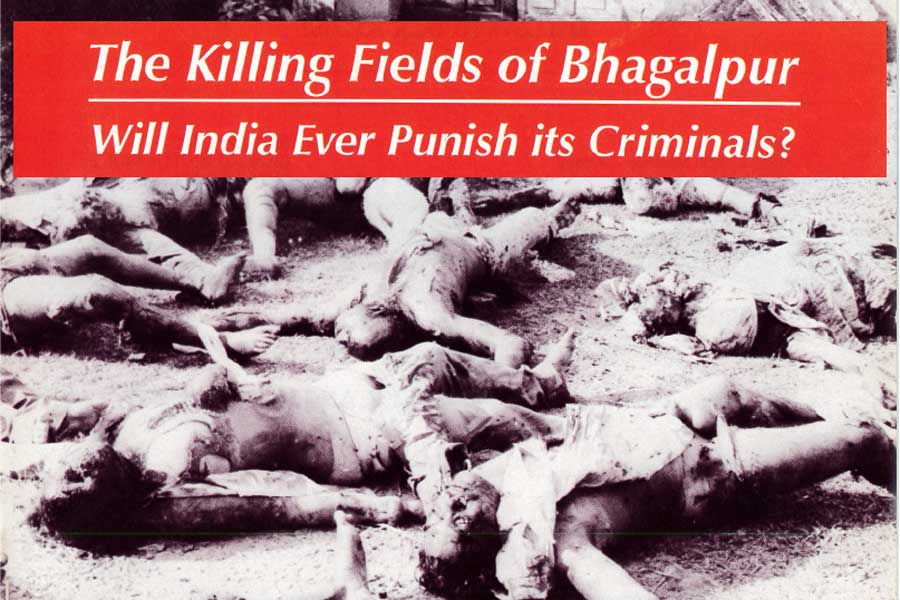
The massacre of innocent Muslims in Bhagalpur City and surrounding villages in the last week of October 1989 may be added to a very short list of mind-boggling tales of human savagery. The grim details are still not fully known and perhaps the full story may never see the light of the day.
The local administration has put the casualty figure to a 1,000 dead and several thousand uprooted. Unofficial estimates are as high as 3,000 dead, a thousand unaccounted for and more than 50,000 homeless. The number of injured may be around 8,ooo.
The medieval atrocities of Genghiz Khan pale in comparison to what the Hindu mobs did in several villages of the Bhagalpur District. A frenzied mob swooped on the village in the Jagdishpur block, killed everyone it could and buried them in a field. To cover its heinous acts, it leveled the mass graves and planted vegetables over them. In Chakjhoura Village, dead bodies and human limbs were found hidden in a paddy field. The corpse-filled ponds of Chanderi were perhaps the ultimate in human barbarism. As an Indian journalist put it, “a monster stalks Bhagalpur.” The most shocking aspect of the anti-Muslim terror in Bhagalpur is the connivance of police, army and local administration. The High Court in Patna, capital of the northeastern state of Bihar, has asked army Maj. G.P.S. Virk to explain why he left 100 Muslims, mostly women and children, of Chanderi Village in the protective custody of the local police and failed to report when he found them “missing” the next day.
The Bihar Military Police is also said to have helped the killer Hindu mobs. Not only that Hindu policeman often turned their backs at the killings, they also killed and maimed people when they were handed to them for safe keeping. After a home-made bomb was thrown at the police party, allegedly by Muslims, the police went on a looting rampage. Some uniformed policemen are reported to have set fire to a mosque. A commander of the BSF could not ‘believe his eyes when he saw Hindu policemen standing on both sides of a narrow lane clobbering Muslim men, women and children, who were rescued from riot-affected areas. Because of the complicity of police, military and local administration, some of the most brutal killing were not reported until recently. Bhagalpur police are notorious for violence. In 1980, several Bhagalpur policemen were arrested for acid-blinding four defendants who were under trial.
Not has the Western media not been interested in doing investigative reports on the Bhagalpur killings, the Indian media, has not been fair to the victims either. Without exception, Indian newsmen have caned the anti-Muslim violence “communal riots” and some have shied away from saying that the victims were Muslim. Instead they have referred to them as members of a “minority.” Why are they ashamed of calling a spade a spade, or of blaming the police for complicity? Because it would tarnish India’s image as the land of “Ahimsa?’5 (nonviolence).
The writer,’ who works at Cornell University in Ithaca, New York, was in India recently.