
بسم الله الرحمن الرحيم

Tag: best ramadan

  • Five Strategies to Maintain Your Ramadan Momentum

    Five Strategies to Maintain Your Ramadan Momentum

    Many of us exert ourselves during Ramadan to perform extra acts of worship: we read more Qur’an, give more charity, make more dhikr, offer more prayers, and seek Allah’s forgiveness more often. This is as it should be, since Ramadan is the holiest month when the rewards for our good deeds are multiplied exponentially. Once Ramadan is over, though, it can be easy to fall back into bad habits, get lazy about our ibadah, and neglect the positive routines we had initiated. How can we avoid the post-Ramadan slump?


    Here are five strategies that can help us preserve the forward momentum we created in Ramadan and be consistent in our efforts to grow closer to Allah.

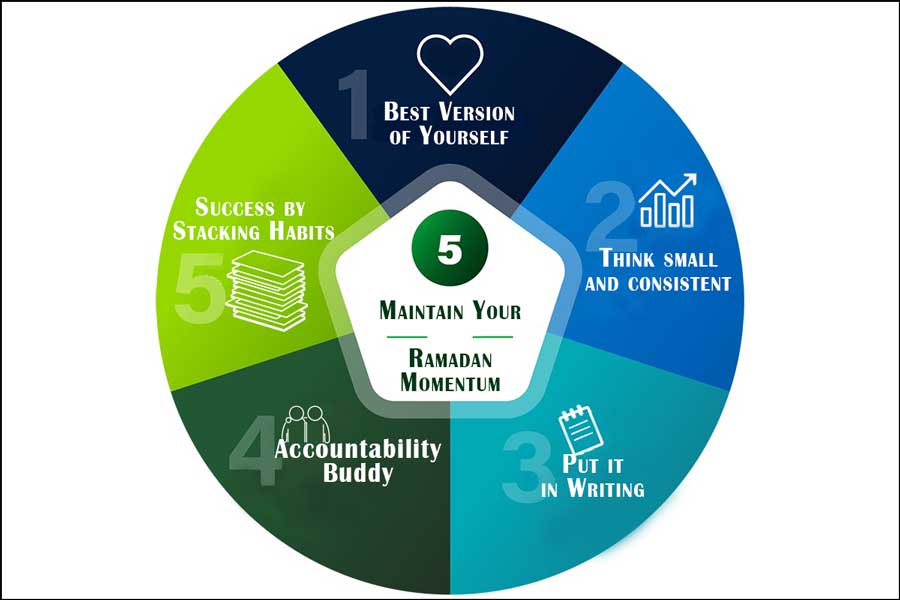
    1. Visualize the best version of yourself. Five years from now, what kind of Muslim do you want to be? What are some of the specific qualities you would like to embody? Which daily habits would the best version of yourself have? Just as important, which actions or bad habits would you eliminate? While you’re visualizing, imagine the Day of Judgment when each and every human will stand in front of the Creator and have their lifetime of deeds placed on a scale. Will your good deeds outweigh your bad ones? Which way will your scale tip? Your eternity depends upon it! Spend some time reflecting on your highest spiritual aspirations for yourself, knowing that your ultimate goal is nothing less than Paradise. Start your endeavor with “Bismillah” and ask Allah to facilitate it for you.


    1. Think small and consistent. Though you want to aim high, don’t immediately overwhelm yourself with unattainable goals. You probably won’t be able to do all the things you did during Ramadan throughout the whole year. But that’s okay! The Prophet (peace and blessings be upon him) said, “The most beloved deeds to Allah are the ones that are consistent, even if they are small” (Bukhari). Think of some extra acts of worship you did this Ramadan that really enhanced your connection to your Creator. Did you pray tahajjud? Did you make a lot of ighstifar? Did you replace mindless entertainment with beneficial Islamic lectures? Whatever you did that made your heart feel closer to Allah, set a concrete goal to continue that habit, but perhaps in smaller increments. Don’t set goals that are too ambitious and overwhelming, or you might not persevere. For instance, maybe you can’t pray tahajjud every single night, but can you commit to doing it every Friday? Perhaps reading ten pages of Qur’an every day isn’t possible, but can you read two? Whatever objectives you set for yourself, make them specific, achievable, and measurable.


    1. Put it in writing. Now that you know what you want to do, take a pen and paper and write down your post-Ramadan goals. Why is it important to put them on paper rather than just thinking about them? “Vividly describing your goals in written form is strongly associated with goal success, and people who very vividly describe or picture their goals are anywhere from 1.2 to 1.4 times more likely to successfully accomplish their goals,” writes Mark Murphy for Forbes. You might want to post your goals in a place where you’ll see them regularly as a reminder of the commitment you’ve made to yourself and to Allah.


    1. Have an accountability buddy. Pick someone who is supportive of you – like a spouse or best friend – and tell them about your intentions. Ask them to hold you accountable by asking you periodically how your post-Ramadan progress is going. If you’re falling short, your buddy can remind you of the importance of your quest and give you a pep talk that will get you back on track.


    1. Set yourself up for success by stacking habits. “When it comes to building new habits,” writes James Clear, the author of Atomic Habits, “you can use the connectedness of behavior to your advantage. One of the best ways to build a new habit is to identify a current habit you already do each day and then stack your new behavior on top. This is called habit stacking.


      For instance, if you already make dhikr every night before you sleep, then consider stacking the additional behavior of making istighfar 100 times. Or, if you always do a quick check of your appearance right before you head to work, then stack a new habit: make the duaa of the Prophet (s) every time you look in the mirror —“O Allah, just as You have made my external features beautiful, make my character beautiful as well.” Is there a mindless task you do every day, like washing dishes, sitting in traffic, or taking a walk? Try stacking the habit of listening to an Islamic lecture while you do it. You’ll increase your Islamic knowledge while tackling your to-do list.


      Wherever you are in your spiritual journey, you can use these five strategies to improve. Whether you are a Muslim who is just beginning to practice, or one who has been Muslim for years, you can customize these strategies to your unique situation. If you consistently add one or two acts of worship to your daily routine with the intention of pleasing Allah, imagine how many rewards you will receive, insha’Allah, and how disciplined you will be when the next Ramadan comes around. You will be on your way to becoming the best version of yourself, and each new Ramadan will then be an opportunity, insha’Allah, to increase your good habits even more and further develop your stamina.


      May Allah allow us to continue any progress we’ve made during this Ramadan and live to see another one. May He reward our intentions to grow closer to Him and support us as we strive to be excellent, wholehearted believers. Ameen.
  • Ramadan: Increasing Awareness of Its Blessings

    Ramadan: Increasing Awareness of Its Blessings

    Ramadan is the ninth month of the Islamic calendar, a blessed and sacred time for Muslims all around the world. During this month, Muslims fast from dawn until sunset, abstaining from food, drink, and sexual activity. This is a way of demonstrating devotion to Allah SWT and as a way to increase faith.

    The Prophet (s) has told us that Allah SWT says, “Fasting is Mine and it is I who give reward for it. One gives up his sexual passion, his food, and his drink for My sake. Fasting is like a shield. And he who fasts has two joys: a joy when he breaks his fast and a joy when he meets his Lord. The change in the breath of the mouth of one who fasts is better in Allah’s estimation than the smell of musk” (Bukhari).

    Fasting is the most well-known aspect of Ramadan, and it requires self-discipline and self-restraint. These are positive traits that benefit us year-round. Yet, there are many other blessings that come with this holy month. For one, Ramadan is an optimal time to increase one’s acts of worship and to engage in spiritual reflection and renewal. Muslims are encouraged to act out of good character at all times, yet Ramadan is the great opportunity to push a bit more, striving to overcome shortcomings that we sometimes indulge in. Coupled with spending more time in prayer and contemplation, this can lead to a deeper understanding of oneself and a greater sense of connection with Allah SWT.

    Ramadan is also a time of community. Muslims often gather with family and friends to break their fasts together, and many mosques host iftar dinners. This is especially important for those who may not have anyone to break their fast with. Some are converts and some live in areas where they may be a small minority. The community iftars allow them to feel connected to a larger network of Muslims, individuals and families who come together to share their faith.

    In addition, Ramadan is a time of generosity and charity. Muslims are encouraged to give to those in need, whether through donations to charity or relief organizations or by volunteering their time to help those less fortunate. This focus on giving back can help to foster empathy and compassion and can lead to a greater understanding and sensitivity to the challenges faced by others.

    Finally, Ramadan concludes with celebration. The end of the month is marked by the festival of Eid al-Fitr, a time of joy when Muslims come together to celebrate with family, friends, and the community. This celebration is a reminder of the blessings that come with the month of Ramadan, and of the importance of faith, family, and community in our lives.

    The blessings of Ramadan are many and varied. This holy month offers a unique opportunity for Muslims to connect with Allah SWT, with deeper levels of self, and with one another. It is a time to gain greater awareness of the many blessings in our lives, and to strive to be grateful. With Ramadan again here, we should spend some time focusing on the wide scope of potential for us to grow spiritually, to increase and strengthen our acts of worship, to incorporate good character traits, and to purify our hearts. This short piece mentions the following blessings:

    • increasing one’s acts of worship
    • demonstrating devotion to Allah SWT
    • deepening faith
    • finding a greater sense of connection to Allah
    • engaging in remembrance of Allah SWT and all His blessings
    • spending time in spiritual reflection
    • striving for spiritual and religious renewal
    • practicing self-discipline self-restraint
    • gaining deeper understanding of self
    • increasing one’s empathy and compassion for others
    • developing generosity and charity
    • feeling a sense of community and underscoring the importance of faith, family, and community
    • celebrating and finding joy

    “If you count the favors of Allah, you cannot enumerate them. Surely, Allah is Oft-forgiving, Most-merciful” (Qur’an 16:18)

  • What the Ummah Needs in Ramadan

    What the Ummah Needs in Ramadan

    What does the ummah (Muslim worldwide community) need today? More specifically, what does the ummah need to do for Ramadan? When reflecting on the many areas of improvement needed, it is crucial to also keep in mind the immense amount of good in our communities. There are countless individuals striving hard every day, sacrificing sleep and other worldly comforts or enjoyments in the pursuit of truth, justice, and relief for those who are suffering. Nevertheless, our ummah can benefit by reflecting on the following areas of need, extracted from three verses of Surat Muhammad.

    Aiding the Cause of Allah

    “Believers, if you aid Allah, He will come to your aid and will plant your feet firmly” (Qur’an 47:7). Allah commands us to “aid” His cause which requires us to prioritize the centrality of divine revelation in our lives and to abide by its commandments, prohibitions, and admonishments. No doubt, one might benefit most by starting in one’s home. Aiding Allah’s cause is to truly live by its principles in private, behind closed doors, when people in the outside world aren’t watching. Aiding His cause is to treat one’s family with mercy, justice, and love. It is to consume only what is permissible of provisions, to refrain from what is prohibited, and to be honest with Allah and with oneself in all matters. Aiding His cause and the deen is to pray on time, fast in Ramadan, and fulfill all the obligations of Islam because they’re of a greater priority than worldly desires and societal pressures. Aiding His cause is to speak the truth in all situations and to stand firm for justice regardless of who is on the other end of a conflict or situation.

    Aiding Allah’s cause is to stay strong when anti-Islamic sentiment increases in the world, when Islamophobia impacts society at a structural level, and when the number of people opposing your religious freedoms increases. It is to be courageous in practicing Islam openly and letting your Muslim identity shine forth, even when others might judge you, misunderstand you, or treat you differently. Aiding Islam is to stand united with your Muslim brothers and sisters and overcome any conflicts or differing opinions that might arise, and doing so in the most Islamic way, with good faith and meticulous adaab, and uncompromising fairness.

    Our ummah today is greater in number and more advanced in technology and worldly materialism compared to previous generations of Muslims, and yet Muslims in many countries are oppressed and suffering. One of the primary reasons for the situation of Muslims today is a disconnect from the practice of Islam; instead, there is an attachment to this world and its illusions. Although this doesn’t imply that all previous Muslims were righteous or that all current Muslims are not, there is certainly room for improvement in our ummah today.

    Increased Guidance and Taqwa

    “As for those who are guided, Allah increases them in guidance and causes them to grow in God-consciousness [taqwa]” (Qur’an 47:17). One of the primary objectives of fasting in Ramadan is to gain taqwa (2:183), the God-consciousness that produces awe and fear of God and cultivates piety. Undoubtedly, taqwa should be an ongoing objective in all acts of worship on our journeys towards Allah, regardless of the time of the year or the phase of life we’re experiencing. Our ummah today needs to bridge the gap between what we believe to be true and what we implement of it. The pursuit of truth is only the first step. Once a human being finds truth, there needs to be an implementation of that truth with dedication and consistency. With Islam, we are required to not only identify as Muslims or to claim we believe in Allah and His final messenger, but to also fulfill as much of Islam as we possibly can.

    There are perhaps two billion Muslims in the world today and the population is growing quickly. However, we can honestly admit that not all two billion Muslims are practicing Islam properly in terms of character, rituals, rulings, etc. A useful question to ask frequently is this: What would the world look like if every Muslim alive today fully practiced Islam by embodying its guidance and striving for taqwa? We would assume that society would be a more just place as Muslims, practicing Islam, would strive regularly to implement what is true and just, to advocate for the oppressed, and to spread morality through norms, beliefs, and policymaking in their respective societies. Another aspect of such an alternative world would be the impact of Muslims on the general optimism spread in the world through Islamic theology, positively impacting mental health and decreasing problems in society related to mental health struggles. Additionally, if all Muslims practiced Islam, it’s likely that Muslims would be more united, and more Muslim-majority countries would be strong and inspiring role models.

    The pursuit of truth begins with embracing Islam after which the pursuit of guidance ensures the strengthening of belief, remaining steadfast in one’s faith, and gaining of taqwa.

    Reflecting Upon the Qur’an

    “Do they, then, not reflect on the Qur’an? Or are there locks on their hearts?” (Qur’an 47:24). An individual’s worldview is the way he or she observes and understands the world in terms of how the universe operates, what the purpose and meaning of life is, whether there is a divine reality and an objective moral code, and what one’s place in the world is. Your worldview impacts everything you do in life, from the way you live, righteously or otherwise, to your perception of what is moral or just in social, political, economic, and other areas of society. For Muslims, our worldview is Qur’anic in that it is based on what Allah, the Exalted, has revealed, and what has been clarified and taught by the Messenger of Allah. However, too many Muslims believe that the Qur’an is from Allah without ever connecting to it, practicing its guidance, or viewing the world through its lens.

    It is as though our spiritual hearts have the potential to be shackled, or locked, as the above verse states. The heart is the most precious thing we must protect. Yet, the state of one’s heart is not necessarily on or off, black or white, open or closed. The spiritual heart operates on a spectrum. Sometimes a Muslim might see the signs of Allah but feel too weak to change for the better or accept advice or open his or her heart to the transformative power. It is like the heart is covered by some layer or layers — it could be laziness or stubbornness or pride or many other things.

    A sign of a covering on the heart is when one does not feel connected to the Qur’an, is not moved by it, doesn’t feel inclined to reference it, or commit to live by it. But the very cure we need is the Qur’an itself. The Book of Allah breaks the shackles and removes the layers upon the heart. Then one is able to see how crucial the Qur’an is for the life of the individual and the life of humanity. The cure of the Qur’an motivates the believer to strive on a path that is straight, a journey toward purification of the heart, a dedication to justice and helping to bring about the fulfillment of all people’s rights and relief from oppression and suffering.

    The Qur’an contains the emotional and psychological tools that facilitate resilience for Muslims in this world of trials and tribulations, and it contains the spiritual remedy for the diseased heart that allows a person to engage in sinfulness or a lifestyle of heedlessness. Indeed, the one who listens to the Qur’an regularly, with open and spiritually supple heart, will conform their desires to what Allah has revealed. No more trying to change Islam to fit their desires.

    Every believer who has come and gone, each one who held the Qur’an in reverence and deep-felt appreciation, had a final experience with it, a final recitation, a final reflection. Let us not depart from this world with anything but profound realization of the powerful guidance, cure, and light that we are all blessed with through the Qur’an. Let us reflect during this Ramadan upon our immense blessings.