بسم الله الرحمن الرحيم

Author: Dr. Zahid Bukhari

  • Ferguson Tragedy: Lessons Learned About Race in America

    Ferguson Tragedy: Lessons Learned About Race in America

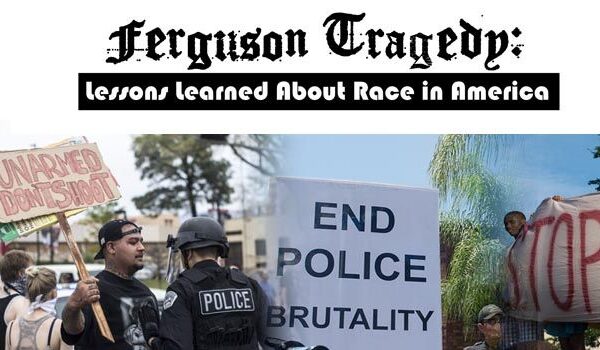
    Ferguson, a small suburban town in Missouri, has recently been the focus of global media attention for The August 9 shooting death of a black teenager, Michael Brown, by a Darren Wilson, a white police officer. The mostly peaceful protests that followed night after night turned violent at times, resulting in Missouri Governor Jay Nixon calling in the National Guard and imposing a midnight curfew. A vigorous debate on the intractable issue of race in America has been ignited once again by media outlets and in public policy forums, and on social media sites where the conversation becomes very intense and divisive at times. The Ferguson tragedy has raised several questions about the social fabric of American society.

    Laws and social norms attempt to regulate, always imperfectly, human behavior. Minds and hearts, though, can only be cleansed and elevated through divine guidance and spiritual practice

    The first issue is the social impact of changing demography. Ferguson, a suburban town of 21,000 people and a part of metropolitan St. Louis, is administratively included in St. Louis County. While most of the county population is white, Ferguson and neighboring towns are predominantly black. Blacks were once a minority in Ferguson, but the city’s demography has shifted in recent decades after white families moved out to surrounding suburbs. In 1970, whites were 99 percent of the Ferguson population. However, in 2010, 67 percent of the population was black and, according to Richard Rosenfeld, a professor of criminology and criminal justice at the University of Missouri-St. Louis, Ferguson has “a relatively stable, working and middle-income community but it does have its pockets of disadvantage.” Yet, the town’s executive leadership and its police force are predominantly white, almost 94 percent in 2014. This disparity can negatively impact the community as shown in a racial profiling study indicating that while blacks make up 67 percent of the city’s population, they account for 86 percent of traffic stops by the police, and 92 percent of all arrests in Ferguson. The Ferguson Annual Operating Budget Report states, “Municipal Court Fines are a product of the penal system. It is not the City’s policy to maximize its government finances through the use of the judicial process.” Yet, the sad irony is that one fourth of the town budget is collected through court fines, as in other small towns in Missouri, and mainly come from black citizens and other minority groups.

    Another sad fact is that, unfortunately, the shooting and killing of a black teenager was not an isolated event in American policing. It is a pattern. According to the latest available homicide data of the FBI, during the seven year period ending in 2012, nearly two times a week in the United States a white police officer killed a black person. Compared to white teenagers, black teenagers are twice as likely to be killed by a white police officer. The unjust American prison-industrial complex also presents the racial divide in a vivid manner. The prison population in the U.S. is larger than that in any other country in the world. Of the total 2.3 million, one million prisoners are black. Hispanics and African-Americans are 25 percent of the U.S. population. However, among the prison population, they account for 60 percent.

    The second issue raised by the killing of Michael Brown is the severe ethnic and political polarization on race issues in American society. According to the latest Pew Research poll, 80 percent of black people believe that the Ferguson case raises important issues about race. Thirty-seven percent of white people surveyed agreed. However, 47 percent of white people also said that race has been getting too much attention in America. The responses broke along political affiliation as well as racial lines, with 68 percent of Democrats thinking the shooting raises important racial issues but only 22 percent of Republicans think so. Some media commentators on Fox News even declared that talking about race issues is itself racism. Conservative pundits generally do not consider that there is a race problem in America and do not seem unduly concerned that young black males are too often subject to racial profiling and presumed suspicious just because of the color of their skin.

    The third issue raised by the killing of an unarmed black teen in Ferguson is that historically racial prejudices are deeply rooted in American society. There is no question that the U.S. has made great strides toward the achievement of racial equality, especially since the 1950s. Having an African-American president in the White House is the greatest testimony to this progress. Still, bigotry remains in the minds and hearts of too many Americans. In 1999, The American Assembly, a public policy forum established by President Eisenhower at Columbia University in New York City, presented a report suggesting that American society has not resolved four divisive issues despite tremendous technological and economic progress. These are economic disparity, racial inequality, family disintegration, and the role of religion in public life.

    Racism is an explosive issue and with increasing political polarization, especially after Obama was elected, it needs to be addressed at all levels. The Assembly in its report on race in America offered several measures to improve the situation. Dialogue, education, economic opportunities, better housing, reforming the prison system, and volunteerism are included in its list of recommendations. Let me also offer two suggestions, one practical and the other philosophical. On a practical level, it would facilitate trust and positive community relations if the racial makeup of law enforcement on the local level was reflective of the racial makeup of the community it serves. This can go far in precluding the deep distrust that exists in Ferguson and the festering tensions that arise out of that. On a more philosophical level, we would do well to consider the limitation of the human intellect in resolving human problems and miseries. Liberal western civilization, after rejecting any role of divine guidance in solving human problems, depends solely on man-made solutions to the big issues that societies face. Race in America is only one of the many gripping issues we are grappling with.

    Laws and social norms attempt to regulate, always imperfectly, human behavior. Minds and hearts, though, can only be cleansed and elevated through divine guidance and spiritual practice. Muslims are well aware of the last sermon of Prophet Muhammad (pbuh) during his last Hajj, when he profoundly declared, “All mankind is from Adam and Eve; an Arab has no superiority over a non-Arab nor a non-Arab any superiority over an Arab; also a white has no superiority over a black nor a black any superiority over a white – except by piety and good action.” The challenge is how such abiding wisdom can be embedded in the hearts and minds of all American citizens and, especially, in our younger generation so they can be liberated from the scourge of racism and realize a future of greater peace and harmony.

  • American Perception of Muslims Needs to Change

    As a Muslim American, I strongly condemn the atrocious attacks on the diplomatic facility in Benghazi, which resulted in the murder of four Americans, including Ambassador Chris Stevens, and the continued violence throughout the Middle East. Contrary to the images that have been replicated around the world, Islam is a religion of peace and does not justify attacks against innocent people.

    As this violence proliferates abroad we must ask ourselves a question: How is this affecting the image of millions of Muslim Americans who live here in the U.S.? The American public continues to view Islam through two basic lenses: First, there is the 9/11 lens that brings to mind images of religious fanatics and terrorism, and second, the disrespect to Prophet Muhammad (PBUH) lens, in which communities throughout the Middle East have responded violently to parodies or insults of the Prophet.

    The American public needs to better understand the Islamic faith and what it stands for by getting to know their Muslim neighbors, approximately 7 million of whom live in the United States. If they did, they might realize that the Islamic faith prohibits any Muslim from criticizing or making fun of any other religious figure such as Jesus, Buddha or Moses.

    Like Jews, Christians and Hindus, the vast majority of Muslims in the world practice their faith peacefully while devoting their lives to worshipping God. No practicing Muslim would advocate violence in any form in response to cartoons or films, no matter how offensive. What is important to note here is that the fundamental elements of our faith are grounded in the belief and respect of Prophet Muhammad (PBUH) and an insult on his noble personality is injurious to more than 1.5 billion Muslims across the globe. Images of terrorists and extremists are being used by politicians and hate groups alike to misrepresent Muslims and propagate religious intolerance.

    All good Muslims live their lives in accordance the teachings of the Prophet, who was known for his tolerance and self-restraint, even when he was faced with mobs that threw trash on him. In fact he prayed for the recovery of a sick woman who was known to have been throwing garbage on his path.

    It is incumbent on Muslim Americans who live in this country to correct the myths and educate our fellow citizens about who we are and what we stand for. Muslim Americans respectfully uphold the United States Constitution which guarantees the rights of freedom of speech and freedom of religion, which enables every citizen to practice his or her faith freely.

    Those who take offense to the film, as I do, should follow the examples of another Prophet, Jesus Christ, who is revered and respected in the Quran. Jesus practiced humility and kindness even as he was faced with those who wished harm upon him. He demonstrated great forbearance, as Prophet Muhammad did.

    Let’s not forget that a handful of religious extremists here in the U.S. produced and disseminated this film, provoking religious extremists abroad. At the end of the day extremism is our enemy. A great American, Dr. Martin Luther King, once said, “The ultimate weakness of violence is that it is a descending spiral, begetting the very thing it seeks to destroy. Instead of diminishing evil, it multiplies it.”

    Hate undermines the righteousness of our cause. Muslim Americans are devout in their faith toward God and at the same time they are good citizens who believe in and are willing to defend America and its freedoms.

    In response to the recent rise in anti-Muslim hate groups and the demonization of Muslims in the media, the Islamic Circle of North America has embarked on a campaign to explain our Islamic faith to the American public. The ongoing campaign is traveling to 36 cities with billboards, PSAs, town hall meetings, college campus seminars, and a 24-hour hotline inviting people to ask questions about Islam and engage in positive discourse.

    We still have a long way to go, and the violent protests in the Middle East only reinforce the need for Muslim Americans to reach out and talk to their neighbors. Our American community needs to address the elephant in the room which is that millions of Americans are being discriminated against, simply because of their religious affiliation.

    To make matters worse, extremists in the United States continue to prey on Americans’ Islamophobic fears, doing so for personal and political gain. As a result, we are calling on members of our Muslim community and on our fellow Americans to stand together and defend our right to religious freedom as citizens of the United States of America and as guaranteed by our Constitution.

  • 34th ICNA Convention: Message from ICNA President

    34th ICNA Convention: Message from ICNA President

    Assalaamu ‘Alaikum wa Rahmatullah
    Peace and Happiness be with you!

    We are indeed thankful to Allah Almighty, Whose Mercy and Blessings have enabled us to hold our annual convention regularly.With the bottom of my heart, I welcome you all to our tenth ICNA-MAS and the 34th Annual ICNA Convention. During the last four decades of its existence, the Islamic Circle of North America (ICNA) has developed several institutions in the fields of dawah, tarbiyah, relief and social service. Alhamdulillah, the Annual Convention has itself become an institution, which not only reflect the growth of ICNA but also present the aspirations of the American Muslim community.

    The theme of the convention, “Global Crisis – Islamic Solution,” is very significant and timely. The American Scholars are depicting the present financial crisis as the crisis of the century. The question is that weather only greed and lack of proper regulations are the main reasons for the meltdown or there are some fundamental contradictions in the liberal capitalist system that created the present crisis? Then there are other crisis too: destruction of the family structure, racism, economic disparity, global poverty, occupations, wars, terrorism and the use of religion for inflicting miseries upon others. It seems that the globe is in the crisis.

    As Muslims, we firmly believe that human beings are in dire need of the Divine Guidance. Sincere obedience and worship of God establishes a strong relationship between man and his Creator and makes it a major and comprehensive source of solving all individual and global problems. How can we infuse the Divine Guidance in the governance of the human society in the 21st century? What would be the Islamic perspective in this regard? I am confidant that the eminent scholars in the convention will provide ample and thoughtful deliberations on these questions.

    The program includes seminars and interactive workshops covering topics such as Outreach, Parenting, Family Issues, Spiritual Development, Civil Rights, Media Relations and sessions in various ethnic languages. A special Youth Conference is also being organized parallel to the convention. For Muslim children we also have specific programs under MCNA, Muslim Children of NorthAmerica.We are very grateful to our learned speakers, guests, volunteers of ICNAandMAS, and the local Muslim community of Hartford, CT. for their active participation. Thanks are also due to our friends in the media, law enforcement officials, the Bazaar vendors, and the convention center officials for their cooperation.

    Finally, we would like to thank you, the participants, who have traveled long distances to attend the convention. May Allah (SWT) accept your efforts and sacrifices! We hope you’ll fully enjoy your stay here and will go back home safe and sound, enriched with improved knowledge and wisdom, fully motivated and determined to put into practice what you’ll learn here. I would also strongly urge you to become an active member of ICNA in your city and fulfill the duty of conveying the message of Islam to our neighbors in the larger society. May Allah (SWT) accept our humble efforts and bless us all. aameen.