بسم الله الرحمن الرحيم

Author: Sumara Khan

  • Fatima Al-Fihri

    The name Fatima Al-Fihri crowns the annals of history with the distinction of having established the world’s very first university. Yes, it was a Muslim woman who pioneered a model of higher learning coupled with the issuance of degrees of various levels.

    Fatima Al-Fihri migrated with her family in the early ninth century from Qayrawan in present-day Tunisia to the city of Fez in Morocco. This was during the rule of Idrees II, an extraordinary ruler and devout Muslim. Fez at that time was a bustling metropolis of the “Muslim West” (known as al-Maghrib), and held the promise in the people’s imaginations of fortune and felicity. Having become one of the most influential Muslim cities, Fez boasted a rich combination of religion and culture, both traditional and cosmopolitan. This was the city, on the left bank of the River Fez, where Fatima’s family settled and she eventually married.

    After much toil and struggle in humble beginnings, the family of Fatima was eventually blessed with prosperity. Her father, Mohammad bin Abdullah Al-Fihri, had become a hugely successful businessman. After the deaths of Fatima’s husband, father, and brother in short succession, Fatima and her only other sibling, Mariam, received a sizable inheritance which assured their financial independence. It was in this latter period of their lives that they distinguished themselves. Having received a good education, the sisters in turn hastened to dedicate all of their wealth to benefitting their community. Observing that the local mosques in Fez could not accommodate the growing population of worshippers, many of whom were refugees from Islamic Spain, Mariam built the breathtaking and grand Andalusian Mosque in 245AH/859CE.  And Fatima founded Al-Qarawiyyin Mosque and University, considered by many historians as the oldest, continually operating, degree-granting university in the world. Historical references note that she directly oversaw and guided the construction process in great detail, certainly a testament to her great dedication as she had no expertise in the field!

    Fatima had grand aspirations, and early on began buying property adjacent to the initial land, thereby significantly increasing the size of the mosque. She diligently spent all that was required of time and money to see the project to completion.  She was also extremely pious and devout in worship and made a religious vow to fast daily from the first day of construction in Ramadan 245 AH/859 CE until the project was completed some two years later, whereupon she offered prayers of gratitude in the very mosque she had so tirelessly worked to build.

    Masjid Al-Qarawiyyin, one of the largest mosques in North Africa, housed the university which was to become a major center of advanced learning in medieval times in the Mediterranean. Al-Qarawiyyin University is credited with producing many distinguished Muslim thinkers including Abul-Abbas, the jurist Muhammad al-Fasi, and Leo Africanus, the famous author and traveler. Other prominent names associated with the institution include the Maliki jurist Ibn al-Arabi (d. 543AH/1148CE), the historian Ibn Khaldun (d. 808AH/1406CE), and the astronomer al-Bitruji (Alpetragius) (d. 1204CE).

    Non-Muslims were welcome to matriculate. In fact, the University’s outstanding caliber attracted Gerber of Auvergne who later became Pope Sylvester II and went on to introduce Arabic numerals and the concept of zero to medieval Europe. One of the university’s most famous students was a Jewish physician and philosopher, Maimonides. He was born in Andalusia in 1138 while it was flourishing as an intellectual and cultural hub under Muslim rule. His family moved to Fez, Morocco in 1160 where he was heavily influenced by Islamic thought. A distinguished theologian, he was the first to introduce articles of faith to Judaism; he considered it mandatory for every Jew to believe in the absolute unity of God, in His exclusive right to be worshipped, in revelation through prophets, resurrection, and Divine punishment and reward.

    By the 14th century, the university housed the Al-Qarawiyyin Library which remains one of the oldest in the world, preserving some of Islam’s most valuable manuscripts. These include volumes from the Muwatta of Imam Malik inscribed on gazelle parchment, the Seerah of Ibn Ishaq, the premier transcript of Ibn Khaldun’s Al-‘Ibar, and a copy of the Qur’an gifted to the institution in 1602 by Sultan Ahmed al-Mansur.

    Fatima Al-Fihri’s Legacy

    Almost 1200 years have passed since the founding of the University of Al-Qarawiyin in 859, and it continues to this day to graduate students in the various religious and physical sciences. This esteemed institution, which already had 8,000 students by the 14th century, is central to the legacy of Fatima Al-Fihri. Her story is one of timeless dedication to the Islamic tradition of learning and academic study, as well as personal devotion to pleasing Allah SWT by serving as a genuine benefactor to humanity. The world is richer as a result.

  • Fatimah bint Sa’d al Khayr

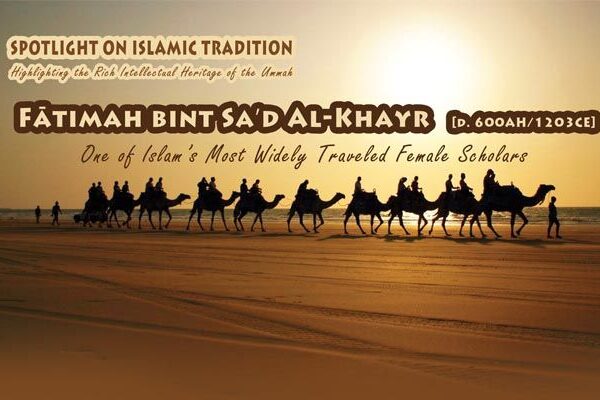
    Fatimah bint Sa’d al Khayr

    The pursuit of knowledge and wisdom into the far reaches of the world is one of the jewels of Islamic civilization, and one of the most widely travelled seekers is a remarkable Muslim woman named Fatimah. Fatimah bint Sa’d al Khayr was born 522AH/1130CE in the province of Kashgar in China to a family from Valencia, the third largest city in Spain. Her family was forced to relocate owing to the changing circumstances facing the Muslims in Islamic Spain. Her father Sa’d al-Khayr [d. 541AH], a prosperous merchant and a scholar of hadith who traveled widely, eventually settled in China where Fatimah, among several other daughters, was born, in the eastern edge of the country.

    Sa’d was very keen on the education of his daughters, and took them with him in his travels far and wide for knowledge and trade. As a result, Fatimah had the fortune to study in some of the most famous cities across the Muslim world, including Baghdad, Isfahan, and Hamadan, under some of the great scholars of her time. As early as age seven, she is described as attending circles of hadith.

    Her foremost teacher was her own father, from whom she directly transmitted hadith. Imam al-Dhahabi describes him as a trustworthy narrator of hadith. Other fellow students of her father included the likes of Ibn ‘Asakir, Ibn al-Sam’ani and Ibn al-Jawzi. Thus Fatimah inherited this lifestyle of scholarship and devotion to hadith from her father, who died in 541AH when she was only 19 years of age.

    While in Isfahan, Fatimah had the rare opportunity to study with the sought-after Fatimah al-Juzdaniyah, the primary narrator of the massive 37-volume hadith collections of al-Tabarani. Fatimah al-Juzdaniyah was the longest-living student of the last student who narrated from al-Tabarani himself, characterizing her scholarship as possessing one of the highest chains (with the shortest links) to the Prophet in her lifetime, all of which Fatimah bint Sa’d al Khayr inherited and began transmitting in her lifetime.

    Fatimah settled for some time in Baghdad in the prime of her young adulthood at age 25 where she also learned from Abul Qasim Hibatullah b. Muhammad b. Husayn, the main narrator of Imam Ahmad’s Musnad. Her other teachers included Hibatullah b. al-Tabr, Abu Ghalib Ahmad b. al-Hasan b. al-Banna, al-Qadi Abu Bakr, Yayha b. Hubaysh al-Fariqi, Yahya b. al-Banna and Qasim Zahir b. Tahir, with whom she studied the Musnad of Abu Ya’la al-Mawsili.

    She eventually married one of her father’s most distinguished students, Zayn al-Din Abul Hasan Ali Ibrahim b. Naja [d. 599AH], who later served as secretary for the famous Ayyubid ruler Nur al-Din al-Zengi. Her husband was held in great esteem by both Salah al-Din and his successor. She resided in her husband’s hometown of Damascus and then moved to Cairo, where she continued her teaching. It is reported that many a seeker of knowledge traveled to these lands for the highly valued purpose of studying with her. Fatimah dedicated her life to disseminating knowledge, and her teachings were carried far and wide by her students after her death. Ibn Hajar notes that her student, Muhammad b. Ismail (Khatib Marda) was responsible for spreading her transmission of the hadith work Musnad Abu Ya’li [d.307/918], which records about 7,500 hadith narrations. Most significantly, Muhammad transmitted her teaching of the seminal Hanbali fiqh work, Mukhtasar al-Khiraqi, one of the first texts in the Hanbali fiqh school, containing about 2,300 legal rulings. This is one of the most widely studied works within this school, inspiring close to 300 commentaries, and Fatimah spent quite some time teaching this particular work.

    Fatimah’s other students included Ismail b. ‘Azzun, Diya al-Din al-Maqdisi, Abdullah b. Abdul Wahid b. Allaq, Abul Qasim b. Husayn al-Qurashi of Tunisia, Abu Muhammad Ishaq b. Muhammad al-Hamadani, Abul Hasan b. al-Qasim of Nablus, and others. Though Fatimah enjoyed much wealth and social status in her life, she remained undistracted, continuing to teach and transmitting till the very end of her life. She died on the 8th of Rabi al-Awwal in 600AH at the age of 78 and was buried in Cairo, resting below Mount Muqattam, on the outskirts of the city she had once so brightly illuminated with her knowledge.

    The Era

    Fatimah bint Sa’d lived during the latter period of the golden age of Islamic scholarship, just prior to the devastating events of the Mongol invasion that was to occur just three years after her death. She lived to see the 20-year rule of the celebrated ruler Salah al-Din al-Ayyubi (reigned 569-589AH) and the famous Battle of Hittin (583AH/1187CE), which liberated Jerusalem from the Crusaders. Hers was a time of relative stability in the heartland of the Muslim world, which she and her contemporaries took advantage of fully, traveling widely in the pursuit of hadith and Islamic knowledge, from the far western edges of the Muslim world to places as far east as China. These extensive travels and experience of varied circumstances and societies greatly enhanced the scholarship of these great individuals, whose legacies are still enjoyed today.