بسم الله الرحمن الرحيم

Author: Sh. Mokhtar Maghraoui

  • Seeking God

    Seeking God

    Common sense informs us that there are inner aspects and outer aspects of created beings. And hardly do the exterior aspects of a created being display the inner charms.  Then the inner realities call out to him or her, we are only a trial so believe not. Subhan’Allah. We seek Allah SWT as al-salik – that is the person who has undertaken a way, a path, to a certain destination. And here it means a person who takes the path — I hope that is all of us — to his or her spiritual destination, with the most resolute of hearts. And to whom?  To Allah SWT. This resoluteness is“hima” which is not just the intention, it is the drive with resolve. Intention is a state previous to hima. Hima is an internal resoluteness and drive toward that which was intended. So this person, imagine, this salik, has a hima and this hima is to arrive at a spiritual destination with his or her qalb (heart) fully surrendered and devoted to Allah SWT. And on the way certain things happen—an unraveling, an unveiling, a displaying. It could be an unraveling of confusions in my thinking or a freeing from complications and difficulties that have afflicted me. It could be unveiling of deeper meanings so that my understanding of things becomes more firm and stable. It could be a displaying in my everyday life of greater devotion to Allah SWT. Indeed, there are many types of unraveling, displaying, unveiling.

    First of all as we alhamdulillah begin to walk the path to Allah SWT and we feel our taubah growing stronger, then we start to perform salat on time and establish zakat and perform some dhikr of Allah SWT. And so in performing the obligatory and also extra dedication in voluntary worship, and doing some good works insha’Allah of learning and sharing and teaching and helping others, then we begin to feel and experience certain beneficial effects and  we begin to like the effort and striving to please Allah SWT;  we begin to feel more peaceful and balanced. Then my hima, as it is aware of that new state that I am in, it wants to stay in a sense and stop and enjoy it. Maybe that’s it. When that happens, you could be hearing with physical ears or spiritual ears the hatif of the haqqiqah which is the voice of truth. It could be a call inside of your qalb. While what I observe or hear is part of my own mental and emotional being, it is nonetheless the haqqiqah, the underlying truth that speaks to me. The underlying truth is the essence, not the outward, superficial meaning of something. For example, the haqqiqah of the human being is not the way we look physically, the external look.

    The haqqiqah of the human being is not physical. It is deep within the inner recesses of the heart. The prophet of Allah said that everything has a haqqiqah and the haqqiqah speaks to the heart. And sometimes the heart wants to stop because the heart of the journeyer, the traveler on the path to Allah SWT, finds delight in reflecting on the inner realities or might find a need for a deserved pause. Then a call from within that speaks to him or her about the realities of things and its vastness, brings reminder that there is more to seek and to be careful not to stop striving. That call from within reminds us, “Don’t think you got itall.  Don’t think there is nothing beyond that. What you seek is still beyond.”

  • Pure Submission: The Prayer of Prophet Ibrahim (pbuh)

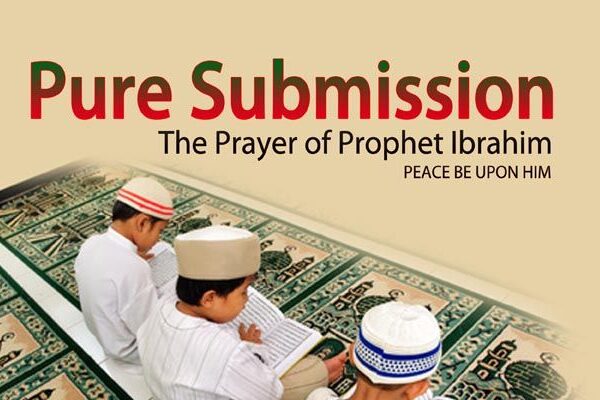
    Pure Submission: The Prayer of Prophet Ibrahim (pbuh)

    Indeed, we cannot give of something if we do not own it. The one who does not possess something cannot dispense it to others. If I do not have peace inside of my heart, I cannot contribute to the peace outside of me. Allah SWT says, “Verily God does not change the state of a people until they change that which is within themselves.” Until I change my heart to be at peace with the Source of Peace, I cannot give of peace to the one thirsty for peace. If I am not tranquil and serene inside of me, I cannot give to those outside of me. I externally may look at peace, may sound of peace, and yet internally I am not at peace. That is the one who does things with ostentation, with lack of ikhlas (sincerity) to Allah SWT. I need to be at peace inside of me in order to be happy in this world, before the hereafter, and that peace is first of all the peace with God through uncompromising belief in tawheed (oneness) of Allah SWT.

    I externally may look at peace, may sound of peace, and yet internally I am not at peace. That is the one who does things with ostentation, with lack of ikhlas (sincerity) to Allah SWT

    Ibrahim, peace be upon him, is the father of Islam, the progenitor of loving surrender of soul, spirit, heart and mind, limbs and senses, to the Divine. He was the ultimate muwahid (one who bears testimony to the oneness of God). Allah SWT says in the Qur’an, in the context of the story of Ibrahim pbuh, “…those who have eman, those with hearts of faith, and do not stain their eman with zhulm (usual meaning is oppression, transgression, injustice)…” And the Prophet (pbuh) explained that zhulm in this verse means shirk, as Allah SWT says in the Qur’an, “Verily shirk is a momentous act of transgression.” When a person has eman, and the belief in tawheed of Allah in his heart, he has faith that is not blemished with shirk. And shirk is the opposite of tawheed. Tawheed is when, in your heart or mine, there is the presence of the Divine, without attachments to any other than Allah. Shirk, in a general sense, is when the heart is attached to other than God. If my heart attaches itself to other than God, and every created thing is other than God, if the attachment in my heart, emotionally, experientially, or intellectually is to other than Allah, and not by Allah and for Allah, that is shirk. And when there is shirk inside of the heart of a creature, that creature is not at peace.

    Sometimes you or I feel depressed, in agony, very low, and insecure. The root of that often times is the presence inside of the heart of an attachment for other than Allah. The root of most psychological ailments is, in fact, a defect or a mediocrity, and absence of full attachment to Allah SWT so that the volition, love, hope, or desire is for other than Allah. If you or I feel down or depressed and there seems to be no reason why, we should look into our hearts to find the quality of our belief in tawheed —not only intellectual or academic, but emotional and experiential as well.

    Prophet Ibrahim (pbuh) was the epitome, the most beautiful expression of loving surrender, of loving attachment to Allah SWT and Him alone. When Allah SWT wanted to give him everything, Allah wanted to give Ibrahim Himself, when he wanted to give him the ultimate gift, He saw in his heart something else that he loved. Ibrahim loved his son, and legitimately so. He loved him very much —the son was so spiritual, so moral, so beautiful in heart and soul and speech and behavior. Allahu Akbar. The yearning of every parent is to have a child like Ishmael and Isaac. Allah saw that love, that attachment in the heart of Ibrahim. So Allah told him to offer his son in sacrifice. Why? So that he would leave inside of him nothing of attachment except to Allah SWT. That is what we must do —kill our drives, volitions, desires, and our love – nullify everything but Allah SWT. You and I need to annihilate the demons inside of us, the hate inside of us, the passions inside of us, and the evil inclinations that we sometimes disguise and claim as beautiful intentions. But they are ugly inclinations of the self. The intent was not that Ibrahim would kill his son; the intent was that Ibrahim and the son would kill everything inside of them but their love for Allah, to be actualized in reality. Then Allah gives them Himself. And therefore Ibrahim became the khalil of Allah, the friend of Allah, the most beloved to Allah. For Allah was to him the most beloved, to the extent that the true love Ibrahim felt for Allah SWT pierced through the innermost recesses of his soul and his heart. As one poet said, “You have pierced through the innermost of my inner self.” And therefore Ibrahim was called a khalil of Allah SWT because the Beloved was present in the innermost recesses of his heart and nothing else. And then he was given everything.

    Islam is not what my tongue speaks. When rasul-Allah was asked, “What is Islam, O Messenger of Allah?” He replied, “Islam is when your heart, in all love, surrenders completely to Allah SWT.” Your heart, your drives, your feelings, your hope, your fear, all lovingly surrender themselves to Allah SWT. Not my tongue only. Not my academic, intellectual drives only. For I could be intellectually claiming Islam, but emotionally and experientially I am not. I could be, in scholarly ways, expressing myself as a Muslim but in reality I am not. Iblis, as the scholars have mentioned, had a lot of knowledge of Allah and he was in the Divine presence in some ways. And yet that did not penetrate the deepest recesses of his heart. It did not transform him so that he becomes one who represents Divine beauty within the creation.

    The legacy of Ibrahim, our father, is that his heart was purified by the hard work of coming to know and to disengage and to detach from within himself everything else but Allah SWT. I am and you are to be the children of Ibrahim, understanding Islam in this way. This true surrender of the heart, not only of the intellect, has practical consequences. Because when I understand Islam in this way, people are safe from my hand and my tongue. People are safe from my might, from my power, whether it is physical, political, military, economic, or emotional. The power that I have over my children, as a father or a mother; or my power, as a child, that I have over my parents, because parents love their children and can be weak in dealing with them, so the child has power over his parents in an indirect, subtle way. And sometimes the child, as an adolescent or as an adult, knows that and abuses that. The practical consequence of complete surrender is that all feel safe from the power of my tongue, from the vociferous words, the venomous words that sometimes my tongue unleashes in my relationship with my father, my mother, my children, my siblings, my friends, my neighbors; those with whom I agree or those with whom I disagree —sometimes I unleash the power of my tongue to hurt them. My tongue becomes a scorpion, a snake, and once I let it loose it begins to bite. But it has been said that when I let it loose it begins by biting me. So I must control it as a Muslim. When the heart is fully surrendered in Islam, the senses are in and of Islam.

    Yet, if the senses seem to be in Islam, it does not necessarily mean that the heart is fully surrendered. The Islam that the Bedouins claimed to have, as the Qur’an tells us in Surah Al-Hujurat, was not an Iman of the heart, rather, it was a surrender of the external senses to the law. I could surrender to the law, but my heart does not. I am not then a Muslim on the path of Ibrahim, pbuh, nor on the path of the most beautiful representation of Divine beauty on earth, Muhammad (pbuh).

    The Qur’an tells us, “Say: Verily, my prayer and my service of sacrifice, my life and my death are all for Allah, Lord of the Worlds” (Qur’an 6:162). Salah is when the heart is in the Divine presence. When we are in salah, we are supposed to rise, to ascend spiritually to the nearness of Allah, to a greater awareness of Allah. And my sacrifices and my living — where I live, the elements of my living, the times of my living, the actions of my living, the omissions of my living, my living second by second, and my dying, not just my death, all are for God. Can you imagine if you and me were as that Muslim who lives every heartbeat in this consciousness and awareness of Allah SWT in everything.

    In that awareness we know that He watches inside of us, inside of our hearts, and we live every second in secret and in public, what we harbor inside of our own souls and what we show to the outside world – all done in awareness and consciousness of the fact that God knows and sees and hears all. And when I am like this, I am at peace, I am nearest to the Source of Peace, Who is God. And if I am next to the Source of Peace, in my heart, then I am at peace. When I am distant from the Source of Peace, from the well that supplies the water of peace, I cannot drink from it; I cannot scoop and give to another. I am not at peace, I am not secure, I am not happy, I am not free. And thus I cannot teach of those states to others. I can only talk about them perhaps.

    The Prophet Ibrahim peace be upon him, made the following du’a (supplication): ““Our Lord! And make us submissive unto You and of our offspring a nation submissive unto You, and show us our Manasik (all the ceremonies of pilgrimage – Hajj and ‘Umrah, etc.), and accept our repentance. Truly, You are the One Who accepts repentance, the Most Merciful. (Al-Baqarah 2:128)