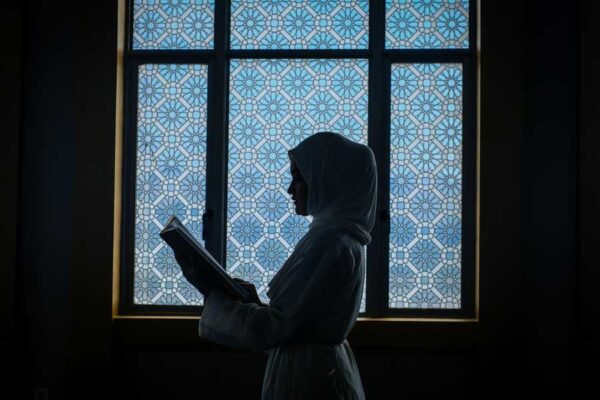
بسم الله الرحمن الرحيم

Author: Bibi Watts

  • National Poetry Month: An Ode to Faith, Visibility, and the Conversations We Don’t Forget

    National Poetry Month: An Ode to Faith, Visibility, and the Conversations We Don’t Forget

    Some conversations never leave you; rather, they linger and leave a mark. Years ago, I experienced such a moment, and from that moment a poem was born.

    It was 2012, and I waiting for my ride home at a coffee shop after work. As I sat, a man approached me, and, so impactful was our interaction, I was inspired to channel our conversation – nearly word for word – into art.

    At the time, I didn’t realize how the moment would stay with me or how relevant it would still feel today. Because, if we’re being honest, the negative perceptions surrounding Islam that spurred that coffee house chat haven’t changed as much as people like to pretend. In fact, sometimes I feel it has gotten worse. There are still many misunderstandings about Muslims and our lives here in America. In my view, there is a lot of projection and, sadly, many people who feel very comfortable hating what they’ve never taken the time to understand. But that night, in the quiet of a coffee shop, there was a genuine question and a sincere answer. This is the fruit of that interaction.

    Oh, beautiful girl, I couldn’t help but notice your style/smile, can you tell me why you’re so covered up?

    So I told him
    I was born a Muslim
    Handpicked
    Chosen and molded by the fashioner of men
    And as I grew to understand His pen
    I then began to wear Islam like I chose it
    To understand my purpose
    I had to learn about His Oneness because a man is only as authentic
    As the study of his worship
    So my readings were between the pages of pseudo and perfect
    The Holy Qur’an is an ocean too deep for me to scratch its surface
    So I begin with a declaration
    I believe in

    Allah
    Malaaikah
    Kutubullah
    Rasuls
    Qiyaamah
    Taqdir
    Aakhira

    I repeat I believe in God
    His angels
    His Books
    His Messengers
    The Day of Judgement
    Divine Fate
    And life after death

    These tenants of faith are the foundation of my existence
    So it’s no coincidence
    That my presence is present
    Sometimes something unpleasant
    I’m nothing more than a mere sinner in the center of pure intentions
    I renew each time I fall a victim to my desires and offer repentance
    But I digress
    Let’s not forget this is a conversation
    This man asked me how I smile so big
    And with the world’s hate as it is
    Embody happiness
    Hypnotizing on-lookers attention like I with his
    I replied
    You know it’s just the contentment having faith gives
    Like how God mixed clay and water
    And said “be and it is”
    Blew soul into the body
    Then said “be, and it is”
    Adam was the first man to live
    He said “be and it is”
    Then created Eve from his ribs
    And since we’re all children of his
    I say we call a truce
    We are the people of the book
    So if you believe in God say, I do
    We give birth to truth
    Walk on faith like Jesus
    Crush lies to pieces
    The media can’t win over the power of the people
    Religious or not, it’s about good and evil
    So when I’m asked if I am forced to wear Hijab
    I reply
    Would you ask our Mother Mary was she forced to exemplify
    self-preservation and class?
    My cloak is a shield from the lustful eye and glance
    And I do it with a smile because I understand my path
    So my smile
    My light
    My joy
    All come from the crown in my Hijab

    Now hush all the noise, I’m trying to adjust my crown. 

    Looking back, what stands out to me isn’t just what I said in response, it’s also that he

    asked, not in a confrontational way or to debate, but out of sheer curiosity. And oftentimes, I think that’s what’s missing in nowadays. People talk and post about Muslims all the time, but they rarely engage with us. It’s even more rare when they speak with the intention to carefully listen. Instead, it’s easier to rely on headlines, stereotypes, or whatever version of Islam gets packaged for public consumption.  But real understanding doesn’t happen through those channels. It happens in small, everyday human interactions, in conversations where no one is performing or judging one another, rather, they are asking and responding.

    This poem is my reminder that we don’t have to do what everyone else is doing or feel how

    everyone else does. It’s also a reminder that my faith was never forced onto me. It’s something I grew into, something I questioned, studied, returned to, and chose over and over again. That nuance gets lost in the noise sometimes, especially when it comes to Muslim women. The assumption is always control, oppression and a lack of choices, but it never looks like conviction to anyone else.

    To me, that is lazy thinking. The effort exerted in practicing Islam could not be

    forced by anyone, at least not on a large scale, because it is a lifestyle. So, if there’s anything I’d want someone to take from this, especially during National Poetry Month, is this: Stories matter more than assumptions, and real voices could never be replaced by the media. We have to collectively stop accepting narratives built from the outside. Stop believing what others are saying about us, and start talking directly to us. This poem isn’t trying to convince anyone of anything, it’s just telling the truth about one moment, a mutual conversation and an explanation of what faith feels like from the inside. For me, it has been a beautiful and challenging experience, and maybe that’s enough, or maybe it’s just a place to start.

  • The Power of Saying No: A Reflection on Boundaries

    The Power of Saying No: A Reflection on Boundaries

    For so long, I believed being a good person meant being available to everyone. That translated into helping, fixing, and showing up no matter how tired, thinly stretched, or quietly resentful I was. Saying no felt wrong, as if it were an offense, like I was selfish or a failure, and, if I’m being completely honest, it still sometimes does.

    Many of us, especially women, are raised to believe our value lies in our usefulness. We are praised for being accommodating, flexible, and dependable. We are taught to be accommodating, fill in gaps, accept discomfort so others don’t have to, only to then feel we must apologize for not being perfect.

    So, when the moment comes to say no, it doesn’t just feel like a personal decision, it feels like a betrayal. What’s more, I have realized this isn’t accidental, but cultural, learned behavior.

    As a Muslim, I’ve had to look to my faith when trying to create a lasting balance. After all, there are certainly moments when putting others first is right and meaningful. There are also times when showing up costs something and is still worth it. The problem is not the sacrifice, but sacrifice without choice.

    It was narrated that Tariq Al-Muharibi said: “We came to Al-Madinah and the Messenger of Allah was standing on the Minbar addressing the people and saying: ‘The hand which gives is the upper hand. Start with those for whom you are responsible; your mother, your father, your sister, your brother, then the next closest, and the next closet.” Sunan an-Nasa’i – The Book of Zakah – Hadith 2532. This hadith illustrates the importance of hierarchy, priority, and order in which the people in your lives should come.

    So, how do know if our no is appropriate or not?

    Cost of Always Saying Yes

    Saying yes all the time doesn’t usually look exhausting from the outside. It looks like being kind and supportive, or, my not-so-favorite compliment, strong. I remember thinking being told I was strong was a good thing, until I connected it to the fact that I was always putting myself last. It was almost as if the more I overextended myself for others, the more my value increased in their eyes. All the while, I was ignoring the way it made me feel. You are being told one thing, but inside, something else is happening. You start having these unhealthy internal conversations, convincing you can rest later, you’ll be ok, it’s not that big of a deal…until it is.

    Over time, always saying yes to everyone creates invisible, unrealistic pressure. You carry expectations never meant for you, and, oftentimes, the line between responsibility and obligation becomes blurred. What makes it even harder is the world often rewards this behavior. People benefit from your overextension, processes start to rely on it, and communities normalize it. So, when you arrive at a point where you hesitate or pause before answering, it can feel like you’re being disruptive.

    Guilt

    One of the biggest lessons I’m still learning is this: Guilt is not the same as wrongdoing. Guilt can show up when you break a pattern, not only when you break a value. For women, and perhaps especially for Muslim women, guilt can be layered. Faith, culture, and gender expectations often intertwine in ways that confuse healthy selflessness with extreme self-neglect. We are reminded to be of service, to be patient, and to sacrifice. Yes, of course these are all important values, but we are rarely taught how to practice them with healthy boundaries.

    In my view, selflessness is meaningful, spiritual, and necessary, to some degree, but it wasn’t meant to be constant, and not at the cost of continually sacrificing oneself. There is a difference between choosing to give and feeling obligated to give. One is an act of kindness connected to intentions; the other is an imposition that slowly drains your energy and sense of agency. Learning to say no doesn’t mean abandoning compassion, it represents practicing discernment.

    Saying No Is a Skill

    I have to be honest, I am not an expert nor have I mastered the art of saying no…yet. But I am much better at it than I used to be, and I’m still learning. Over the last few months, I have really tried to become more comfortable with saying no, but more importantly, trying not to feel guilty when I do.

    I’ll admit, it’s not easy nor immediate. The process is gradual. Sometimes you say no and feel awful afterward. Other times you say yes when you want to say no and you still feel awful afterward, but also like you’ve committed an offense to yourself, once you realize it later. Sometimes you set a boundary and immediately want to take it back.

    Having these mixed emotions does not mean you’re failing. It means you’re slowly unlearning. Each time you say no, you’re building muscle. Each pause allows you to honor yourself and what you can give in that moment. Each moment of honesty with yourself matters, even when it’s messy and doesn’t feel good.

    What has changed for me is the freedom I feel when I have the courage to say no. I feel lighter, less pressure to manage everyone else’s comfort, and the permission to listen to myself. It becomes much easier to manage what I can based upon my current bandwidth. That freedom didn’t come from becoming harder or less caring. It came from becoming more honest about my limitations.

    Boundaries Create Balance

    There’s a common fear that boundaries push people away. But in reality, they add layers and understanding to your relationships. When you say no thoughtfully, you are teaching people how to engage with you. You are replacing feelings of resentment with clear expectations. You are ultimately choosing the health of the relationship over burnout, which can positively impact the relationship’s longevity.

    But let’s be honest, some people won’t like it, especially if they are accustomed to hearing yes from you. You will ruffle some feathers, and it won’t be easy, but that is part of the process. Not everyone benefits from your boundaries, but you likely do, and the people who truly respect you will adjust, even if it takes some time, recognizing you’re not looking to withdraw or be neglectful, but to create balance.

    If negative reactions make it difficult for you to achieve needed balance, remember this hadith, narrated by `Aisha, who reported that Allah’s apostle said, “Do good deeds properly, sincerely and moderately and know that your deeds will not make you enter Paradise, and that the most beloved deed to Allah is the most regular and constant even if it were little.” Sahih al-Bukhari 6464

    This speaks about focusing on consistent, small steps when doing good deeds, and how that is most beloved to Allah (SWT). Rather than attempting to complete a host of unattainable goals, the hadith lends itself to practicing moderation, steering us to concentrate on smaller acts that can be achieved consistency, including serving those around you.

    Measure of Strength

    We often measure strength by endurance. How much we can carry, how long we can last, how quietly we can struggle through to the end of the current difficulty. But there is another kind of strength that isn’t often mentioned, that of restraint. It is shown through honesty, and knowing that you don’t have to be everything to everyone in order to be worthy.

    You are not less generous because you have limits, and you definitely are not selfish for choosing balance. I am still practicing, still learning, and still catching myself trying to overextend for others. The beautiful thing about life is, as long as you are alive, you have time to work towards getting better each day, and each time I choose myself with intention, I feel more grounded and present for everyone around me, not just myself. Saying no has not made me smaller or less capable, it has made me more myself, and that, I’ve learned, is not something to feel guilty about.

  • Hijab, Identity, and the Cost of Belonging

    Hijab, Identity, and the Cost of Belonging

    Hijab is a personal journey but also a collective effort. Individual actions seldom exist in a vacuum. Our choices shape culture, our visibility matters, and our struggles can affect those around us, even when we pretend they don’t. Hijab, in particular, sits at the intersection of faith, politics, beauty standards, and belonging. It is both worn on the body and also demonstrated by how we carry ourselves, speak, and move through the world. Right now, it feels heavier than ever.

    We live in a world where nothing is sacred and nudity is marketed as freedom; where access to women’s bodies are framed as empowerment, where exposure equals confidence, and where privacy is treated like insecurity. So, it is disheartening to continually witness women removing layers of clothing, namely hijab, and calling it growth, especially when those same women once stood as visible reminders that modesty, faith, and dignity could coexist with beauty, creativity, and success. It forces us to ask an uncomfortable question: Do we believe we cannot be successful with hijab on, or that doors will close, opportunities will cease, or our relevance will fade if we remain visibly Muslim? And if so, who convinced us of that?

    Was it corporate culture?

    The algorithm?

    Brand deals?

    The male gaze?

    Perhaps it was society’s endless demand that women offer their bodies as proof of worth?

    At what point did liberation become sacrificing ourselves? And when did empowerment start to look like less clothing, more access, and more consumption?

    The Subtle Pressure to Conform

    It’s disturbing how society pressures women to be palatable, particularly Muslim women. We are either too covered, too foreign, too religious, or not covered enough, not liberal enough, not modern enough. There is not enough balance or acceptance, and too much reshaping of who we are. We are told to evolve, but evolve into what? My only guess is to change into something more digestible, marketable, and acceptable to systems never built for us in the first place.

    It’s not lost on me that visibility in today’s world often comes with conditions. You can be successful, but only if you don’t make people uncomfortable. You can be seen, but only if you soften your edges. You can be Muslim, but don’t look too Muslim. The thing is, hijab refuses to comply with that, and it isn’t meant to. Hijab is a boundary, a statement, and a refusal to perform for public  consumption.

    So, when sisters remove it and label it growth – I must be honest – I grieve, because something sacred is being traded for something fleeting, and that exchange deserves deep reflection, not applause. There are many who will say that what one woman does with her body and how she decides to present herself, with or without hijab, is no one else’s business or problem, but I strongly disagree.

    Asking Myself the Same Questions

    I don’t pretend to stand on some moral pedestal. I don’t have it all figured out, and I cannot say I have never struggled with hijab. So, I ask myself these same difficult questions I pose to you.

    Was hijab ever just for show?

    Was it about community approval?

    Aesthetics?

    A season of identity?

    Was it worn only when convenient, when it felt empowering, when it earned praise?

    Or was it always meant to be a covenant with Allah? One that deepens with time, and not convenience?

    Faith is not complacent. It demands growth, but growth does not always seem liberating. Sometimes growth feels like restricting. When in reality it is choosing Allah (SWT) when no one is watching and when no one is clapping. We have to be honest about that. Hijab is not supposed to be trendy and convenient. It’s not supposed to blend in. The Prophet (peace be upon him) said, “Islam began as something strange and will return to being strange, so glad tidings to the strangers.” (Muslim) This hadith hits home because I have always been proud of how my siblings and I were raised not to follow the crowd. We were reared to stand out and be comfortable with it.

    A Community Check-In

    As a community, we cannot avoid accountability. We all have a part to play, and we have to take a look at how we show up for each other.

    Have we not been supportive enough?

    Have we reduced hijab to a symbol without protecting the women beneath it?

    Have we turned it into a badge of honor instead of a spiritual commitment?

    Are we creating room for struggle, doubt, and complexity, or have we only celebrated what

    appears to be perfection?

    So many sisters feel if they struggle or question hijab and its meaning then they are failing or are weak.  Or worse, if they remove the hijab, then they are beyond redemption. I don’t believe that fear is rooted in Islam, I believe it is cultural. Allah (SWT) doesn’t ask us to “come as you are” only to expect perfection in our practice. Let’s stop pretending that faith is linear. It isn’t. It bends, it stretches and it wavers, and sometimes it’s barely present. However, Allah (SWT) never leaves us. Instead, we leave ourselves, and we leave Allah because we begin to feel unworthy of His love during our difficulties.

    If we truly cared about hijab, we would care about the women wearing it more than the fabric itself. We need to start checking in before making assumptions, listening before lecturing, and honoring the difficulty instead of condemning them for their experiences.

    Accountability Without Condemnation

    So how do we hold each other accountable? We are living in one of the hardest times to hold onto the rope of Allah. Confusion is loud. Immorality is trendy. Discipline is framed as oppression. Yet, Allah still asks us to hold firm.

    Allah says, “And hold firmly together to the rope of Allah; and do not be divided. Remember Allah’s favor upon you when you were enemies, then He united your hearts, so you—by His grace—became brothers. And you were at the brink of a fiery pit and He saved you from it. This is how Allah makes His revelations clear to you, so that you may be ˹rightly˺ guided.” (Quran 3:103) Holding firmly to His rope, even with it’s not easy or popular, is what sincerity looks like.

    In another ayat Allah says, “The believers, both men and women, are guardians of one another. They encourage good and forbid evil, establish prayer and pay alms-tax, and obey Allah and His Messenger. It is they who will be shown Allah’s mercy. Surely Allah is Almighty, All-Wise.” (Quran 9:71)

    However, one thing I often see forgotten when we try to support one another is compassion and grace. If we learn how to decenter ourselves in the struggle of others, we would be much better advisors.

    Walking Alone, But Not Isolated

    Personally, I don’t need company in wearing a hijab. No one will stand before Allah with me, and they won’t be able to answer for my intentions or deeds. Nor will anyone carry my compromises. However, I won’t pretend sisterhood doesn’t matter, and I won’t act like I am not affected when I see a sister remove her hijab, either. I feel it, and it always feels personal, although I know it isn’t.

    Knowing I’m not walking this road alone matters, and it comforts me that other women are choosing Allah in a world that makes self-preservation difficult. It makes me feel I’m not alone, and it reminds me I’m not crazy for caring. Sisterhood doesn’t mean we always make the same choices. It means we respect each other while staying anchored to truth, in shaa Allah.

    The real question is not: “Why did she take off her hijab?” The real question is: “What are we willing to trade for belonging?” Are we trading discipline for validation? And who benefits when we do? It’s definitely not us, and it isn’t our daughters, nieces, or our community. Instead, systems profit off women’s insecurity. Industries that monetize minimal clothing and a woman’s need to be validated by the public and algorithm, but our souls do not.

    Choosing Allah When It’s Uncomfortable

    I’ll be honest, holding onto hijab is extremely difficult these days, and oftentimes it’s not glamorous. It doesn’t go viral, and most of the time, it doesn’t get brand deals either. It rarely gets support. But it results in something better – barakah, peace, alignment – and we pray it is added to our scale for the aakhirah.

    Of course, it’s not always easy. Some days it feels heavy and you question everything about yourself. That’s when you have to remember who and what you’re doing this for. After all, it is an act of obedience and done for the pleasure of Allah.

    Nothing makes me feel more beautiful than when I wear a hijab. Donning it has always been deeply personal for me, and whenever I see sisters struggling to wear it, or taking it off, it always makes me want to wrap them in parts of my journey and share my story. I know our paths look different, but when we share it often helps others that are going through what we’ve already conquered.

    A Dua for All of Us

    I don’t want to leave without saying is, to the sisters struggling to wear hijab, know you are not alone and Allah (SWT) is ever merciful. Reach out to the sisterhood, talk to someone who will support you, and ultimately, call on Allah. He hears you and will not leave you to yourself.

    May Allah rectify our affairs. May He strengthen the hearts that are tired but still holding on. May He guide those who are struggling with sincerity and gentleness. May He soften us without weakening us. May He protect us from trading eternity for momentary comfort. And may He allow us to live and die clinging to Him in a time when letting go is the easiest thing to do. 

    Allahumma Ameen.

  • Social Media as Sadaqah Jariyah: A Reflective Piece 

    Social Media as Sadaqah Jariyah: A Reflective Piece 

    In an age where a single post can reach thousands in seconds, it becomes impossible to ignore the powerful influence of social media. What was once created for connection and conversation has evolved into one of the greatest tools for impact, awareness, and collective upliftment – if that is what you seek on these platforms. For Muslims, this digital age presents a unique and often overlooked opportunity; the chance to turn our online presence into sadaqah jariyah, a continuous charity,a reward that can last long after we’ve logged out and left this world. 

    As someone who has spent years using social platforms, I’ve always saved room to bring attention to humanitarian work, one of my passions. I’ve seen firsthand how a share, comment, or donation link can change lives. But my journey also taught me that using social media for good is not accidental, it is intentional, and rooted deeply in our faith. 

    Understanding Sadaqah Jariyah in the Digital Era

    Islam teaches us that charity is not limited to wealth. The Prophet Muhammad (peace be upon him) said, “When a person dies, all of his deeds come to an end except three: ongoing charity (sadaqah jariyah), beneficial knowledge, or a righteous child who prays for him.” (Sahih Muslim) 

    This hadith summarizes which deeds continue to benefit us even after death. We often think of a few certain deeds when we hear sadaqah jariyah, such as building a well, sponsoring an orphan, planting a tree, or projects like constructing schools or masjids. But today, we have new spaces where our efforts can live on, and one of the most unique is social media. 

    A post offering the opportunity to give in charity, a reminder of kindness, or a Quranic verse that inspires someone to get closer to Allah, can become an ongoing stream of reward too. The domino effect is real. One person shares, ten others see it, two donate, one volunteers, and then suddenly, a chain of good has been formed, all starting by a single post on social media. 

    My Journey from Sharing Posts to Witnessing Impact

    When I first began posting on social media, circa 2007, it wasn’t about charity work, it was more like a shared diary of posted pictures and thoughts. I didn’t really have a plan or understand the magnitude of what social media could do. At the time, my intention was simple: spread inspiration, share my poetry, opinions, and pieces of my life.  

    Eventually, I realized I could create bigger and more impactful change. That’s when I began to assist organizations, spreading awareness so more people could support humanitarian projects I believed in. What’s more, as the posts gained traction, I began receiving messages from strangers across the world telling me a video moved them to donate, a caption pushed them to pray, or a photo reminded them to be grateful. There were moments that left me speechless, honored, and, at times, unworthy of this feedback. For me, I was simply sharing things I was passionate about.  

    A single Instagram story once helped raise money for a divorcee who hadn’t eaten properly and needed to flee an abusive husband. Another post brought in enough support for a mental health organization to stay in business. Sometimes, it wasn’t even the video or effort I put in, it was seeing others repost, comment with prayers, or encourage their own circles to give. It was building communities and alliances. It became clear to me that even if I could not physically be everywhere, my message could spread far and wide.  

    That is one of the gifts of our time. Social media isn’t just a tool, it also can be a bridge between those who need help and those who are able to give it; a bridge between awareness and action, between intention and impact. 

    Spreading Good

    Allah (SWT) reminds us, “Whoever guides someone to goodness will have a reward like the one who did it.” (Quran 4:85) 

    This isn’t limited to in-person guidance. In our day and age, “guiding someone to good” often happens through screens. Consider this, when you share a fundraiser link, remind someone to give, or spread knowledge that leads to charity, you also are guiding others toward good deeds. Every action they take can add to your scale of good, without diminishing theirs. 

    In another verse, Allah says, “The example of those who spend their wealth in the way of Allah is like a seed [of grain] which grows seven ears; in every ear is a hundred grains.” (Quran 2:261) 

    Now imagine this multiplied through social media. One post becoming seventy, then seven hundred, then thousands. The rewards become unimaginable! 

    Four Reasons to Embrace Social Media as a Platform for Continuous Charity
    1. Small actions lead to huge impact. You don’t need millions of followers to make a difference. Sometimes the right message reaches the right heart at the right time. One reminder to donate $5 might feed a family, and one repost might inspire someone else to fund an entire project. 
    1. Knowledge spreads faster than ever before. Sharing a Quran verse, an authentic hadith, a reflection, or a reminder of compassion can reach people who are struggling, distant from faith, or looking for direction. 
    1. You can unknowingly create ongoing benefit. Your content stays online, people may find it weeks, months, or even years later, and each time it inspires good, your rewards continue, inshallah. 
    1. It allows you to fulfill your duty to uplift the ummah. Social media connects us to the suffering of the ummah in real time and gives us the ability to respond immediately.  
    Your Voice Matters

    If you’ve ever wondered whether your posts make an impact, or if your small efforts are seen, just keep hope in Allah (SWT) that someone will see your post and act on it, that someone will be inspired, someone may give, and someone will help, and that chain reaction of good might continue long after we’re gone. 

    This is one of the ways we can leave a legacy behind. 

    So let us use our platforms with purpose. Whenever you can, fil your timelines with reminders of compassion. Let’s raise awareness for those who cannot speak for themselves. Let us turn some of our scrolling into sadaqah, service, and our platforms into pathways of mercy.  

    May Allah (SWT) accept every sincere effort, every post shared for good, and every action taken to uplift His creation. And may our social media, often seen as a distraction, become a source of ongoing reward in this life and the next. 

    Allahumma Ameen. 

  • Back to the Basics of Worship

    Back to the Basics of Worship

    In a world that often feels complicated with algorithms, hustle culture, and constant notifications, it may be easy to forget that worship was never meant to be a chore. At its core, worship is simple; it is consistently and sincerely remembering the One who created us, showing Him gratitude, and being present.

    Somewhere along the way, many of us start thinking worship only “counts” if it looks a certain way – long duas, perfect tajweed, standing in prayer for hours – and while those practices are beautiful, the basics of worship teach us that Allah (SWT) doesn’t ask for perfection; He asks for consistency and sincerity.

    It begins with intentions

    The Prophet (peace be upon him) taught us, “Actions are judged by intentions.” Which means the smallest act, like pouring a glass of water for a loved one, cooking dinner for your family, or even getting dressed, can be worship if your heart connects it to love for Allah (SWT).

    Back to basics of worship means checking in with our intentions and continually purifying them before rushing into any action. We can ask ourselves: “Is this for the dunya, or is it for the One who owns it?”

    Anchored by prayer

    Sometimes we complicate prayer by judging it with a measuring stick that Allah (SWT) didn’t prescribe for us; maybe even halting if it doesn’t look and feel like we think it should. If we’re not performing it with khushoo – complete submission and concentration – we might question whether it’s being accepted. Perhaps performing prayer at a time when our faith is wavering, we may feel unworthy of salaat, as if Allah (SWT) will be unhappy if we are standing before Him. No matter our circumstance, we must strive to stand in salaat before Allah five times each day and declare “I am here.”

    No matter how you feel, you should always pray through it, even when the connection isn’t as strong as you wished it would. I often liken salaat to exercising, which so many people loathe. It may be difficult to begin, however, once you finish a workout, you are rewarded with a dose of serotonin and endorphins that make you believe everything is better, and that’s exactly what prayer does – physically, emotionally, mentally, and spiritually.

    Allah says, “Establish regular prayer: for prayer restrains from shameful and unjust deeds; and remembrance of Allah is the greatest thing in life without doubt.” (Quran 29:45)

    Back to basics means doing what’s required of us, even when we’re distracted. It means making wudu slowly, letting the water reset us, and giving our few minutes in prayer to the One who deserves all of our hours.

    Dhikr isn’t small

    We may underestimate the power of saying “Subhanallah, alhamdulillah, Allahu akbar” throughout the day; yet these are small but mighty utterances with big rewards. The tongue may move lightly, but the weight of those words can fill the scales. And the best part about this type of dhikr is that it is innumerable and easy to recite throughout your day.

    While worship is something you should strive to complete with concentration, it comes in many different forms and some forms are allowed while doing other acts. Dhikr is one of them. Allah (SWT) promises that “If you remember me, I will remember you.” (Quran 2:152) And also, “Verily in the remembrance of Allah, do hearts find ease.” (Quran 13:28) Isn’t ease in this life what we all want?

    Back to basics means filling the quiet moments – the drive to and from work, the endless loads of laundry, the walks – all with remembrance of Him. Do so without audience, make it just you and Him, in hopes that the whispers are building our palace in jannah.

    Become close to Quran

    In the West, we are so hard-wired to seek therapy from professionals, engage with self-help books and podcasts for guidance, and find so many worldly ways to ease our daily stresses, yet often the Quran sits on our bookshelves collecting dust, waiting for its turn to give real healing. Even one verse a day is better than none at all.

    After all, a single line of Allah’s words, read with sincerity and reflection, carries light that no other source can offer, not even close.

    Back to basics means treating the Quran not as a seasonal Ramadan habit, but as daily nourishment, like a daily cup of coffee or plate of food. It may sound silly, but it is irreplaceable.

    Worship in the mundane

    I remember attending nikkah and talaq classes as a child and learning that something as small as cooking dinner can be worship – as previously mentioned. That took a while to sink in. I used to think, “How can something you do for your family every single day be a means of worship?” It seemed like an easy ticket, until it was my responsibility and I better understood Allah’s grace.

    Working with honesty can be worship. Studying, parenting, building a business – all can be acts of worship when tied to serving Allah’s creation. And when you begin anything with the intention to do it for the sake of Allah (SWT), and use the guidelines that He prescribed, you can quite actually make everyday life a wonderful form of ibaadah.

    Reflection

    To realize this, maybe we don’t need a new routine, a new method, or a new app. Maybe what we need is to go back to the simplicity of Allah’s advice. Patterning our lives and behaviors after our beloved Prophet Muhammad (peace be upon him).

    We need to return to the simplicity of sincere intentions, five daily prayers, quiet constant dhikr, Quran in our hands, charity, and hearts that see worship in ordinary, everyday actions. It needn’t be this long, drawn out, perfected presentation. Although my intention isn’t to reduce ibaadah down to being ordinary, because worshipping Allah SWT) in any way is nothing short of extraordinary.

    But worship was never meant to be far from us; it was always meant to be the center. The small acts, the big intentions, and no matter what you do in between, as long as Allah (SWT) is the goal and it’s done for His sake, we pray that it will weigh on your scale as worship and good deeds.

    May Allah (SWT) call us closer to Him and keep Him in the center of everything we do.

  • Wearing Freedom: The Power of Modesty as a Form of Self-Respect

    Wearing Freedom: The Power of Modesty as a Form of Self-Respect

    Modesty is a deeply personal decision that looks different on every woman and girl who chooses it. It can be rooted in faith, culture, self-worth, or all of them. For me – when I was around 13 and about two years into wearing hijab – I realized modesty was empowering instead of oppressive, contrary to what the media often portrayed. That was the first time I really remember noticing how society responded to modest women, especially those who wore hijab like me. I can still hear the voices of men as they walked by, sometimes whispering, sometimes not even attempting to be discreet.

    “Oh, she’s one of those Muslims. You have to respect her.”
    Or, “You gotta talk to her daddy before you can speak to her.”

    I’m pretty sure some of it was meant as respect; nevertheless, it always felt a little strange to me, as if I wasn’t seen as a full person, but merely as a symbol. Of course, for every comment like those, there were plenty of stares, smirks, outbursts – “You must be oppressed!” – as well. It’s almost as if some in society cannot imagine a woman would choose to cover herself for any reason other than being forced by a man. Likewise, it can be difficult for others to grasp that a woman might practice modesty in adherence to her faith or simply because she wants to.

    However, if more people understood that hijab isn’t just a headscarf or a piece of clothing, but instead about behavior and conduct, they’d realize the choice to cover runs much deeper than fabric. It’s not just what you put on, it’s a mindset, a boundary, a form of protection, and – for some – a way of demanding to be seen for who you really are, not just what you look like.

    What’s more, while clothes absolutely are a form of self-expression, they’re also a means of communication. When you dress modestly, you signal to the world, “You’re going to have to go deeper to get to know me.” It almost forces you to look inward. Instead of focusing on dressing to impress strangers, the focus becomes dressing in a way that honors your body, your values, and your purpose.

    Modesty brings challenges and confidence

    Of course, that doesn’t always make it easy, particularly if you love fashion. I’ve had to find my balance between covering my skin, shape, and hair, all while still showing my personality and creativity. However, I see that as part and parcel of the beauty of modesty; it’s a challenge that invites you to get creative and intentional. It’s not about hiding, instead it puts the focus on highlighting what you choose to show and how you choose to be viewed.

    There’s also a particular kind of confidence that comes from not needing to display your body or be validated. When you’re dressing for the pleasure of Allah (SWT) and for your own peace instead of society’s approval, it greatly shifts your intention. When choosing what to wear, you’re not seeking approval, online “likes,” stares, or compliments. This affords a kind of freedom many people don’t fully understand until they experience it.

    That said, the journey isn’t linear. Our faith increases and decreases, and some seasons feel harder than others. There are days when wearing hijab feels like second nature and others when it seems like a struggle. When faced with those challenges, I always come back to my why: I do it for the pleasure of Allah (SWT), and I do it because He (SWT) commanded it. What’s more, and perhaps most importantly, I recognize there’s beauty and reward in that obedience, even when it’s difficult.

    Modestly brings meaning

    Covered women will always carry a certain kind of mystery. When we walk into a room, people have to listen more carefully, engage more intentionally, and pay attention to what we’re saying and doing, not just how we look. We aren’t immediately offering up everything to be seen, so the world has to dig deeper. That alone changes how others interact with us. It’s a quiet kind of power, a silent demand to be respected, and an effective way to be heard.

    But let’s be honest, every woman wants to feel beautiful. However, remember there’s something so sacred and grounding about the kind of beauty that doesn’t rely on external validation. It’s internal, it’s spiritual, and it’s rooted in knowing your worth isn’t on display for everyone to consume.

    As for me, I believe, whether a woman covers her body or not, most of us do feel like our bodies are sacred. We understand they’re not meant to be shared with just anyone, be it emotionally, mentally, or spiritually. So, in that way, modesty is just another form of protection and an extension of boundaries, which we can wield as an act of self-respect and dignity.

    It’s also important to note that modesty isn’t exclusive to Islam, even though it’s often treated as such. Women in other faiths such as Christianity and Judaism indeed have modest dress traditions. But somehow, when a Muslim woman covers the conversation oftentimes turns to oppression, a double standard I believe should be called out more frequently.

    Modesty brings freedom

    We live in a society that pushes hyper-visibility, often turning women into products and objects and telling us our value lies in how attractive or desirable we are. Your face, your hair, your waistline – all these things are treated as some sort of currency. In fact, it’s pushed so hard that some are literally cutting into their bodies to meet an ever-shifting aesthetic standard. Today, in the name of “freedom,” we’re told true autonomy means showing everything there is to display.

    However, Islam teaches us the opposite, that freedom comes from submitting to something higher, from choosing modesty and boundaries and knowing your worth is not for sale. Allah (SWT) says, “And tell the believing women to lower their gaze and guard their modesty; that they should not display their beauty and ornaments except what must ordinarily appear thereof; and to draw their veils over their bosoms…” (Quran 24:31)

    This verse isn’t meant to limit us; instead, it aims to protect us, and I fear that’s what many people miss. To my mind, real freedom isn’t about how much skin you show, but it’s about having the choice to decide how you want to show up in the world. It’s about defining your own values and not letting the world define them for you. It’s also about honoring yourself, even when that choice makes other people uncomfortable.

    Remember, modesty calls you to a higher standard. It asks you to live and act with intention, and to purify your heart along the way. Even on the days it feels heavy, I am always reminded that I wear this not just because I have to, but because I choose to. To me, that is the real means of wearing freedom.

  • The Rise of Modest Lifestyle Creators: Redefining Influence, and Why It’s So Important

    The Rise of Modest Lifestyle Creators: Redefining Influence, and Why It’s So Important

    For years it seemed as if the influencer space was dominated by people who looked, talked, and lived similar lives, a perception that struck me as deceptively perfect. They seemed to have the best clothes, the most money, flawless hair and makeup, and everything around them appeared expensive and was showcased in abundance. What’s more, it was overwhelmingly dominated with scantily dressed “Instagram models.”

    Not only could I not relate, but I knew my daughter and other young girls would one day look for role models, and they wouldn’t see themselves in any of these people. To me, this was a problem, and whenever I see a problem, I want to fix it. But this wasn’t something I could just…fix. I realized I had two choices: I could search endlessly to find modest, positive representation in mainstream media, or I could become the representation I knew was missing.

    Being the change

    Around 2011, I realized my time had come, but there was some hesitation. Instagram was just starting to pick up, but I was already a mother of two and still wrestling with the idea of whether I, as a Muslim woman, should even be “on display.” That inner conflict was real. I had grown up with a strict Islamic foundation, co-written two nasheed CDs, and was just beginning to take performing seriously. Even with mixed emotions, I knew that modesty had to be represented; not just the idea of it, not a watered-down, whimsical version, but the full picture. The real thing, in its entirety.

    So, with some trepidation, I began creating content by sharing what felt natural to me, including my everyday modest looks, reflections on being a Muslim mother and wife, and just small parts of my life that felt worth documenting. I gained followers, and what started as quiet personal posts slowly turned into a community of women who saw themselves in me. That’s when I realized posting content with intention was already a form of influence.

    Landscape change

    Not long after I dipped my toes into content creation, I began to see a shift on social media and modest influencers started to emerge. Maybe it was Allah (SWT) sending me a sign that what I was doing was okay, or maybe it was the law of attraction. Regardless, what had once felt like a void was slowly, quietly being filled, and as Instagram grew, so did the presence of hijabis. Their content began to challenge the influencer landscape, not as a rebellion, but as an inevitability. It wasn’t always intentional, but it didn’t have to be; their presence alone was powerful and different.

    You see, building trust and community as a modest creator comes with its own set of challenges. When you can’t share everything, when you choose to maintain a level of mystery, and when the kind of visibility the internet rewards doesn’t align with your values, you have to lean on something deeper. You have to be really adept at storytelling – visually, verbally, and emotionally. Also, by default our content is more value-driven and rooted in purpose. We weren’t raised to glorify this life and the material things in it, or to compete in worldly status. Sure, those things still exist in our communities, but, for many of us, they’re the minority.

    Pop culture teaches our youth that the most visible stories are the most valuable, and when our Muslim communities are left out of those narratives, our girls are at risk of growing up believing they have to change in order to be seen. However, that started to shift when more modest women began using these social media platforms. It created new paths, and it sent the message that autonomy isn’t just the freedom to show your body, but also the freedom to cover it. It also forced others to see us beyond our physical appearance.

    Being the representation

    For many young women and girls watching, it was validating and uplifting. They could see themselves not just as an “exception” but as a presence in the public eye. That visibility eventually caught the attention of brands, and, slowly, modest creators began to be recognized as a viable part of marketing and media.

    I’ve been a writer since I was nine, but when I started creating content, I knew it would be a challenge. I knew I’d be criticized, not just by strangers online, but by elders in my own community. I’d be an example for the youth, whether I liked it or not, and, as a beginner, that pressure was heavy. It weighed on my heart and weighed on my mind. Putting yourself out there as a visibly Muslim woman means carrying the weight of public opinion, and, as I navigated this new role, I realized that showing up modestly wasn’t just about clothing, it was about intention. This intention is something I have to continually renew and purify, even today. It shaped how I wanted to present myself, and how I viewed other modest creators doing the same.

    Posting for profit

    As for the financial benefits, let’s be honest, modest creators didn’t really start “selling” until recently. In the early days, we were still proving Muslim women even deserved to be seen. We were showing that Muslim communities were a legitimate market, and, despite not being favored by the algorithm or chosen as the face of campaigns, we kept pushing forward.

    Eventually, we made our way to the front of the line, whether anyone liked it or not. I’ll never forget 2016 when Halima Aden became the first hijabi model on the cover of Sports Illustrated and Ibtihaj Muhammad won Olympic gold in fencing while sporting a hijab. You can say what you want, but those moments made an impact. You couldn’t deny it. No one could, and the world was watching. Even in controversy, it forced conversations that were long overdue.

    Moving forward, if brands are smart, they’ll embrace the fact that Islam is the fastest-growing religion in the world. With more than 2 billion Muslims globally, we’re not a niche, we’re a movement, and we’re a powerful market that’s taking up digital space while hailing from all backgrounds, cultures, and walks of life.

    The media may not favor conservatism, but we’re still here. We are represented in beauty, fashion, culture, and everyday lifestyle, and not only do we live outside the narrative the media has tried to write about us, we are the authors of our own stories. Modesty is not invisibility, it is a message, and we’re here to tell it honestly and in first person.

  • Ramadan in the South: Traditions, Challenges, and Community Connections

    Ramadan in the South: Traditions, Challenges, and Community Connections

    In the heart of the South, where sweet tea and Sunday church gatherings are a way of life, Ramadan beats to its own rhythm. Despit the often-intense heat, the Muslim community comes together in large numbers to break its fast, filling masjids with warmth, devotion, and the sounds of shared prayer. Ramadan is observed across the world, but even within the U.S., the experience varies depending on where you live.

    For Texans and Houstonians in particular, the abundance of halal restaurants, Muslim-owned catering services, and masjids offering daily iftars and taraweeh prayer is a privilege. No matter what you’re craving, there’s always a place to find it. It’s one of the things I love most about living here, and why I always say I’ll never move. Of course, fasting in 109-degree heat with 15-hour days is no easy feat, but it builds a deep appreciation for sacrifice and commitment. Each day completed feels like a victory for the soul and a step closer to Allah.

    Every family has its own Ramadan traditions, and ours revolve around the masjid. We love arriving just before Maghrib, breaking our fast in the company of others, and staying for taraweeh. Whenever there’s a qiyam program that lasts until dawn, chances are we’ll be there. You see, worshiping, praying, and eating in community has always been important to me. There is nothing like standing shoulder to shoulder with people who have all gathered for the same purpose – to worship Allah.

    Of course, food also looms large in our traditions. One of our family favorites is pitted dates stuffed with cream cheese and served with cashews and fresh fruit. It’s simple, but we look forward to it every year. In the past, we made it a point to visit different masjids around the city, exploring new cultures and cuisines while teaching my children about the diversity within our own communities. These days, the kids are older and just want to be with their friends, even if that means going to the same masjid every night.

    One thing I’ve learned about Muslims is that our physical location doesn’t change our cultural practices. No matter where we go, we bring our traditions with us. A black American Muslim home. whether in Brooklyn or Chicago, might have barbecue chicken, mac and cheese, candied yams, and greens for iftar. A Pakistani home will always have some variation of curry, roti, chai, and biryani. Our meals are just another way we stay connected to our roots.

    As a working Muslim, Ramadan comes with its own set of challenges. Regardless of where you are, colleagues will notice when you stop joining lunch runs. And, of course, there’s the universal question Muslims get every year – “Not even water?” Many people can’t grasp the idea of going without food and drink for so long, especially in the heat. I’ve learned to give a heads up before Ramadan starts, answering their questions early, because I definitely won’t be in the mood to explain when I’m running on an empty stomach.

    One of my favorite things, though, is when non-Muslim friends or coworkers show genuine curiosity and want to participate in Ramadan. Lately it’s become trendy for people to try fasting, and I’m not sure how I feel about that. However, when someone sincerely wants to experience what we do, it means a lot to me. Some have even asked to join me for iftar or attend Friday jummah prayer at the masjid. That kind of openness and respect is always welcomed.

    Ramadan in the South is special because of the diversity I’ve been blessed to grow up around; it feels like having the whole world in one city. I’ve met people from nearly every background, heard countless languages, and tasted global cuisines without even needing a passport. And the beautiful part? We’re all connected by Islam. The Prophet (peace be upon him) said in his last sermon, “Muslims constitute one brotherhood.” While not everyone gets to experience that sense of unity, I know how blessed I am to have it.

  • A Singular Struggle: How Black Muslim Woman Experience Islamophobia and Racism

    A Singular Struggle: How Black Muslim Woman Experience Islamophobia and Racism

    In 2020, I wrote an article titled “On Being Othered In Muslim & Non-Muslim Spaces” where I discussed the anti-black racism, colorism, prejudice, and Islamophobia black Muslim women face. Five years later, I wish I could say these issues have faded, but, sadly, they persist. Some might say this topic has been discussed endlessly, but how can one grow tired of a story that keeps repeating itself? How can you ignore an experience that continues to shape your everyday life?

    Islamophobia is an irrational fear, hostility, or hatred directed at Islam and Muslims. It can manifest in hate crimes, stereotypes, negative media portrayals, employment discrimination, and policies designed to exclude or monitor Muslim populations. This hostility is often fueled by misinformation, political rhetoric, and a fundamental lack of what Islam teaches.

    On the other hand, anti-black racism is deeply rooted in the legacies of slavery, colonialism, and segregation. It shows up racial profiling, economic disparities, police brutality, cultural erasure, and exclusion from professional and social opportunities.

    For black Muslim women, these two forces collide in ways that create a distinct and often overlooked form of discrimination. In most environments, we are either being racially discriminated against or religiously profiled, and many times, both experiences overlap, intensifying our challenges.

    The Crossroad

    In the West, Islamophobia is heavily racialized, centering predominantly on Arab and South Asian Muslims. When stories of Islamophobic violence, discrimination, or prejudice make headlines, the faces and names that dominate the conversation typically belong to these communities. For decades, the media and political discourse has portrayed Islam as something foreign, as something that belongs to the Middle East or South Asia. This narrow framing erases the presence of black Muslims, despite the fact we make up a significant portion of the global Muslim population.

    Black Muslims have played an integral role in shaping Islamic history and culture, yet our struggles with Islamophobia are frequently dismissed or ignored. This erasure is so common that when black Muslims face discrimination, it’s rarely recognized as part of the broader Islamophobic landscape. Instead, these experiences are often categorized solely as anti-black racism, as if our religious identity has no bearing on the biases we encounter.

    This creates what can be described as double invisibility, which leaves black Muslims vulnerable to both anti-black racism and Islamophobia while receiving little to no advocacy or support. Hate crimes, workplace discrimination, police surveillance, and racial profiling affect black Muslims just as they do other Muslim communities. However, because mainstream narratives rarely associate blackness with Islam, these stories remain in the shadows, leaving black Muslims to navigate these injustices alone.

    Unique Struggles

    Imagine going to work, knowing you have the experience, knowledge, and qualifications for a leadership role, yet continually being overlooked. When promotions arise, they always go to someone else, someone who never looks like you. Or learning that you have more years of experience, yet your salary is significantly lower than that of your lateral colleagues.

    Then, after enduring these challenges, you arrive at your local masjid, only to be met with skepticism about your faith. You’re questioned about how authentic your Islamic knowledge is, how much of the Qur’an you’ve memorized, or whether you are a “real” Muslim because your ancestry oftentimes isn’t seen as valid, or does not trace back to a Muslim-majority country.

    These are not hypothetical scenarios. They are realities many black Muslim women have experienced for decades and continue to face today.

    In addition to racial and religious discrimination, black Muslim women also face colorism and identity policing within both Muslim and non-Muslim spaces. Western beauty standards, which glorify fair skin, straight hair, and uncovered femininity, dominate mainstream media and pop culture. These ideals infiltrate Muslim spaces as well, where black Muslim women often are placed at the bottom of the hierarchy. For example:

    • We’re often the last to be invited to speak at Islamic lectures.
    • We’re frequently the last to be acknowledged for our religious or secular scholarship.
    • We’re usually the last to be represented in Muslim media.

    Within the broader Muslim community, our voices are almost always excluded from mainstream platforms; within non-Muslim spaces, we’re either tokenized or ignored. It’s an exhausting cycle of invisibility and hypervisibility, constantly proving we belong while fighting against the forces that try to erase us.

    Black Muslim Women Own Their Narratives

    Despite these challenges, black Muslim women have never allowed these barriers to define or limit us. Instead, we’ve built our own platforms, movements, and communities, using our voices to reclaim space and tell our own stories.

    For over a decade, the strength and resilience of black Muslim women have been magnified through social media platforms like X (formerly Twitter), Instagram, YouTube, and TikTok. Through these digital spaces, we’ve shared our experiences, built communities, and documented our histories; stories that mainstream Muslim and non-Muslim platforms often ignore.

    Take for example Dr. Su’ad Abdul Khabeer, the creator of “Sapelo Square,” an award-winning media and education collective that produces and archives the black Muslim experience in the U.S. Her work has been instrumental in preserving the voices and histories of black Muslims, ensuring our narratives are not erased.

    Or Hakeemah, the visionary behind “Double Pin It.” While her platform is centered on modest fashion, she’s spoken openly about facing both Islamophobia and anti-black racism in Muslim spaces. Her work not only highlights the intersectionality of these struggles but also serves as an example of a black American Muslim woman staying true to her faith and identity despite societal pressures.

    Black Muslim women have always been at the forefront of community-building, advocacy, and storytelling. We refuse to be invisible, and we continue to create spaces where we are seen, heard, and valued.

    Moving Forward

    One thing that remains true about black women is that we are always on the front lines of solidarity and support for others. But how often are those sentiments truly reciprocated?

    It’s time for other ethnic communities within Islam to amplify black Muslim women’s voices, not just in moments of crisis but as an ongoing commitment to inclusion and justice. Here are a few ways this can be done:

    • Support black Muslim-led organizations and initiatives.
    • Invite black Muslim women onto your platforms and into your spaces, not as an afterthought but as valued contributors.
    • Educate yourself on the history of black Muslims, particularly in the U.S.
    • Speak out against racism and prejudice within your own circles, families, and ethnic communities.

    True solidarity isn’t just about sharing hashtags, it’s about creating inclusive spaces where all Muslims, regardless of race, feel a sense of belonging.

    When we push past our discomfort and engage in honest conversations, we often realize that our struggles, though unique, are deeply connected. Instead of allowing our differences to divide us, we can use them as opportunities for deeper understanding and community-building. Because at the end of the day, justice is only justice when it includes all of us.

  • The Burden and Beauty of Black Hijabis

    The Burden and Beauty of Black Hijabis

    It was a chilly night more than 20 years ago when my sister, mother, and I were getting out of our car to head into Walmart. Out of nowhere, we heard someone yell, “Go back to your country. We don’t want you here.” Though it was so long ago, I remember turning around in slow motion, and before I could even see who said it, Ummi replied, “This is our country. We belong here just as much as you do.” More words were exchanged, but by then I was in a daze. Although it wasn’t the first time something like that occurred, you never truly become accustomed to aggressive, unwarranted attacks – that I can say from experience.

    Let me offer a little history. I’m a second-generation Black Muslim, originally from Philadelphia, Pennsylvania. When I was seven years old, my parents decided to migrate to Houston, Texas -the deep South. At the time, I didn’t wear the hijab, but only a few years later I reached womanhood and it was time for me to put it on. I wasn’t exactly ready, but I really didn’t have a choice. I was homeschooled then, and I’d hear from friends about their experiences wearing hijab to school, including being picked on, having it pulled off, or being called names. It’s no wonder that at the tender age of 11 I wasn’t thrilled about the idea, and being in the South, with its fair share of racism and Islamophobia, didn’t help. I didn’t want to join the victims club because I knew I wasn’t ready.

    A Double-Edged Sword

    To illustrate the discomfort we often go through, Black Muslim women who wear hijab are outnumbered in two ways – by non-Muslim women who bare all and by some Muslim women who judge us. There’s a perception that Islam belongs to certain regions of the world, which can make us, as Black Muslims, feel like foreigners even in our own spaces. It’s the elephant in the room. Most of the time, we’re the odd ones out, and our modesty and Blackness are equally under attack.

    What always adds insult to injury is the dual scrutiny of being questioned by non-Muslims and then facing the same judgment within our faith community. Allah says in the Qur’an, “We created you from different nations and tribes so that you may know one another.” (49:13). But we often act as if we don’t know this ayah. While non-Muslims ask if we’re oppressed, forced to wear hijab, or if we can take it off at home, we go to the masjid only to have fellow Muslims ask if we can read Qur’an in Arabic, if we know how to pray, or when we converted to Islam. What do these comments have in common? They’re all preconceived notions.

    The media isn’t much help. It often paints one-sided pictures of Islam, focusing on “liberal” Muslim women who don’t cover, or it spews harmful narratives that fuel misconceptions and fear. This misrepresentation isolates many of us. I know Black Muslims who feel “othered” in community spaces and, in turn, create micro-groups to feel more comfortable. While I understand why, it saddens me. Islam teaches togetherness, and the only judgment allowed is that which enjoins good and forbids evil.

    Fostering Growth Through Connections

    Growing up with this dynamic made me want to be part of the solution, so I started bringing people together to have conversations about these topics. I soon discovered that this is where the beauty happens, when you realize people are often a product of their environment. They don’t always recognize where their biases come from, but when they sit down and talk, they’re much kinder and more understanding than you might expect.

    Even the hijab alone can bring people together by sparking curiosity. When I started working in corporate America in 2007, people would ask genuine questions about Islam and Muslims. Oftentimes, I was the only visible Muslim in the room, so all the focus was on me. That responsibility can be heavy, knowing you’re a walking representation of Islam, but it also taught me resilience. My parents always encouraged their children to be confident in who we are, and corporate America solidified that. When people asked insulting or ignorant questions, I redirected the conversation’s energy and responded with kindness. I learned some people genuinely didn’t know Muslims and were innocently curious.

    To my fellow Black muhajabah, particularly those who may be struggling with similar challenges, my advice is simple: First, understand the purpose and function of hijab, then develop love and respect for it. Lastly, be firm and confident in who you are. Identity struggles are tough, especially in a world that judges so harshly.

    For non-Muslims, I won’t speak for everyone, but many Muslims, including Black Muslims, love to teach about Islam. If you approach us with kindness, curiosity, and sincerity, nine times out of ten you’ll receive a warm and welcoming response.

    Islam is the fastest-growing religion in the world, and while it’s becoming easier to be a visible Black Muslim woman, challenges remain. But our voices need to be heard, so we can’t shy away from spaces where we’re the only ones who look like us.

    As a Black Muslim, I’ve faced many bumps along the road, but it’s all been worth it. The intersection of race and religion isn’t easy to navigate, but it is possible, and it’s a path I’m proud to walk every day. I love hijab, and it is a vital part of my identity that’s enabled me to stop caring what others think about me as I wear my faith outwardly. It forces people to focus on more than just my beauty. How could I be oppressed when I have the free will to look and act differently in a world obsessed with conformity? Wearing a hijab makes me feel free, expressive, and fulfilled, and it allows me to represent the religion I love so dearly.