Introduction
Imagine a city in 16th century West Africa where thousands of Black African students pondered over the latest ideas in science, mathematics, and medicine. A fabled town in the middle of the scorching desert, overflowing with countless valuable books, wonderful crafts, exquisite fabrics, and unrivalled gold jewelry! Imagine a community of highly cultured, wealthy people whose famed city was the subject of legends, its prosperity and mystique behind ochre walls attracting some of the greatest adventurers of the time.
Timbuktu gives solid proof of a powerful African past and an unbroken chain of African scholarship.
For most people, knowledge of such a place is vague, and not surprisingly the phrase “From here to Timbuktu” conveys, to those in the Western world, a place of remoteness and far distance from civilization. Yet West African people and the Berbers of the Sahara desert knew such a place well and took pride in being connected to it in any way possible. Timbuktu in the 16th century was home to one of the most respected universities in the world and its intellectuals reached the pinnacle of scholarship and spiritual development. Its commercial networks stretched from below the Niger River to the Mediterranean Sea, and from the Atlantic Ocean to the Arabian Peninsula. Timbuktu was the most famous meeting place of the camel and the canoe, where the highest grade gold was exchanged for salt, cloth and other essential items.
A fabled town in the middle of the scorching desert, overflowing with countless valuable books, wonderful crafts, exquisite fabrics, and unrivalled gold jewelry!
How did this fabulous city of commerce and scholarship appear on the shores of the Sahara desert? What became of its wealth of knowledge and material goods? A journey into present day Timbuktu may very well reveal some of the answers.
The Founding of Timbuktu
The story begins with a Tuareg client woman named Buktu who founded a settlement in the 11th century, some 12 kilometers (eight miles) north of the Niger River flood-plain along the southern edge of the Sahara. It was a perfect resting place for the nomadic Tuareg Imashagen who roamed the desert in the rainy season and were in need of a malaria-free base for their animals to graze during the scorching heat of the summer. Buktu’s camp had fresh water wells, and she would protect their heavy goods when they left the camp at the first rains. This small, seemingly insignificant campsite, known as “Tin-Buktu” or the well of Buktu, according to ‘Ali Ould Sidi and many historians of the region, and it became the cornerstone of a thriving, bustling city.
Early Development
Timbuktu, from its inception, was in a unique position to serve all of the people of the region since it was located at the precise point where the Niger flows northward into the southern edge of the desert. It provided a natural meeting place for the Tuareg, the Arabs, the Wangara, the Songhai, the Soninke, the Fulani, and others. It provided a central marketplace for the gold of the south and the salt and goods of the Mediterranean. Salt came from the Tegaza mines of the Sahara and gold came from the famous Boure and Bambuk mines of Mali. The first permanent settlers were African merchants of the Marka, Wangara, Sarakole and Mandinka peoples. They came from Gao, just to the southeast, the ancient city of Jenne, the commercial capital of the Middle Niger and the mysterious towns of Dia and Kabura in the southwest. These merchants developed the first marketplace and built fine houses of mud. A symbiotic relationship formed between the merchants and the tent dwelling Tuareg. The first Masjids (mosques) soon appeared and traders and scholars began to flock to the city.
Mansa Musa’s Impact
In 1325, Mansa Musa, the ruler of the vast empire of Mali returned from his fabled pilgrimage to Makkah. He had crossed the desert with over 60,000 followers. His caravan contained eight thousand soldiers, servants, and courtiers who drove 15,000 camels laden with gold, salt, perfumes, and stores of food supplies. It is said that the Mansa carried so much gold with him (approximately 180,000 kilograms) that he changed the economy of every land that he reached. On his return, Mansa Musa built a masjid at every stop and on reaching Timbuktu, he commissioned his chief architect, the Andalusian Abu Ishaq As-Saheli, to build the largest house of worship in the whole of West Africa and a spacious royal palace. The grand masjid called Jingarey Ber or Al-Masjid Al-Kabir is still standing and has been the primary site for Friday prayers in Timbuktu since that time! Mansa Musa’s exploits made Mali and Timbuktu world famous and legends of gold-lined houses and fabulous riches were spread throughout Europe.
Timbuktu in the Eyes of the Muslim World
To the Muslim world, the rulers of Mali had revealed another form of wealth. Timbuktu had become a center of learning and a producer and exporter of rare and valuable Islamic books. Famous Muslim travelers like Ibn Battuta and Hasan al-Wazan (Leo Africanus) visited Timbuktu and were amazed at the high level of scholarship and the insatiable love for the study of the Arabic language and the Blessed Qur’an. Hasan al-Wazan wrote: Hither are brought diverse manuscripts or written books, which are sold for more money than any other merchandise.”
To the Muslim world, the rulers of Mali had revealed another form of wealth. Timbuktu had become a center of learning and a producer and exporter of rare and valuable Islamic books.
Timbuktu was a principal staging point along the pilgrimage route to Makkah and thus, became a central point for scholars and travelers to the Middle East and a perfect base for the dissemination of Islamic knowledge and ideas. Thousands of manuscripts were stored in private collections and copied by local scribes for use in the many institutions of learning.
Timbuktu’s Educational Achievements
At the height of the city’s golden age in the 16th century, Timbuktu boasted over 150 schools and a major University at the Sankore Mosque that enrolled over 25, 000 students. The curricula were intensive and included the Islamic sciences like Qu’ranic interpretation (tafseer), the Prophetic sayings (hadeeth), Islamic jurisprudence (fiqh), sources of Islamic law (usool), and Islamic doctrinal theology (aqeedah). These formed the core of the syllabus. The students were also required to memorize the entire Qur’an and the famous religious texts (mutoon) and gain mastery over the Arabic language through the study of grammar (nahw), literary style and rhetoric (balaagah), and Arabic poetry and logic (mantiq).
After mastering the basic texts and memorizing the required material, the student was assigned a mentor who specialized in a particular field of study. The relationship of student and the master often grew to the point where the student would work for the master or become part of his family. This mulaazamah system produced scholars who benefited not only from their teachers’ theoretical knowledge but also from internalizing their manner of living and thus coming to more deeply understand and embody their teachings.
Timbuktu also highlights Islam’s great legacy of development in Africa and its proper place in the annals of African achievement.
Timbuktu’s history has come to us from a series of historical works or Tarikhs written from the mid 17th century through the 18th century. These well written Arabic treasures enable us to enter the African world of scholarship and deep intellectual thought. Some of them were bound with beautiful leather binding and have stood the test of time. The most famous chronicle in this period was the Tarikh-as-Sudan, or the History of the Sudan, written in 1653 by Timbuktu’s most illustrious historian ‘Abd ar-Rahman as-Sa’di. It gives a detailed exposition of the history of the city from its founding till the time of the writing. The two Tarikhs that corroborate the historical detail of Tarikh as-Sudan are Tarikh al-Fattash by Mahmoud Al Ka’ti and the anonymous Tadhkirat an-Nisyaan or A Reminder to the Oblivious. These chronicles remind us of the glorious past and lament the decline of the city.
Present Day Documentation Centers
Today, many of these great works have been unearthed from private collections and stored in documentation centers. The most famous is the Ahmad Baba Center for Documentation which began its collection around 1970 through a UNESCO educational grant. Named after one of the greatest scholars in Timbuktu history, this center has been chosen by President Thabo Mbeki of South Africa as the focus of a major drive to preserve the manuscripts of Timbuktu and train Malians in the modern art of archival science. Mr. Mbeki visited Timbuktu in 2001 on a diplomatic mission and was so impressed by the thousands of manuscripts written by African scholars that he made this project one of the chief endeavors of the African Union.
In addition to the Ahmad Baba Center, the Bibliotheque des Manuscrits “Al Wangary” houses the private library of the family of Shaykh Muhammad Bagayogo, the teacher of Ahmad Baba. The Mahmoud Ka’ti Collection contains numerous rare manuscripts from the great scribe’s personal collection. The Mamma Haidara Memorial Library has brought together a host of important documents and has sent displays around the world. The As-Sayouti Collection contains some of the most beautiful handwritten copies of the Qur’an in West Africa. So much work has been done in bringing together the written history of Timbuktu, that a network of 23 private collections has been formed to give local direction to this sensitive task.
Important Masjids and Heritage Sites
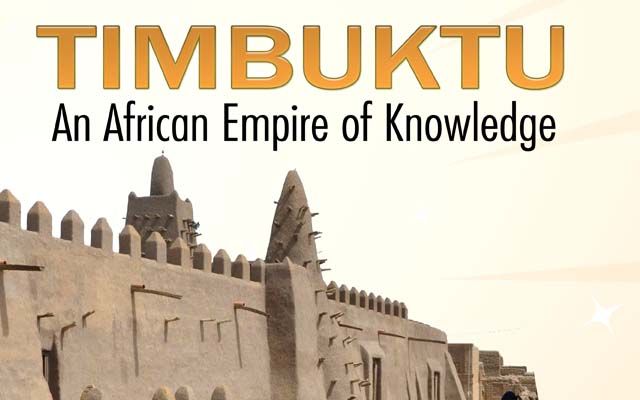
Timbuktu’s skyline has always been dominated by its houses of worship. It is to the famous mosques that the old city with its triangular layout owes its different quarters. These adobe mosques have become famous throughout the world for their unique shapes and their long histories. In the northern quarter, at the apex of the triangle lies the Sankore Masjid with its pyramid shaped minaret laced with protruding wooden support beams. It was here that the Sankore University housed its thousands of students and produced some of the greatest scholars in Africa. In the western corner of the city lies the Jingerey Ber Masjid built by Mansa Musa in 1325. Five hundred years later in 1858, the British traveler Henry Barth wrote that the mosque “by its stately appearance made a deep impression on my mind.” This masjid is now considered the oldest standing mosque in West Africa and it has hosted the main Imam of Timbuktu at the only Jumu’ah Prayer (Friday Prayer) in the city since its inception. In times of crisis, it stood as a sanctuary for the people of Timbuktu and for centuries was a center for deep spiritual reflection. The third major masjid is the Sidi Yahyia Masjid that was originally built by Shaykh Ibrahim Hamallah Al Kunti in the 14th century and rebuilt about 1400 by Amir Muhammad Naddi. It is the best preserved of the main houses of worship and, along with the other two, is a world heritage site.
A Great Legacy and a Catalyst for Renewal
The first non-Muslim to enter the city was the French explorer Rene Caille, on April 20, 1828. He was disappointed at the condition of the buildings of Timbuktu but noted that “apparently all of the population could read the Qur’an and even know it by heart.” The golden age had passed but the spirit of scholarship and piety still remained. Timbuktu, at its height in the 16th century— with its wide-ranging commerce, fabulous prosperity, countless rare and esteemed manuscripts and rich scholastic legacy, its designation as a center for the dissemination of religious and spiritual teaching—destroys racist notions of Black inferiority, educational and commercial backwardness, lack of record-keeping or public archives such as libraries and universities; indeed, Timbuktu is a death knell to the deception that Africa had no history.
Timbuktu gives solid proof of a powerful African past and an unbroken chain of African scholarship. Timbuktu also highlights Islam’s great legacy of development in Africa and its proper place in the annals of African achievement. The city’s well preserved trove of spiritual wisdom may hold some of the answers to today’s complex problems and never-ending conflict and war. Perhaps the heat of the desert sands and the emptiness of its expanse can be catalyst for the deep reflectiveness and sincerity of heart necessary for an African Rennaisance of economic, cultural and political liberation; and God willing, a wider renewal of hope and aspiration for humanity.