بسم الله الرحمن الرحيم

Author: Freelancer

  • Islamic Reaction: Strong, But Not Strong Enough

    By Aliya Sultana (the writer lives in Boston, Massachusetts)

    The mass killings of Muslims in Bihar and other states of India has shocked the world. Muslims have held street demonstrations at the Indian diplomatic missions in several countries. The Muslim media has condemned the massacres. Political activists in the Islamic world have issued press statements deploring the senseless genocide by the Hindu police in Bihar and other places. All this is very familiar to the observers of the Indian Muslim scene since independence in 1947. What is new are the statements of Muslim governments in Iran, Pakistan, Saudi Arabia and Bangladesh. All four governments have strongly deplored the violence directed by the police against unarmed civilians. The statement of Pakistani Prime Minister Benazir Bhutto was the strongest when she caned the killing of Muslims “reprehensible,” and the desecration of Babari Masjid as “a matter of concern to the Muslim Ummah at large.” For the first time in recent memory, the Iranian Foreign Ministry lashed out at the Indian government’s failure to protect its Muslim citizens. Expressions of “distress” at the premediated violence was expressed from – the official quarters in Saudi Arabia and Bangladesh. To the Muslims in India in general and Bihari Muslims in particular, the expression of sympathy from Bangladesh was extremely heartwarming. It demonstrated to the Hindu fanatics in India that despite bitter differences among them, Muslims of South Asia are one and indivisible. For no matter how unpleasant the recent history of Bengali-Bihari relations – the Muslims of the two regions will be united against their common enemy – the upper-caste Hindus who have oppressed Muslims, untouchables and the tribals.

    The feelings of the Muslim Ummah at large were succinctly expressed in a statement of the Organization of Islamic Conference (OIC) issued at the time of Bhagalpur massacre. “The Muslim world is outraged at the willful murder of hundreds of innocent Muslims at the hands of armed police,” it said. But one must ask, is the expression of outrage enough? Now that Muslim governments have broken their long silence on the butchery of their fellow faithful, is it not time to match action with words? One would even say that it is time to match rhetoric with swift and effective retribution against states neglecting the safety of their Muslim citizens. Muslim countries, specially the oil-rich countries, ought to know that India is far more vulnerable to their pressure than they realize. Anytime there is an outbreak of violence against Muslims, Muslim governments should take whatever punitive measures are at their disposal against the offending states. India received subsidized oil, financial aid and grants, employment for its large labor force, and contracts for its public and private sector from the Arab world and Iran. All of these economic ties should be reviewed in light of India’s deplorable record of human rights.

  • The Killing Fields of Bhagalpur

    By Omar Afzal

    The massacre of innocent Muslims in Bhagalpur City and surrounding villages in the last week of October 1989 may be added to a very short list of mind-boggling tales of human savagery. The grim details are still not fully known and perhaps the full story may never see the light of the day.

    The local administration has put the casualty figure to a 1,000 dead and several thousand uprooted. Unofficial estimates are as high as 3,000 dead, a thousand unaccounted for and more than 50,000 homeless. The number of injured may be around 8,ooo.

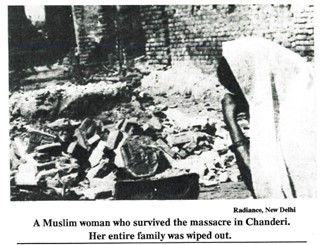
    The medieval atrocities of Genghiz Khan pale in comparison to what the Hindu mobs did in several villages of the Bhagalpur District. A frenzied mob swooped on the village in the Jagdishpur block, killed everyone it could and buried them in a field. To cover its heinous acts, it leveled the mass graves and planted vegetables over them. In Chakjhoura Village, dead bodies and human limbs were found hidden in a paddy field. The corpse-filled ponds of Chanderi were perhaps the ultimate in human barbarism. As an Indian journalist put it, “a monster stalks Bhagalpur.” The most shocking aspect of the anti-Muslim terror in Bhagalpur is the connivance of police, army and local administration. The High Court in Patna, capital of the northeastern state of Bihar, has asked army Maj. G.P.S. Virk to explain why he left 100 Muslims, mostly women and children, of Chanderi Village in the protective custody of the local police and failed to report when he found them “missing” the next day.

    The Bihar Military Police is also said to have helped the killer Hindu mobs. Not only that Hindu policeman often turned their backs at the killings, they also killed and maimed people when they were handed to them for safe keeping. After a home-made bomb was thrown at the police party, allegedly by Muslims, the police went on a looting rampage. Some uniformed policemen are reported to have set fire to a mosque. A commander of the BSF could not ‘believe his eyes when he saw Hindu policemen standing on both sides of a narrow lane clobbering Muslim men, women and children, who were rescued from riot-affected areas. Because of the complicity of police, military and local administration, some of the most brutal killing were not reported until recently. Bhagalpur police are notorious for violence. In 1980, several Bhagalpur policemen were arrested for acid-blinding four defendants who were under trial.

    Not has the Western media not been interested in doing investigative reports on the Bhagalpur killings, the Indian media, has not been fair to the victims either. Without exception, Indian newsmen have caned the anti-Muslim violence “communal riots” and some have shied away from saying that the victims were Muslim. Instead they have referred to them as members of a “minority.” Why are they ashamed of calling a spade a spade, or of blaming the police for complicity? Because it would tarnish India’s image as the land of “Ahimsa?’5 (nonviolence).

    The writer,’ who works at Cornell University in Ithaca, New York, was in India recently.

  • Caste and Communalism in India:  Are They Prescriptions for Civil War?

    Caste and Communalism in India: Are They Prescriptions for Civil War?

    By Laxmi N. Berwa

    India is a vast country with a population of approximately 800 million. It has multitude of cultures, religions, languages and ethnic groups. As a matter of fact, one might call it a federation of “small nations.’= Historically, it should be noted that India was at one time a land of various kingdoms, with their own territories and governments. India is a predominantly Hindu nation, where Hindus constitute 80 percent of the total population. Among the rest are Muslims (12%), Christians (2%), Sikhs (2%), and other religious minorities (4%).

    India has been a scene of communal violence in most of its recent history. There have been ghastly crimes committed against the so-called low-caste Hindus by the high-caste Hindus. When Muslims came to rule India, there were Muslim and Hindu riots. When the British came, there were riots between the Indian nationals and the British police. The infamous incident at the Jalian Wala Bagh in Punjab, in which hundreds of people were shot dead by the British, is very vivid in the memory of many Indians.

    India became independent on August 15, 1947. At the time the founding fathers of India declared India a secular and democratic republic. The constitution of India “guarantees equality for all citizens irrespective of their religion, caste, sex, or place of birth.” For 10 to 15 years, India had a relatively peaceful time, but starting in the mid-’70s there was a sudden upsurge in violence between the high-caste and the low-caste Hindus, between Hindus and Muslims, and between Hindus and Christians. The chart in the middle lists communal incidents occurring since 1977. These riots have occurred because the government has failed to fulfill its constitutional obligations, and the people have failed to live up to it.

    For centuries, the untouchables or the low-caste Hindus, have been the victims of a vicious caste system in which they have been systematically deprived educationally, socially, culturally, economically and politically. What makes it worse is that these sanctions against the untouchables have the blessings of the Hindu-caste system of Manu smriti, thereby thwarting all efforts at reformation. Those who have challenged the Hindu social structure have met with stiff opposition from Brahmins, the highest caste, and other high caste Hindus.

    The Brahmin attitude and philosophy has been aptly captured by Abbe J.A. Dubois in his book. Hindu Manners. Customs. And Ceremonies. Mr. Dubois says: “Intense selfishness is also a common characteristic of a Brahmin. Brought up in the idea that nothing is too good for him, and that he owes nothing in return to anyone, he models the whole office life on this principle. He would unhesitatingly sacrifice the public good, or his country itself, if it served his own interest; and he would stop to treason, ingratitude, or any deed, however black, if it promoted his own welfare. He makes it a point of duty not only to hold himself aloof from all other human beings but also to despise and hate from the bottom of his heart everyone who happens not to be born of the same caste as himself. And further, he thinks himself absolved from any feeling of gratitude, pity, or consideration towards them. If he occasionally shows any kindliness, it is only to someone of his own caste. As for the rest of mankind, he has been taught from his earliest youth to look upon them all as infinitely beneath him. According to the principle in which he has been brought up, he ought even to treat them with contempt, hatred, and harshness, as being created solely to serve him and the minister to his wants without there being any necessity for him to make the smallest return. Such are the Brahmins!”

    The untouchables constitute approximately 120 million, which is close to half of the U.S. population or the combined populations of France and Britain. After practice of the caste system was outlawed by the Indian Constitution, one had hoped for an end to the problem. Unfortunately, the untouchables have continued to be victims of constant violence at the hands of the high-caste Hindus. This is very well compiled by Professor N.D. Kamble in his book, Atrocities on Untouchables (August 6, 1947, through August 6, 1979.) The incidents of Daoli, Shadopur, Puliangadi, Kestara, Marathwada, Gujrat and Agra are very fresh in the minds of Indians. In Rajasthan, the untouchables were not allowed to enter the Nathadwara Temple. In the district of Dausa, again in Rajasthan, the high-caste Hindus would not allow an untouchable bridegroom to ride a horse, because it is below their dignity to see an untouchable ride a horse during his marriage celebration. There have been other6vilandhumanrightsviolations, 6utthe government, the politicians and the have just not done anything.

    After low-caste Hindus, Muslims are the most frequent target of violence by Hindu chauvinists and fundamentalists. Hindus have been slaves for centuries and suddenly they have found nationalism as their moral, social and religious salvation. Although there have been numerous Hindu-Muslim riots in the past in which Muslims got the short end of the stick and bore financial and physical losses, the recent rise in violence against them has stemmed from Ram Janmabhoomi-Babri Masjid controversy.

    A respected Indian magazine India said in its last October 31 issue, “This year alone, between January and September, some 336 people have been killed – more than the toll for the whole of last year – in communal flare-ups in Uttar Pradesh, Karnataka, Bihar, Madhya Pradesh, Gujarat, Maharashtra and Rajasthan. More alarming, violence has broken out in areas hit her to untouched by the communal scourge”. An Indian Home Ministry document states that “no single issue so adversely effected the communal harmony between Hindus and Muslims as Ram Janmabhoomi- Babri Masjid controversy.” India Today said, “It is the BJP (Bharatiya Janata Party) that has set the tone for nasty chauvinism.” Many other Hindu organizations like R.S.S. (Rashtriya Swayam Sewak Sangh) and V.H.P. (Vishwa Hindu Parishad) have similar a Hindu fundamentalist ideology, which is against the secular ideas of the Indian Constitution. These very forces have formed alliances and become a major force in the political arena today. BJP’s gains of 88 parliament seats in last year’s election testifies to the rise in “Hindu nationalism.” To me, it reminds of the Nazi Germany’s rallies during the rise of Hitler. Those interested in a detailed account of the problem may find M.J. Akbar’s two books, Riot after Riot: Reports on Caste and communal Violence in India, and India: The Siege Within, Challenges to a Nation’s Unity, very informative.

    Nearly three years ago, the police in Meerut killed innocent Muslim women, children, and old men at close range. Dead bodies were dumped in the nearby river. Recent riots in Badaun, Kota, Sasaram and Mhow are fresh in everyone’s memory. Although these riots have resulted in the loss of lives-on both sides, Muslim losses have been overwhelming.

    The people who were at one time neighbors and friends and used to respect each others’ faith are now blood thirsty and look at each other with great suspicion. The government of India, under former Prime Minister Rajiv Gandhi, had been soft peddling on this issue in order to cash in on the votes and the people’s religious sentiment. As a result, people have ousted the Rajiv Gandhi Government. The fundamentalist on either side, Hindu as well as Muslim, have taken a position of confrontation rather than reconciliation. The central government should have taken a position like the Bengal Chief Minister, Jyoti Basu, who said, “If anybody wants to worship bricks, then he is free to do it at home, but I will not allow it in public places at the cost of communal harmony.”

    The next minority that is affected by the communal violence are the Christians. The Hindu fundamentalists look at Indian Christians as foreigners. Interestingly, an of the top Hindus go to the Christian schools, colleges and other institutions of higher studies, but still consider Indian Christians to be foreigners, In a November 17, 1989 article, India Abroad, a New York City weekly, reported that, “Most of the church leaders with whom the India Abroad reporter met (none wanted to be identified) said they felt even forty years after independence, Christianity is often seen as a foreign religion.”

    Catholic Bishop Menez has even stated publicly that there still is mistrust among the Hindus about the Indian Christians and they consider them outsiders. There are 16 million Christians in India.

    The Sikhs and Hindus have always enjoyed a very peaceful and harmonious relationship. As a matter of fact, the Constitution of India categorizes Sikhs, Buddhists and Jains as Hindus. Recently, the Sikhs have realized their distinct language, history, culture and religious identity and they are struggling for a Sikh homeland. I do not wish to go into the political aspect of it, but as a religious minority, Sikhs are recognizing their own identity. This has led to the killings of Hindus in Punjab and a lot of Sikhs in other areas. Nearly 3,000 Sikhs were killed in New Delhi in a very planned and organized manner by Hindus at the behest of some prominent politicians following Prime Minister Indira Gandhi’s assassination by her Sikh bodyguards in 1984.

    Seeing Hindu discrimination against low-caste Hindus, many former adherents of Hinduism have converted to Buddhism, particularly in the Indian state of Maharashtra. Called neo- Buddhists, they have started to assert their basic human rights. As a result, there have been many conflicts between the high-caste Hindus and the so-called neo-Buddhists. Shiv Sena chief, Bal Thackery, has openly stated that he is very concerned about the neo-Buddhists and is looking for a chance to teach them a lesson. Hindu fundamentalist shad tried to block the publication of Dr. Ambedkar’s book, The Riddle of Hinduism, Volume 4, by the Department of Education in Maharashtra. But they were counterattacked by the Buddhists and other sympathizers of Dr. Ambedkar’s philosophy, who believed in freedom of expression. Eventually, the wisdom prevailed, and the book was published with a disclaimer that the government does not necessarily agree with the views of the author.

    Because of explosive ethnic passions, it is possible that India may one day face a bloody civil war. And it is the duty of all Hindus, Muslims, other minorities and the government to avert such a situation. There should be an interfaith dialogue among the various religious and social leaders to create an understanding among the people of different faiths in the country. The religious leaders as well as public officials must teach Buddha’s lesson of love, compassion and brotherhood, rather than perpetuate the negatives and stereotypes of other ethnic groups. The government must take swift actions against the culprits who disturb the communal harmony, irrespective of the electoral consequences.

    Any fundamentalist organization which propagates hatred, contempt and distrust which are against the spirit and the values contained in the Indian Constitution, must be outlawed irrespective of its affiliations.


    The writer is an Indian-American physician in Maryland and has written frequently on human rights situation in his native country.

  • Muslim Mayor From Israel…

    Muslim Mayor From Israel…

    A Muslim mayor of an Israeli town told a recent gathering in Detroit how Muslims in that country were rediscovering Islam after almost losing it.

    Mayor Raid Salah of Umm el-Fahem, who was among four other Muslim mayors from Israel visiting the United States early December, said that due to Israeli policies of de-Islamization Palestinians under Israeli occupation had long lost touch with Islam and lived in a religious and political vacuum.

    Mayor Salah stunned the Muslim gathering, organized by Detroit unit of the The Islamic Circle of North America and also attended by Adam Shakoor, deputy mayor of Detroit, when he said that Palestinian Muslims were forced to study Torah and Western literature, while discouraged from studying Islam. All this had resulted in Muslim children imitating the West and viewing Islam as the religion of their forefathers, Mr. Salah said.

    Since the 1970s Palestinians within Israel, which was founded in 1948 in what was then Arab Palestine, have undergone a major change in their attitude towards Islam, according to Mr. Salah. Now the Palestinians know a great deal more about Islam, he said, and their love for Islam is reflected in large congregations at the local mosques. Palestinian women, who would be indistinguishable from those in the West until only a decade ago, are now increasingly wearing hijab and interested in Islam, he said.

    by Naeem Saroya