
بسم الله الرحمن الرحيم

Author: Dr. Mohamed Esseghir

  • Hayaa’ – A Virtue Forgotten in Our Times

    Hayaa’ – A Virtue Forgotten in Our Times

    Hayaa’ is shyness, bashfulness, humility, modesty (intellectual and otherwise) and no one English word conveys the full meaning of this Islamic virtue. For this reason, Muslim educators have suggested the use of the Arabic word itself, rather than a translation of hayaa’. As beautiful as it is encompassing, hayaa’ stands tall in its meaning, and is rooted in prophetic teachings throughout human history. It is the peak of a value system, which unfortunately humanity has in large forgotten. Muslims themselves are in need of its re-discovery so that the people in the world will recognize this virtue in Muslims before their tongues utter a word.

    Hayaa’is a mighty protection against breaking boundaries and engaging in illicit activity in order to fulfill desires

    This article intends to explore hayaa’, what it is and what it is not. Some background is a good place to start. The Messenger of Allah (peace be upon him) said: “Verily your Lord is the One Modest and Generous, and when His servant raises his hands to Him in supplication, He is diffident from returning them empty” (Termidhi and others). Our Lord is described in this prophetic tradition as having the sifa (divine characteristic) of perfection and completeness of hayaa’, befitting His majesty and Divine authority. His hayaa’ is unlike that of humans; it is a hayaa’ of abundant generosity, kindness, and elevation above all His creation.

    It is out of this hayaa’ that He refers to the human nature of His prophets and messengers in a special, but simple way: “They were (men) who ate food and walked through the streets” (25:20); a straightforward description of the normal activities, including the cycle of eating food. But beyond all, and despite their nobilityand a status, fit for selection as Divine messengers , they themselves remain human and have no share in divinity.

    It is also out of His greatness and ultimate power that He exercises hayaa’ and refrains from exposing human beings, His servants, despite their propensity for disobedience, sometimes in the open and in full defiance of his Maker. Man is the one who is weak, in need of assistance, and surviving on provisions from his Creator, whether air, water and food, or guidance. At the same time, Allah (be He exalted), out of love for His creation, draws His servant to Him by bestowing His bounties on him. If the servant makes a step towards his Lord, his Lord in return reciprocates with much more; this is the hayaa’ of the Divine . By contrast, human defiance stems from ignorance of the Divine, which leads to a lack of hayaa’. This is why the first command in revelation is an invitation to read, learn, and understand — ‘ilm (knowledge) is a cornerstone of Islam.

    In a far-reaching narration, explaining the scope of hayaa’, the messenger of Allah (peace be upon him) said: “Exercise hayaa’ towards your Lord, the true hayaa’.” We said, “O! Messenger of Allah, we do exercise hayaa’, thanks be to God!” He said: “It is not that hayaa’, but it is to exercise hayaa’ from Allah, the true hayaa’— that you protect the mind and that which it perceives/retains, and protect the stomach and that which it contains (goes into it), that you remember death and testing, and whoever desires the last day, would leave out the beauty of this world; whoever does that then has exercised the true hayaa’ from Allah” (Termidhi). This narration is an invitation to observe the mind and that which filters into and is retained by it. Everything that shapes thought and reasoning, as part of the constant search for the truth, is an individual responsibility. Therefore we are commanded to always search for haq (truth, justice)and accept it, and reject batil (falsehood, injustice) whatever its source. We are taught to have the courage to accept a truth once discovered, even after years of practicing its opposite, as well as to speak up in support of the truth regardless of the outcome. In the second case particularly, failing to do so should certainly not be under the justification of hayaa’, for the Qur’an teaching early companions visitation manners relates:” Such behaviour annoys the Prophet and he exercised haya’ towards you, and Allah does not exhibit hayaa’ to tell you the truth” (33:53). The intellect must be sound and should have an urge to challenge ideas, reject unfounded concepts. It is out of lack of hayaa’ from Allah to insist on falsehood after being corrected. In today’s terminology, this would be ultimate intellectual arrogance. This applies to Muslims first; we are commanded to learn the pristine religion, which sometimes may not be in line with our cultural inheritance. To non-Muslims, it is an invitation to discover Islam with an open mind, explore its tenants, its contribution to humanity, and its stand on many issues of today. This can present a positive challenge to the intellect, as recently discovered by a former member of a Dutch right-wing political party. His original intent was to research Islam in order to vilify the religion and its prophet (peace be upon him). But in the process, he discovered something different from what he had previously perceived about the Islamic faith. His journey was a true freeing of the intellect and a disavowing of intellectual arrogance.

    Muslims should welcome this type of change, learn how to embrace it, and forgive past excesses of those who spoke ill of Islam. Fundamentally, Muslims must treat people with respect for their humanity despite the sometimes strong disagreement with their beliefs. The cardinal rule must be to engage the outspoken critic, hold the hand and remove the road blocks so they might find their own path of discovery. Such behavior will generate the desired hayaa’, i.e. deflate all intellectual arrogance. If Muslims succeed in doing so, they should be confident of the eventual outcome: A life correction in thought and attitude from the most obstinate. Meanwhile, when those who defame Islam do so loudly,, do Muslims really derive benefit from their own loud protests that generate counter protests, increased hate and obstinacy from the “other”? One should ponder what would have been the outcome if the Prophet (peace be upon him) responded with such a bellicose approach to the endless and hayaa’-less provocations of Abu-Jahl and his clan.

    Earning what is lawful and claiming only what rightfully belongs to you, and consuming nothing that is unlawful, is another pillar of hayaa’. This includes refraining from illicit earning or consuming what is haraam (forbidden) as well as earning or consuming that which is legal in itself but acquired through illegal means. Today we see widespread corruption and the unchecked self-enrichment of the few, while the majority of people suffer in despicable living conditions. Those who continue to engage in such behavior have certainly no hayaa’, neither in front of their people nor the world, let alone their Lord. Likewise is the case of those who disregard the popular will, crush ballot boxes or peaceful protests and plunge their countries into civil wars that destroy property and cause the deaths of thousands, with countless others disappeared or displaced. What would have been the outcome if they just had hayaa’ and deflated the arrogance that led them to obdurately hold onto power despite a legitimate, clear and loud popular message?

    Arrogance and egotism make one blind, unable to learn from the present or the past, and unwilling to consider anything beyond one’s own self-interest. All should remember that if one somehow escapes the justice of this world, there will be no escape of the justice of the hereafter. The governor and the governed, the weak and the powerful, all shall be made to answer for their deeds. This belief is powerful and shapes the worldview and disposition of a Muslim. This is what gives strength to the believer to withstand temptation by the glamour of this world. Hayaa’ is a mighty protection against breaking boundaries and engaging in illicit activity in order to fulfill desires. Thus the drive to observe limits and refrain from disobedience out of hayaa’ before one’s Lord (be He exalted) —knowing that one is fully seen at all times, including when alone and out of the sight of other humans.

    In another prophetic tradition, The Messenger of Allah (peace be upon him) said, “Verily, from what was learnt by people from the words of earliest prophethood is this: If you exercise (or have) no hayaa’, then do as you wish” (Bukhari). This is a clear indication that hayaa’ is a noble character that was known and practiced by people and nations throughout history, through the teachings of various prophets. It is not a new concept. As for “do as you wish,” this is not a sanction to actually do what you wish without boundary, or that you are free to do what you wish, but rather a warning that without hayaa’, illicit actions will follow. It is inferred, and supported by other teachings, that all infractions will be severely recompensed by the Creator, that every illicit deed shall be met with its measure in torment. In this regard, the Qur’an is clear: “Do what you wish; verily He sees clearly all that you do” (41:40). The barrier against illicit and lewd acts is hayaa’, and once removed, the slide to self-destruction begins.

    The final aspect of hayaa’ is the one most commonly understood amongst Muslims. It is the one illustrated, for example, in the verses from the Qur’an related to the story of Prophet Musa (peace be upon him): “And when he arrived at the water of Madyan, he found there a group of men watering, and besides them he found two women who were keeping back (their flocks). He said: ‘What is the matter with you?’ They said: ‘we cannot water (our flocks) until the shepherds take (their flocks). And our father is a very old man.” (28:23). The women were keeping back, not thrusting themselves amongst men: Out of hayaa’, they would wait until the time was appropriate rather than risk being exposed to unpleasant or improper behavior or unwelcome advances. This illustrates well that hayaa’ as displayed by these two women is part of the teaching of early prophets, even before Musa (peace be upon him), as mentioned in the tradition quoted previously. As the Qur’anic story continues, Musa (peace be upon him) takes the initiative and waters the women’s flocks, “Then he turned back to shade, and said: ‘My Lord! Truly, I am in need of whatever good that You bestow on me!’’ (28:24). This is a profound exercise in humility as he turns to His Lord in supplication. Despite being in a strange town, not knowing where to go, nor having any acquaintance, he addresses his Lord in full reverence, without complaint or direct request. Afterwards, the Qur’an relates the following: “Then there came to him one of them, walking shyly. She said: ‘Verily, my father calls you that he may reward you for having watered (our flocks) for us’’ (28:25); an expression of hayaa’ by a woman talking to a stranger. The beautiful outcome of this encounter is told in the next few verses of the same chapter, where again with hayaa’, one of the women suggests to her father that he should hire this man, the “strong and trustworthy.” And the story ends with the marriage of Musa (peace be upon him) to one of the women. There is no indication that Musa (peace be upon him) had such expectation with his humble supplication earlier, or that the woman, when she exhibited haya’, realized that she would become the wife of one of the most prominent prophets in human history! This story illustrates a Prophetic tradition: “When lewdness is a part of anything, it makes it defective; and when hayaa’ is a part of anything it makes it beautiful.”

    A fitting closure is what Prophet Muhammad (peace be upon him) has said: “Every faith has an innate character. The character of Islam is hayaa’.” (Al-Muwatta of Imam Malik).

  • Islam Comes to Rescue Algeria

    Islam Comes to Rescue Algeria

    Many People, secularists and Islamists alike, were stunned by the results of the Algerian election of June 12, 1990. A previously unknown Islamic party, Al-Jabhatu al-Islamiyyatu Lil’inqadh, or Islamic Salvation Front (better known by its French acronym F.I.S.), shocked political observers inside and outside the country by sweeping a clear majority of the votes in local and provincial elections, thus defeating the ruling National Liberation Front (F.L.N.) party, which governed Algeria for nearly three decades. The victory becomes even more intriguing if one notes that the F.I.S. was only legalized in October 1989, and had only 10 months to prepare for the elections. During this time the F.L.N. had a monopoly on all the means of propaganda, such as the national TV and all major newspapers.

    But on the other hand, the triumph did not come about in a vacuum. It was rather the fruit of years of silent and hard work by sincere Muslims who wanted Islam restored to the Algerians’ lives.

    In order to understand Algeria, it must be kept in mind that although it is perceived as a secularized and Westernized country in the Arab world, its popular tradition is still based on Islamic values. So, when officially gagged and ostracized Islamists win the day in an election, it should only serve to highlight the battle that has been dragging for almost two centuries between the forces of Islam and the might of the West’s stooges. This battle of Westernization that started with the weakening of the ottomans in the early 1800s, and the subsequent fall of Algeria under the French occupation in 1830, is still being fought. And although the French were physically ousted from Algeria about thirty years ago, the ideological battle continues. Algerian Muslims have never given up hope for the triumph of Islam no matter how long it might take. A quick tracing of major historical events takes us to Emir Abdulkader, who organized the Muslim resistance, and proclaimed Jihad against the French from 1832 until his capture in 1847. To Al-Mokrani, who in 1871 reorganized the resistance and for a long time followed the footsteps of the Emir until his death. Continuing the battle in 1931, one year after France celebrated the one hundredth anniversary of its occupation, Abdulhamid Ibn Badis founded Jamiyyat al- Ulamaa al-Muslimeen al- Jaza’iryylin, or the Association of Algerian Muslim Scholars (AAMS). The goal of the association was threefold: (1) to reform the Algerian Muslim personality by restoring the people’s self-confidence which was savagely damaged by occupation, (2) to convince the people that only through Islam could they regain their freedom and break the chains of colonization, and (3) to fight the established “French-Islam,” a mystic order that was prevailing and nourished by the occupying forces to keep dominance over the Ummah. This was the type of Islam that preached occupation to be a “Qadar’ from Allah, and thus erasing the concept of jihad from people’s mind. Ibn Badis was an uncompromising man when it came to dealing with the enemy. He is reported to have once stated: “if France told me that there is no God but Allah, I would not have believed her.” The Association that Ibn Badis founded had a major impact, and was quite successful in its task. The methods it adopted are still being used by contemporary Islamists in Algeria, and might be the main reason on recent success.

    The Association of Muslim scholars was the driving force behind the 1954 popular revolt that brought independence to the country, although the fruits were later stolen by secularists. For example Alistar Horne, a British historian who wrote about the Algerian war, testified that although they were not the first in the field, it was probably the Scholars (Ulamaa) that provided the nationalists with their first momentum, that their philosophic influence was of primary and inestimable significance, even remaining very much a force in present day Algeria, that Ibn Badis was an ascetic and deeply conservative theologian who believed that Algerian regeneration could only be achieved by a return to the basic principles of Islam. In tackling the issue of Algerian identity, Ibn Badis authored the popular slogan: “Islam is a Deen, Arabic is our Language, and Algeria is our nation.” In reply to calls by Algerian Francophones for merging and assimilating within the French nation on the basis that Algeria never existed (calls popular at that time due to an identity crisis), Ibn Badis replied: “We have examined history, and indeed discovered a Muslim Algerian nation which has its culture, its traditions and its characteristics, good or bad like any other nation on the earth. And next, we state that this Algerian nation is not France, cannot be France, and does not wish to be France.” Alongside Ibn Badis were prominent scholars that should be remembered for their struggle. Amongst these were: Taibi al-Uqbi, Mubarak al-Mili, Fudheel al-Wurtulani, Bachir al-Ibrahimi, Abdullatif Soltani, and Ahmed Sahnoun. This last one, is the only surviving personality of Ibn Badis’ time, and is the senior Islamic scholar of today’s Algeria who enjoys wide respect among Algerians. Last year he founded the League for Islamic Da’wa, intended to be the umbrella organization for all Islamic groups, including the F.I.S. After a long and bloody struggle, independence was gained in 1962, but only to be confiscated by secularists. Following bitter internal conflicts, Ahmad Ben Bella was brought to power. What must go down as the national tragedy, Ben Bella dismantled and banned AAMS under the pretext that its mission was completed and did not have a raison d’etre anymore. He also put under house arrest Bachir al-Ibrahimi who was its president at the time. Al-Ibrahimi later died under arrest in a hospital in Algiers, the capital. During his short rule, Ben Bella tried to enforce his socialist dogma, and originated the one-party dictatorship. Sheikh Mahfouz An-Nahnah, a politically active Islamic scholar, once reported that the man mixed his blood with that of Fidel Castro in a symbolic brotherhood of the socialist-marxists. Ironically this is the same Ben Bella who is denouncing the one-party dictatorship that he himself installed, and whose failures emboldened army colonels to capture power in 1965. He is being presented today as the “historical figure,” the man of compromise, who can save the country. Nothing could be further from the truth.

    After a short rule, Ben Bella was ousted in a military coup that brought Houari Boumedienne to power. From 1965 to 1978, Boumedienne reinforced the one-party system, and provided the ruling F.L.N. with a power to dominate every aspect of Algerian life. A benign picture of Algeria was painted to the outside world, while dissent was mercilessly suppressed inside. He went on with a full-fledged Soviet-style planned economy and collective farming. Although it was a period of relative economic prosperity (oil was $36 a barrel), a large part of that wealth was used to cover miserable failures in other sectors of the economy, and mostly agriculture. Waste and corruption were at their peak.

    For Islamists these were difficult times. In the footsteps of Jamal Abdul Nasser, Boumedienne hit hard on Islamic activists, driving many into hiding until his death in 1978. Among these was Mahfouz An-Nahnah, who was given a life sentence for opposing Boumedienne’s National Charter that was drafted in 1976. This period was also marked by a strong underground Islamic movement that taught the activists efficiency and secrecy in conducting da’wah.

    After Boumedienne’s death in 1978, Chadli Benjedid came to power, and a relative freedom came to be enjoyed in Masajid. The situation in Algeria since 1980 can be described as follows:

    1980-1988

    Relative freedom in Masajid was enjoyed, and the Islamic da’wah was conducted more openly. In speeches and Khutabas, open criticism of the regime and socialism became more frequent. This period also witnessed some violent activities against Islamists by Boumedienninsts. Many people were thrown into jails. Abbasi Madani, along with other Muslims, publicly challenged the regime and asked it to release Muslims. Instead, he too was thrown into jail for a while. Errors and serious failures of socialist policies became more acute. Serious economic repercussions became evident, creating unemployment and total discontent.

    Since October 1988

    Popular revolt broke out that almost toppled the regime. The army fired on demonstrators killing more than 500. Islamic “Fundamentalists” were blamed for instigating the riots. President Chadhi Benjedid, shocked by street protests, agreed to amend the constitution and abolish the one-party system, allow freedom of the press and radical reforms, shift socialist economy towards free-market and send the army back to the barracks. Soon many groups came forward and asked for an official recognition of their parties. The government was reluctant but gave in.

    In mid-1989 the Islamists formed the Islamic Salvation Front, and Benjedid had to recognize it under intense street protests.

    The F.I.S. includes Islamists of many views and approaches, but not all Islamic forces. For instance Sheikh An-Nahnah, called it a premature move, and exhorted Muslims to be more cautious until things became clear. Unconcerned, Abbasi Madani went ahead with the work of structuring and organizing his party and its platform.

    Things started moving too fast and beyond the government’s expectations. Sheikh An-Nahnah moved to form Jamiyat al-Islah wal-Irshad, or the Association for Reform and Guidance.

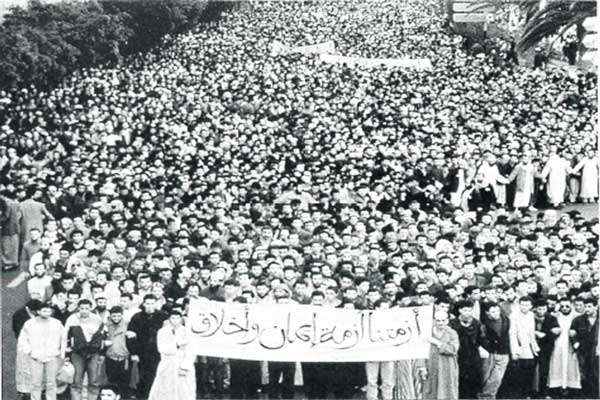
    A situation of political chaos seemed to emerge as a result of the formation of nearly 25 political parties within a year. As time passed, only the strongest remained in the field. The streets started to resonate with ideological clashes. Soon Algeria saw, among other things a rally by secular-Westernized women demanding abolition of the Family Code, which they thought was judged too Islamic and against modern time and aspirations of women in the 20th century. The rally which brought 700 people, was backed by several secular parties and organizations. On the heels of that rally came a call by Islamic leaders for pro-Islamic Women of Algeria to speak up and show the world that they are the representatives of their country. The world was stunned by a 700,000 strong demonstration. A list of demands was given to the parliament. Political analysts concluded that the question of women in Algeria had been answered with the overwhelming showing of the pro-Islamic women.

    The ruling party planned a counter demonstration, but retreated because of a lack of support. Its weakness became more and more evident. Some desperate moves were attempted by the F.L.N., including a motion in parliament to ban the use of mosques.

    The Long Road to Victory

    The Islamic victory in provincial and local elections results from a concerted effort on the part of Islamic leaders who have persevered in adversity. It also stems from the miserable failure of all ideologies. A country which is striving for spiritual, social and economic direction, responded to Abbasi Madani’s slogan that “Islam is the solution.” It is not true, as some misguided people charge that people chose Islam in revenge for the failures of the secular ruling party. People had other choices that they could opt for. Those who boycotted the elections did so because they knew they could not beat the Islamists. By such a boycott, they think they have saved their honor and achieved political survival.

    What’s Next?

    The secularists are not the only ones to be sad over an Islamic victory. There are also the Western planners and enemies of Islam. This victory is a rejection of Western and secular values, which were implanted in the heart of a Muslim Arab country and reinforced by colonial masters and their stooges.

    The enemies of Islam are not likely to give up so easily. There are already signs that they are trying to instigate trouble and give an excuse to military to take over. This possibility is already being talked about in the French media. It is also that external foes of Islam would impose an economic blockade against a future Islamic government of Algeria.

    This is a critical time for Algeria’s Islamists. While they have won provincially and locally, they cannot be effective without capturing power at the national level. If elections for the national parliament – which are controlled by F.L.N. – were to be held today, the Islamists would surely win. As the government knows this too well, the Islamists have to demand parliamentary elections tactfully and without sounding a threat to their opponents.