بسم الله الرحمن الرحيم

Author: Abu Zayd M.D.

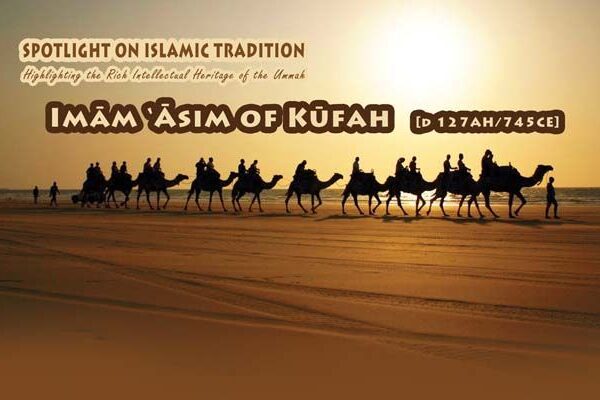
  • Spotlight: Imam Asim of Kufa

    Spotlight: Imam Asim of Kufa

    There is perhaps no single person in our history whose name is as integrally linked to the Quran as that of Imam ‘Asim of Kufah. His name was AbuBakr and he belonged to the generation of the Successors (the students of the Companions of the Prophet).

    His Attachment with the Qur’an

    His discovery of the Quran is linked to the story of some of the most important figures in the preservation of the Quran. It was a golden chain of teachers who were all inspired by the statement of the Prophet, “The best of you are those who learn the Quran and teach it to others.” The Companion Uthman b. Affan heard these words and was inspired to unite the Muslim nation behind a uniform Quranic script, such that every copy of the Quran that was and will ever be written in our entire history—from its beginning to its end—will necessarily follow the Uthmanic orthography. He in turn related these words to his student Abu Abd al-Rahmanal-Sulami (d 75H) who was then inspired to spend more than four decades teaching the Quran in the city of Kufah to generations of students.

    His Illustrious Teachers

    Among the students that flocked to al-Sulami was Imam ‘Asim of Kufah. He eventually distinguished himself as the foremost among al-Sulami’s students and inherited the mantle of Quranic leadership in Kufah after him. The student now became the teacher, and the golden chain of the Quran continued. If it is true that it is the students that truly distinguish the teachers, then Imam ‘Asim perhaps surpassed al-Sulami. For among the numerous students of Imam ‘Asim there was the famous Successor Ata b. AbiRabah (who was also the student of IbnAbbas, Ibn Umar and Aishah), the great Imam al-A mash, the hadith scholars, Shubah, Sufyan b. Uyaynah, and Sufyan al-Thawri  and the great Imam of fiqh Abu Hanifah himself.

    Imam ‘Asim was known for his adherence to the Sunnah, his mastery of the Quran and his grasp of the Arabic language. He was a trustworthy narrator of hadith, and his narrations are found among the six canonical works. He was also noted to have the best voice in reciting the Quran. For these qualities and others, he became one of the most sought after teachers of his time.

    An Exemplary Family Man

    His most distinguished student, however, points to another story, one of love and devotion to family. While many teachers and imams immersed themselves in their academic pursuits at the expense of their families, it was not the case with Imam ‘Asim. Among all of these illustrious personalities who claimed to be his disciples, the one who truly carried his mantle forward was his own stepson Hafs b. Sulayman. The son of his wife from another marriage, he was treated like his own son—perhaps even better than that. He received far more time than his other fellow students, living in the same house, and this careful cultivation bore fruit. Hafs in turn became the disseminator of this Quranic legacy, and when the Readings of the Quran became documented and canonized according to ten well-known Imams, or authorities of Quranic reading, Imam ‘Asim was one of these Imams, and Hafs became his most famous transmitter. This reading of the Quran, which happens to be the dominant one today, came to permanently bear this imprint—the Reading of Hafs on the Authority of Imam ‘Asim (RiwayatHafa ‘an Asim).
    He died in 127AH in Kufah, and his last spoken words were the 62nd verse of Surah al-An‘am— “Then are men returned unto Allah, their protector, the reality.”

    The Reading of Imam ‘Asim

    The recitation of the Quran is conveyed through ten authentic Readings (Qiraat) named after ten prominent Imams from the second century of the Hijrah, with transmissions from two students of each Imam. The reading that is popular in the overwhelming majority of the Muslim world today is that of Hafs on the authority of Imam ‘Asim. There are pockets in the Muslim world where other Readings are also prevalent, such as the Reading of Warsh on the authority of Imam Nafi in North Africa, but by and large those are exceptions. For the past few centuries, and for the foreseeable future, it appears that the Muslim world will be reciting the Quran by the Reading of Imam Asim. Various reasons have been proposed for this, including the fact that the Reading is relatively easier on the tongue than others (although that is somewhat subjective), or its association with the Ottoman empire which ruled over the bulk of the Muslim world for almost a millennium (as the Ottomans were inclined to the Hanafi legal school and Abu Hanifah preferred this Reading). Perhaps the strongest reason is technology. All the printings of the Quran since the dawn of the printing press to our times today have corresponded to this Reading, and the first audio productions of the Quran likewise were done in this Reading.

    In the final analysis, it is an unimaginable honor for this great Imam whose name is forever linked with the Quran.

  • Injustice in Syria

     
    The Prophet Muhammad (peace be upon him) said:

    O My servants! I have forbidden injustice to Myself and I have made it unlawful for you, so do not oppress one another.

    [Sah?h Muslim 6524]

    Today Syria burns. Syria. The center of historical Sham, vibrant heart of the Islamic world for over a millennium.

    Since the dawn of the Islamic era, the faithful have flocked to this ancient land. Many made it their home. Others came seeking knowledge, wisdom or simply a better life. The first Muslim empire made it their capital for nearly a century. In turn, the region produced over time some of our brightest minds. After all, it was the Prophet himself who had advised, Go to Sham, for it is the chosen among God’s lands, and the destination of His chosen ones. [Abu Dawud, authenticated by al-Albani] And so it was naturally the Companions of the Prophet who were first to settle in Damascus, heart of Greater Syria, bringing with them the Prophetic legacy.

    The Quintessential Damascene Tradition

    Among these was Abu Dharr al-Ghifari, and among the Prophetic traditions he passed on was the hadith cited above on the subject of justice. It was taught from generation to generation until another great scholar of Damascus, Imam Nawawi, immortalized it for posterity. Consequently, it became a sort of quintessential Damascene tradition and was celebrated as such. In fact, Nawawi remarks, “The people in the chain of transmitters of this Hadith from myself to Abu Dharr are all from Damascus.” And Imam Ahmad before him made the claim, “There is no tradition that the people of Sham possess that is nobler than this one.”

    Justice is God’s Own Value

    This is a qudsi hadith, which means “sacred tradition” and refers to the statements of God as related by the Prophet Muhammad. The above hadith represents the initial words of a lengthier tradition instructing humanity on one of the most important values in Islam, a value that permeates all Islamic laws and teachings: justice.

    Its opening words are, at the same time, universal and intimate. My servants speaks to humanity in the broadest terms possible and addresses them in a warm and close manner that suggests the great care the Creator has for His creation. Only after such an introduction does God deliver the point—justice is His own value, His guiding principle.

    He declares that He forbade injustice—its exact opposite—upon Himself. Two of His Names have to do with justice: al-’Adl (“The Just One”) and al-Muqsit (“The Dispenser of Justice”). God created the world with justice, and it is self-evident all around us:  And the heavens He has raised up and established the scale of justice, so do not transgress the scale of justice. [Quran 55:7-8]

    Justice is an Islamic teaching which has its roots in God Himself. God is Just, created the world with justice, and enjoined the same standard on humanity. Unfortunately, far too few heed this call. Perhaps that is why the instruction given was to avoid injustice rather than to implement justice. Even the angels had recognized earlier that humans would bring injustice to the world:

    Are you going to place in the earth those who will inevitably sow corruption therein and shed blood? [Quran 2:30]

    Hence the reminders throughout our history, through Messengers, whose central message was to establish justice:

    Verily, we sent Our Messengers with clear proofs, and we revealed unto them the Scripture and the Balance in order that they lead people with justice. [Quran 57:25]

    Two Sides to Injustice

    So God made injustice unlawful and instructed us to avoid it. The term used (tazalamu) is in the reflexive form, which does not simply mean Do not commit injustice, as is commonly translated, but includes the involvement of two sides. That is because for every act of injustice there is a perpetrator and a victim. Oppression requires the oppressed. And institutionalized tyranny can only operate with a steady supply of victims, willing or unwilling. When victims refuse to be victims, then the system crumbles as the Arab Spring continues to demonstrate.

    With this same insight, the Prophet advised his followers, Help your brother whether he is an oppressor or oppressed. In response to how an oppressor could be helped, he replied, Stop him from his oppression!  So the meaning of these words is much deeper than they would appear: avoid injustice in all its forms, whether it is direct involvement or by becoming accessories, or whether it is by being perpetrators or becoming victims.

    It is ironic that Syria of all places has become a tragic stage for the most egregious injustices being played out in the world today—the same region that disseminated this lesson on justice! Both the perpetrators and victims are Muslim, which makes these violations all the more egregious.

    The justice maxim is quite clear in the Quran and in the life mission of the Holy Prophet. It was also clear in the minds of the early Muslims, such as the Muslim emissary to Persia who famously told the Emperor:

    We came to rescue God’s servants from being slaves to other men to serving the Creator of all men, from the constraints of this life to the vastness of the next life, and from the tyranny of other religions to the justice of Islam.

    The world needs this offer once more.

  • Imam Al-Shawkani: Promoting Evidence Based Religion

    In 1870 a prodigal child named Muhammad was born in the mountains of Shawkani in Yemen to a scholarly family. This child received his Islamic training in the Zaydi school of jurisprudence, a branch of Shi’ism, in the capital city of Sana from his father Ali al-Shawkani and other prominent scholars. A brilliant student, he was destined to ascend the ranks of learning to become a leading scholar in his own right, issuing fatwas by the age of 20, and serving as the chief judge of Yemen for more than four decades.

    Imam Muhammad Shawkani, as he came to be known, was born into the world of Zaydi Shi’ism, in a country that had been an independent Zaydi Imamate for centuries, tucked away from the rest of the world. Early on, Imam Shawkani distinguished himself in that world to become a leading judge and authority capable of ijtihad (the ability to derive legal rulings based on independent interpretation of the Quran and Sunnah). Ultimately, however, he broke ranks with the Zaydi tradition and preferred to follow the evidences where they took him and became a vociferous opponent of the blind and uncritical following of any single legal tradition (commonly known as taqlid).

    He lived a life devoted exclusively to learning and scholarship, —at one point— teaching up to thirteen lessons per day to thousands of students

    He lived a life devoted to learning and scholarship, teaching—at one point—up to thirteen lessons per day to thousands of students. He became a celebrated source of knowledge and guidance in his time and a transmitter of nearly five hundred works, including books of hadith, with chains of transmissions (isnads) to the authors of these works. These works were listed in his massive Ithaf al-Akabir bi Isnad al-Dafatir along with his chains to these works. In addition, Imam Shawkani managed to author nearly 250 works in a broad variety of disciplines, despite his busy schedule.

    In 1209/1795, he was summoned by the ruler to accept the post of chief judge of Yemen, which he accepted after much hesitation, primarily due to the insistence of his colleagues. He became qadi al-qudat (“judge of judges”) of the Yemeni state and remained so for the next forty years until his death. This influential post made him responsible for issuing fatawa and legal judgments, appointing judges, setting legal precedents in the state, advising on matters of public policy, settling political disputes and much more.

    His contribution to Islamic thought was manifold and included reorienting Muslims to the real sources of Islamic law, bypassing the rigid dogma of the legal schools, and reviving the notion of ijtihad as a fully relevant institution. In a milieu of staunch Zaydism and adherence to tradition, he advanced the notion of textual evidence-based religious practice and sparked an interest in the hadith collections, even on the part of his Zaydi counterparts. He developed his own legal methodology (usul al-fiqh) in approaching the primary textual sources as well as a complex system of education designed to train jurists for the official court systems.

    The standard which does not ever stray is for the student of knowledge to be with the evidence wherever it may be

    The sum of his efforts were directed towards the revival of true Islam as he saw it and transforming Yemen into a fully functional Islamic state under the sway of the shariah. It is quite remarkable that the rulers of the state—including three successive ones—accorded him great independence in his reforms, submitting to his rulings and defending him against his opponents. In turn, Imam Shawkani ensured the central role of Islamic law independent of the rulers. In the words of the researcher Bernard Haykel, he “conceived of a bureaucratic hierarchy that would employ the products of this epistemological and educational system to administer the state irrespective of the qualifications of the ruler.”

    His ideas and reforms did incite frequent riots and clashes in his own lifetime and beyond, mostly from more fanatical elements of Zaydi Shi’ism, but the political establishment, despite being Zaydi Imams, defended him against his opponents and insured his independence.

    By the end of his life, Imam Shawkani had served as the chief judge of the Yemeni state through the reigns of three successive rulers over a period of about four decades. He was a towering figure in the region, referred to by his followers as Shaykh al-Islam and the mujaddid (reviver) of the thirteenth century.

    The Republican revolution of 1962 in Yemen—which established the government that rules to this day—terminated the Imamate and ended a millennium of Zaydi rule. Mostly Sunnis, they adopted the personality of Shawkani as a galvanizing figure and transformed him into a national hero. Today, streets, public halls, schools, institution and even food items in Yemen are named after Imam Shawkani. The president of the Republic of Yemen from 1967-1974 was a second generation student of Shawkani, and another generational student headed the commission of jurists that drew up the 1979 civil code and affirmed that the drawing up of the code was consistent with al-Shawkani’s legal methodology.

    Imam Shawkani saw taqlid—defined as following an opinion without knowing its textual proof—as a reprehensible innovation that was absolutely prohibited, even for the common person

    Beyond Yemen, the legacy of Shawkani was equally transformative. His works were published throughout the Muslim world and are widely read to this day. The reformer Rashid Rida of Egypt was inspired by him and helped publish his works in Egypt. From India, Abdu’l-Haqq of Benares traveled to Yemen to study directly under Shawkani and brought his ideas back to India. There, he along with Siddiq Hasan Khan of Bhopal—who also published his works extensively—became foundational figures in the Ahl-e hadith movement of the Indian subcontinent.

    How Imam Shawkani was able to achieve such local influence and global reach is astounding. His ideas and legacy may be interpreted in various ways, but it is universally accepted that he was an outstanding figure in the 19th century Muslim world whose impact is still felt today. He remainswidely quoted across a diverse spectrum of Muslim schools and traditions today. The rector of Sanaa University, Abd al-Aziz al-Maqalih, notes he devoted his life to “liberating mankind’s thinking from the prison of taqlid and fanaticism.”

    He died in 1250/1834 and was buried in Khuzaymah, a famous cemetery in Sana.

    Nayl al-Awtar: A Magnum Opus

    Among his hundreds of works, Nayl al-Awtar is perhaps Imam Shawkani’s magnum opus. He achieved precisely what the title indicates—“Attainment of the Objective”—in that it represents a colossal expression of his comprehensive vision of Islamic disciplines centered on hadith.

    The book is a commentary on one of the most complete legal had?th works in existence—Muntaqa al-Akhbar authored by the grandfather of Ibn Taymiyyah. This original work was a vast compilation of all the hadith texts used by scholars as evidences in Islamic law. The idea for the commentary on this work came from Shawkani’s teachers and senior students, who yearned for his penetrating insights into the detailed evidences of Islamic law.

    Reluctant at first at such an ambitious undertaking, his great zeal for solving problems ultimately compelled him to take on the challenge. He reported that while he left straightforward issues with only brief comments, those matters that were controversial and difficult felt the full brunt of his research and copious pen, for “those are the battlefields where the ranks of the knights become clear.”

    The end result was a vast work that includes an analysis of the chains (isnad) as well as the texts (matn) of the hadith narrations, linguistic and grammatical perspectives on the words used in the texts, discussions of their legal implications as well as the methodologies used in analyzing the evidences. Above all, it includes a comparative fiqh perspective that was not confined to the four canonical Sunni fiqh schools but included other voices such as the literalist school and the Zaydi branch of Shi’ism. In sum, Nayl al-Awtar is an indispensible work for the scholar of fiqh today, irrespective of his/her affiliation.

    For someone who advanced the notion of evidence-based religious practgice, it was only befitting that it was he who undertook the responsibility of producing a commentary on the bulk of shariah evidences.

  • Shah Ismail Shaheed

    The Indian subcontinent boasts a lush history of Islamic revival, scholarship, and activism, and one of its leading figures is Muhammad  Ism??l of Delhi, more popularly known as Sh?h Ism??l Shah?d.

    Born on 1193/1779, he was the grandson of the celebrated revivalist Sh?h Wal?ullah and heir to the rich intellectual, spiritual and religious heritage of this scholarly family. He memorized the Qur?n  by the age of eight, and studied under his father Sh?h Abdu’l-Ghan? until he died when he was ten, and then under his paternal uncles, the other three sons of Sh?h Wal?ullah. In this way,he had inherited the scholarly legacy of his entire family, including attaining proficiency in all religious texts and in the science of Had?th by the age of fifteen.

    He was a prodigal student with extraordinary intelligence. He frequently moved beyond lesson plans, was observed to recall texts from memory as if he was reading from them, and engaged in hearty debates with his senior teachers. It was also said that he had 30,000 Had?th on the tip of his tongue!

    He also possessed a profound sense of mission and vision of reform-much like his grandfather- which precluded his involvement in more mundane endeavors like teaching and leading prayers like the rest of his family. He travelled the lands in search of purpose. Destiny led him to a meeting of minds that transformed his life forever-as well as that of the Indian subcontinent.

    He met the celebrated reformer and fellow student of the family, Sayyid  Ahmad  Shah?d of Bareill? in 1234/1819. Sayyid Ahmad had the same reformist vision coupled with a charismatic personality, leadership and military skills. He had formally raised the banner of revival and invited others to join the cause. Sh?h Ism??l pledged allegiance to the new leader, who was 7 years younger than he. With this charismatic leader and Sh?h Ism??l the scholar, together they sought to transform India. They took village after village by storm, filling the once empty masajid, organizing the communities and gaining new recruits.

    Sh?h Ism??l had a huge impact. His sermons attracted large crowds and were compared to Eid gatherings. He spoke the language of the people, focused on practical reforms and easy-to-follow guidelines. He wrote numerous works and pamphlets and maintained public access for guidance and counseling.

    One example of his broad vision and vigor was his approach to the much neglected institution of the Hajj. Due to the extreme hardships of the journey and the lax fatwas issued by religious authorities, this obligation had fallen by the wayside and become a religious relic. Sh?h Ism??l raised awareness of its obligatory nature and denounced the lassie faire attitude of the Muslims. To demonstrate their own commitment to what they preached, he along with his leader resolved to undertake the pilgrimage in a very visible and public way, and offered to pay the expenses of anyone who could not afford the journey. They took with them close to one thousand Muslims, on ten rented ships, with Ameers appointed for each ship. They embarked from Calcutta and returned almost a year later, having successfully revived an essential pillar of Islam.

    The piety and personal example of Sh?h Ism??l left an unforgettable impression on all. An official of the British East India Company once came to visit him in Calcutta and was pointed by Sayyid Ahmad to a man in dirt-filled clothes. Annoyed, the official insisted, “The person I am inquiring about is Sh?h Ism??l the nephew of Sh?h Abdu’l-Az?z!” When he realized it was indeed him, he was moved to tears. Sh?h Ism??l was often seen walking while his colleagues were mounted on his horse.  Another associate reported that he was led in a prayer of two rakahs  by Sh?h Ism??l in which he recited S?rah al-Isr? in its entirety in such an emotional manner that he would never forget that prayer his entire life.

    The Text
    He wrote numerous works in Persian and Urdu of varying sizes but his most famous work is undoubtedly a book called Taqwiyat al-?m?n (“Strengthening of the Faith”). First published in 1242/1826 in his own lifetime, it is an exposition of the doctrine of tawh?d in the context of the social and religious life of the Muslims of the region. Written during the arrival of the printing press, it was one of the first Islamic works published in mass quantities and distributed widely, making it one of the most read Urdu works in the region.

    The Era
    The backdrop of Sh?h Ism??l was the 18th century global Islamic revival, which took place in the face of deteriorating Muslim political power. In 1241/1826, the movement of Sayyid Ahmad and Sh?h Ism??l formally launched a campaign against the injustices of the Sikh rulers in Punj?b. During one such campaign in the town of B?lakot on May 6, 1831, Sh?h Ism??l , Sayyid Ahmad Shahid and most of their followers lost their lives.

    Although their campaign was short-lived, their movement and sacrifices gave new life to their far-reaching work of Islamic revival which continues to inspire great number of people to this day.  The late poet-philosopher Muhammad  Iqb?l  remarked, “India has so far produced one really great scholar and his name is Ism??l.”

  • Two of the most undervalued assets by people are health and leisure time.

    Human beings have a stubborn tendency to overlook many things, including those that matter the most. It’s one of our cardinal vices. It’s also a cause of tremendous heartache and regret in our lives. But it doesn’t have to be that way. It helps to be reminded of these things from time to time, and that is precisely what the Prophet of Islam did with these thoughtful words.

    He reminded us of two of the most important treasures of God that we enjoy—our health and our time. In a world rattled by increasing economic turmoil where every dollar counts, it helps to view the things we often take for granted in concrete and quantifiable ways. The Prophet described these two qualities as tangible assets, as real and perceptible blessings given to us so graciously by our Creator. The term used is ni‘mah, which the scholar Ibn Hajar defines as a bounty or blessing that contains some tangible good or benefit that we can enjoy.
    Perhaps the Prophet was predicting our own times when he remarked that these are qualities that are ignored and squandered by so many people to their own detriment. In another narration of this tradition, the Prophet stated, Verily health and leisure time are two bounties from the bounties of God, which most people cheat themselves over.
    Never before has there been such an assault on our time and productivity as we witness today by the rise of high tech distractions and the demands of modern lives and work schedules. Time has become a rare commodity among parents, families and friends. It’s a casualty of our lifestyles.

    It is estimated that 99% of American households have at least one TV, and the average person will probably have spent a total of 13 years of his/her life watching TV, and 3 ½ years watching commercials. Add to that internet, video games, phone apps, etc. and the numbers become even more staggering.

    Islam places enormous weight on comprehending the value of time and utilizing it in productive ways. Allah swears by time in the Qur?n, and repeatedly warns of the impending regret in store for those who squander it. It is one of life’s most precious resources, a continuous stream that never stops and never returns once it passes us by. Im?m al-R?z? quotes a wise man who said, “I understood the value of time from an ice seller in a hot marketplace who was crying out ‘Have mercy on the one whose wealth is melting away.’”

    The other casualty of our times is our health and wellbeing, another of life’s treasures whose value is only realized when it is lost to illness and disease. And it is fast being lost today. We live toxic lifestyles and are fed toxic diets, coupled with little time invested in nurturing our physical, emotional and spiritual wellbeing. It is only inevitable that diseases are on the rise like never before.

    Nearly half of all children in the US are overweight or obese, and two-thirds of all adults. Almost 10% of all Americans have diabetes, including 1 in 400 children, and the numbers are rising. Add to that a sharp rise in mental illness and an ever-expanding list of illnesses whose rates are rising across the US and the rest of the world.

    But these are relative states, and each of us experiences varying levels of health, illness and time-constraints. One must look at what he/she possesses in terms of health, leisure time and other blessings, in comparison to those who are less fortunate. It was the Prophet who also said, “Always look at those who are below you and not above you, for that allows you not to belittle God’s blessings.” By always focusing our attention on the less privileged—and there is no shortage of such people these days—it helps us be more grateful for own lives, and more importantly, it should inspire us to serve others.

    So the Prophetic lesson is two-fold: first, to recognize these blessings and be grateful for them; and second, to nurture them and utilize them in productive ways. Again, it helps to view things in economic terms, as one Muslim scholar aptly put it: “Time is like capital in the hands of an investor, which he invests for the purpose of profit. The greater the amount being invested, the greater the returns. So whoever takes advantage of doing good deeds in his life has achieved success, while whoever wastes his investment will not see any profit but incur great loss.”

    Finally, the Prophet alluded to the deceptive nature of time and health. Looking forward, there is always the illusion of lots of time, but looking backward, it is always gone with the blink of an eye, always far faster than we anticipated. When we are healthy, we have the illusion of great strength and stability, but when illness strikes abruptly—as it usually does—we are left looking back in a daze, with mixed feelings. We feel cheated by our own shortcomings, our negligence and our faulty lifestyles. It is for this reason that the Prophet used a term (maghbun) that implies fraud and deception in financial jargon.

    There is a way out of this deception. It is simply to recognize all of God’s blessings and resources that we enjoy, and the responsibility that comes with these. We must use them wisely and invest them towards a sound future. The Qur?n advises, Believers, observe your duty to Allah, and let every soul look to that which it sends for tomorrow. [59:18] And along the same lines, the Prophet advised: “Seize the opportunity of your youth before you become old, your health before you become sick, your wealth before you become poor, your spare time before you become very busy and your life before you die.”

  • Rush to Virtue

    The Prophet Muhammad (saws) said:

    “You should rush towards virtuous deeds before you are overtaken by turbulent times like a portion of a pitch-dark night, times in which a person may wake up believing and lose faith by nightfall, or believe at nightfall and lose faith by morning, selling one’s religion for a paltry, worldly profit.” (Muslim)

    A timely prescription, a warning and a truthful prediction! These insightful Prophetic words could not come at a more opportune time. The prescription is for general virtue, the prophecy a time of unprecedented turmoil of faith and intense greed.

    The Moral Virtue Imperative

    These words open with an important Islamic value with universal implications. We all know what virtue and good means. It stems from an innate sense of goodness ingrained in all of us, known in Islamic tradition as the fitrah. It is for this reason that—despite all of the differences between people of varying cultures, regions and religions—basic human values and morality is generally equivalent and agreed upon across nations and societies throughout the world. These values include decency, modesty, justice, fairness, truthfulness and respect for the less fortunate, among many others.

    Not only does Islam call to this basic morality but the manner in which it does so is highly instructive. The Prophet used the term mubadarah (meaning rush, hurry, hasten), indicating a sense of urgency and priority. In fact, this is a consistent pattern in Islamic texts. Even the Quran, whenever it calls to virtue or to the Hereafter, uses the language of competition, racing and rushing. There are numerous such verses including Race to the forgiveness of your Lord and to Paradise [3:133]; Compete with one another in goodness [2:148], and others.

    Contrast this to the verses which allow human beings to partake in the business of the world, such as food, drink, and sustenance: “He made the earth subservient to you, so walk in its paths and eat from His providence.” [67:15] Running versus walking. This world versus the next one. The difference is subtle but at the same time unmistakable.

    The lesson is that the world is in urgent need of virtue, we are in need it. The lesson is that our time is running out, and we should feel the sense of urgency. Raise the bar and push yourself harder, in the spirit of athletics and healthy competition.

    Faith Turmoil

    The Prophet then mentioned the consequences of neglecting this important teaching, with a warning of a frightening time of unstable faith and greed.

    According to the commentators of the Prophetic narrations, this warning has several layers of meaning. On one level, it is a warning for us to busy ourselves in virtue before we are personally overtaken by turbulent times in our lives that distract us from good works. On a broader level, it is a call for us as a nation to busy ourselves in preparing for the Hereafter before a collective period of turbulence overtakes us, towards the end of time, that shakes the foundations of our faith. On another level, the implied lesson is that when one does not adopt a life prioritized and oriented to virtue and the Hereafter, the inevitable result is that our life becomes marked by turbulence and strife which places our faith in danger.

    The well-known ability of the Prophet Muhammad to express profound and deep meanings with the choice of his words (jawami‘ul kalim) makes it probable that all these meanings and lessons are intended.

    It can easily be argued that the period foretold by the Prophet is closer to our times than any other point in our history. Could anyone have visualized 14 centuries ago a future world that would be interlinked into a global village, where the views and thoughts expressed by a single person in the far reaches of the world would have repercussions throughout the nations, and where the issue of religion and religious identity would have become as fluid as they are today?

    We are all proudly aware that Islam is the fastest growing religion in the West today, which means that people are leaving other religions to embrace Islam. But at the same time, most of us live in denial of the fact that there are also a growing number that are leaving Islam to adopt other religions, or ceasing to practice and live by the principles of Islam.

    Did the Prophet Predict Islamophobia?

    Moreover the phenomenon of Muslims, or “former Muslims” to be more precise, selling their religion for a paltry price is also painfully obvious. We live in an era of rising Islamophobia and hatred of others, where an industry exists that places financial incentives in speaking out against Islam and Muslims in sensational ways. There are numerous individuals claiming to be former Muslims who are rewarded with lucrative book contracts and immediate airtime on FOX, CNN and other media outlets.

    Our Prophet predicted this time of fluid and shifting faith, with Muslims leaving their religion and vice versa, and the resulting cottage industry that rewards this practice with worldly incentives. For believers it is important to note that the Prophet described these financial gains as meager and paltry in the final analysis.

    The solution from our Blessed Prophet is very simple: Rush to virtue and good works. Let us as a community respond to the barrage of Islamophobia and national hatred with an equivalent barrage and national campaign of good works.

    “Goodness and evil can never be equal. Repel evil with that which is better, and you will find that your enemy become your friend.” [The Quran 41:34]

    Let us repel evil with virtue, and hatred with love. That is the Prophetic way.

  • Spotlight: Imam Al-Qurtabi

    Spotlight: Imam Al-Qurtabi

    Imam Al-Qurtub? [died 671H/1272CE]: Ab? ‘Abdullah Muhammad ibn Ahmad ibn Ab?bakr al-AnS?r? al-Khazraj? al-Qurtub?, also known as “the Shaykh of the Qur’anic commentators,” was a prolific scholar born and raised in Andalus whose learning and expertise extended to a broad variety of subjects, including not only the Islamic sciences but the social and cultural issues of his era. He was a beneficiary of the rich and vibrant intellectual heritage of Cordoba, where he had access to some of the world’s most renowned scholars, numerous schools and the biggest public libraries in the world.

    He also lived during a period of constant conflict with the neighboring Christian kingdoms. In 627H his own father was killed defending their farm from invading Crusader armies, and al-Qurub? was forced to carry his body home and provide him a proper burial. At the age of 25, he was compelled to leave the region altogether with the fall of Cordoba in 633H/1236CE. He moved to Egypt where he travelled widely, continuing his tradition of learning and teaching. He was a contemporary and friend of the famous M?lik? jurist Shih?b al-D?n al-Qar?f? [died 684H/1285CE].

    His focus was more on writing than teaching, and it is debated whether he had any students at all. Im?m al-Dhahab? described him as an ocean of knowledge who wrote many beneficial works which exhibited his broad knowledge and great wisdom. He eventually settled in southern Egypt and died on the 9th of Shaww?l 671H in the city of al-Miny?. In 1971 a shrine was built over his grave.

    The Text

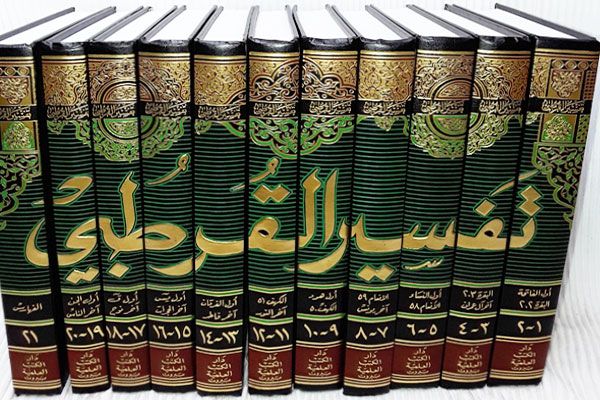
    Al-Jami‘ Li Ahkam al-Qur’?n
    [commonly known as Tafs?r al-Qurtub?]

    Undoubtedly the most famous of Imam Al-Qurtub?’s works, this is an exhaustive, encyclopedic commentary of the Qur’?n, of about twenty volumes, that has continued to enjoy wide support and acknowledgment among Muslims since its publication.

    Its title, which translates as “The Compendium of Legal Rulings of the Qur’an,” reveals its basic aim as a work—to deduce the practical, legal implications of the verses. And yet, while this work was intended to be a practical guide for the lives of its readers, it becomes much more than that due to the brilliant mind of the author, his broad knowledge, extensive travels, rich life experience and penetrating insight into the affairs that affect individuals and societies.

    What makes this work unique include the extensive correlations with authoritative Prophetic traditions (the work includes more than 6500 hadith of the Prophet, which is about the size of Saheeh al-Bukh?r?); discussions of finer aspects of Arabic grammar, linguistics and classical poetry; exploring the additional implications of the various modes of Qur’?nic reading (qir?’?t); weighing various opinions and possibilities in light of the evidences and choosing the strongest view, in the spirit of a true faq?h (jurist); considering the statements of the Companions, early Muslims and previous commentators; and finally, providing critical comments on the social issues and deviant trends in Islamic thought, in the spirit of a theologian.

    In sum, this is an evidence-based encyclopedia of the Qur’?n coming from the brilliant mind of one who is at once a muhaddith, grammarian, jurist, reciter, historian, theologian and social commentator. To quote the historian-scholar al-Dhahab?, “Im?m Al-Qurtub? has authored a Qur’?nic commentary in which he brings everything amazing.”

    The Era

    Im?m al-Qurtub? was a product of the great Islamic kingdom of al-Andalus in present-day Spain. This glorious civilization spanned nearly eight centuries, beginning in 711 with the Berber general Tariq bin Ziyad landing on the shores of Gibraltar until its fall in 1492 to King Ferdinand and Queen Isabella. Al-Andalus was a beacon of learning for the entire world and produced some of the greatest intellectual and scholarly minds of the ummah. This was a civilization that has much to teach us today in terms of intellectual and cultural vibrancy, regard for knowledge and literacy, public welfare and religious tolerance. Jews in particular flourished in Andalus and witnessed what is described as a golden age of their civilization.

    Of historical interest is the fact that Im?m al-Qurtub? lived during a historical period of relative decline and turmoil in the ummah. He witnessed the tragic fall of Cordoba in 633H/1236CE, the jewel of Andalus and the capital of the Islamic state for over 525 years. He witnessed with his own eyes the destruction of the Crusaders, who killed his own father. He was eventually compelled to flee Andalus and settle in Egypt, where he witnessed the struggle against the invading Mongols, including the famous battle of Ayn Jalut in 658H/1260CE. He escaped the Crusaders only to meet the Mongols!

    His was a time of military conflict, great turmoil and waves of Islamophobia, not unlike ours. Yet from our darkest times emerged some of our greatest minds. This, in essence, is the divine wisdom behind difficult times and behind human suffering— to distinguish heroes from others, the extraordinary from the ordinary.

  • Prophetic Wisdom for Our Times

    “Verily God honors nations through this Book and debases other nations through this Book.”
    [Had?th related on the authority of ‘Umar bin al-Khatt?b in Sah?h Muslim 1353, Ibn M?jah 214, Musnad Ahmad 226, Sunan al-D?rim? 3231]

    Far from being only a private manual for individual piety, the Book of Islam was always meant for entire nations and societies. The first words of revelation – “Read in the name of your Lord who created” – came down on that fateful night in the lonely cave of Hir?. It transformed a humble citizen of a fractured society into a divinely appointed leader, destined to guide his people out of darkness and into the forefront of the world stage. Within a hundred years, the Qur’?n had extended its influence to most of the known world at the time.

    The Qur’?n has since been a document of transformative power in bringing together human beings and societies, and erasing the boundaries between them. The lesson encapsulated in the above narration is that human individuals and societies enjoy honor and esteem through the principles and teachings of the Qur’an. The converse also applies.

    There are two important dimensions to every Prophetic narration: the content and the context. In the case of this Had?th about the virtue of the Qur’?n, both aspects contain wonderful lessons for us, especially in the realm of race relations, which continue to challenge us today.

    This Had?th was one of the few narrated by the second khaliph of Islam,‘Umar ibn al-Khatt?b. ‘Umar governed the Muslim world from the capital city of Mad?nah and appointed governors to take care of affairs in other cities. For Makkah, the holiest city of Islam, he had appointed an individual from the powerful Khuz?‘ah clan named N?fi‘ b. ‘Abd al-H?rith. On a trip to the city of ‘Usf?n in northern Arabia,‘Umar was surprised to see his governor there and asked him who was left in charge of Makkah in his absence. N?fi‘ replied that he left a man named Ibn Abz? in his absence, and when ‘Umar inquired who he was, the response was simple – “a former slave of mine.”

    ‘Umar was shocked. A former slave in charge of the most sacred city of the Muslim world!

    His response, however, was not one of disapproval but that of positive surprise. For this was precisely what the Qur’?n had taught with regard the equality of human beings. That was a difficult task in 7th century Arabia, and it remains a difficult task for some people till today. What ‘Umar was asking, in effect, was ‘How in the world did you manage to pull that off?’The response of the governor contained the punch line and the lesson. “He is the most knowledgeable of us in the Qur’?n, as well as the most knowledgeable in the rules of inheritance.” ‘Umar replied, quite pleased, “And indeed I heard your Prophet saying, ‘Verily God honors nations through this Book and debases others through it.’”

    This is the profound history and context through which this Prophetic teaching found its way into our books of Had?th, recorded for all posterity. It revolved around the story of ‘Abd al-Rahm?n Ibn Abz?, a member of the slave class, who ultimately rose in the ranks of Muslim society due to one simple thing – his knowledge of the Qur’?n. In a society governed by Qur’?nic values, this former slave could become a political leader over the holiest city of Islam for a period of time, and later in his life, Khaliph ‘Al?’s governor in the important city of Khur?s?n. ‘Umar eventually said about him, “‘Abd al-Rahm?n Ibn Abz? is from those individuals who were honored and raised up through the Qur’?n.”

    Compare that to our times today. In the most advanced nation on earth, how do people fair? Consider these facts . . .

    • The first African American invited to dine at the White House: Booker T. Washington in 1901.
    • The first African-American US presidential candidate: the Reverend Clennon King in 1960.
    • The first African-American mayor of a US city: Robert C. Henry of Springfield, Ohio in 1966.
    • The first African American elected mayor of Washington, D.C.: Walter Washington in 1975.
    • The first African-American President of the United States: Barack Obama in 2008.

    The dates are astonishing as most of these are in our lifetimes. The Qur’?n had accomplished 14 centuries ago what we are still struggling today to achieve in the modern civilized world. There were no incidents, no mass protests, and no social upheavals as a result of the Qur’?nic advancement of people.  Not so today.

    The election of Barack Obama has been such a seismic event in American history that we are still dealing with the aftershocks. The rise of xenophobia in the society seems to be a direct consequence of the election of an African-American president. It’s that simple. Nothing else explains the intensity of emotion conveyed by those who oppose a sitting president.

    The real spirit of the Qur’?nic teaching is the unity of the human race. The Qur’?n is the only document that has historically been able to overcome the divisions between people in such a complete manner, elevating slaves to the ranks of leaders and scholars.

    As a living document, it can still inspire these changes in our society. America needs to know the Qur’?n today.

    By Abu Zayd, M.D.

  • Sh. Sayyid Sabiq: A Living Encyclopedia of Fiqh

    Sh. Sayyid Sabiq: A Living Encyclopedia of Fiqh

    The Scholar

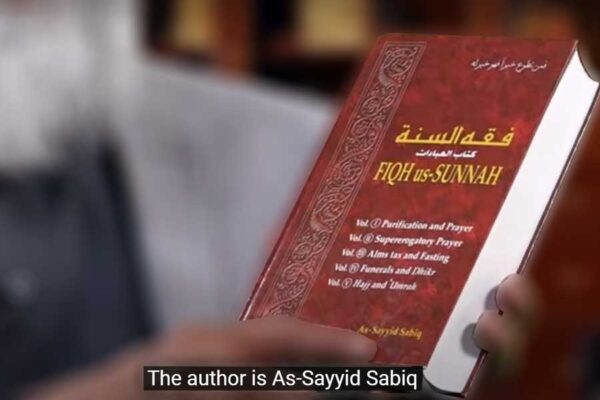
    Shaykh Sayyid Sabiq was a great Egyptian Muslim scholar who left a profound legacy to the world in the field of fiqh studies, having written one of the most popular and widely used Islamic books in the world today.

    He was born in 1915 in the Egyptian Nile Delta region, where he memorized the Holy Qur’an by the age of nine and pursued a formal education in Islamic studies that culminated in his attendance at the prestigious al-Azhar University. He spent his early years under the tutelage of Shaykh Mahmud Khitab al-Subki (died 1352/1933), who was his greatest teacher, and he, in turn, was his most distinguished student. He graduated from the Faculty of Shari‘ah of al-Azhar in 1947 and continued higher studies thereafter.  He then served in various capacities at al-Azhar-affiliated institutions before moving to Saudi Arabia to teach at Abdul Aziz University in Jeddah and Umm al-Qura University in Makkah. During his broad academic career, he taught and trained generations of scholars in various countries and oversaw the publication and dissemination of hundreds of articles and scholarly dissertations.

    But Shaykh Sabiq was more than just a scholar. He was described as one devoted to worship, especially prayer and fasting, and possessed a sharp and witty mind along with a strong memory and exceptional intelligence. It is said that when he spoke, even dignitaries and scholars listened attentively without interruption. He also had a keen interest in, and deep knowledge of, the affairs of the Muslim world, adding a dimension of relevance to his lectures and written works that is often missing from the works of more traditional scholars.
    He touched the lives of many over the years, and his more famous students included Shaykh Yusuf al-Qaradawa, Dr. Ahmad al-‘Assil, Dr. ‘Abdul-Satt?r Fathallah, the Imam of the Haram in Makkah Dr. Salih b. Humayd, and countless others. Among his contemporaries who relied on him for reference and support were the likes of the late Grand Imam of Azhar, Shaykh Mahmud Shaltut (died 1963), the popular author and scholar Muhammad al-Ghazali (died 1996) and the author Muhammad Ab? Zahr? (died 1974).

    His work did not go unnoticed on the world stage. He received a Medal of Honor in Egypt in 1992 and the King Faisal Prize for Islamic Studies in 1994. His works have been translated into most languages and disseminated widely throughout the Muslim world.

    He spent the last three years of his life in his native Egypt, where he continued to teach and lecture in various mas?jid until his death at the age of 85, in Dhul Qa‘dah 1420/ February 2000.
    It is said that fiqh was a closed door for the masses that was opened by him in our times. He was described by a contemporary scholar as a “living encyclopedia of fiqh.”

    The Text

    Since its publication more than half century ago, this simple textbook of fiqh entitled Fiqh al-Sunnah, has enjoyed a remarkable popularity and acceptance in the contemporary Muslim world that appears to be unrivalled. Though several works exist with this title, its name evokes only one author. This popularity stems partly from the nature of the work and its intended purpose: to serve as a comprehensive manual of fiqh, written for the common person in modern times, and written in a comprehensible style. It is equally useful for the average person with little background in fiqh and for the more advanced students of the Islamic sciences. It has been the subject of numerous commentaries and discussions.

    The book presents the practical fiqh rulings, organized topically and in a comprehensible format, along with the evidences for the rulings. Exhibiting an independent mind, he is yet free of fanaticism. He presents the strongest opinions based upon the evidences on many issues. Because it is based so heavily on Qur’an and Hadith texts, it reads at times more like a work of Had?th in the tradition of the Muwatta’ than a traditional fiqh work.

    The work represents a part of the rich tradition of comparative fiqh works, and draws heavily on the works of Ibn Qudamah al-Maqdisi, Ibn al-Qayyim, al-Shawkani and al-Sanani. His contribution to the field has been in making fiqh both relevant and accessible to the modern world.

    The Era

    The author was born at a time which could be characterized politically as the post-colonial era in the Middle East.  Many divergent ideas and movements were emerging to reassert the newly independent Muslim nations and societies, including Arab nationalism, socialism and communism. More importantly, from the perspective of the Muslim ummah, this period also represented the height of the Islamic revival period, a time of renewed intellectual vigor and interest in turning to the traditions and teachings of Islam for solutions to the world’s problems. Shaykh Sayyid, who died in 1420AH/2000CE, represents one of the premier fruits of the Islamic revival and the Islamic movement, and his work has left a mark on us all.